Biomech Hip
 Call Kai
 Learn
 Practice Test
 Spaced Repetition
 Match
 Flashcards
 Knowt Play
1/130

There's no tags or description
Looks like no tags are added yet.
131 Terms
the ____ is responsible for moving the body to position our upper extremity and hands in space
lower extremity
what segments comprise the lower extremity?
hip/core + knee + ankle/foot
the hip, knee, and ankle/foot are highly coordinated to ...
support the weight of the body (HAT specifically)
the ____ is the link between the upper body and the lower body
hip
what is the primary function of the hip?
support the weight of the head, arms, and trunk in static (standing) and dynamic (gait) postures
T or F: the LE is constantly in an open chain
FALSE; 1/2 the time it is open chain & 1/2 the time it is closed chain
the function of the hip is primarily (mobility/stability)
stability
the hip has ____ DoF. what motions are available at this joint?
3 DoF; flex/ext (S), abd/add (F), IR/ER (T)
list the joints of the hip complex
*coxofemoral*, lumbosacral (L5-S1), sacroiliac, & pubic symphysis
list the bones of the hip complex
femur, innominate (ilium, ischium, pubis), & sacrum
what bones make up the innominate
ilium, ischium, pubis
what is the function of the acetabular labrum?
increases the concavity of the acetabulum which increases stability
T or F: the acetabular labrum does not take loading forces
TRUE; this is good bc it prevents tears
explain the orientation of the acetabulum
anteversion; faces laterally, inferiorly, and anteriorly
(anterior orientation)

what happens to stability of the coxofemoral joint if the acetabular anteversion is increased?
decreased stability (+ increased risk of anterior dislocation)
T or F: due to the acetabular anteversion hyperextension is favored to flexion
FALSE; anterior orientation favors flexion
the femoral neck is angulated to allow the femoral head to face ____, _____, and _____
medially; superiorly; anteriorly
T or F: the acetabulum does not fully cover the femoral head superiorly and anteriorly but it is still considered to be a congruent joint
TRUE
explain the partial vacuum created by the acetabular fossa
- the orientation of the acetabulum creates a suction effect
- maintain joint contact between the femoral head and acetabulum which contributes to stability of the joint
describe the angle of inclination and the normal adult value
the angle between:
- the axis of the femoral head/neck
- the longitudinal axis of the femoral shaft in the frontal plane
normal adults = 125°

T or F: women have a larger angle of inclination
FALSE; men have larger
explain why the angle of inclination is larger in infancy
the angle reduces (to 125) due to the effects of gravity when upright and ambulating
~150° in infancy
_____ describes a pathological angle of inclination that is greater than 125°, meaning that the head and neck point more superiorly
coxa valga

_____ describes a pathological angle of inclination that is less than 125°, meaning that the head and neck point less superiorly
coxa vara

describe the angle of torsion and the normal adult value
the angle between the axis of the femoral head/neck and the axis of the distal femoral condyles in the transverse plane
normal anteversion (normal anterior torsion) = 15-20°
describe the gluteus medius in coxa valga and vara alignments
valga (>125°): glute med length tension (on greater trochanter) is STRETCHED.. decrease torque
vara (
what is the normal angle of torsion?
anteversion (15-20°)
- increases ROM anteriorly (flexion and internal rotation)... needed for functionality
- less ROM posteriorly for hyperextension

_____ describes an angle of torsion beyond 20° and _____ describes an angle of torsion below 15°
excessive anteversion; retroversion
reduced posterior hip ROM is associated with (excessive anteversion/retroversion). why?
excessive anteversion; the femoral head/neck are closer to the posterior acetabulum & the greater trochanter is more posteriorly oriented
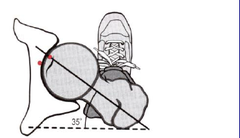
reduced anterior hip ROM is associated with (excessive anteversion/retroversion).
retroversion
- decreased flexion
- now closer to a 0° angle of torsion.... theoretical increase in extension
individuals with (excessive anteversion/retroversion) will compensate by turning their toe in
excessive anteversion
explain how the angle of torsion and angle of inclination impact the hip joint when there are abnormalities
CLOSED CHAIN MOVEMENT
compensations at the hip, alter hip stability, and alter weight-bearing biomechanics/ muscle mechanics
T or F: foot or knee injuries might result from hip deviations/pathologies
TRUE; due to closed chain
the articular capsule of the coxofemoral joint is thicker____ and thin/loose ____
anterosuperiorly; posteroinferiorly

list the 3 reinforcing capsular ligaments at the coxofemoral joint
iliofemoral (Y ligament), pubofemoral, ischiofemoral
in what joint position is the ligamentum teres most susceptible to damage?
flexion & adduction (most taut in this position)
***especially bad when leg is in flexion and adduction, yet the proximal trunk still moving (football player injury)
what is the primary function of the ligamentum teres?
transmits secondary blood supply (obturator) to femoral head and provides nerve pathway

damage to the ligamentum teres results in what?
absence of secondary blood supply to femoral head causing increased risk of avascular necrosis
*often leads to need for THA
trabeculae in the proximal femur line up along ____ which form systems to meet stress requirements
stress lines

_____ provides downward forces through the hips and into femoral head and ____ creates upward forces through the femoral shaft.
weight of HAT; ground reaction force (travels up through femoral shaft)
GRF causes (compressive/tensile) forces at the superior femoral neck and HAT causes (compressive/tensile) forces at the inferior femoral neck
tensile; compressive
____ creates bending at the femoral neck
GRF (newton's 3rd law)
explain the 2 major trabecular systems
1. Medial trabecular system: oriented vertically to offset compressive forces from the HAT
2. Lateral trabecular system: oriented obliquely to offset tensile forces from GRF
*medial and lateral accessory systems contribute at the femoral shaft and greater trochanter

The resistance is greatest when the trabecular systems cross each other at _____. Where on the femur does this occur?
right angles; inferior femoral head & inferomedial to greater trochanter

The _____ is the area at which the trabeculae are thin and do not cross and therefore are more susceptible to bending and/or injury. Where on the femur does this occur?
zone of weakness; inferolateral femoral neck

why does regular activity reinforce the trabecular systems?
gravity!
explain how the hip joint works like a Chinese finger puzzle
in flexion the joint capsule/fibers are slack and allow for more translations but in extension the capsule/fibers are taut
T or F: little to no joint distraction occurs at the hip joint
TRUE
how much of our body weight is supported by the hip?
2/3
explain how the concave-convex rule applies to the hip joint during open chain movements
convex moving on concave = OPPOSITE
- convex femoral head glides within the concave acetabulum
- sliding occurs in the OPPOSITE direction of the distal femoral motion (same as shoulder, just less translation)

explain how the concave-convex rule applies to the hip joint during closed chain movements
concave moving on convex = SAME
- hip motion is largely from the pelvis moving on femur
- concave acetabulum articulates with convex femoral head so sliding occurs in the SAME direction as the pelvis motion
_____ is the primary motion of the hip
flex/ext
do we have greater hip flexion ROM with knee ext or flexed
flexed
(extension has greater active/passive insufficiency)
what is the normal ABD/ADD ROM? limits hip ADD? ABD?
ABD (45-50°): limited by gracilis
ADD (20-30°): TFL & ITB limits
what limits hip ext rotation ROM?
excessive anteversion
During flex/ext, what accessory motion(s) occur at the hip joint?
[almost] pure spin of the femoral head around the x-axis
During abd/add, what accessory motion(s) occur at the hip joint?
spinning and gliding of the femoral head (y-axis)
During internal rotation/external rotation, what accessory motion(s) occur at the hip joint?
spinning and gliding of the femoral head (z-axis)
closed chain hip motion occurs largely from the _____ moving on the ____ when all other joints are static.
pelvis; femur
list the normal flexion/extension ROM values at the hip with the knee flexed vs knee extended
knee flexed = 120° flex/
list the normal hip internal rotation/external rotation ROM values
40-50° either direction in 90° knee flexion
(IR/ER) of the hip is measured by moving the foot medially when seated with knees at 90°. (IR/ER) is measured by moving the foot laterally.
ER; IR
what is the close-packed position of the coxofemoral joint?
extension, slight abduction, internal rotation
T or F: optimal articular contact at the coxofemoral joint is in the closed packed position
FALSE;
articular contact is increased in *flexion, abduction, and external rotation* (true physiologic position)
what is the true physiologic position of the coxofemoral joint?
flexion, abduction, external rotation
in what position is the hip at greatest risk for subluxation?
flexion and adduction (occurs when legs are crosses)
***car accident
when knees hit the dashboard during an MVC, the femur dislocates (anteriorly/posteriorly)
posteriorly
describe the position of the ASIS and PSIS in neutral, posterior tilt, and anterior tilt
neutral = ASIS and PSIS are level
posterior = ASIS is superior to PSIS
anterior = ASIS is inferior to PSIS

(anterior/posterior) pelvic tilt is characterized by hip extension and slight external rotation. Describe the lumbar spine in this postion.
posterior; lumbar spine is kyphotic

(anterior/posterior) pelvic tilt is characterized by hip flexion and slight internal rotation. Describe the lumbar spine in this position.
anterior; lumbar spine is severely lordotic

Pelvic tilting causes changes in _____ which rotates the femur
acetabular anteversion
how would you instruct a patient to correct an anterior pelvic tilt? posterior pelvic tilt?
anterior = contract abdominals
posterior = contract glutes

explain lateral pelvic tilt.. where is the AoR
- stance leg in closed chain = AoR
- swing leg in open chain
stance leg becomes the AoR for motion of the contralateral hip as it elevates or drops (frontal plane)

when standing on the L leg, the L hip (abducts/adducts) to hike the R hip
abducts

when standing on the L leg, the L hip (abducts/adducts) to drop the R hip
adducts
when shifting weight to take a step with the R in a bilateral stance, describe the 3 steps to go to unilateral
AoR at left
if we step with R:
1. pelvis must shift to L side to move CoM or HAT and R leg = L ADD
2. R pelvic drop as leg reaches forward and down (AoR at L hip)
3. With R leg now on ground, results in R ABD, L ADD

when shifting weight to the R in a bilateral stance, the (R/L) hip drops. In what plane does this occur?
L hip drops (R becomes stance leg); frontal plane
(L hip rotates around the R hip in frontal plane)
explain forward & backward pelvic rotation
Forward = opposite loaded limb moves anteriorly... IR of supporting (stance) hip
Backward = opposite loaded limb moves posteriorly.. ER of supporting (stance) hip
*occurs in the transverse plane

T or F: the stance leg is the L leg in L pelvic rotation
FALSE; the stance leg is the R leg, the L hip moves forward/backward
L forward rotation: L leg advances forward
L backward rotation: L leg advances backward
What is pelvifemoral rhythm?
coordination of the femur, pelvis, and spine to produce larger ROM at the hip
explain pelvifemoral rhythm in an open chain
- combo of motions increases available ROM at distal segments (foot and head)
- once coxofemoral flexion/abduction is maxed out, the spine will move and reposition the coxofemoral joint (pelvis) to increase ROM

explain pelvifemoral rhythm in a closed chain
- must identify 2 fixed ends (foot and head)
- other joints in the chain, like the spine and pelvis, move to compensate

what activates pelvifemoral rhythm in a closed chain?
structural deviatons: tight hip flexors & leg length discrepancies
dynamic problems: pelvic drop & hip hike
explain the open chain compensation to tight hip flexors
hip flexors pull on pelvis and HAT will move forward in response

explain the closed chain compensation to tight hip flexors
- anterior pelvic tilt will occur
- leading to increased lumbar lordosis and thoracic kyphosis to keep the head over the hips

explain inversion of function
the joint position influences the function of a given muscle
_____ is the most important hip flexor
iliopsoas
what is the open chain function of the hip flexors?
- primary function: MOBILITY (flex the hip to swing leg)
- secondary function: resist hip extension forces
what is the closed chain function of the hip flexors?
increase lumbar lordosis as trunk & head extend to compensate

T or F: iliopsoas flexes the trunk when in neutral upright position
FALSE; iliopsoas is active when moving from trunk extension to neutral
does iliopsoas m. assist in hip flexion from a seated position?
no - hip is already flexed (lean too far forward, hip flexion is due to gravity)
____ is responsible for hip flexion, abduction, and external rotation but is most functional when simultaneous hip and knee flexion occur
sartorius
_____ flexes the hip but it's force generating capacity is affected by the position of the knee since it is also a knee extensor
rectus femoris
during simultaneous knee extension and hip flexion, rectus femoris is susceptible to _____
active insufficiency
what position is the rectus femoris the best contributor to hip flexion
when the knee is flexed
Action of TFL
- flexes, abducts, and internally rotates the hip
- mostly responsible for maintaining tension in the ITB
_____ is a strong hip extensor with a long moment arm
gluteus maximus
**longer moment arm than hamstrings and adductor magnus
_____ are a group of muscles that act to extend the hip and flex the knee
hamstrings
when the hip is flexed and the knee is extended the hamstrings are susceptible to _____
passive insufficiency
when the hip is extended and the knees is flexed beyond 90°, the hamstrings are susceptible to ______
active insufficiency