Art His Midterm 1
 Call Kai
 Learn
 Practice Test
 Spaced Repetition
 Match
 Flashcards
 Knowt Play
1/56

There's no tags or description
Looks like no tags are added yet.
57 Terms

Hall of the Bulls
Period: Paleolithic
Location: Lascaux Cave in France
Context: The paintings were created long before written history so we don’t know who drew them or exactly why they were made
Function: These people were hunter-gatherers who depended heavily on the natural environment. The prominence of large predatory animals shows their importance to humans and to their survival. The painter’s sole concern was representing the animals, which is why they are in composite view.
Form: Used natural pigments, outlines, and shadings. Composite view.

Ziggurat, Ur
Culture: Sumer
Location: Ur
Context: A ziggurat is a large, raised, tiered platform that supported a temple associated with a city’s patron deity (god/goddess who looked over the city). The Ziggurat of Ur was dedicated to Nanna, the moon god.
Function: Religious temple platform. Ancient Mesopotamians worshipped many gods who were believed to interfere with humans. Commissioning a monumental religious structure showed that the king had the resources to honor the gods. Religion and political power were closely connected.
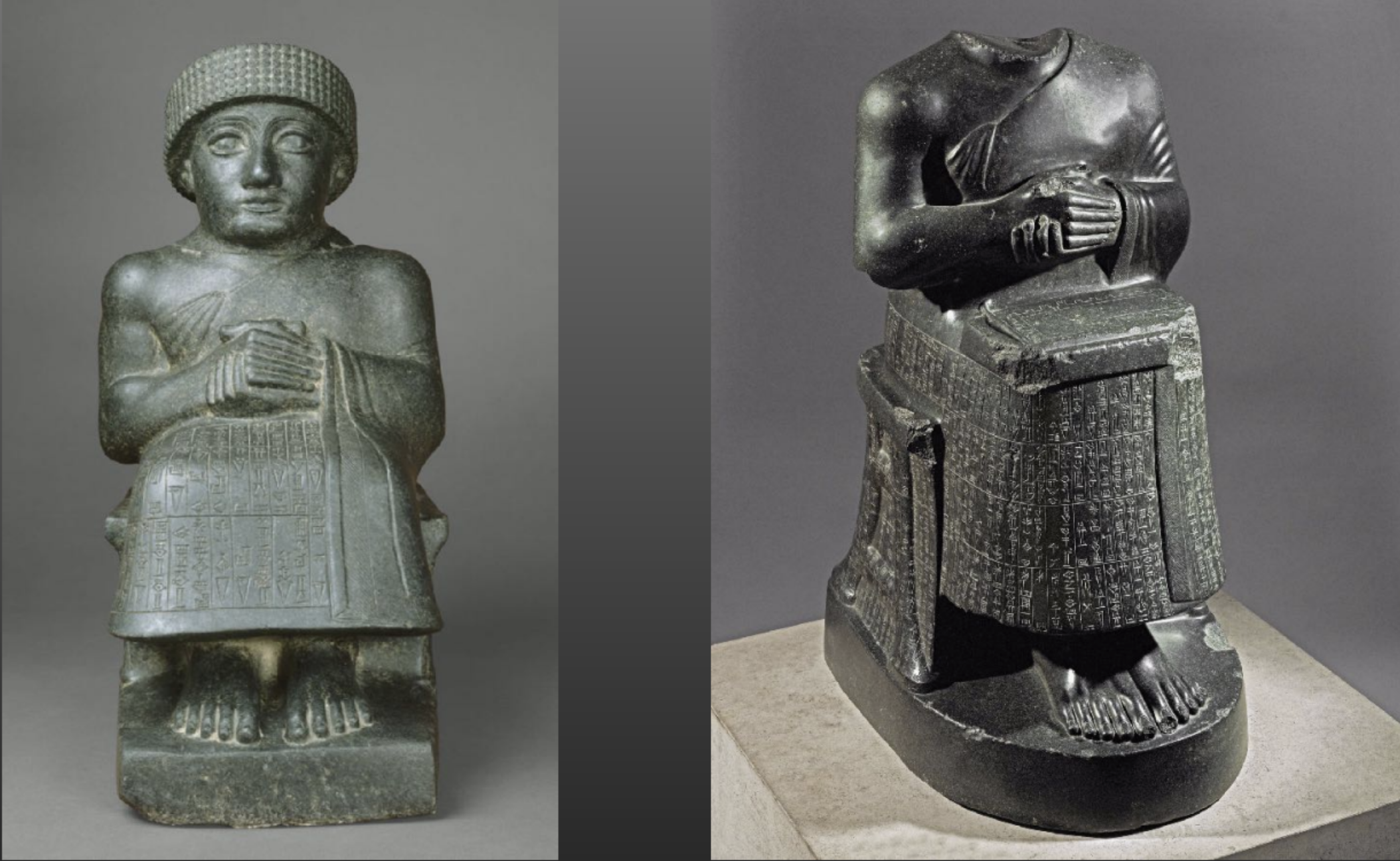
Statues of Gudea
Culture: Sumer
Location: Lagash, Mesopotamia
Context: Gudea was a ruler of Lagash in Southern Mesopotamia. He is remembered for his religious building projects and the numerous statues made in his image. He was a religious ruler who served the gods.
Description: Gudea sits with his hands joined in a gesture of prayer. This communicates humility, devotion, and respect toward the gods rather than him as a warrior. He is in an upright posture, which communicates dignity and discipline. The diorite stone signifies the intention to create a lasting dedication to the gods. Often placed inside temples as lasting representations of the ruler before the gods.

Stele of the Vultures
Culture: Sumer
Context: Ancient Sumerian stone monument commemorating the military victory of Eannatum, ruler of Lagash, over Umma. A stele is a stone containing images, inscriptions, or both. This stele combines military propaganda, religious belief, and political authority.
Description: Rows of soldiers march together, carrying spears and shields. Their overlapping bodies create a dense and organized formation and they walk over fallen enemies. The stele represents military success as evidence of Lagash’s power and Eannatum’s effective leadership. Ningirsu is a god who is watching the battle, he shows his support for Lagash. The king’s authority is reinforced by divine power rather than represented as purely human.
Form: Hierarchy of scale-the ruler is represented more prominently and visibly larger than the soldiers, emphasizing his superior status

Stele with law code of Hammurabi
Culture: Babylon
Context: Tall stone monument inscribed with 300 legal provisions issued under Hammurabi, the most powerful king of Babylon.
Description: Shamash, the Mesopotamian sun god and god of justice, sits on a throne facing Hammurabi. Flames/rays emerge from his shoulders, showing his divine nature. Babylonians believed divine authority and human government were connected. Hammurabi stands respectfully before Shamash, raising one hand toward his face in a gesture as prayer. The king is shown receiving divine authorization for his role as a lawgiver.
Form: Hammurabi and the sun god are similar in size and the god is distinguished only by his throne.
-cuneiform writing covering the stele

Stepped Pyramid
Location: Egypt
Context: King Djoser’s tomb. A series of stacked mastabas. The pyramid reflects Egyptian beliefs about the afterlife and the king’s divine status. Under the pyramid was a complex network of hundreds of underground rooms and galleries, resembling a palace. It was to be Djoser’s new home in the afterlife.
Description: Six levels stacked on top of one another. Developed from an earlier mastaba-style tomb.

Khafre Enthroned
Location: Giza, Egypt
Context: Pharaoh Khafre seated on a throne, looking calm and powerful. Ancient Egyptians believed that pharaohs were more than human. They had a relaitonship with god.
Description: Khafre has a very compressed expression, has broad shoulders, a straight back, and a muscular body. He represents the ideal royal strength. His expression suggests control, permanence, and authority. There is a falcon behind Khafre’s head representing the god Horus. He seems to be protecting Khafre. The sides of the throne include plants associated with upper and lower egypt tied together, representing unification.The pharaoh is responsible for keeping Egypt united and maintaining political order.

Menkaure and Khamerernebty
Location: Giza, Egypt
Context: The king wears headcloth associated with Egyptian pharaohs. The woman’s arm around Menkaure. The figures face forward in formal, stable poses. Their idealized forms and durable stone express royal authority and permanence.
Form:

Ti watching a hippopotamus hunt
Location: Saqqara, Egypt
Context: Comes from the tomb of Ti, a high-ranking official who lived during Egypt’s Old Kingdom. Ti is a wealthy and influential official.
Description: Ti is larger than other figures and in composite view. The artwork communicates social rank rather than the actual distance between people. The hunt demonstrates human ability to confront and control a powerful part of the natural world. It presents a world in which food and resources are available for the afterlife.

Akhenaten, Karnak
Location: Egypt
Context: Major turning point in ancient Egyptian art and religion. Unlike idealized muscular pharaohs, Akhenaten is often shown with an elongated face, narrow eyes, full lips, and a round belly. He promoted the worship of Aten, the sun disk. Akhenaten’s arms are crossed over his body, holding a crook and flail, traditional symbols of authority. Androgynous, a lack of traditional gender, symbolizing the Aten as the father and mother of all creations.
may be an attempt to represent aten, a sexless sun god.
- Shifted worship in Egypt from multigod to monotheistic

Akhenaten, Nefertiti, and three daughters
Location: Egypt
Context: Shows Akhenaten and his wife Nefertiti and their three daughters beneath the rays of Aten, the sun disk.
Description: Emphasizes family relationships and the royal household, while still presenting the family as specially favored by Aten. The family becomes the visible link between the sun disk and human society

Last Judgement of Hu-Nefer
Location: Egypt
Context: an ancient Egyptian collection of spells and instructions intended to help a deceased person navigate the afterlife. A person’s heart is weighed on the scale, and if their heart is heavier than the feather, the creature adjacent to it will devour the heart. Shows how they thought about death, mortality, divine judgement, and the afterlife.
Function: funerary manuscript
Purpose: to help Hu-Nefer successfully navigate judgment and reach the afterlife.
Description: Hu-Nefer’s heart is being weighed and evaluated for entering the afterlife. Different gods are leading Hu-Nefer through the process of his last judgment, which illustrates the significance of divine judgment and the authority of gods to Egyptians.
Form: composite view, hierarchical scale

Kouros
Period: Archaic Greece
Context: nude young man from Archaic Greece. These statues often stand upright with one foot stepping forward, arms straight at their sides, and a frontal, symmetrical body. This is an earlier representation of the Greeks approach to developing their idea of the human body.
Description: The left foot stepped forward suggests movement/life, while the body is stiff to emphasize symmetry and perfection. Kouros has an archaic smile, has almond-shaped eyes, and carefully arranged hair.
Function: Kouroi were placed at graves to commemorate the deceased while others were dedicated to gods at sanctuaries
Connection to Egyptian sculptures: the similarities are evidence of cultural contact and artistic influence. Differences: Egyptian statues were often clothed and represented a king/deity, emphasized permanence, authority, or religious significant. Greek were typically nude, emphasized youthful beauty

Kroisos
Period: Archaic Greece
Context: young man called Kroisos died a hero in battle so his family got him a kouros statue to put over his grave. The Kroisos statue is a lot more proportional than the Kouros and his body is more natural.
Description: The shoulders, chest, abdonment, and legs show a better understanding of human muscle anatomy than earlier kouroi. The Greeks at this point were moving toward more convincing representations of the human body.
Increased naturalism
funerary monument

Kore from Chios
Period: Archaic Greece
Context: Clothed woman from archaic greece. Kore means youthful female. Upright and stiff which aligns with the archaic greek style, but Kore’s body is fully covered in elaborate clothing and her hair seems to be carefully patterened. This goes to show the Greek’s attitudes toward women.
Description: the kore emphasized clothing and fabric with decorative detail. Her hair is braided and she’s wearing earrings; these ornaments add richness and make the figure appear more carefully presented
Function: religious and votive (an object given to a god as an act of devotion/gratitude)

Zeus (Poseidon?)
Period: Classical
Context: monumental statue of a Greek god caught in the motion of throwing a weapon. It could be Zeus throwing a thunderbolt, or Poseidon throwing a trident. The weapon the god origianlly had went missing.
Description: Dramatic outstretched pose, unlike the Kouros, you can see and imagine the movement through the statue. The body is idealized, but the bodily proportions are convincing and more natural. This reflects the Greeks interest in beauty and the capabilities of the human body. Unlike earlier sculptures, this one does not have an archaic smile. Rather, the god has a controlled and serious expression to convey dignity and concentration.
Function: uncertain but could have been for religious dedication as in honoring a god

Discobolos by Myron
Period: Classical
Context: early classical greek sculptors started exploring representing figures engaged in action. Greek culture valued atheltic competition, physical training, and the ideal human body.
Description: his body is bent forward with his limbs in a position that forms two arcs. His face is still calm rather than emotional, which contrasts with the expressive bend of the torso and stretch of the arm. He appears to be highly athletic with an idealized body.

Doryphoros (Spear Bearer)
Period: classical
Context: originally carried a spear that rested on his shoulder. Polykleitos explored how mathematical proportion and balanced body parts could create an ideal human figure.
Description: Contrapposto (body’s main weight rests on one leg) position. The figure no longer looks rigid and tense. His body appears to be in a more natural position as if he could begin to walk. The man still has an idealized athletic physique with defined muscles and balanced proportions.

Athenian Acropolis
Period: Classical
context: religion, victory, and athenian power
Religion
The acropolis was dedicated to Athena, a goddess who protected Athens.
War
Persian forces captured and damaged Athens, including Acropolis.
Athenian power
Athens became powerful after its victories over Persia. Acropolis was turned into a monumental expression of Athenian wealth, identity, and cultural achievement
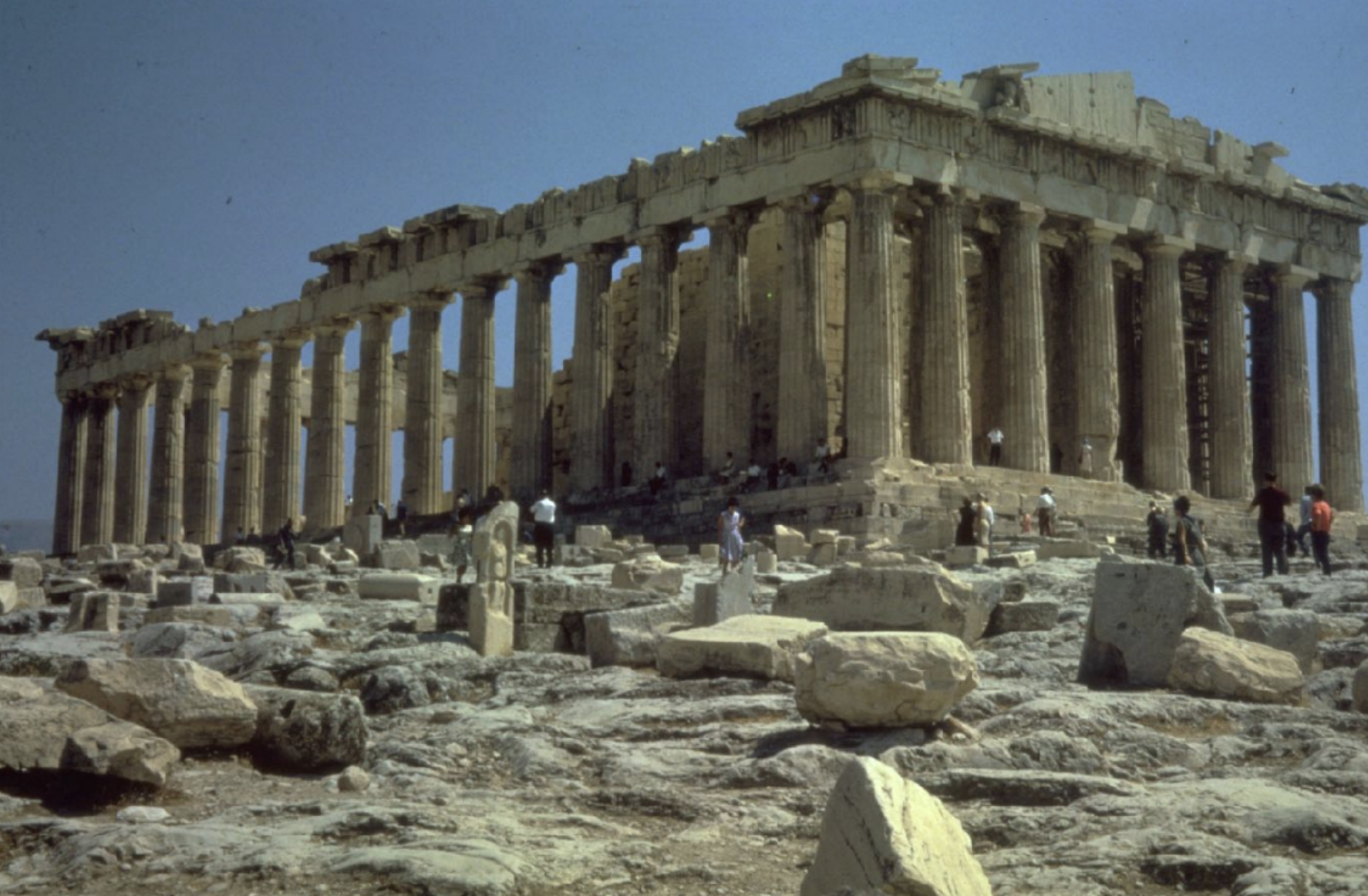
Parthenon (Athenian Acropolis)
Period: Classical
Description: Built in the Doric order with some Ionic features. Inside was a statue of Athena. It honored athena wile expressing the wealth, confidence, and power of athens
Function: gathering place for ordinary worshippers. It was a temple where people gathered to honor Athena through festivals and rituals.

Pediments, Three Goddesses, (Athenian Acropolis)
Period: Classical
Description: sculptural decoration on the Parthenon. Depicts the birth of Athena from the head of Zeus. Natural bodies of women emphasized in wet drapery while heavily clothed to hide them.
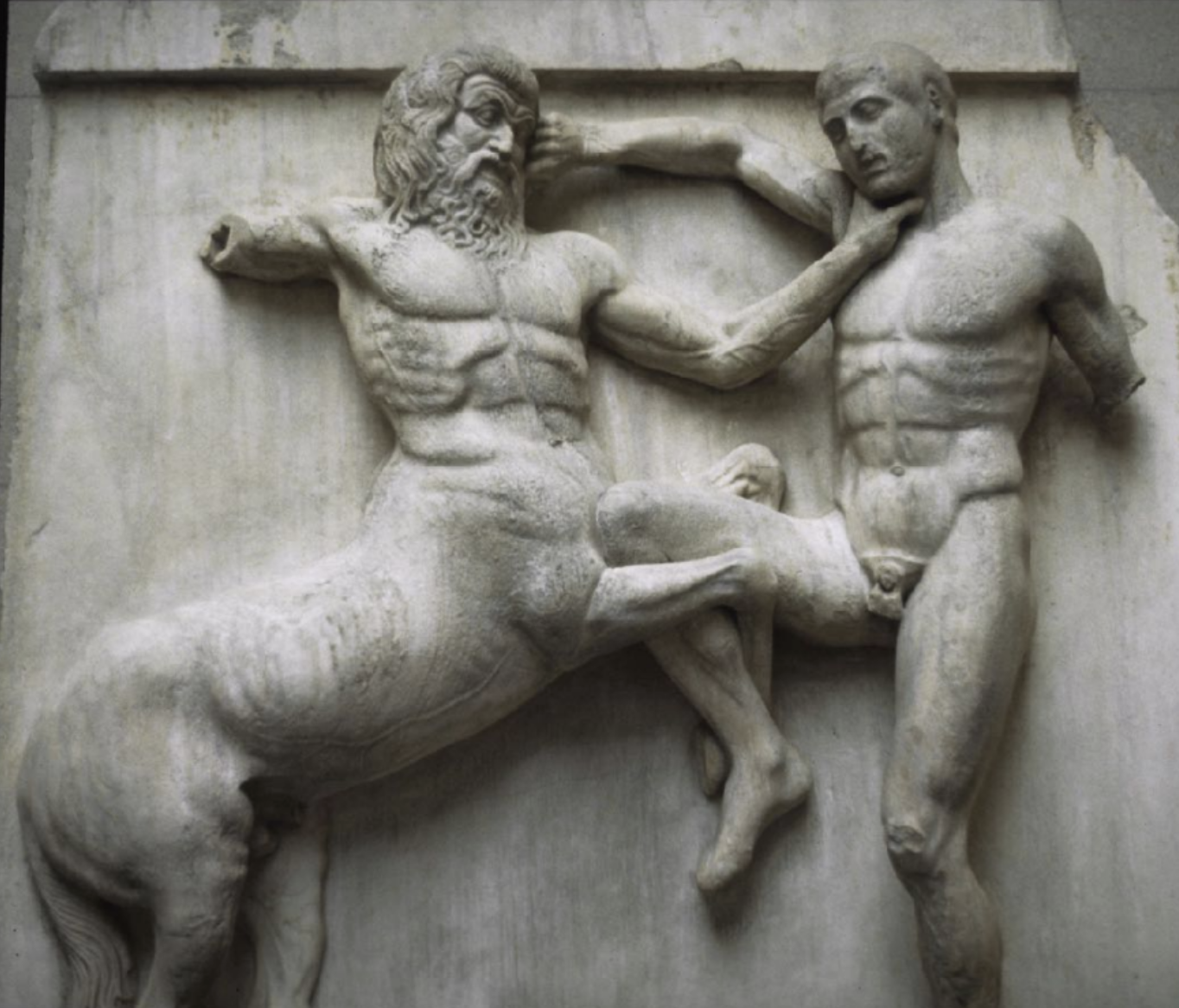
Lapith vs. Centaurs (Athenian Acropolis)
Period: Classical
Description: Lapith means a people in greek mythology, centaurs are mythical creatures who are half man half horse. At the wedding feast of the Lapith king, the centaurs became drunk and attempted to abduct the women. A violent battle broke out between the Lapith and Centaurs, and the Lapiths eventually prevailed.
Meaning: the centaurs broke a social rule, and the Lapiths defend their community. It is also a continuation of the Greek ideal that gods and heros defeat forces that threaten the established order.

Panathenaic Festival Procession
Period: Classical
Context: Marble frieze of the Parthenon on the Athenian Acropolis. It shows Athenians taking part in a major religious festival honoring Athena, the city’s goddess. The Panathenaic festival was held in Athens to honor Athena. It was held every four years, was important and included athletic contests.
Description: Horsemen and horses with turned bodies make the figures look lifelike. Women carrying ritual objects associated with religious ceremonies meaning that this was a sacred event. Gods seated at the center of the frieze which connects the human community with the divine world. The gods are part of the festival’s religious meaning.
Function: its religious function was to honor Athen and its civic meaning was to represent Athens as a community united through public worship.

Hermes and the Infant Dionysos
Period: Late Classical
Context: Hermes, the messenger god, holds an infant Dionysos, god of wine. Shift toward a more relaxed and intimate style of Greek sculpture.
Description: in myth, zeus trusted Hermes to take care of Dionysos. His hand is missing but it is thought that he was holding a bunch of grapes. Contrapposto and the S curve-Hermes puts most his weight on his left leg, creating an imbalance in his hips and shoudlers. His pose is rather effortless and calm. Hermes’s body is more soft toned than earlier sculptures. The Late Classical period was often associated with grace and elegance rather than athletic power.
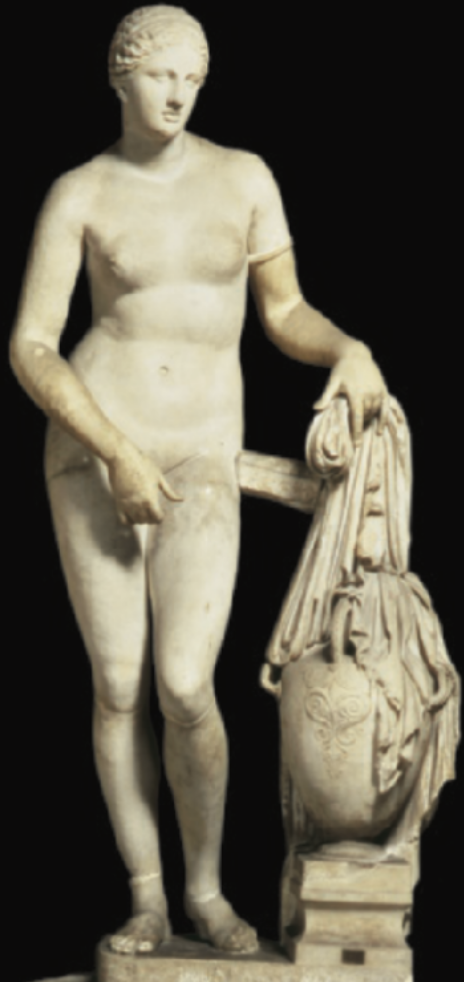
Aphrodite of Knidos
Period: Late Classical
Context: Aphrodite, the goddess of love and beauty, but she is not completely nude. Greek goddesses were traditionally shown fully clothed, but Aphrodite was not.
Description: There is tension between modesty and exposure in this sculpture.

Portrait of Alexander the Great
Period: Late Classical
Context: Example of how Greek art evolved from depicting idealized gods and athletes to portraying a real historical ruler as a powerful, superhuman figure. Alexander the Great became the king of Macedon and conquered a vast empire stretching from Greece to Egypt.
Description: His hair is thick and wavy, like a lion, which suggests strength and heroic energy. His face is clean-shaven to show his youthfulness. He has an upward and distant gaze.
Function: political communication-helped communicate the idea that he was an exceptional leader worthy of loyalty and admiration.

Battle of Issus
Period: Late Classical
Context: depicts the battle between alexander the great and Darius III, the king of the Persian Empire.
Description: Alexander is the one on the left charging into the Persian army without a helmet, his gaze fixed on his opponents, his spear pointed toward a Persian soldier. Alexander appears fearless and decisive. Darius III appears near the center-right, standing in his chariot and reaching for an injured Persian soldier while looking toward Alexander. His expression communicates distress and alarm.
Function: Decoration in a roman house-it shows appreciation of a homeowner for Greek culture, military history, and powerful rulers.

Priene
Period: Hellenistic
Context: Priene is an ancient Greek city. Priene demonstrates the Greek’s development in urban planning rather than building individual buildings. They focused much on organizing the spaces where the people lived, traded, worshipped, and participated in civic life.
Description: Priene’s streets intersect at perfect right angles, diving the city into blocks, making it easier to allocate plots for homes and organize movement through the city. Important buildings and religious sanctuaries were incorporated into the overall plan

Seated Boxer
Period: Hellenistic
Context: emotionally powerful sculpture from ancient greece. Unlike idealized, youthful athletes such as the Doryphoros and Discobolos, this boxer looks exhausted and physically worn down.
Description: He has a broken nose, cuts, and cauliflower ears. The haunched posture shows the vulnerability of the athlete after what seems like a lost fight. The turned head creates psychological tension. We wonder whether he is watching the crowd or anticipating an upcoming fight.
Hellenistic art focuses on pathos, the expression of intense emotion/suffering that makes the viewer feel sympathy

Old Market Woman
Period: Hellenistic
Context: Depiction of how Hellenistic Greek art deviated away from idealized beauty toward realism and naturalism through expressing raw emotions of ordinary people.

Head of an elderly patrician
Period: Rome
Description: Serious and stern face conveying responsibility and authority. The portrait avoids the idealized, youthful appearance that is common in Greek sculpture. An example of the veristic style, which emphasizes exaggerated realism in physical characteristics.
Function: Roman elite families preserved images of their ancestors in their homes. Could be displayed during funerals. Portraits like such communicated family status.

Portrait of a Roman General
Period: Rome
Context: Roman Republican portrait that combines two different artistic traditions.
Description: the head demonstrates the veristic style, realistic, aged, and tired-looking. Roman Republican elites used signs of age to suggest dignity and seriousness. The body is sort of in Greek style: muscular, youthful-looking. Heroic nudity.
Function: Served as an honorific representation of a Roman military/political figure who communicated his authority through civic duties.

Pompeii
Period: Rome
Context: The Forum was a large paved public space that brought people together for civic business, religious events, and public announcements. Temple of Jupiter-a triple shrine with corinthian columns. A Basilica, a large roofed hall with rows of columns, was used for legal proceedings.
Description: The Forum shows how a Roman city organized its public life in one central location.

Reconstruction of typical Roman house with atrium, peristyle
Period: Rome
Context: private house belonging to a wealthy family,
Atrium-open roof that allows rainfall through, connected to rooms used for household activities and receiving visitors
Peristyle-located farther inside the house, has a garden and is surrounded by a covered walkway supported by columns
Function: communicate wealth and status
Gardenscape, Villa of Livia
Period: Rome
Context: ancient Roman wall painting. Livia was the wife of Emperor Augustus, Rome’s first emperor. The villa was an elite retreat outside the city.
Description: Entire wall looks like a garden. peaceful.
Function: for Livia


Ixion Room, House of the Vettii
Period: Rome
Context: dining room in the wealthy roman house of the vettii. Elaborate mythical wall painting.
Description: Ixion bound to a wheel as punishment for attempting to seduce Hera. Hermes appear around the scene. Consequences of violating divine rules and disrespecting the gods.
Function: dining room

Pont-du-Gard
Period: Rome
Description: Three tiers of arches, semicircular arch, narrow channel at the top. Channel allowed water to be carried by gravity.
Function: demonstrates roman skill in construction and managing water across dificult terrain. it supplied 100 gallons a day for each inhabitant
Colosseum
Period: Rome
Context: Largest amphitheatre
Description: beneath the arena was rooms. gladiators and animals could be moved up into the arena through openings in the floor. The velarium is a large fabric awning that could provide shade.
Culture: The emperor presented himself as a provider for the people. It demonstrated roman engineering-the the entrances made entering and existing the amphitheatre extremely efficient. 80 ground-level arches.
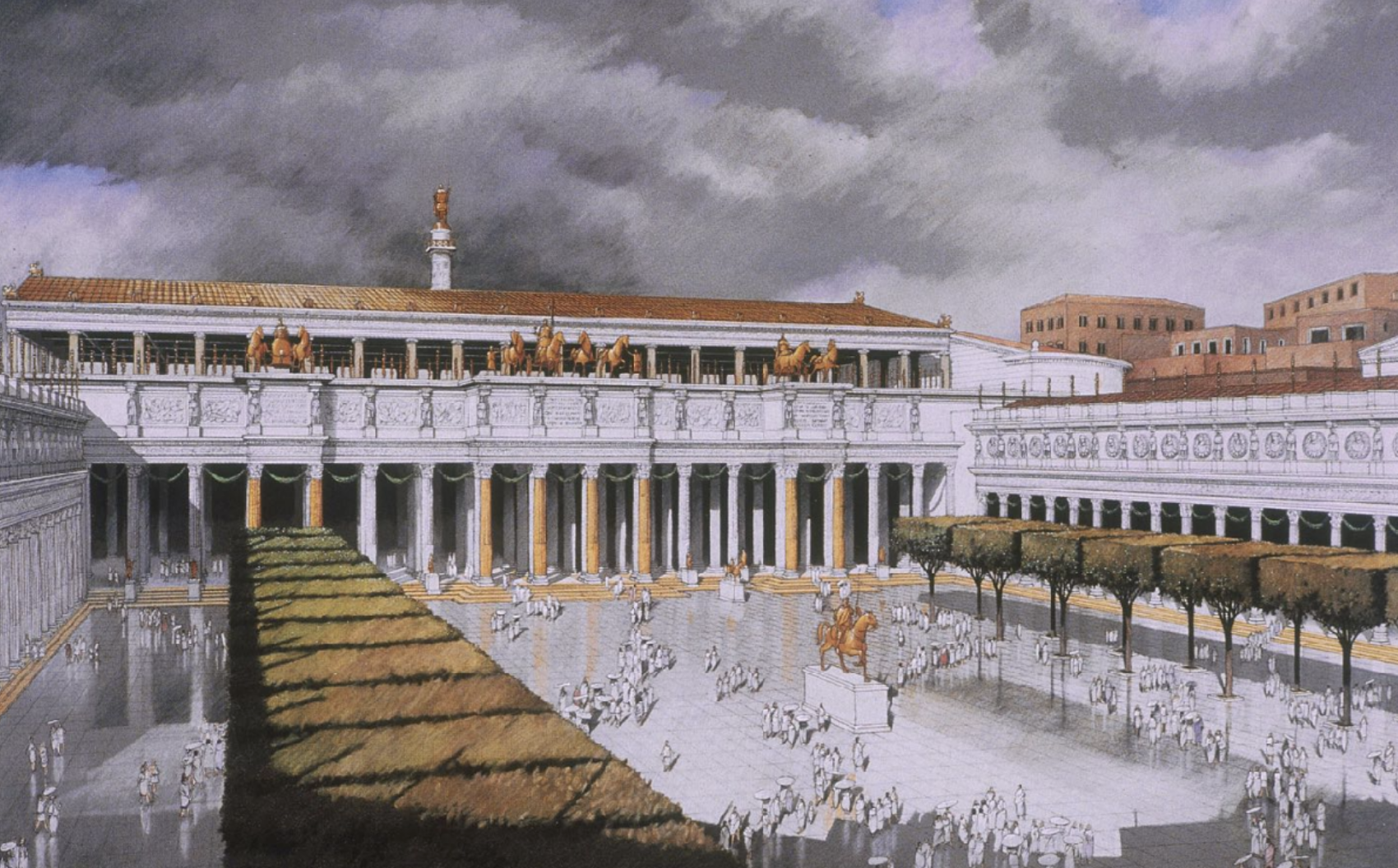
Forum of Trajan
Period: Rome
Context: huge public complex built under Emperor Trajan. It was the most elaborate Roman imperial forum. It combined a public square, law court, libraries, monuments, and places for civic activities.
Description:
Basilica-a huge column-filled building at one end of the forum that served civic and legal purposes including court proceedings.
Trajan’s column: tall marble column covered with a continuous spiral of carved reliefs depicting Roman compaigns against Dacia. It commemorated military victory and celebrated Trajan’s success as an emperor.
Function: it demonstrated political power through the column as it narrates the emperor’s victories over the Dacians.

Equestrian Statue of Marcus Aurelius
Period: Rome
Context: shows the Roman emperor Marcus Aurelius riding a horse with his right arm extended. It is an example of how Roman art used portraits of emperors to communicate authority, leadership, and control.
Description: the large scale makes Marcus Aurelius appear powerful and important. His hand is extended as if he is addressing an audience or making a gesture to the public. Unlike earlier Roman sculptures, Marcus Auerelius appears clean-shaven with curly hair and youthful, associated with the appearance of Greek philosophers. He has a calm expression.

Column of Trajan
Period: Rome
Context: commemorated military victories of Rome against the Dacians and later served as Trajan’s tomb monument.
Description: Trajan appears repeatedly throughout the narrative. He is shown addressing soldiers, overseeing activities, and receiving the submission of enemies. The column tells a story of roman armys preparing and marching, building forts and infrastructure, Trajan in front view speaking to his army, and the romans fighting the Dacians.

Pantheon
Period: Rome
Context: famous for its concrete dome with an opening, oculus. Combines traditional Greek-looking temple entrace with innovative Roman interior design.
Description: Has tall corinthian columns and a triangular pediment, similar to Greek temples. Roman concete made it possible to create a large, unified interior space without rows of columns filling the center. The dome showcases how roman builders used concrete and careful structural design to create spaces that were difficult to achieve with traditional construction. The Corinthian columned porch looks like a traditional classical temple but behind it is a massive circular hall covered by a concrete dome.

The Good Shepherd, Jonah and orants
Period: Early Christianity
Context: Early funerary art, how Christians used familiar Roman artistic styles to communicate ideas about salvation, resurrection, and eternal life.
Description:
The good shepherd is in the center, representing Christ and he is carrying a sheep on his shoulders. Jesus seeks and saves the lost.
Man with hands up-Orant means a person shown praying with both hands raised. In a funerary setting, they can suggest the hope for divine protection and salvation after death.
Story of Jonah-Jonah is swallowed by a great fish and later survives, it symbolizes Christ’s resurrection after death.
→ The Good Shepherd communicates protection and salvation, prayer and devotion, and deliverance from death. Together they show how early Christian artists adapted familar Greek inspiration instead of immediately developing an entirely new visual style
Christians decorated catacombs, an underground burial complex

Old St. Peter’s
Period: Early Christianity
Context: early Christian church, built under emperor Constantine over the burial site of Saint Peter. It adapted the layout of the Roman public basilica into a space for Christian worship and pilgrimage
Description: the nave is the broad cnetral space where people gathered. Narrow aisles run on either side, separated by columns. Visitors would enter through the atrium, an open courtyard, then pass through the narthex, foyer, into the church. The transept is the crosswise section intersecting the nave. the apse is the rounded end of the building. It was build over Saint Peter’s tomb bc he was thought to have been martyred. Christians later came to appreciate his burial site and Constantine commissioned a monumental church around it.
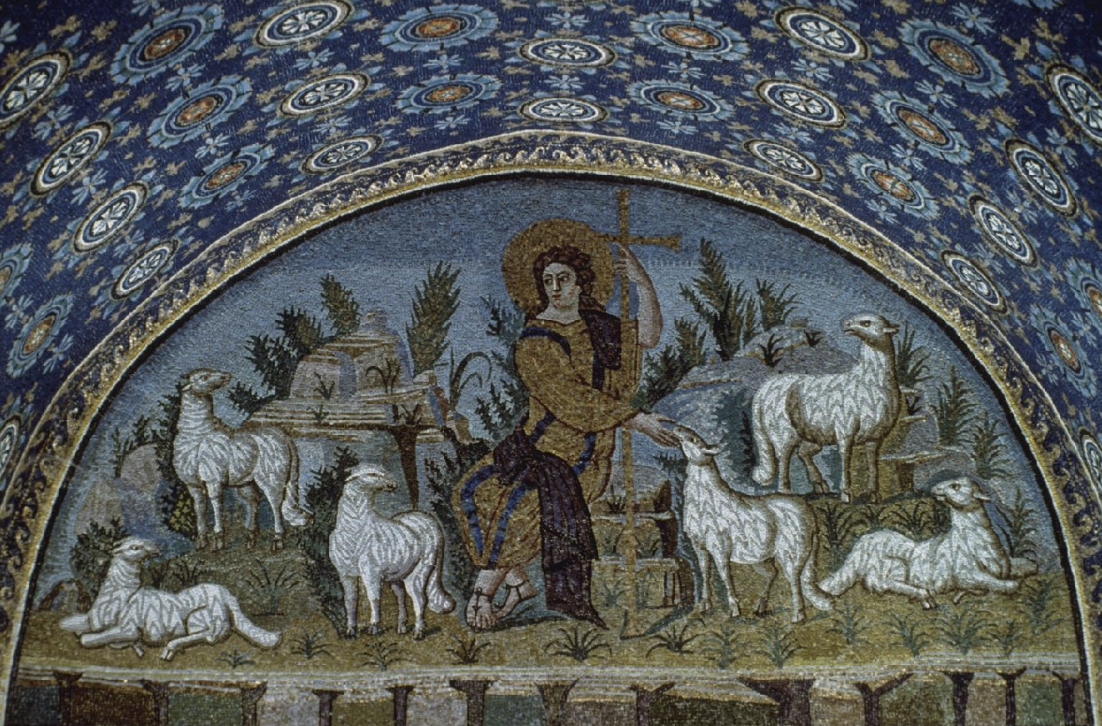
Christ as Good Shepherd
Period: Early Christianity
Context: Mosaic showing Christ as a powerful and caring shepherd, protecting his followers. It combines the Greco-Roman art’s naturalism with Christian symbolism, showing how early Christian art developed during the late Roman Empire.
Description: Christ in the center with a golden halo holding a cross-shaped staff. The sheep surrounding him are looking at him and he is seen gently reaching toward one sheep. Christ cares and protects his followers.

Great Mosque
Period: Islamic Spain
Context: Major political and cultural center under Muslim rule.
Description:
Hypostyle-roof supported by many columns. Repeating columns create a vast communal prayer space and demonstrate how Islamic builders adapted earlier architectural traditions
Mihrab-decorated prayer in the wall indicating the direction of Mecca
Building provides a large communal space for prayer. Mihrab indicates the direction of Mecca and the courtyard supports ritual washing

Court of the Lions
Period: Islamic Spain
Context: A palace courtyard in the Alhambra. It features elegant columns with intricate geometric decoration and a central fountain expressing royal luxury.
Description: 12 sculpted marble lions that are stylized rather than realistic. Slender columns. Intricate islamic decoration that had geometric patterns and Arabic inscriptions.

Plan for a monastery
Period: Early Medieval
Context: an ideal facility for monks that included everything they needed so they felt no need to wander outside its protective walls.
Description:
The church is the spiritual center. Beside it is the cloister, an enclosed courtyard surrounded by covered walkways and important monastic buildings.
Cloister-similar to the early christian atrium
widespread adoption of the early christian basilica
Refectory-where the monks ate
Benedictine monks followed the rule of saint benefict, structuring their lives around prayer, communal living, obedience, and work
Many early christian basilicas had one main apse at the end of the alter, this one has two
shows how the Carolingian church design developed beyond the typical early Christian basilica

Reliquary of Sainte Foy
Period: Romanesque
Context: a reliquary is a container for the remains or peronsal objects associated with a holy person. Relics were believed to connect the faithful with saints. She was a young Christian martyr who was killed for refusing to participate in a religious ritual. Her relics became an important focus of devotion at Conques. Conques became a pilgrimage destination.
Description: made of gold, silver, and gems to communicate the importance of the saint. Sainte-Foy is an authoritative figure so she is seated.
relics attracted travelers to churches and monasteries
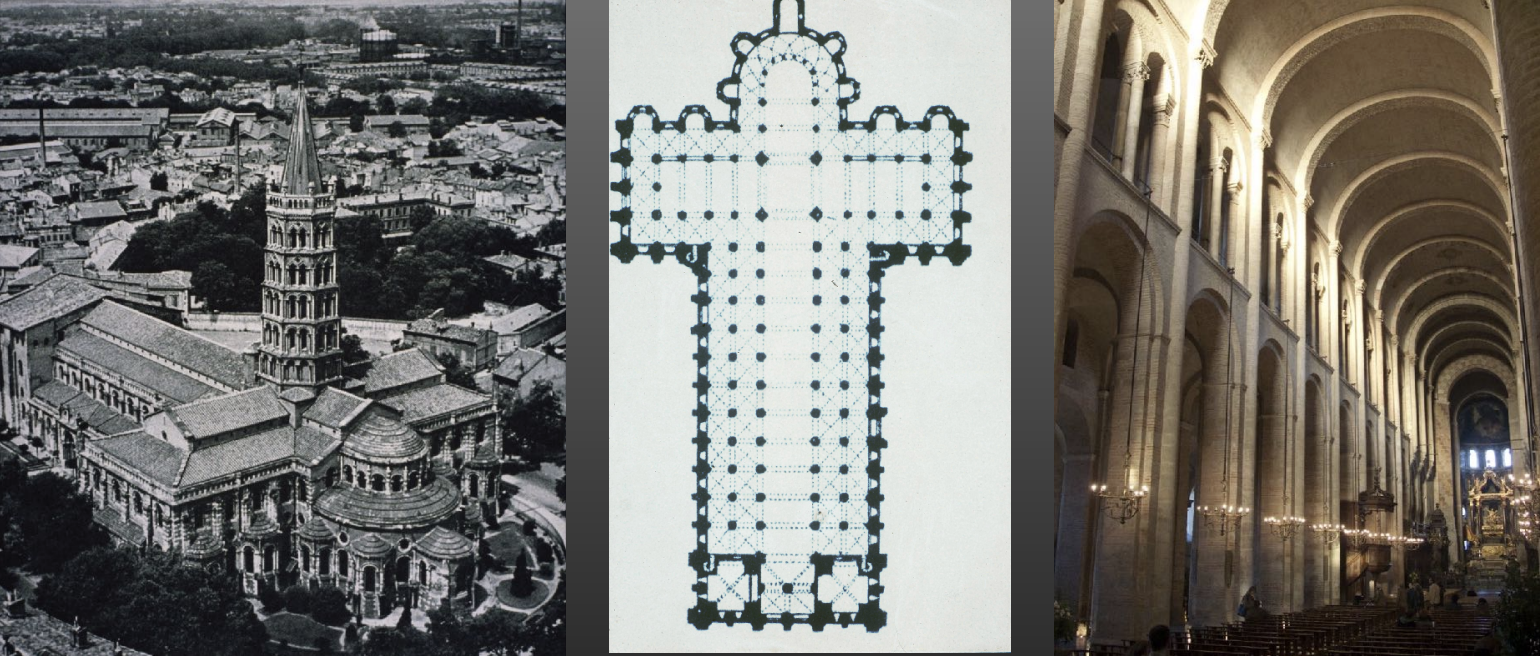
Saint-Sernin, Toulouse
Period: Romanesque
Context: brick and stone, christian church and pilgrimage destination, dedicated to saint.
Description: Rounded arches and barrel vaults, cross plans/transept, ambulatory that supported the movement of pilgrims while not disrupting the church services.

Last Judgment, Autun Cathedral
Period: Romanesque
Context: When Christ judges souls and separates the saved from the damned
Description: Christ is in the center with a halo around him. To his left, figures are weighing souls while the demon attempts to influence the outcome, representing the judgment of each person’s actions and moral choices after death. To his right, the saved are entering Heaven, where Saint Peter guards the entrance. In the tympanum above the entrance of a Cathedral.
hierarchical scale-christ is much larger
viewers can visually understand the difference between salvation and punishment
Function: teach Christian beliefs

Abbey Church, Fontenay
Period: Romanesque
Context: limestone, for monks, a monastery for prayer. Simplicity and restraint reflected the Cistercian belief that excessive decoration would distract the monks from God.
Description: Plain decoration, barrel vaults and rounded arches, Latin-cross plan, Cloister and monastic buildings made it self-sufficient.

Bayeux Tapestry
Period: Romanesque
Context: Events leading up to and including the Norman Conquest of England, the Battle of Hastings.
Description:
Harold Godwinson swears an oath to Willaim, Duke of Normandy. The oath becomes important to william’s claim that Harold broke his procmise by accepting the English throne himself.
William becomes king of England and transformed english political history
not a neutral account of history.
Function: to narrate a historical event. communicate political claims, and justify or celebrate Norman rule

Chartres Cathedral
Period: Gothic
Material: stone and stained glass
Description:
pointed arches to allow greater flexibility in building tall spaces, flying buttresses to accommodate larger windows, ribbed vaults
stained glass windows that communicated Christian teachings and brought heavenly beauty of natural light into the church
Function: christian cathedral dedicated to Virgin Mary, is an important pilgrimage destination

Royal Portal with jamb statues
Period: Gothic
Context: jamb statues at Chartres show the transition from Romanesque art. Gothic is more naturalistic bodies, individualized faces, and a stronger sense of human presence.
Description: Christ appears enthroned in the center, surrounded by the symbols of the four Evangelists, emphasizing his divine authority. the left portal, christ ascends to Heaven after his resurrection. in the right potal, christ becomes human.

Sainte-Chapelle
Period: Gothic
Context: enormous stained-glass windows, King Louis patron
Description: sainte-chapelle was both a religious building and a statement of royal power. Louis had relics associated to Christ’s Passion, including a fragment of the true cross. He built the chapelle to house these relics
Main message: divine legitimacy of kingship

Hours of Jeanne d’Evreux
Period: Gothic
Context: handmade medieval prayer book for Jeanne d’Evreux
Description: made for the queen Jean d’Evreux for prayer throughout the day.