Comprehensive Biology: Atomic Structure, Bonding, Water, and Amino Acids
 Call Kai
 Learn
 Practice Test
 Spaced Repetition
 Match
 Flashcards
 Knowt Play
1/105

There's no tags or description
Looks like no tags are added yet.
106 Terms
How is an element's atomic number determined?
By the number of protons in its nucleus
How is an atom's mass determined?
By the number of protons and neutrons added
How are atomic mass and atomic weight different?
Atomic weight is the average mass of all naturally occurring isotopes of an element, while atomic mass is the sum of the protons plus neutrons of an atom
If an atom has 8 electrons and a mass of 16, how many protons does it have?
8 protons
If an atom has 8 electrons and a mass of 16, how many neutrons does it have?
8 neutrons
If an atom has 8 electrons and a mass of 16, how many electrons does it have?
8 electrons
If an atom has 8 electrons and a mass of 16, how many electron shells does it have?
2 because the first one fills up only 2 electrons while the second one fills up 3 pairs of electrons, making 8 total electrons
If an atom has 8 electrons and a mass of 16, how many valence shells does it have?
6 because there are only three pairs of electrons in the outermost shell of the 2nd shell
An atom has 13 neutrons and 14 electrons. How many protons does it have ?
14 protons
An atom has 13 neutrons and 14 electrons. What is the mass?
protons plus neutrons = mass so 14+13=27
An atom has 13 neutrons and 14 electrons. How many electron shells does it have?
1st shell gets filled by 2 electrons, the 2nd shell gets filled by 8 electrons, and the 3rd shell gets filled by 4 electrons, so in total there are 3 shells
An atom has 13 neutrons and 14 electrons. How many valence electrons does it have?
4
An atom contains 14 protons and a mass of 29 ? How many neutrons does it contain?
29-14= 15 mass - protons = neutrons
An atom contains 14 protons and a mass of 29 ? How many electrons does it contain?
14 electrons
An atom contains 14 protons and a mass of 29. How many electron shells does it contain?
1st shell is 2 electrons 2nd shell is 8 and 3d is 4 electrons so 3 shells
An atom contains 14 protons and a mass of 29 ? How many valence electrons does it contain?
The third shell only contains 4 electrons
An "unknown" uncharged atom has an atomic number of 7 and contains 8 neutrons, How many electrons does this atom have?
7 electrons because atomic number is the amount of protons
An "unknown" uncharged atom has an atomic number of 7 and contains 8 neutrons, How many protons does this atom have?
7 protons
An "unknown" uncharged atom has an atomic number of 7 and contains 8 neutrons, What is the mass of this atom?
15 protons plus neutrons = mass 7+8=15
An "unknown" uncharged atom has an atomic number of 7 and contains 8 neutrons, How many valance electrons does this atom have?
1st shell gets filed with 2 electrons second shell gets filled with 5 so 5 valence electrons
what are 8 most common elements found in living things
(Oxygen, nitrogen, carbon, hydrogen:96.2%)(phosphorus, calcium, sulfur, potassium: 3.2%) in total this is 99.4% all living matter
Define electronegativity
Electronegativity is how strong the attraction force is of an atom to attract electrons.
Explain how differences in electronegativity between atoms influence the formation of nonpolar covalent
Electronegativity between atoms causes nonpolar covalent bonding when electronegativities are almost the same, so they share an electron
Explain how differences in electronegativity between atoms influence the formation of polar covalent bonds.
Electronegativity between atoms causes polar covalent bonding when the electronegativity of one atom is stronger than that of the other, causing them to share a pair because electrons are being pulled, creating a pole or dipole bond
Explain how differences in electronegativity between atoms influence the formation of ionic bonds.
Ionic bonds form when electronegative have large differences and rip electron from weaker electronegative creating ions.
Water is a polar molecule. Explain why this is, and describe water's polarity
Water is polar because oxygen has a higher electronegativity than oxygen and this causes partial positive charges on hydrogen and partial negative charge son itself
Draw two water molecules interacting, label all atoms, covalent bonds, hydrogen bonds, and full/ or partial charges

Water has several physical properties that are important to living organisms. Explain how hydrogen bonding between water molecules contributes to: water's relatively high specific heat
Hydrogen bonding contributes to water's high specific heat because most of the energy goes into breaking the hydrogen bond, and this leaves behind a smaller amount of energy that slowly speeds up the particles, causing water to have a high specific heat
Water has several physical properties that are important to living organisms. Explain how hydrogen bonding between water molecules contributes to: water's cohesive properties
Hydrogen bonding contributes to water's cohesive properties because each molecule can hydrogen bond to the others, and this is called cohesion. This is also what causes water surface tension
Explain why polar and ionic molecules are hydrophilic, and why nonpolar molecules are hydrophobic.
Polar and ionic molecules are hydrophilic because they have electronegative charges that can interact with water's electronegative charges, while non-polar molecules have no charge distribution, making them unable to interact, thus hydrophobic
An aqueous solution has a proton concentration of 1 x 10⁻⁸ M. What is the pH of this solution?
it is 8 also if you plug into a calc -Log(1x10^-8)=8
An aqueous solution has a pH of 6. What is the proton concentration of this solution?
1 x 10^-6
Consider the pH of the following two aqueous solutions:a. Solution #1: pH = 5 b. Solution #2: pH = 11 Which solution is more acidic? Explain
Solution #1 because a lower pH means a higher H+ concentration
Consider the proton concentrations of the following two aqueous solutions: a. Solution #1: [H+ ] = 1 x 10^-12 M b. Solution #2: [H+ ] = 1 x 10^-5 M Which solution is more basic? Explain.
Solution 1 is more basic because it has less H+ concentration
Define the term isomer. Explain how two molecules can have the same molecular formula but different structures and/or properties.
An isomer is a molecule that has the same molecular formula but a different shape or arrangement of atoms. Because of the different molecular arrangements, they would have different chemical and physical properties even though they contain the same types of atoms and # of atoms

Aspertate(Asp)
An acidic amino acid that is Polar

Glutamate
A amino acid that is acidic and polar
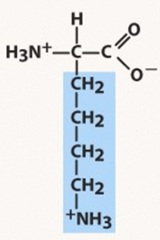
Lysine
A amino acid that is basic and polar

Arginine
A amino acid that is basic and polar

Histidine
A amino acid that is polar and basic and hydrophilic

Serine
A amino acid that is polar but neither acidic or basic it is neutral and hydrophilic

threonine
A amino acid that is polar but neutral and hydrophilic
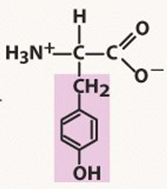
Tyrosine
amino acid that is polar and neutral and hydrophilic
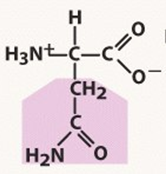
Asparagine
Amino acid that is polar and neutral and hydrophilic
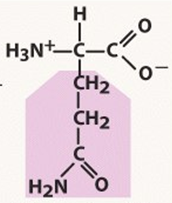
Glutamine
an amino acid that is polar and neutral and hydrophilic

Glycine
Non polar amino acid that is neutral and hydrophobic

Alanine
amino acid that is nonpolar and neutral and hydrophobic

Valine
Amino acid that is nonpolar and neutral and hydrophobic

Leucine
amino acid that is Nonpolar and neutral and hydrophobic

Isoleucine
Amino acid that is non polar and neutral and hydrophobic

Methionine
Nonpolar and neutral and hydrophobic

Cysteine
polar and neutral and hydrophilic
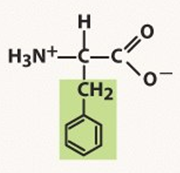
Phenylalanine
nonpolar and neutral and hydrophobic

Tryptophan
Non polar and neutral and hydrophobic
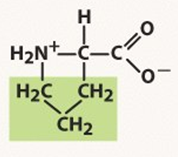
Proline
nonpolar and neutral and hydrophobic
Two amino acids are joined together to form a dipeptide. What type of covalent bond joins the two amino acids?
A peptide bond also known as an amide bond that links two amino acids to form a protein or peptide chain
Two amino acids are joined together to form a dipeptide.Describe how this bond is formed, including the functional groups involved and what molecule is produced as a byproduct.
A peptide bons is formed through a condensation reaction also know as a dehydration reaction. The functional groups are carboxyl (-COOH)group that reacts with amino group(-NH2). The bond is formed between the two groups between the carboxyl's OH group and NH and a covalent amide linkage is formed. and a byproduct is a single water
Two amino acids are joined together to form a dipeptide.Explain what is meant by the N-terminus and C-terminus of a polypeptide
N-terminus: The start of the chain, featuring a free amino group (-NH2)
C-terminus: The end of the chain, featuring a free carboxyl group (-COOH).
A globular protein that is normally found in aqueous solution primarily contains the following amino acids in its primary structure: tyrosine, arginine, cysteine, and aspartate. Predict where each of these amino acids would be found in the fully shaped protein - on its exterior or in its interior? Explain your predictions.
tyrosine is polar and both arginine and aspartate are charged so all 3 are going to be outside. cystine will be found on the inside because it is non polar.

Primary structure
Primary structure is the specific sequence of amino acids in a polypeptide. The amino acids are joined by peptide bonds

Secondary structure
Secondary structure refers to local folding patterns in the polypeptide backbone, especially αhelices and β-pleated sheets. These structures are stabilized by hydrogen bonds between atoms in the peptide backbone.
Tertiary structure
Tertiary structure is the overall three-dimensional shape of a single polypeptide. It is determined by interactions among the R groups (side chains) of the amino acids. These interactions can include hydrogen bonds, ionic interactions, hydrophobic interactions, van der Waals interactions, and disulfide bonds.
Quaternary structure
Quaternary structure describes the arrangement and interaction of two or more polypeptide subunits in a functional protein. It is stabilized by many of the same interactions involved in tertiary structure, including hydrogen bonds, ionic interactions, hydrophobic interactions, van der Waals interactions, and sometimes disulfide bonds.
identify the three major components of a nucleotide
A nucleotide is made of three major components: a phosphate group, a five-carbon sugar, and a nitrogenous base.
Describe the basic structure of a nucleotide and compare DNA nucleotides with RNA nucleotides. explain which components can vary among nucleotides
The nitrogenous base can vary among nucleotides. The sugar can also vary depending on whether the nucleotide is part of DNA or RNA. The phosphate group is the same basic component in all nucleotides.
describe the differences between DNA and RNA nucleotides, including ribose vs. deoxyribose and the 2′ carbon
DNA nucleotides contain the sugar deoxyribose, while RNA nucleotides contain ribose. The key difference is at the 2′ carbon of the sugar: ribose has a hydroxyl group (-OH) attached to the 2′ carbon, while deoxyribose has only a hydrogen (-H) at this position.
difference between DNA and RNA
DNA contains adenine (A), guanine (G), cytosine (C), and thymine (T), while RNA contains adenine (A), guanine (G), cytosine (C), and uracil (U) instead of thymine.
RNA in terms of their monomeric composition
Nucleotides, but these consist of a ribose sugar, a phosphate group, and one of four nitrogenous bases (adenine, uracil, cytosine, guanine). RNA does not have thymine; instead, uracil replaces it.
RNA in terms of their shape
Usually single-stranded but can fold into complex three-dimensional shapes due to base pairing within the same strand - results in sections of unpaired bases forming "loops" and sections of paired bases forming "stems" (small sections of antiparallel double helices). Highly variable tertiary structures, dependent on primary structure.
RNA function
Processes, edits, & regulates genetic information. Can also act as catalysts (like enzymes): "ribozymes"
DNA in terms of their monomeric composition
Nucleotides, which consist of a deoxyribose sugar, a phosphate group, and one of four nitrogenous bases (adenine, thymine, cytosine, guanine).
DNA in terms of their overall physical shape
Typically exists as a double helix, composed of two complementary strands running in opposite directions (antiparallel). The strands are held together by hydrogen bonds between complementary bases (A-T and C-G pairs). Often "supercoiled" into more compact/dense unit
DNA in terms of their functions
Long-term storage of genetic information
What type of covalent bond joins adjacent nucleotides?
Adjacent nucleotides in a nucleic acid are joined by phosphodiester bonds, which are covalent bonds.
Which parts of neighboring nucleotides are joined by this bond?
A phosphodiester bond forms between the phosphate group attached to the 5′ carbon of one nucleotide and the hydroxyl group on the 3′ carbon of the sugar of the next nucleotide. This creates the repeating sugar-phosphate backbone of the nucleic acid.
Explain what is meant by the 5′ end and 3′ end of a nucleic acid strand.
The 5′ end of a nucleic acid strand is the end with a free group associated with the 5′ carbon of the sugar, while the 3′ end has a free hydroxyl group (-OH) on the 3′ carbon. Because nucleotides are linked in this way, a nucleic acid strand has directionality and is conventionally written 5′ → 3′.
DNA contains two strands that are described as antiparallel. What does this mean?
The two strands of DNA are antiparallel, meaning they run in opposite directions. One strand runs 5′ → 3′, while the other runs 3′ → 5′.
Amylose
Monomers:α-glucose
Type of bondMonomers:1,4 glycosidic linkages
Polymer structure/shape:unbranched helix
Polymer function:glucose storage in plant cells
Amylopectin
Monomers:α-glucose
Type of bond:1,4 glycosidic linkages, sometimes 1-6 linkages
Polymer shape/structure:moderately branched helices
Polymer function:glucose storage in plant cells
Glycogen
Monomers:α-glucose
Type of bond(s):1,4 glycosidic linkages; more 1,6 linkages
Polymer structure/shape:heavily branched helices
Polymer function:glucose storage in animal & fungi cells
Cellulose
Monomers:ß-glucose
Type of bond(s):1,4 glycosidic linkages
Polymer structure/shape: unbranched linear sheets; "stacked" and held together by hydrogen bonds
Polymer function:structure/rigidity to plant cells
Chitin monomeric composition
Chitin is a polysaccharide made of repeating modified ß-glucose monomer called N-acetylglucosamine (NAG).
Chitin's biological role
It functions mainly as a structural material, providing strength and support.
Where is chitin found
Chitin is found in the cell walls of fungi and in the exoskeletons of arthropods, such as insects, spiders, and crustaceans.
Peptidoglycan monomeric composition
Peptidoglycan is a structural polymer made of repeating modified ß-glucose monomers, N-acetylglucosamine (NAG) and N-acetylmuramic acid (NAM), with short peptide chains that cross-link the sugar chains
Peptidoglycan biological role
. It provides strength and support to the cell wall and helps cells resist bursting due to osmotic pressure.
Where is peptidoglycan found?
. Peptidoglycan is found in the cell walls of bacteria.
Explain why humans can digest starch but not cellulose
It is because humans produce an enzyme called amylase that can break starches down into usable sugars, while cellulose requires a special enzyme called cellulase that we don't produce, so it passes as dietary fiber
Saturated fatty acids
Mnemonic: Saturated = Straight = Single bonds = Solid at room temp (like Steak fat or Solid butter).
Unsaturated fatty acids
Unsaturated = Bent (Un-straight) = Double bonds = Liquid at room temp (like Oil).
Composition of triglycride
Tri = Three: Stands for 3 fatty acid chains Glyceride = Glycerol: Stands for 1 glycerol backbone holding them together.
how triglyceride is joined
A glycerol molecule combines with three fatty acid chains through condensation reactions, forming 3 ester bonds and releasing 3 water molecules
Function of triglyceride
function of triglycerides is long-term energy storage. Some are used for waterproofing external structures.
why are triglycerides hydrophobic
Triglycerides are largely hydrophobic because most of the molecule consists of the long nonpolar hydrocarbon chains of the fatty acids.
Steroids (Structure )
Structure: Lipids composed of 4 fused carbon rings (3 six-carbon + 1 five-carbon ring), with no fatty acid tails.
Steroids(function)
Functions: Regulates cell membrane fluidity (cholesterol) and acts as chemical messengers/hormones (signaling).
Steroids vs Triglycerides vs Phosopholipids
Steroids differ from triglycerides and phospholipids because they are not built from glycerol attached to fatty acids. Instead, their structure is based on the four fused carbon rings.
Permeability
the tendency of a structure to allow a substance to pass through it
Selective Permeability
the tendency of a structure to allow certain substances to pass through it more easily than other substances
Which two (2) solute characteristics, as discussed in lecture, impact permeability?
Size and charge/polarity