Economics 22060: Production, Costs, Perfect Competition, Monopoly, and Pricing Strategies
 Call Kai
 Learn
 Practice Test
 Spaced Repetition
 Match
 Flashcards
 Knowt Play
1/39

Earn XP
Description and Tags
Comprehensive practice flashcards covering production theory, cost functions, perfect competition, monopoly pricing and deadweight loss, price discrimination, and monopolistic competition.
40 Terms
What is the primary economic objective of a firm, and how are profits calculated?
The goal of the firm is to choose the quantity of output (q) to maximize profits, defined as total revenue minus total costs: Profits=TR−TC, where TR=P×q.
What is the fundamental difference between variable inputs and fixed inputs?
Variable inputs (such as labor, L) can be adjusted in the short run to alter the quantity produced. Fixed inputs (such as physical capital, K) cannot be changed in the short run regardless of output.
Why is financial capital not considered a factor of production input in economics?
Financial capital (such as stocks, bonds, and debt) is not an input itself; rather, it is the financial means used by a firm to purchase physical capital (factories, machinery, office space).
How do economists define the boundary between the short run and the long run?
The short run is the period during which at least one input is fixed (typically capital). The long run is the period where no inputs are fixed and all inputs are variable.
How do the Average Product of Labor (APL) and Marginal Product of Labor (MPL) differ in definition and formula?
APL measures the average output per worker (APL=Lq), whereas MPL measures the additional output generated by hiring one additional worker (MPL=ΔLΔq).

In this marginal product of labor (MPL) diagram, what explains the initial increase and the subsequent decline of the curve?
MPL initially rises due to specialization, where workers are assigned distinct tasks. It eventually falls due to diminishing returns to labor as more workers share fixed inputs.
What is the mathematical and graphical relationship between MPL and APL?
The MPL curve intersects the APL curve at the maximum of APL. When MPL>APL, APL is rising; when MPL<APL, APL is falling.
How are Total Costs (TC), Fixed Costs (FC), and Variable Costs (VC) defined and related?
TC=FC+VC. Fixed costs are incurred even if output is zero (q=0) and do not vary with quantity, whereas variable costs change directly as output changes.

In this cost curve diagram, what does the vertical distance between the Average Total Cost (ATC) and Average Variable Cost (AVC) curves represent?
The vertical distance represents Average Fixed Cost (AFC). Because ATC=AVC+AFC, this distance continuously narrows as quantity increases because AFC=qFC declines.
Why can Marginal Cost (MC) be calculated using either the change in Total Cost or the change in Variable Cost?
Because fixed costs do not change when output varies (ΔFC=0), any change in total cost is entirely driven by the change in variable cost: MC=ΔqΔTC=ΔqΔVC.
How is Marginal Cost (MC) derived from the wage rate (w) and the Marginal Product of Labor (MPL)?
Since variable cost is VC=w×L, changing output requires changing labor: MC=ΔqΔVC=w×ΔqΔL=MPLw.
At what specific points does the Marginal Cost (MC) curve intersect the AVC and ATC curves?
The MC curve intersects both the Average Variable Cost (AVC) curve and the Average Total Cost (ATC) curve at their exact minimum points.
How does an increase in wages differ from an increase in fixed costs in its effect on short-run cost curves?
An increase in wages increases variable costs, shifting MC, AVC, and ATC upward. An increase in fixed costs only increases total and average fixed costs, shifting ATC upward while leaving MC and AVC unchanged.
What distinguishes Increasing, Constant, and Decreasing Returns to Scale along the Long-Run Average Total Cost (LRATC) curve?
Increasing Returns to Scale (Economies of Scale) occurs when LRATC decreases as scale expands. Constant Returns to Scale occurs when LRATC remains unchanged. Decreasing Returns to Scale (Diseconomies of Scale) occurs when LRATC rises as scale expands.
What is the general profit-maximization rule for any firm?
A firm maximizes profits by producing the quantity (q∗) where Marginal Revenue equals Marginal Cost: MR=MC.
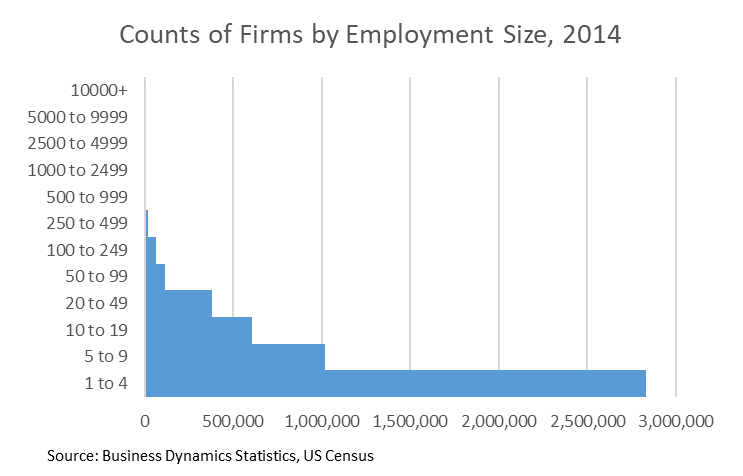
Based on the 2014 U.S. Census data shown in the graph, what does the firm size distribution reveal about the economy?
The vast majority of firms are small: 56% have fewer than 5 employees, 76% have fewer than 10, 88% have fewer than 20, and only 2% have more than 100 employees.
Why is Marginal Revenue (MR) equal to the market price (P) for a perfectly competitive firm?
Because the firm is a price-taker facing a perfectly elastic individual demand curve, selling any additional unit brings in exactly the prevailing market price: MR=P.
How is Producer Surplus (PS) related to profits and costs on a firm's graph?
PS=TR−VC. It represents the area above the marginal cost curve and below the market price, which is equivalent to economic profits plus fixed costs.
Under what condition will a firm shut down in the short run versus exit in the long run?
A firm shuts down in the short run if revenue cannot cover variable costs (TR<VC or P<minAVC). It exits in the long run if it incurs economic losses (TR<TC or P<minATC).
Why can a competitive firm rationally operate at a loss in the short run?
If P≥minAVC but P<minATC, the firm earns enough revenue to cover all its variable costs and pay off a portion of its fixed costs, resulting in smaller losses than shutting down entirely.
What drives long-run economic profits to zero in a perfectly competitive market?
Free entry and exit. Short-run profits attract new firms, shifting market supply right and lowering price until P=minLRATC. Short-run losses cause firms to exit, shifting supply left and raising price until economic profits equal zero.
What is the difference between economic profit and accounting profit?
Economic profit subtracts both explicit costs and implicit opportunity costs from total revenue, whereas accounting profit only subtracts explicit monetary costs. Zero economic profit (normal profit) means resources earn as much as their next-best alternative.
What are the four primary barriers to entry that can create a monopoly?
Legal provisions (patents, copyrights, antitrust exemptions like MLB). 2. Geography (location limiting local demand). 3. Returns to scale (natural monopolies with large fixed capital infrastructure). 4. Anti-competitive behavior (predatory pricing).
Why is the Marginal Revenue (MR) curve for a monopolist downward-sloping and located below the demand curve?
Because the monopolist faces the entire market demand curve, it must reduce the price on all units sold to sell one additional unit. Thus, the gain in revenue from the extra unit is offset by the price cut on all previous units.
A monopolist selling 4 cans of peas at $1.00 each can sell 5 cans only by lowering the price to $0.90 for all units. What is the MR of the 5th can?
TR1=4×1.00=4.00; TR2=5×0.90=4.50. MR=5−44.50−4.00=0.50. The firm gains 0.90 on the 5th can but loses 4×0.10=0.40 on the previous four cans.
How does a monopolist determine its profit-maximizing quantity and price?
The monopolist produces quantity qm where MR=MC, and charges price pm, which is the maximum price consumers are willing to pay at qm found on the demand curve.
Why can a monopolist earn positive economic profits in the long run while a competitive firm cannot?
Barriers to entry prevent new competitors from entering the market, protecting the monopolist's market share and preventing the market supply expansion that would eliminate economic profits.
Why is a monopoly market outcome inefficient compared to perfect competition?
A monopoly produces a lower quantity (qm<Q∗) and charges a higher price (pm>P∗), transferring consumer surplus to the producer and creating deadweight loss (DWL).
What is the typical duration of a U.S. patent, and what trade-off does it address?
U.S. patents last between 15 and 20years. They balance providing temporary monopoly profits to incentivize costly upfront research and development (R&D) against the deadweight loss of monopoly pricing.
How did the University of Minnesota ensure long-term monopoly rents from the SweeTango apple variety?
They protected the apple with both a patent and a trademark. While patents expire, trademarks do not, allowing them to indefinitely require growers to pay royalty fees to use the brand name SweeTango.
How does the price elasticity of demand affect a firm's ability to mark up price above marginal cost (MC)?
The more inelastic demand is, the higher the markup a firm can charge above MC. For perfectly elastic demand (Ed→−∞), markup is zero (P=MC), whereas an elasticity of Ed=−2 leads to a 100% markup (P=2×MC).
What is first-degree price discrimination, and what is its effect on consumer surplus?
First-degree (perfect) price discrimination occurs when a firm charges each consumer the maximum price they are willing to pay. This captures all consumer surplus, converting it entirely into producer surplus (CS=0).
What defines second-degree price discrimination?
Charging different per-unit prices for different quantities or bundles of a good, such as offering a lower unit price for a 12-pack of soda compared to an individual can, or value combo meals.
What is third-degree price discrimination, and which consumer segment receives the higher price?
Charging different prices to distinct groups of consumers based on differences in their price elasticity of demand. Groups with more inelastic demand (less price-sensitive) are charged higher prices.

According to this comparison table between theatre and store concessions, why can theatres charge such high prices?
Theatres hold a local monopoly inside the venue, prohibit outside food, and cater to consumers who have highly inelastic demand for snacks to accompany a movie.
Why do colleges offer less favorable financial aid packages to accepted students who went on official campus visits?
Visiting the campus signals strong interest and a high willingness to attend, indicating more inelastic demand. The college does not need to offer as large an aid discount to entice the student to enroll.
How does a two-part tariff extract consumer surplus?
It charges consumers an upfront fixed fee for the right to buy or participate (capturing consumer surplus), followed by a per-unit price for the goods actually purchased (e.g., Costco or Sam's Club annual membership).
What are the three core characteristics of a monopolistically competitive market?
Many firms competing in the market. 2. Free entry and exit. 3. Differentiated (heterogeneous) products, which gives each individual firm a downward-sloping demand curve.

What long-run market outcome is illustrated by the red demand and marginal revenue curves in this graph?
Long-run equilibrium in monopolistic competition. Free entry of competing substitute products shifts the firm's demand left until it is tangent to the ATC curve (P=ATC), driving economic profits to zero.
What are the two primary economic roles of branding and advertising in monopolistic competition?
To differentiate products from rivals, reducing substitution and making demand more inelastic to allow higher markups. 2. To attract new customers, shifting the demand curve to the right.