Tubular Function: Loop of Henle
 Call Kai
 Learn
Learn Practice Test
 Spaced Repetition
 Match
Match Flashcards
 Knowt Play
1/21

There's no tags or description
Looks like no tags are added yet.
Name | Mastery | Learn | Test | Matching | Spaced | Call with Kai | Chat |
|---|
No analytics yet
Send a link to your students to track their progress
22 Terms
Why is conserving water important in humans?
Water is essential for maintaining:
Blood volume and blood pressure
Cellular function
Metabolic reactions
Temperature regulation
Transport of nutrients, hormones and waste products
Appropriate electrolyte concentrations
What determines whether the kidneys produce dilute or concentrated urine?
Mainly the hormone ADH (or vasopressin)
High ADH → increased water reabsorption → concentrated urine
Low ADH → decreased water reabsorption → dilute urine
ADH increases the water permeability of the collecting ducts by promoting insertion of aquaporin-2 channels into their apical membranes
Loop of Henle
Looped region of the nephron that has countercurrent flow inside it
Filtrate contains water that change in concentration as you move around the loop
Designed to ensure as much water as possible can be reabsorbed from LoH itself, but primarily from DCT and collecting ducts
Absorbed water is taken up by specialised blood vessels called the vasa recta

Role of the LoH
Create a hyperosmotic medullary interstitium
Makes the fluid of the medullary interstitium surrounding the LoH and also surrounding the collecting ducts have a very high solute osmolality
As you move from outer renal cortex to inner renal medulla, interstitum of medullary region becomes progressively more concentrated - corticomedullary or corticopapillary osmotic gradient
What is the cortico-medullary osmotic gradient?
It is an increasing osmolarity from the renal cortex towards the inner medulla - this gradient allows the kidney to reabsorb water from the collecting ducts and therefore produce concentrated urine
Ascending limb - extrusion on solutes
Actively extrudes solutes into surrounding interstitium – this will increase interstitial osmolality but decrease that of the filtrate making it hypo-osmotic
Removal of Na+/Cl- from filtrate into interstitium requires a lot of energy – hence a lot of Na+ K+ ATPases are found on tubular cells in this region
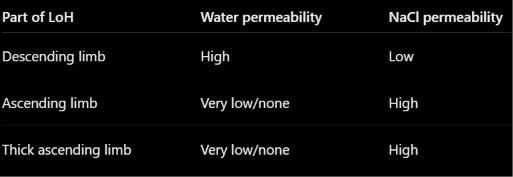
Water does not follow because this part of the LoH is impermeable to water and only permeable to solutes - water stays in the filtrate as the cells are tightly packed so water is unable to leave via osmosis

Thick ascending LoH extrudes solutes into the medullary interstitium making it hyperosmotic - diagram

Na+ and Cl- extruded into medullary interstitium from ascending limb of LoH - diagram
Channels are targets for drugs
No aquaporins so water can’t leave

Descending limb - extrusion of water
Passively reabsorbs water by osmosis. Filtrate in descending LoH surrounded by hyperosmotic medulla – thanks to ascending LoH water enters medullary interstitium and is picked up by vasa recta
NOT obligatory water reabsorption as in PCT where water reabsorbtion is directly linked to Na+ reabsorption. Filtrate becomes hyperosmotic as it equilibrates with interstitium
This part of the LoH is impermeable to solutes and only permeable to water. Solute stays in the filtrate
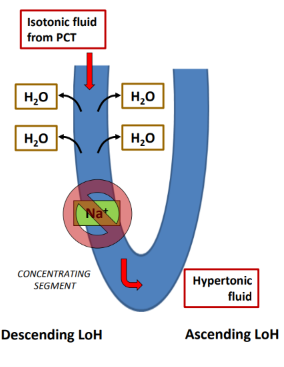
Thin decending LoH extrudes water osmotically due to solutes in surrounding interstitium - diagram

Cortico-medullary interstitial gradient
Extrusion of Na+/Cl- from ascending and water reabsorption from descending LoH leads to an INCREASING VERTICAL hyperosmotic gradient in the medullary interstitium. The LoH, DCT and collecting ducts are therefore bathed in an interstitium that is very concentrated. This means water can be reabsorbed by osmosis from the descending LoH – BUT it will also have the same effect on the DCT and collecting ducts
The outer cortex is less hyperosmotic (closer to plasma osmolality) and the inner medulla is more so – vertical corticomedullary gradient
What is countercurrent multiplication and what’s the process involved?
It is the process by which the Loop of Henle establishes a progressively increasing osmotic gradient from the cortex to the inner medulla
The process involves:
NaCl leaves the ascending limb
This increases the osmolarity of the surrounding interstitium
Water leaves the descending limb by osmosis
More concentrated tubular fluid enters the ascending limb
More NaCl can then be transported into the interstitium
Repetition along the length of the LoH produces a large cortico-medullary osmotic gradient
Why is it called ‘countercurrent’?
Because fluid flows in opposite directions in the two limbs:
Descending limb → fluid flows towards the medulla
Ascending limb → fluid flows towards the cortex
This opposing flow allows the osmotic gradient to be progressively multiplied along the LoH
Why is it called ‘multiplication’?
A relatively small osmotic difference between the ascending limb and surrounding interstitium is repeatedly multiplied along the length of the Loop of Henle, producing a much larger gradient between the cortex and inner medulla

Differnces between the ascending and descending limbs of the LoH or countercurrent multiplier - table

What is urea recycling?
Movement of urea between the collecting duct and medullary interstitium, with some urea entering parts of the Loop of Henle and eventually returning to the collecting duct - allows urea to accumulate in the inner medulla
Why is urea particularly important in the inner medulla?
Urea contributes a large proportion of the osmolarity of the deep inner medulla, helping to produce the very high osmolarity needed to concentrate urine

How does ADH use the medullary osmotic gradient to concentrate urine?
When ADH levels are high:
ADH increases water permeability of the collecting duct
The collecting duct passes through the increasingly hyperosmotic medulla
Water moves out of the collecting duct by osmosis
Water enters the hyperosmotic medullary interstitium
Water is returned to the circulation
Less water remains in the tubular fluid
Urine becomes more concentrated
What happens when ADH levels are low?
Less water leaves the collecting duct
More water remains in the tubular fluid
A larger volume of dilute urine is produced
What happens during dehydration?
Increased plasma osmolarity
Increased ADH secretion
Increased collecting duct water permeability
Increased water reabsorption
Concentrated urine
Reduced urine volume
What happens after drinking a large amount of water?
Plasma osmolarity decreases → ADH secretion decreases → collecting ducts become less permeable to water → less water is reabsorbed → a large volume of dilute urine is produced
Loop Diuretics
Increase urine flow by acting on the thick ascending LoH
Block Na+ K+ 2Cl- ions channels in ascending LoH
No reabsorption/extrusion of Na+/Cl-into medullary interstitium
Prevent generation of a cortico-medullary gradient
No hypertonic interstitium surrounding LoH, DCT and CDs
Decreases the osmotic driving force to pull water out of CDs
Increased urine is produced – less fluid in body – DIURETIC !
Decreased Na+ reabsorption at ascending limb which means more Na+ excretion
Decreased blood volume
Decreased blood pressure