Geology Test 1
 Call Kai
 Learn
Learn Practice Test
 Spaced Repetition
 Match
Match Flashcards
 Knowt Play
1/98

There's no tags or description
Looks like no tags are added yet.
Name | Mastery | Learn | Test | Matching | Spaced | Call with Kai | Chat |
|---|
No analytics yet
Send a link to your students to track their progress
99 Terms
What is Geology? Provide a few examples as to what a geologist does
Geology is the scientific study that focuses on Earth.
Geologists may work in Oceanography, Astronomy, Wetlands
Do all geologists work outside “in the field”? Explain
No, not all of them work outdoors or ‘in the field’. Many of them also work as professors, in laboratories, or in environemntal engineering.
What is the sceintific method? What are the order of steps involved that were presented in class? Do geologists follow it?
The scientific method attmepts to minimize influence, bias, or prejudice in an experiment by providing an objective, stardardized approach to conducting experiments, and evaluating and solving a problem.
The steps we discussed in class are
1) Recognizing and observing a problem which leads to a quesiton
2) Questions are turned into possible explanation called a hypothesis (idea)
3) Evidence is collected and our hypothesis is empirically and measurably tested
4) Hypothesis is accepted, rejected, and motified
5) Data and results are reported, reviewed by peers, and published
What is the difference between a hyptohesis and a theory?
A theroy is a hypothesis that has been rigorously tested, supported by an abundance of evidence is reputable and has not been disproven. Theories can eventually be disproven. A hypothesis on the other hand can be proven or disproven?
What is cosmology
study of the overall structure and history of the universe
What is the theory that the earth is the center of the unvierse?
geocentric
What is the theory that the sun is the center of the unvierse?
heliocentric
What are the key differences between terrestrial planets and giant planets in our solar system
The two types of planets are terrestrial and giant planets. Terrestrial planets include the first 4 in our solar system, while the remaining ones are ice giants or ‘jovian’ planets.
Terrestrial planets are made up of more rock and heavier material, while jovian planets are made up of lighter material such as gas and ice (which caused them to get knocked to the back when the solar system was forming)
When did the big bang happen?
13.8 billion years ago at an infinately hot, dense, and tiny point (singularity)
What is teh primary difference beween Big Bang Nucleosyntehsis, Stellar Nucleosynthesis, and Supernova Nuclearsynthesis? Explain as it relates to when/how things are formed and associated with naturally occuring elements discussed in class
The primary difference between the three types is what is leading to the nucelosyntehsis and what is produced.
For big bang nucleosynthesis, the big bang created hydrogen and helium.
For stellar nucelosynthesis, the creation of new stars form new elements (first 26 or so elements)
For supernova nucleosynthesis, the death of stars creates new elements (remaining 90 elements)
Explain nebular theory
Nebular theory says that the solar system formed from a large rotating cloud of gas and dust (solar nebula) that collapsed under gravity and flattened into a disk. Most material collected at the center to form the sun (protosun at first), while the remaining dust and gas int he disk stuck together and became protoplanets before becoming planets
What is a nebula
A nebula is a cloud of gas, dust, and ice in space
What is a supernova
A massive and extremely bright explosion of a star
What is the imaginary barrier of the protoplanetary disk?
frost line
What are protoplanets formed by?
continuous collisions.
they go on to form terrestrial planets or ice giants.
What does ALMA allow us to do?
ALMA allows us to see stars in other galaxies that are in the early stages of developemnt.
Explain differentiation
DIfferentiation is the separation of materials due to density differnces.
The earth began by being homogeneous inside, temps increased and iron began to melt, and iron accumulated to form metallic core
Based on the majort elements that make up the Whole Earth, how do they differ from the major elements of the crust? (discussed in class with pie chart)
The crust has mostly silicon and oxygen while the whole earth is mostly iron and oxygen as well as magnesium and nickel. Our crust is alot lighter as compared to the earth as a whole.
What are the three primary layers of Earth? What is the distinction between them
Crust mantle, and core
The distinction between them is density.
What are the two types of crust? What is true of each type
The two types of crust are oceanic crust and continental crust.
Oceanic crust is thinner and heavier, while Continentalo crust is thicker and lighter.
What is the name for the boundary between crust and mantle
moho
What is Earth’s crust predominately made of? What is it like in terms of weight?
oxygen and silicon.
It is generally lighter than the rest of the earth
What is true of what the mantle contains
The mantle contains rock with a high % of iron and magnesium
It is composed of the upper and lower mantle
What is true of the lower mantle
The lower mantle is more dense than the upper mantle
What does the upper mantle contain?
The upper mantle contains the Lithospheric mantle and the Asthenospheric Mantle
Which part of the upper mantle is cool and rigid like the crust but is made of different materials?
Lithospheric mantle
What part of the upper mantle is composed of rock that is the same of the other part of the mantle, but it is much hotter?
Asthenospheric Mantle
What are the key differences between inner and outer core.
Outercore is liquid iron alloy and induces the earth’s magnetic field due to convection currents.
Innercore is made of solid iron alloy due to high pressure
How are seismographers able to see what the earth’s layers are like
An earthquake creates seismic waves that propogate through the subsurface,
As these waves move, they change speed, bend (refract), or stop entirely when they encounter different materials. By measuring how P‑waves and S‑waves arrive at seismograph stations around the world, scientists can map out where the mantle, outer core, and inner core must be.
What are the two types of seismic energy waves?
Body waves and subsurface waves
What are the two types of Body-waves? What is the difference between them in terms of what they are able to pick up?
P-waves (compressional waves) and S-waves (shear waves)
P-waves travel faster than S-waves and go though solids and liquids. S-waves (shearwaves) do not travel fast and cannot go through liquid
What was the zone between P-waves and S-waves that scientists found that allowed them to determine that there is liquid in the core?
Shadow Zone
What are the six realms of earth?
-magnetosphere
-geosphere
-atmosphere
-hydrosphere
-cryosphere
-biosphere
What is the realm of earth in earth’s magnetic field? Protects us from solar flares.
Magnetosphere
What is the realm of Earth that is solid earth, what we think of when we think geology?
Geosphere
What realm of earth is the gasses? 78% nitrogen and 21% oxygen
the atmosphere
What is the line over which everything needs a propulsion system of some sort?
The Karman Line
What is the realm of earth that houses all of the water on earth?
Hydrosphere
What is the realm of the earth is in polar regions and high altitudes (ice,snow, etc)
the cryosphere
what earth realm has all living organisms including us?
biosphere
Who was Alfred Wegener and what did he hypothesize?
Alfred Wegener was a metorologist who traveled the world. Wrote ‘the origin of the continents and oceans’ where he hypothesized about the continental drift theory. Had 5 key comonents of ‘evidence’
1)Fit of continents
2)past glaciation
3)dist of climate belts
4)dist of fossils
5)matching geographic units.
What were the five componenents of Wagner’s evidence on plate techtonic theroy.
-Fit of continents
-Past Glatiation
-Distribution of Climate Belts
-Distribution of Fossils
-Matching of Geological Units
What is bathymetry
measurement of depth variations in a body of water.
What does Bathymetry use to determine depths in water?
Sonar. it works by emitting acoustic pulse of sounds into the water and that sound bounces off objects and returns as echo.
What are teh four things that bathymetry revealed (Marie Tharp)
1- mid-ocean ridges
2- deep-sea trenches
3-fracture zones
4- seamount chains
Who was Alfred Wegener and what did he hypothesize? (EDIT)
What was found by expeditions like the Glomar Challenger that started to drill down into the sediment
Oceanic crust mostly made of basalt (Fe and Mg) which was different from the contenental crust made of O and Si)
Who followed Marie Tharp’s work and during WW2 equipped his boat with Solar which he used
Harry Hess
In general, how do most of Earth’s volcanic and earthquake activity relate to Plate Techtonics?
Most of Earth’s volcanic and earthquake activity happens along plate boundaries, where plates interact. As plates diverge, converge, or slide past each other, they generate stress that produces earthquakes, and they allow magma to rise abnd form volcanos. In short: plate movements create conditions that cause most quakes and volcanos
Define paleomagnetism? How does it contribute to the understanding of plate motion?
Paleomagnetism is the study of Earth’s ancient magnetic field as recorded in the remanent magnetization of rocks, sediments, and archaeological materials. Magnetic minerals align with the geomagnetic field during rock formation or deposition, preserving information about past field direction, intensity, and polarity
What is the name for the past magnetic North
Paleopole
What instrument is used to measure paleomagnetism in our oceans and what did it reveal?
magnetometer.
It revealed a pattern along the sea floor showing that there were equal patterns of pole reversal on each side of mid-ocean ridges
What is a contenental rift and what kind of plate boundary is it?
A continental rift is a region where Earth's continental crust and lithosphere stretch, thin, and break apart, and it occurs at a divergent plate boundary.
What measures the magnetic field strength of the seafloor? What did this tell us
Magnetometer.
The areas moving away from the midocean ridges varied in if they were pointing to the normal or reversed north pole. this tells us that sea floor spsreading is something that does occur over time. Final proof needed
What are the four basic principals of plate techtonics?
-we have intact cool and ridgid lithospheric plates (lithosphereic mantle and crust)
-plates float and move on top of watrmer and more maluable part of the mantle ‘asthenosophere’ which moves like a conveyor belt
-plates have various types of boundaries and most undergo intense rock deformation
-Earth’s surface is consistantly changing due to plates
What are the three types of plate boundaries? explain them.
Divergent Boundaries, Convergent Boundaries, Transform Boundaries
Divergent Boundaries are when the lithosphere on the asthenosphere is moving apart
Convergenbt Boundaries are when the Lithospheric plates are moving together
Transform Boundaries are when Lithospheric plates are scooting past each other
What is a known results of divergent plate boundaries?
Seafloor spreading and continental rifting.
Ex: East african rift and Rio grande rift
What determines the strength and success of a rift?
Type of rock and depth of continental crust
What are the distinctive features of a convergent boundary? What are the three types?
A convergent coundary occurs when two plates crash into one another
these can include
-ocean/continent
-ocean/ocean
-continent/continent
What is the zone where the oceanic crust goes under called
subduction zone
The subduction zone leads to the creation of ______ and ______
trenches and volcanos
______ is the scraping off of sedimenets as the crust subducts
accretionary prism
What is an example of volcanic islands formed by ocean/ocean convergence
Japan
What occurs at continent-continent convergent boundaries?
Neither can subduct. Too large and thuck. Forms mountain ranges. The himalayas and the apalachan mouuntains are examples of these. no volcanos are present.
Explain Transform boundaries
two plates slide past each other in opposite directions. Mid-ocean ridges have transform boundaries within them. Known for really bad earthquakes
Describe how hot spots form
Mantle is hot and under lots of pressure, when mantle allows magma up due to weakness, the hotspots form. Hot spots are essentially a stationary magma plume
Name the hotspot that is present in the united states of america
Yellow Stone National Park
Explain what causes plate movement
Convection, Ridge-Push Force, and Slab-Pull Force are all driving factors of platemovement
Explain convection
Heat rises, cools at surface, and goes back down. This rotates in a cricle and there are many of them in the mantle. These are called ‘convection cells’
Explain Ridge-Push Force
Mass of newly formed elevated rock ‘push outward’. added extra force that helps push new crust out
Explain Slab-Pull Force
Denser oceanic lithosphere ‘pulls’ the slab down into the lighter asthenosphere. tuggs as subduction occurs
Name three examples of minerals
gold, coal, and silver
Define a mineral
A mineral is a naturally occuring solid crystalline material formed by geological processes that has a definable chemical component.
Can a mineral be made in a lab
no
Define crystalline material
Crystalline material are atoms fixed in an orderly patern (chemically bonded)
What is the most abundanct mineral on earth? What is its chemical formula
SiO2
Define a crystal
A crystal is a single, continuous piece of a crystalline solid that is typically backed by a flat surface.
What control sthe shape of the crystal?
the crystal lattice. What atoms are present and how many of them are present also imapcts things
What are the two types of minerals?
silicates and nonsilicates
Define a silicate
silicates contain Si and O very closer to each other. Most of the mantle and continental crust are silicates and nearly all of the ocean is comprised of silicates
Explain non-silicates
There are many types of nonsilicates, however they are not nearly as abundant as silicates. Includes sulfides, oxides, halides, carbonates, native metals, and sulfates.
What are a few of the different ways that geologists test the properties of minerals?
color, streak, and luster (probs won’t be on test)
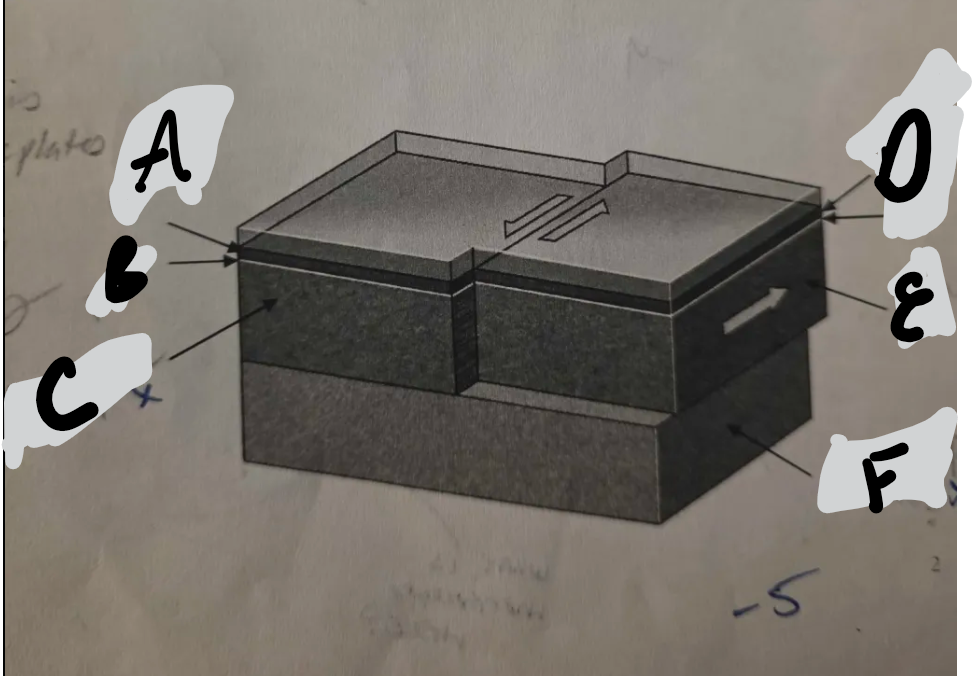
What kind of plate boundary is this? What is occuring here?
Trasform
Transform plate boundaries are formed when lithospheric plates slide past each other in opposite directions. This type of of plate boundary is known to experience frequent earthquakes
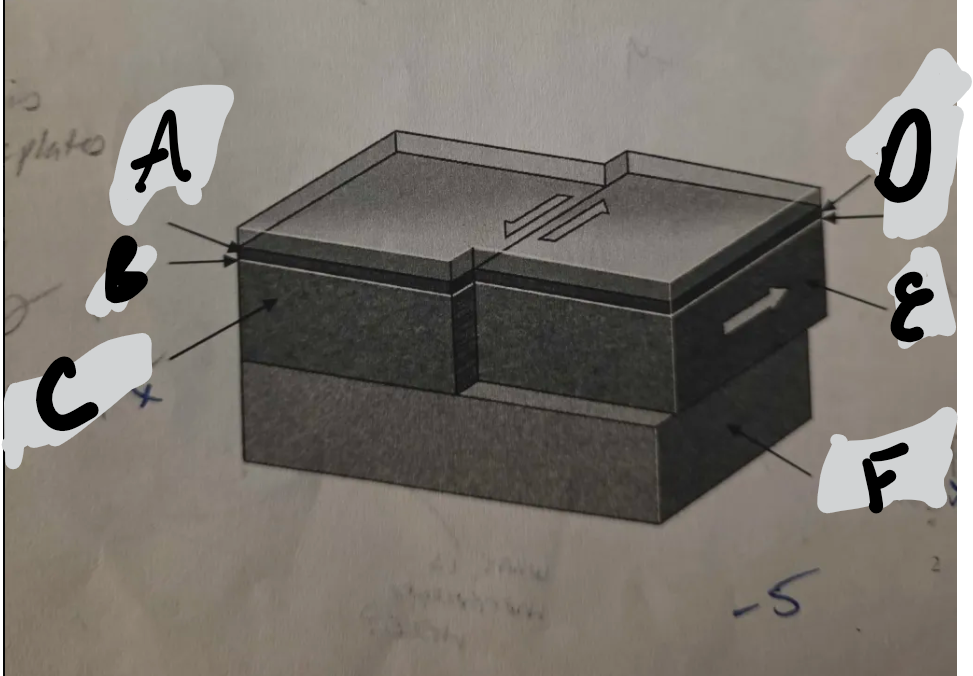
Label A, B and C
Oceanic Crust
Moho
Lithospheric mantle

Label D, E, and F
D- Oceanic crust (and moho below it)
E- Lithospheric mantle
F- asthenospheric mantle

What type of plate boundary is this? What is occuring
This is a convergent plate boundary.
Specifically, this is an ocean-ocean convergent plate boundary. It is fomred when two oceanic lithospheric plates collide. When collision occurs, the older, denser lithosphere subducts under the younger lithosphere. This relults in the formation of volcanic island arcs. The fuel for these comes from the melting of the subducting plate.

Label H, J, and I
H- asthenospheric crust
J- moho
I- lithospheric crust

Label B, C, D
B- volcanic island arc
C- Accretionary prism
D- Trench

Label E, F, G
E- oceanic crust
F-moho
G- lithospheric mantle
H-asthenospheric mantle
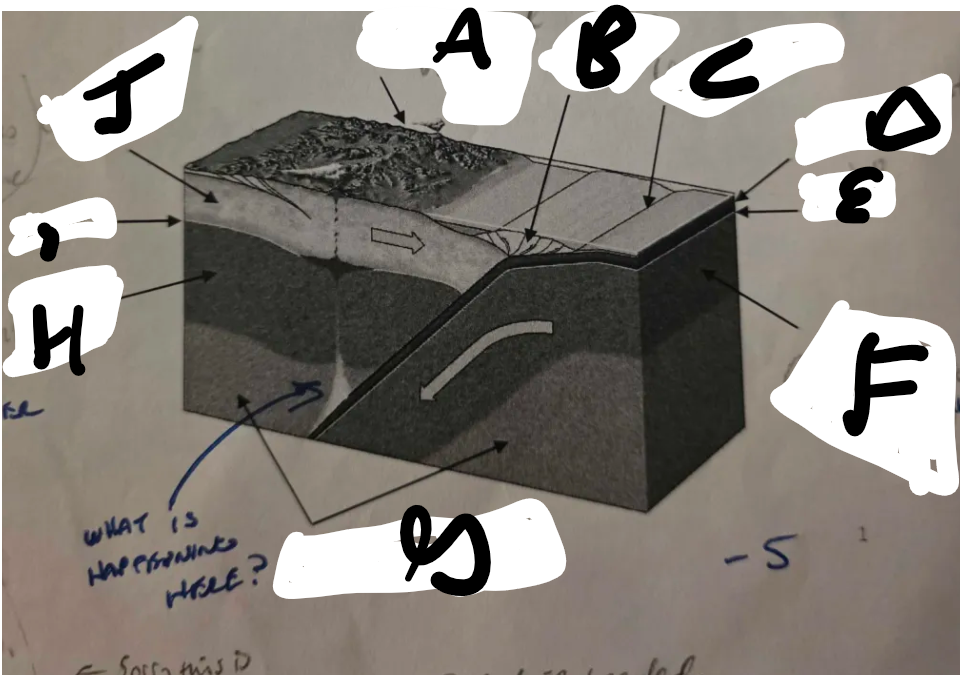
What type of plate boundary is this? Expalin what is occuring
This is a convergent plate boundary.
Specifically, this is an ocean-continent convergent boundary. This occurs when oceanic lithospheric plate and continental lithospheric plate collide. When this collision occurs, the oceanic lithospheric plate will always subduct because it is thinner and denser than the thick and lighter continental lithospheric crust. These plate boundaries form areas such as deep sea trenches and continental volcano arcs. Continental volcano arcs are red the subducting oceanic crust to keep going.

Label J,I.H, and G
J- continental crust
I- moho
H- lithospheric mantle
G- asthenospheric mantle
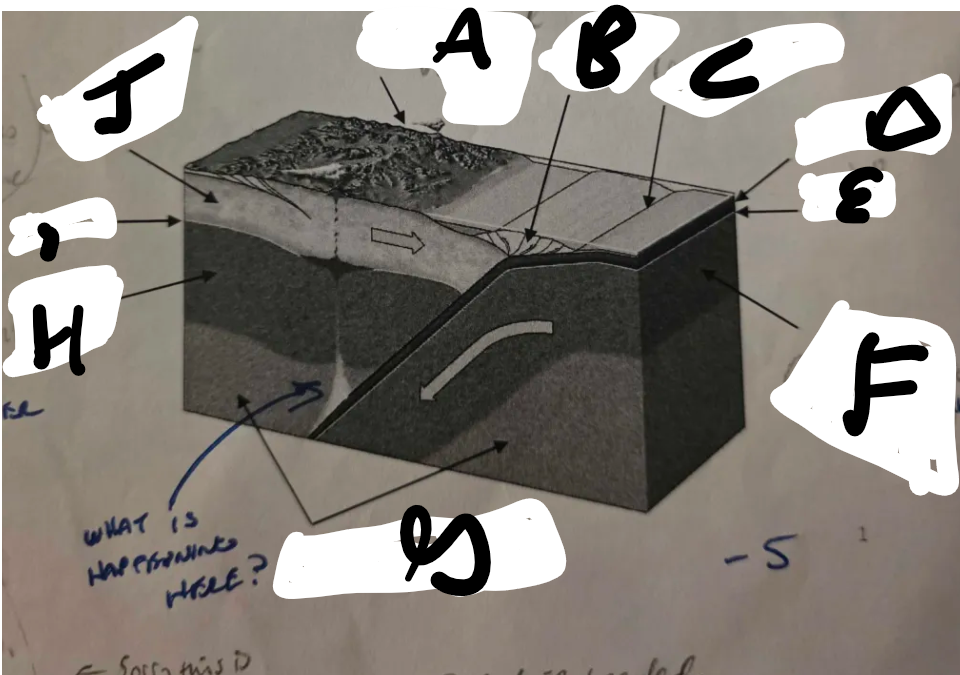
Label A, B. and C
A- continental volcano arc
B- Accretionary prism
C-Trench axis
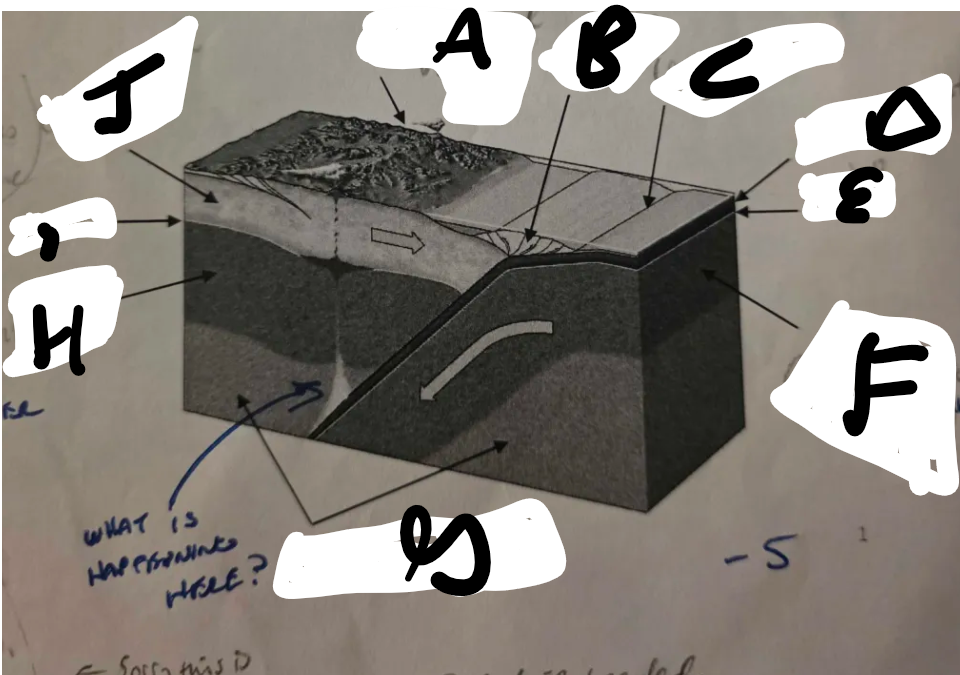
Label D, E, F
D- oceanic crust
E- moho
F- lithospheric mantle

What type of plate boundary is this? Explain how it is formed and features of it.
This is a divergent boundary. It occurs when two lithospheric plates are moving away from each other. This forms a plate boundary that leadsd to sea floor spreading and containtnal rifting due to the spreading apart of the plates. Hot magma from the aesthenospherer moves up and produces more sea floor as the plates move apart. This leads to sea floor spreading.

Label A, B, C,
A-oceanic crust
B- mid oceanic ridge axis
C-moho

Label D and E
D- lithospheric mantle
E- asthenospehric mantle