art history 1301 midterm
 Call Kai
 Learn
Learn Practice Test
 Spaced Repetition
 Match
Match Flashcards
 Knowt Play
1/29

There's no tags or description
Looks like no tags are added yet.
Name | Mastery | Learn | Test | Matching | Spaced | Call with Kai | Chat |
|---|
No analytics yet
Send a link to your students to track their progress
30 Terms
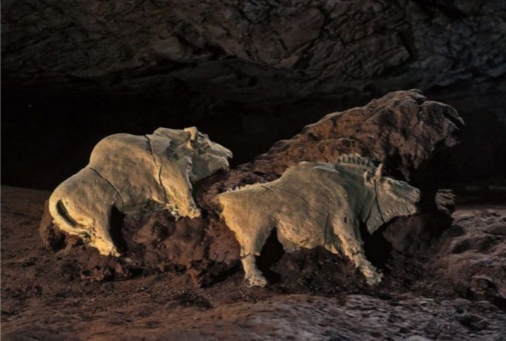
Bison relief in Tuc d’Audoubert
Culture: Paleolithic (13,000 - 15,000 BCE), Magdelenian period, France
Function and Composition: Made of unbaked clay, the sculpture depicts a bull positioned behind a cow as if to mate. It was moulded by hand and the details of heads and necks carved/incised using tools. It’s positioned deep inside a cave and was likely used for secret or restricted ceremonies relating to fertility or a hunting ritual.
Importance: Highlights the ancient connection between humans and animals in our survival and imagination.

Newgrange
Culture: Neolithic (Stone Age, around 3,200 BC), Ireland
Function and Composition: Made of loose river stones, soil, rock, and kerbstones (boulders), Newgrange was likely constructed as an ancient passage tomb and ceremonial temple. It housed cremated and physical remains of chosen individuals. The passage and chamber are precisely aligned with the rising sun on mornings around the Winter Solstice.
Importance: Cultural and religious significance, show of prehistoric engineering, one opening above the entrance lights up the central chamber on the dawn of winter solstice every year (possibly symbolizing rebirth and return of light in the darkest time of the year).

Tanum Rock
Culture: Nordic Bronze Age with some extending into the early Iron Age (1700 - 500 BCE), early Scandinavian farming and seafaring communities, Sweden
Function and Composition: The rock carvings depict the lives of people in the Bronze Age. Includes scenes of travel, seafaring, communal gatherings, status, warfare, and religion. Likely served as a practical tool of reference and record for spiritual, social, and cosmological happenings of ancient Scandinavian society.
Importance: Significant artistic achievement through skilful and detailed depictions of animals, humans, weapons, agriculture, and symbols of the Bronze Age. Highlights culture of the European Bronze Age.

Woman of Willendorf (Venus of Willendorf)
Culture: Upper Paleolithic (28,000 - 25,000 BCE), found near Austria but material originated from northern Italy
Function and Composition: A limestone figurine. Her exaggerated anatomy (rounded breasts, large abdomen, wide hips/thighs) and lack of a face, hands, eyes, or feet suggest that she could’ve been a fertility symbol. The features suggest the archetype or concept of womanhood rather than a specific individual.
Importance: Insight into abstract, symbolic, ritual, and spiritual framework of early humans. With modern perspectives of feminism, the figure could be a self-portrait of a woman looking down at herself during pregnancy.

Stag Hunt mural from Çatalhöyük
Culture: Neolithic (5750 BCE), Çatalhöyük, Turkey
Function and Composition: Mural on lime plaster using brushes and red ochre. Humans are not depicted as static or stick figures but instead are highly active; shows hunting with people holding weapons and running. Murals were permanent visual narratives for storytelling, hunting tactics, and community history.
Importance: Reflection of social structure; relationship with nature—in Paleolithic cave art, animals dominated, and humans were submissive outsiders. At Çatalhöyük, humans are shown clearly organizing, surrounding, and exercising dominance over the animal kingdom. It captures the exact era when humans transitioned from nomadic hunter-gatherers to settled farmers. (Nomad → settled farmer)

Ishtar Gate
Culture: Neo-Babylonian Empire (575 BCE), revival of Mesopotamian art, Iraq
Function and Composition: Constructed by the Neo-Babylonian Empire under King Nebuchadnezzar II. Made from mud bricks and cobalt (blue cobalt designed to imitate lapis lazuli). Defensive structure and propaganda—imposing height and radiant colors were supposed to awe foreign visitors, citizens, and enemies, projecting the divine favor and absolute power of King Nebuchadnezzar II. Has lions (Ishtar, goddess of war, fertility, and love), dragons (Marduk, chief national god of Babylon), and bulls (Adad, god of storms and rain). Dedicated to the goddess Ishtar, the gate reflected the empire’s wealth, cosmic religious devotion, and the absolute authority of the monarchy.
Importance: Beautiful piece of ancient engineering, carries an architectural legacy as one of the seven wonders of the world, and important historical documentation (cuneiform inscriptions containing details about Nebuchadnezzar).

Code of Hammurabi
Culture: Ancient Babylon (1750 BCE), Iraq
Function and Composition: Hammurabi was the most far-reaching leader of Mesopotamian history. What is interesting about the representation of Hammurabi on the legal code stele is that he is seen as receiving the laws from the god Shamash, who is seated, complete with thunderbolts coming from his shoulders. The emphasis here is Hammurabi’s role as pious theocrat, and that the laws themselves come from the god. Set up legal precedents and social order.
Importance: Established divine authority and justice, political propaganda, and creating fundamental concepts for future legal codes.


Standard of Ur
Culture: Sumeria (2,600 - 2,400 BCE)
Function and Composition: Rectangular-like box object made of shell, lapis lazuli, limestone, and bitumen that depicts the grandeur and violence of Sumerian kingship. One side, face up, depicts war and is divided into three registers (bands) that are meant to be read from bottom up, left to right. The opposite peace panel depicts the celebration of the king, this time for great agricultural abundance which is afforded by peace.
Importance: Detailed window into social structure, economy, and warfare of the time.

Square Temple Votive Figures (Standing Male Worshipper) (Tell Asmar)
Culture: Sumerian (2900 - 2350 BC), Eshunna (Modern-day Tel Asmar), Iraq
Function and Composition: All of the twelve statues appear deeply focused, staring straightforward, some with very large eyes, most with hands clasped, some holding cups. Of the twelve statues found, ten are male and two are female; eight of the figures are made from gypsum, two from limestone, and one (the smallest) from alabaster; all would have been painted. Not gods, but humans stood in perpetual worship of the god of the temple. Some of the statues are inscribed on the back or bottom with a personal name and prayer; others state “one who offers prayers.” These sculptures represent a very early form of individual actions of faith, expressions of personal agency.
Importance: Archaeologists believe that this group of sculptures representing mortals from Tell Asmar were not only working spiritually on behalf of each individual but also as a group, asserting a new status of elite non-religious classes within the context of the temple.

Great Ziggurat of Ur
Culture: Neo-Sumerian Mesopotamia (2100 BCE), Iraq
Function and Composition: Like a pyramid, a ziggurat is a sacred bridge between the earth and the heavens. It served as a theocratic center for the Sumerian moon god Nanna and the economic hub of the city. It established political legitimacy by demonstrating favor to the gods, projecting royal power, and unifying the state.
Importance: One of the best-preserved and most famous ziggurats of the Middle East, defined Mesopotamian identity.

Temple of Ramses II
Culture: Abu Simbel (13th century BCE), Egypt
Function and Composition: Dedicated to the sun gods Amun-Ra and Re-Horakhty, as well as Ptah (the god of craftsmen) and the deified Ramses II himself. Used as propaganda because of the sheer scale of the labor and architecture served to validate Ramses II's absolute authority and divine right to rule over both Egypt and subjugated regions. The inner sanctuary was engineered so that twice a year (around February 22 and October 22), the morning sun penetrates deep inside to illuminate the statues of the king and the gods.
Importance: Ancient legacy: It represents the architectural zenith of the New Kingdom and stands as a testament to Ramses the Great's obsession with immortality.

Portrait of Akhenaten, Nefertiti, and Children
Culture: Ancient Egypt (c. 1350 BCE), Amarna Period, Egypt
Function and Composition: During this period, there was a radical change in art due to the ruling of Akhanaten. He changes the religion from the worship of the god Amun to Aten, and makes him and his wife the only representatives of Aten on earth, and so he upsets the entire priesthood of Egypt by making him and his wife the only ones with access to this new god, Aten. This shift also represents the shift in style from the eternal, rigid perfection of traditional pharaonic art to a distinct, curvilinear style with elongated skulls, thin necks, slender arms, and swollen bellies. It’s realistic and almost informal, we have a sense of a couple in Akhenaten and Nefertiti.
Importance: The first major historical view of a pharaoh and queen engaging in affectionate acts rather than engaging in godlike aloofness. This period also marks the elevated status of women. Queen Nefertiti is shown on a scale and throne nearly equal to Akhenaten, highlighting her unprecedented political and religious partnership.
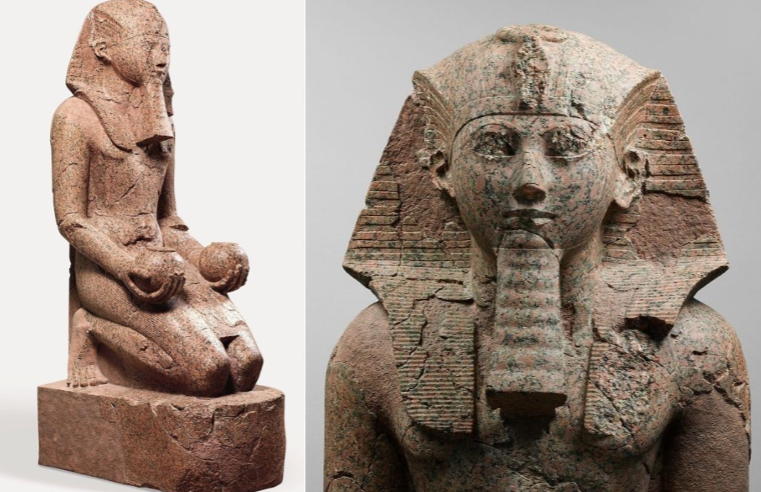
Hatshepsut Kneeling
Culture: Ancient Egypt, New Kingdom, (1473 - 1478 BCE), Egypt
Function and Composition: Pharaoh Hatshepsut adopted traditional male royal regalia—including the nemes headcloth, a ceremonial false beard, a broad-shouldered masculine torso, and a shendyt kilt—to present herself as the ideal, eternal Egyptian king rather than explicitly as a female ruler. While pharaohs were viewed as living gods who only knelt before higher deities, her kneeling posture uniquely highlights her dual role as a supreme monarch submitting humbly to Amun-Re. The sculpture bridged the gap between traditional expectations and a female pharaoh holding absolute power.
Importance: Visualizes political legitimacy, religious devotion, and political propaganda during the New Kingdom of Ancient Egypt.
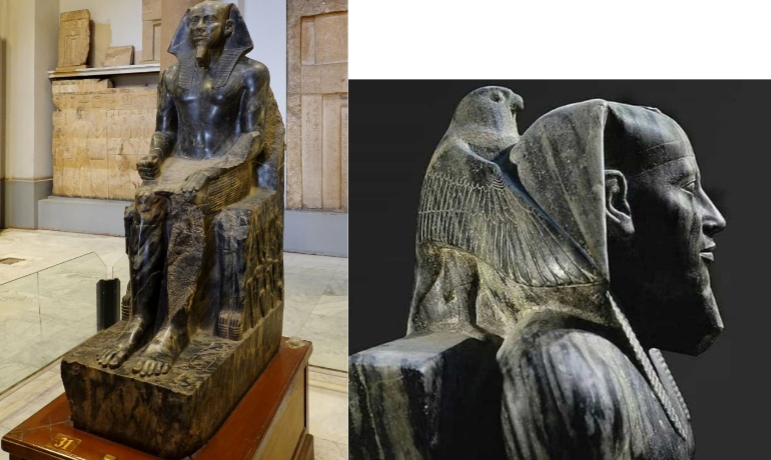
Khafre Enthroned
Culture: Ancient Egypt, Old Kingdom, (2550 BCE), Egypt
Function and Composition: Divine kingship—using an idealized, musclar body to show the pharaoh as a godlike superhuman rather than an ordinary mortal. As a vessel for the pharaoh’s life force after death, it was used for the mortuary ritual. The falcon-god Horus spreads his wings behind Khafre's head, showing the divine protection and direct link between the king and the gods.
Importance: Portrays the pharaoh Khafre as an eternal, divinely sanctioned ruler.

Lallibela
Culture: 13th century Ethiopian Orthodox
Function and Composition: A sacred medieval site featuring 11 monolithic rock-hewn churches carved top-down from volcanic rock in the 13th century. New Jerusalem: King Gebre Meskel Lalibela designed the complex to mirror the holy sites of Jerusalem so local Christians could make a spiritual pilgrimage at home.
Importance: Remains an active parish utilized daily by local clergy and worshippers.

Mask of Agamemnon
Culture: Mycenaean (1550 - 1500 BCE), Greece
Function and Composition: A gold funerary death mask. Dated before Agamemnon’s time, the name is a mislabel. Intended to honor the deceased, represent their physical likeness, and establish a tangible link between the dead and the spirit world. Served as a symbolic guard to help guide the soul and frighten away malevolent spirits.
Importance: Stands out among other flat death masks found at the site because it is three-dimensional, featuring intricate engraved and chased details.

Bull Leaping fresco from the palace of Knossos
Culture: Bronze Age (1,400 BCE), Minoan, Palace of Knossos in Crete, Greece
Function and Composition: (A fresco is a mural painting technique where water-based pigments are applied to freshly laid, wet lime plaster.) What we see is a freeze-frame of a very fast moving scene. The central image of the fresco as reconstructed is a bull charging with such force that its front and back legs are in midair. In front of the bull is a person grasping its horns, seemingly about to vault over it. The next person is in mid-vault, upside down, over the back of the bull, and the final person is facing the rear of the animal, arms out, apparently just having dismounted. There are both a female and male depicted, and the brown person in the center is probably a man. The meaning is likely that riding the bull was a rite of passage.
Importance: Represents Minoan vitality, acrobatics, and serves as an insight into Bronze Age rituals.

Dipylon Krater
Culture: Geometric period (760 - 730 BCE), Athens, Greece
Function and Composition: Aristocratic Athenian society that used large-scale, expensive material investments to display family wealth, status, and civic standing. Kraters marked elite male graves with open bottoms that allowed mourning families to pour liquid offerings like wine, water, and oil into the earth for the deceased.
Importance: Marks the critical reintroduction of human and animal figural shapes into Greek art after the abstract dark ages following the Bronze Age collapse.

Gnosis Stag Hunt mosaic
Culture: Macedonia (300 BC), Hellenistic Greek Culture period during Alexander the Great
Function and Composition: The composition depicts two heroic hunters attacking a stag alongside a hunting dog. The hunter on the right is widely identified as Alexander the Great due to his distinct upswept hair. The companion on the left wielding a double-headed axe is believed to be his general and close companion, Hephaestion. Used as a decorative floor covering for a formal dining room of a wealthy home.
Importance: It is the first signed mosaic in history. Instead of using cut tiles, the “painterly” quality is achieved using natural pebbles. It serves as a stylistic bridge demonstrating how ancient Greek mosaicists began imitating panel paintings on floors, paving the way for the complex floor mosaics of the later Roman and Byzantine eras.

Riace Bronzes
Culture: Classical Greek, 5th century BC (the “Young” cast around 460 BC and the old cast around (430 BC), Greece
Function and Composition: Captures the definitive shift from the rigid, stiff forms of the Archaic period to the dynamic realism of the Classical era. They were originally outfitted with heavy military attributes, holding bronze shields in their left arms, spears or swords in their right hands, and wearing helmets. They were almost certainly part of a larger multi-figure monument erected in a public sanctuary (such as Delphi or Olympia) to celebrate a military victory or honor mythological founding heroes.
Importance: Textbook examples of contrapposto, Greek bronze statues are extremely rare

Sarcophagus of the Spouses
Culture: Etruscan (520 BCE),
Function and Composition: A terracotta sarcophagus with a couple of top. It’s likely a banqueting scene, with the couple reclining together while eating and drinking (mixed gender banquets were different from other Mediterranean cultures, especially the Greeks). This cultural custom generated some resentment—even animus—on the part of Greek and Latin authors in antiquity who saw this Etruscan practice not just as different, but took it as offensive behavior. Women enjoyed a different and more privileged status in Etruscan society than did their Greek and Roman counterparts. While we cannot identify the original owner of the sarcophagus, it is clear that the person(s) commissioning it would have been a member of the Caeretan elite.
Importance: A masterwork of terracotta sculpture. The Sarcophagus of the Spouses conveys a great deal of information about Etruscan culture and its customs.The lively, friendly theme of the sarcophagus reflects the funeral customs of Etruscan society and the elite nature of the object itself provides important information about the ways in which funerary custom could reinforce the identity and standing of aristocrats among the community of the living.

Dancers and Diners fresco
Culture:
Function and Composition: One of the most celebrated motifs of ancient Mediterranean wall art. These cultures viewed the afterlife as a joyous, celebratory continuation of earthly pleasures. These frescoes were not meant for public viewing; they were painted using the permanent buon fresco technique directly onto the wet plaster walls of sealed, underground tomb chambers.
Importance: Because very little written literature from civilizations like the Etruscans survives, these frescoes serve as a vital visual archive. They document ancient clothing, hairstyles, gender roles (showing men and women socializing dynamically together), musical instruments (like the aulos and lyre), and domestic pets.

Patrician Carrying Portrait Busts of Ancestors
Culture: 1st Century CE, late Roman Republic to the early Empire
Function and Composition: Serves as a lasting stone or marble translation of ephemeral wax masks, proving the family's ancient roots and civic nobility. Reflects the elite Roman aristocracy (patricians) who held exclusive political rights, high offices, and historical prestige. Uses the hyper-realistic style of verism (exaggerating facial lines, sagging skin, and wrinkles) to signal maturity, wisdom (sapientia), seriousness (gravitas), and unyielding public duty (virtus)
Importance: Demonstrates how Roman art broke away from Greek idealism by celebrating individual facial features, age, and biological distinctness.

Ruins of Pompeii
Culture: founded in the 7th-6th century BC and buried by the eruption of Mount Vesuvius in 79 AD.
Function and Composition: By the 1st century AD, it operated as a flourishing Roman resort and market town adorned with frescoes, mosaics, temples, and fine villas. Social life was centered around public baths, theaters, gladiatorial games in the amphitheater, and family shrines. Served as a busy coastal trading port exporting wine, olive oil, and fish sauce (garum) across the Mediterranean region. Functioned as a local urban hub with a central Forum used for law, commerce, and the worship of Roman and foreign deities like Apollo and Isis.
Importance: Offers a preserved look at everyday urban, social, economic, and religious life in the Roman Empire.

Column of Trajan
Culture: Roman (completed 113 AD)
Function and Composition: The 650-foot continuous spiral frieze wraps around the shaft 23 times, detailing 155 scenes from the Dacian Wars (101–102 and 105–106 AD) to broadcast Roman military might and organizational discipline.
Importance: Designed to resemble an unrolled giant papyrus scroll, it taught an largely illiterate public about imperial legitimacy, engineering prowess, and the Pax Romana. Using luminous marmor Lunense (Carrara marble) physically manifested the eternal, unyielding power of the Roman Empire. In the 16th century, Pope Sixtus V placed a bronze statue of Saint Peter atop the column where Trajan's statue once stood, transforming a pagan symbol of conquest into a cornerstone of Christian Rome.

Tuscan Order
Simplest and plainest roman order featuring a smooth, unfluted shaft and a basic capital and base. It stands about 7 column diameters high. (Example: St. Peter’s Square Basillica)

Doric Order
The oldest and most sturdy Greek order, known for a heavy, stocky column with a plain round capital and a fluted shaft (though Roman versions added a base). It stands about 7 to 8 diameters high. (Example: Parthenon)

Ionic Order
A more graceful Greek style distinguished by twin scroll-shaped ornaments called volutes on its capital and a slender, fluted shaft. It stands about 8 to 9 diameters high. (Example: Temple of Athena Nike)

Corinthian Order
The most ornate and slender order, recognizable by its bell-shaped capital decorated with carved acanthus leaves. It stands about 9 to 10 diameters high. (Example: Temple of Zeus)

Composite Order
A late Roman hybrid order that combines the large corner volutes of the Ionic style with the acanthus leaves of the Corinthian style. It shares the tall, slender proportions of the Corinthian order at about 10 diameters high. (Example: Arch of Titus)