Unit Processes - Particle size reduction and Size separation
 Call Kai
 Learn
 Practice Test
 Spaced Repetition
 Match
 Flashcards
 Knowt Play
1/31

There's no tags or description
Looks like no tags are added yet.
32 Terms
What are some of the processes required for the production of solid dosage forms?
Particle size reduction and size separation
Mixing
Granulation
Drying
Reasons for reducing particle size
Essential for manufacturing process
Controls properties of final products
Pharmaceutical formulation includes API, excipients
Good mix-homogeneous distribution
Uniformity of content, dissolution rate, etc
Flow properties
Initial powder size:
Could be larger than pharmaceutical requirements
Aggregates - flow properties
Why is particle size reduction important in pharmaceutical manufacturing?
Increase surface area
Improve dissolution rate
Improve drug absorption and bioavailability
Improve mixing and content uniformity
Improve powder flow in some formulations
Produce particles of a suitable size for the dosage form
Improve extraction of active ingredients
Make powders easier to process and handle
Aims of particle size reduction
Reducing particle size can:
Improve mixing
Size distribution
Increase the total surface area, flow properties and dissolution rate
The quality and stability of some formulations i.e. suspensions is affected by particle sizes
The impact of particle size on organoleptic properties is clearer with semi-solids such as pastes
Size reduction also affects the distribution of sizes of the powdered material

How does particle size affect dissolution?
Smaller particles have a larger surface area exposed to the dissolution medium
Therefore:
↓ particle size → ↑ surface area → ↑ dissolution rate
This can be particularly important for poorly soluble drugs
How can particle size reduction affect drug absorption?
If dissolution is the rate-limiting step for absorption, reducing particle size can increase dissolution and therefore potentially increase the amount/rate of drug available for absorption
However, particle size reduction does not automatically increase bioavailability because absorption also depends on factors such as permeability and drug stability
How can particle size affect powder flow?
Very fine particles often have poorer flow because their high surface area increases:
Interparticle attraction
Cohesion
Electrostatic forces
Therefore, very small particles can form aggregates and resist movement
What other powder properties are affected by particle size?
Bulk and tapped density
Flowability
Compressibility
Cohesion
Dustiness
Electrostatic behaviour
Dissolution rate
Segregation
Uniformity of the final dosage form
Definitions - toughness & hardness
Toughness is the ability of a material to absorb the applied energy and deform without fracturing
Or toughness is the strength with which the material opposes rupture
Tough material (i.e. steel, iron) undergo plastic deformation and absorb a lot of energy before breaking
Brittle material (i.e. glass, ceramic) experience breakage easily - they have little elasticity and don’t stretch easily
Tough materials break through crack propagation
Tough materials are resistant to fracturing, measured by the amount of breaking energy they can withstand
Hardness = resistance to surface wear, scratches, cuts or permanent deformation
Mohs scale
A minerals hardness is a measure of its relative resistance to scratching, measured by scratching the mineral against another substance of known hardness on the Mohs Hardness Scale
Mohs scale is used to help identify minerals
Diamonds are at the top of the table while talc is at the bottom

Definitions - elasticity & plasticity
Elasticity is the property of a solid material that allows it to restore its shape after an external load is removed
Elastic materials that are subject to external stresses beyond the elastic limit, will not return to the original shape
Plasticity is the property of a solid substance that allows it to keep its deformed shape even when the external load is removed
Reversible vs irreversible deformation
No fracture in both
Ductile materials are easily stretched and clearly show plastic deformation under pressure
Brittle materials, experience little elastic or plastic deformation - they break through crack propagation rather than stretch
Elastic materials such as rubber, are extremely soft yet difficult to size-reduce

Influence of material properties
Size reduction of solid materials occurs by a process of crack propagation, whereby localised stresses produce strains in the particles that are large enough to cause bond rupture and thus propagate the crack
It is hard to break (reduce particle sizes) tough and hard materials
How about soft materials?
Materials such as rubber that are soft under ambient conditions, waxy substances such as stearic acid that soften when heated, and ‘sticky’ materials such as gums are capable of absorbing large amounts of energy through elastic and plastic deformation without crack initiation and propagation
These materials can be more easily size-reduced when temperatures are lowered below the glass transition point of the material
At these lower temperatures the material undergoes a transition from plastic to brittle behaviour, and crack propagation is facilitated
The glass transition point is the temperature at which a material change in properties - below this temperature, the material is brittle while above this temperature, the material is rubbery
What are the main mechanisms of particle size reduction?
Compression
Impact
Cutting
Combined impact and attrition
Many pharmaceutical mills use a combination of these mechanisms
What is compression as a size-reduction mechanism?
Compression involves applying a force that squeezes a particle until it fractures
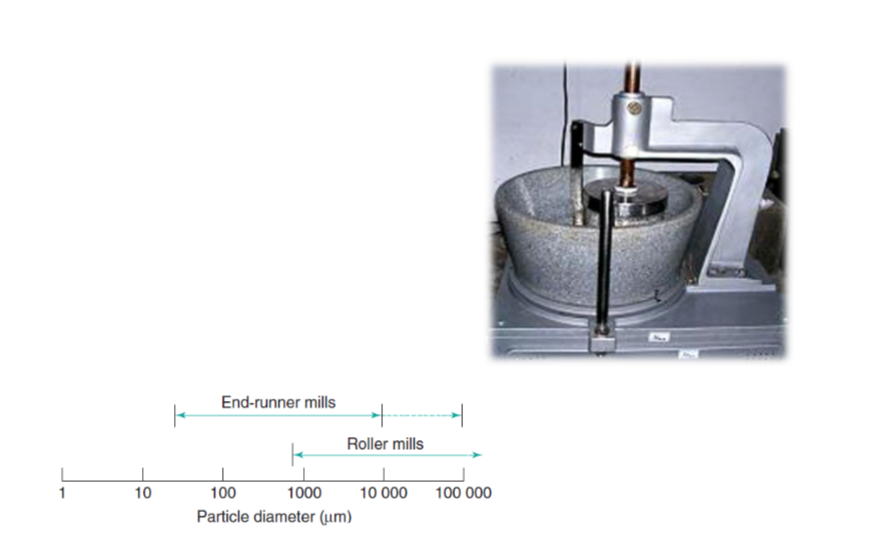
It is particularly useful for brittle materials e.g. Roller mill
Roller mills use 2 cylindrical rollers mounted horizontally and rotated about their long axes - the size reduction range is 1000-100000 microns

What is cutting as a size-reduction mechanism?
Cutting involves sharp blades or edges physically cutting particles into smaller pieces
It is particularly useful for soft, tough or fibrous materials e.g. Cutter mill
Particles are fractured between 2 sets of knives - a stationary set on the mill casing and a set attached to the rotor
The size reductions range is 500-50000 microns
There’s a risk of segregation

What size reduction method uses the end-runner mill?
Compression
Powder is compressed using a mortar and pestle
The size reduction range is 50 to 10000 microns
What is attrition as a size-reduction mechanism?
Attrition is size reduction caused by rubbing or friction between particles and/or surfaces
The particles are gradually worn down e.g. Ball mill
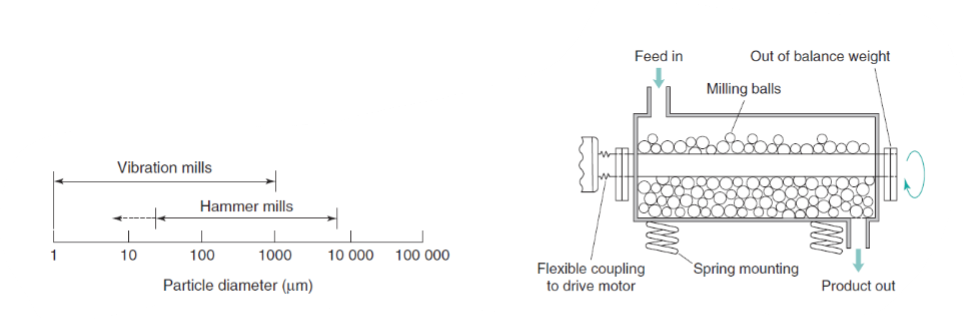
What is a hammer mill?
A hammer mill uses rapidly rotating hammers to break particles through impact
Material is fed into the mill and repeatedly struck until particles are small enough to pass through a screen
Size reduction range is 50 to 10000 microns

Advantages and limitations of the hammer mill
Advantages
Rapid
Suitable for many materials
Can produce relatively fine powders
Limitations:
Generates heat
Not ideal for heat-sensitive materials
Performance depends on material properties
What is a vibration mill?
Size reduction method: Impact
A cylinder filled to 80% with porcelain or stainless-steel balls. Particle size is reduced upon repeat impact driven by vibration of the whole body of the mill
The size reduction range is 1 to 1,000 micron
What is a ball mill?
A ball mill consists of a rotating chamber containing balls
Particle size reduction occurs mainly through impact and attrition as the balls collide with and rub against particles
Size reduction method: combined impact & attrition
Size reduction range is 1 to 100 microns
Tumbler, vibratory and planetary mills

What are the advantages and disadvantages of a ball mill?
Advantages:
Can produce fine particles
Useful for hard materials
Can be used for wet or dry milling
Disadvantages:
Relatively slow
Can generate heat
Equipment can be noisy
Possible contamination from the milling media
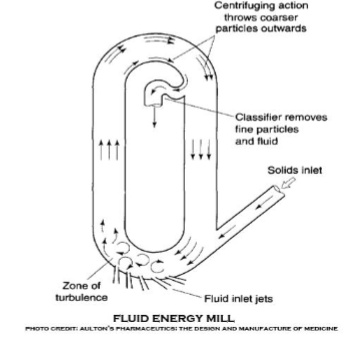
What is a fluid energy mill?
Size reduction method: combined impact and attrition
Air is injected at a high-pressure, creating turbulence which will lead particles to collide with other particles and with the wall of the mill
Size reduction range: 1-50000 microns
What is a pin mill?
Size reduction method: combined impact and attrition
A pin mill uses two discs containing pins, with one or both discs rotating at high speed
It can produce fine powders
Particle size reduction occurs mainly be impaction with the pins and by attrition between pins as the particles travel outwards under the influence of centrifugal force
Size reduction range: 10-10000 microns
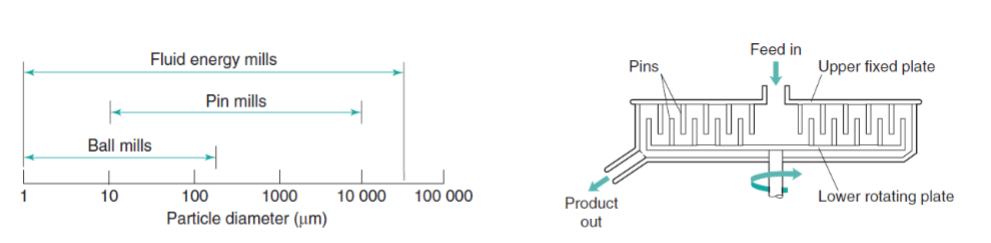
What factors determine which size-reduction method is selected?
Initial particle size
Required final particle size
Material hardness
Material toughness
Material brittleness
Moisture content
Heat sensitivity
Required particle-size distribution
Desired production scale
Risk of contamination
Whether wet or dry processing is required
Cost of the process
Table showing selection of size reduction mills according to particle properties and product size required

Why is heat sensitivity important during milling?
Milling can generate heat through friction and mechanical energy
Heat-sensitive substances may therefore:
Degrade
Melt
Lose potency
Why is moisture content important during drug milling?
Too much moisture can cause particles to:
Stick together
Become difficult to mill
Block screens
Form agglomerates
Why is particle-size separation performed?
Remove oversized particles
Obtain a desired particle-size range
Improve uniformity
Control powder properties
Ensure the material meets a specification
What factors affect sieving efficiency?
Particle size
Particle shape
Particle density
Moisture content
Screen aperture size
Duration of sieving
Vibration/agitation
Amount of material on the screen

Size separation by sedimentation
Separating particles based on the differences in settling velocities of particles with different diameters
The fluid is stationary and the separation of particles of various sizes depends solely on particle velocity
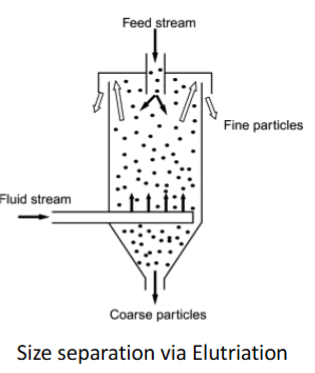
Size separation by elutriation
There is a fluid flow in the opposite direction to the sedimentation movement so that in gravitational elutriators particles move vertically downwards while the fluid travels vertically upwards