Test 2: Muscles of Facial Expressions & Tongue, Foramens, Sinuses
 Call Kai
 Learn
 Practice Test
 Spaced Repetition
 Match
 Flashcards
 Knowt Play
1/64

There's no tags or description
Looks like no tags are added yet.
65 Terms
Functions of Paranasal sinuses
lighten the weight of the skull
Resonate sound
Provide mucous
Mucous aids in:
moisturizer/tissue conditioner
Antibacterial/antifungal/antiviral
Clinical considerations of Paranasal Sinuses
visible on radiographs (maxillary)
Proximity of roots of posterior teeth
Sinus pain may be felt as dental pain
Sinus congestion → limit use of water and worsens when patient is reclined
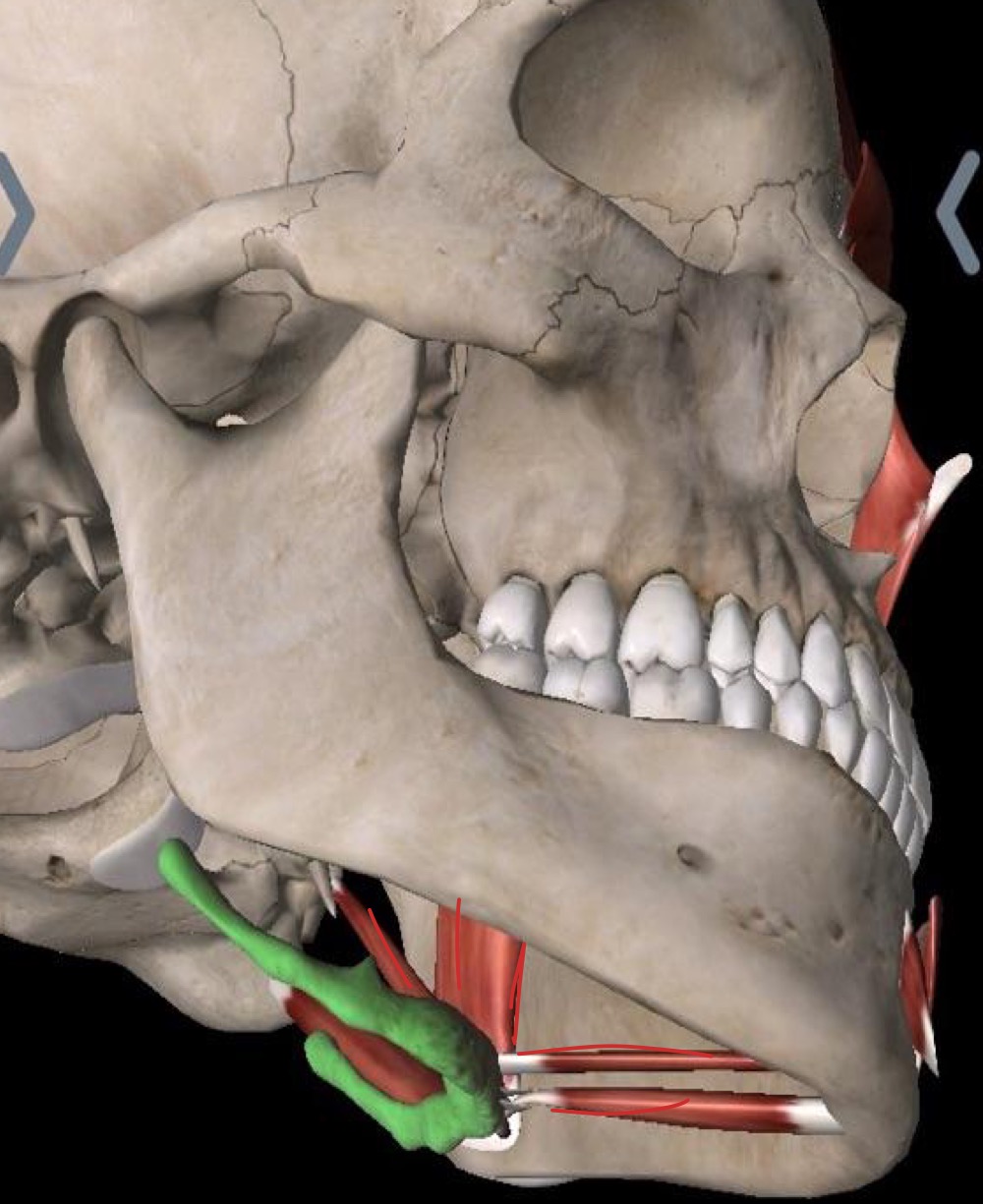
Hyoid bone

Infratemporal fossa

Boundaries
Superior - greater wing of sphenoid & temporal bone
Anterior - maxillary tuberosity
Lateral - medial surface of ramus
Medial - lateral surface of lateral pterygoid process

Pterygopalatine fossa
Infratemporal fossa is an important landmark bc ___
Many muscles, nerves, and blood vessels pass through this fossa
Pterygopalatine fossa is an important fossa bc ___
Contains numerous nerves, a ganglion, and blood vessels that supply the oral cavity
Pterygomaxillary fissure is the ___
“Door frame” between the Infratemporal fossa & Pterygopalatine fossa

Pterygomaxillary fissure

Foramen lacerum junctions
sphenoid bone
Occipital bone
Temporal bone

Stylomastoid foramen
Carotid canal
Foramen lacerum
Jugular foramen

Foramen lacerum
Jugular foramen
Foramen rotundum
Ovale foramen
Spinosum foramen
Hypoglossal canal

Epicranial Muscle
Epicranial muscle has:
Two bellies:
frontal
Occipital

Frontalis muscle
O - tendon the scalp
I - skin of eyebrows & root of nose

Occitpitalis muscle
O - occipital bone & mastoid process
I - tendon of the scalp
Frontalis muscle function
Raises the eyebrows; surprised

Orbicularis Oculi
O - orbital rim, frontal bone, maxilla
I - skin at lateral canthi, encircle the eye
Orbicularis Oculi components:
orbital portion
Palpebral portion
Orbital portion of Orbicularis Oculi function:
forceful closure of the eye
Protect and moisten the eye
Palpebral portion of Orbicularis Oculi function:
within the eyelids
Gentle closure of blink

Orbital portion
Palpebral portion
Orbicularis oculi

Corrugator Supercilii
O - superorbital region of the frontal bone, superior to the medial canthus
I - skin under central portion of the eyebrows

orbicularis oris
O - none on the bone
O & I - skin and fascia of the lips
orbicularis oris functions:
closure, pursing of the lips
rolling lips inward in between the teeth
movement of lips during speech

Risorius muscle
O - fascia overlying the masseter muscle
I - skin at commissures
Risorius muscle function
extends commissures laterally → grimace

Buccinator muscle
O - Alveolar process of max & mand, pterygomandibular raphe/fold
I - labial commissures
Buccinator muscle functions:
facial expressions: pulls commissures laterally to function with other muscles in smiling
Mastication: compress cheeks to keep food on chewing surfaces of posterior teeth
Wind instruments/whistle; expel air to produce sound; trumpet muscle
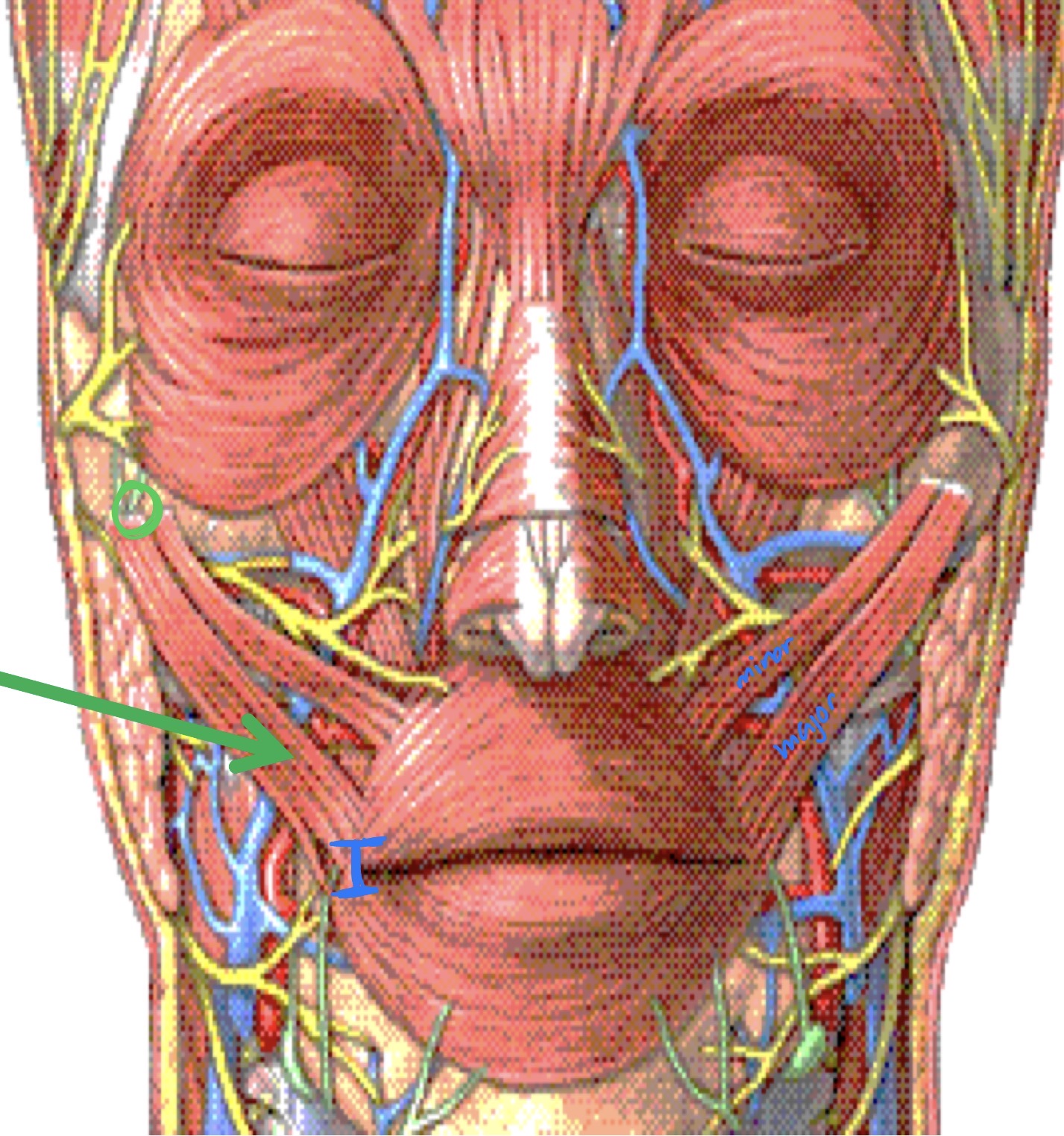
Zygomaticus major
O - zygoma
I - skin at commissures
Zygomaticus major function:
raises & pulls commissure laterally
functions with other muscles when smiling

zygomaticus minor
O - zygoma
I - skin of upper lip at max. canine area
zygomaticus minor function
elevation of the upper lip assist in smiling

Levator Labii superioris
O - inferior rim of orbit
I - skin of upper lip
Levator Labii superioris function
elevates upper lip

Levator Labii superioris alaeque nasi
O - frontal process of maxilla, near medial canthus
I - skin of the alae & upper lip below the alae
Levator Labii superioris alaeque nasi functions:
elevates upper lip
dilates the nostril
sneer

depressor anguli oris
O - inferior border of mandibule
I - skin at commissures
depressor anguli oris functions:
pulls commissures down
frown

depressor labii inferioris
O - inferior border of mandibule medial to depressor anguli oris
I - skin of lower lip, medial to nguli oris muscle
depressor labii inferioris function
pulls lower lip down, shows the lower teeth

mentalis
O - midline of anterior surface of man; mental fossa
I - skin of chin
mentalis function
raise chin, displacing lower lip down in pout

platysma
O - skin over clavicle and shoulder
I - orbicularis oris at commissures AND inferior border of mand
platysma function
tenses neck, pulls commissures down, grimace

intrinsic muscles of the tongue
vertical fibers
extend from dorsal to venal surfaces
transverse fibers
extend from the median setpum to right and left lateral borders; work with vertical fibers to make tongue long & narrow
superior & inferior longitudinal muscle fibers
extend from apex to base of tongue on dorsal/ventral surfaces
work together; shorten & thicken the tongue
work individually; curl the tongue down/upward
extrinsic muscles of the tongue
O - areas outside the tongue
I - within the tongue

styloglossus muscle
O - styloid process
I - tongue: lateral border of body to apex
styloglossus muscle function
retracts tongue up and back

hyoglossus
O - hyoid bone
I - lateral border tongue
hyoglossus function
depresses tongue toward floor of mouth

palatoglossus muscle
O - median palatine raphe
I - lateral border of tongue
palatoglossus muscle functions:
elevates tongue
pulls soft palate down during swallowing
forms palatoglossal arch

musculus uvulae
O - posterior border of hard palate
I - uvula
musculus uvulae function
close nasopharynx during swallowing
Corrugator Supercilii function
draw eyebrows down and together; frown

genioglossus muscle
O - genial tubercles
I - ventral surface of tongue from base to almost to apex
genioglossus muscle functions:
protrude tongue out of mouth
prevents tongue from dropping back and blocking the airway

Levator Anguli Oris
O - canine fossa of max; deep to zygomatic muscle
I - skin at commissures
Levator Anguli Oris function
pulls corner of mouth upwards during smiling