week two
 Call Kai
 Learn
 Practice Test
 Spaced Repetition
 Match
 Flashcards
 Knowt Play
1/33

There's no tags or description
Looks like no tags are added yet.
34 Terms
what are phonetics
The study of the physical properties of speech sounds, including how they are produced, transmitted, and perceived.
what is phonology
The study of how speech sounds are organised and used within a particular language, including the rules governing sound patterns.
what is morphology
The study of the structure of words and how smaller units of meaning (morphemes) combine to form words.
what are semantics
The study of meaning in language, including the meanings of words, phrases, and sentences.
what are pragmatics
The study of how language is interpreted in context, including implied meanings, intentions, and social rules of communication
what is a lemma
An abstract mental representation of a word that contains its meaning and grammatical properties, but not its sound form.
what is a lexeme
the basic unit of vocabulary representing a word and its variants. For example, run, runs, running, and ran belong to the same lexeme.
what is lexicalisation
The process by which a concept becomes represented by a specific word or expression in a language.
what is picture-word inference task
A language-production experiment in which participants name a picture while ignoring a distractor word. Researchers use it to investigate stages of word retrieval and speech production.
what are minimal pairs
Two words that differ by only one phoneme and have different meanings, such as bat and pat. Used to identify meaningful sound contrasts in a language.
what is an allophone
Different pronunciations of the same phoneme that do not change word meaning. For example, the /p/ in pin is pronounced differently from the /p/ in spin in English.
what is onomatopoeia
Words whose sounds imitate the sounds they represent, such as buzz, hiss, or bang.
how is language structured
phonetics - speech sounds
phonology - sound system
morphology - word formation
syntax - sentence structure
semantics - meaning
pragmatics - language context
what are the types of phonetics
Articulatory: how sounds are produced
Auditory: how they are perceived
Acoustic: physical properties of sound
what are the types of phonology
Phones: the inventory of phonetic segments that occur in your language; the instantiations (physical
characteristics) of a phoneme
Phonemes: the sounds in your language that can distinguish between words
Uses minimal pairs to determine the phonemes of a language
Languages differ in which phones they choose to use as phonemes
Allophones: different realisation of same phoneme
how are spoken words produced
conceptualisation (preverbal) - what to express by message planning, language is neutral
formulation - how to express it
lexicalisation
Two stage retrieval process
Meaning -> lemma + form -> lexeme
2 different word substitution errors
Semantic and phonological
Syntactic planning
Phonological encoding
Phonetic planning
Uses word selection (lemmas) and sound processing (lexemes)
articulation - expressing it using pronunciation
self-monitoring - internal (what you’re going to say), external (during speech)
what is the self monitoring model

what evidence is used to support the self-monitoring model
speech errors
tip of the tongue
picture naming
picture word interference
what are speech errors
unintentional deviations from what a speaker intends to say
Automatic
Less attention to speech production than comprehension
1-2 errors for every 1000 words
Errors do not occur at random
involve units that can be considered to correspond to whole words or individual speech sounds
what are the types of speech errors
Shift: an exchange of one element to a different place (decide to hits it → decides to hit it)
Exchange: an exchange of two elements to different places (model renosed → nose remodelled)
Anticipation: already knowing upcoming sounds and so saying it (bake my bike → take my bike)
Perseveration: saying previous sounds (pulled a pantrum → pulled a tantrum)
Addition: adding an element (didn’t explain this carefully enough)
Deletion: dropping an element (muttered intelligibly → muttered unintelligibly)
Substitution: word is substituted by a word that is not in the same sentence/context (it’s too light → too heavy)
semantically related word substitution
phonologically related word substitution
morpheme substitution
sound substitution
Blend: two words are activated and related to each other, and so are combined together (he is cable → he is stable/calm)
what do processes do speech errors indicate
word retrieval
construction of syntactic frames
what is the difference between word and speech errors
Word errors: not restricted by distance and always of the same type
Sound errors: close together and can cross word type, happens later
what is Garrett’s model of speech production
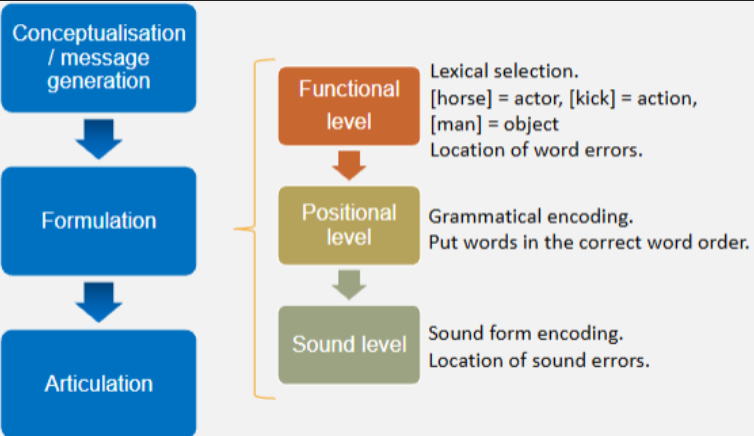
what is tip of the tongue
when phonologically related words get activated along side partial information
initial sounds
numbers of syllables
correct stress pattern
how does tip of the tongue provide evidence for the 2-stage model of lexicalisation
Completed first stage but can't completed second → retrieval of meaning is independent of its sound
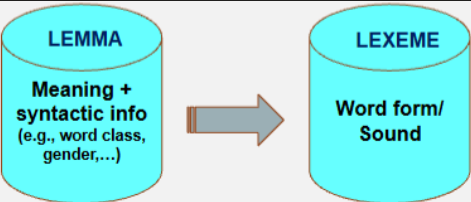
what theories does the tip of the tongue provide
blocking hypothesis (Jones and Langford) - interlopers prevent activation of the right word
Transmission-deficit hypothesis - due to weak links between the meaning and the word form, only limited activation of the target word forms
how does tip of the tongue evidence favour the transmission deficit account

what is picture naming
Part 1 - generation
Part 2 - picture naming
Results in
Long-term facilitation for naming lasting over trials
Homophone priming does not persist
No facilitation across languages
what is picture word interference
Naming a picture as quickly as possible whilst ignoring distractor words
If words are semantically related -> slower than control group
If words are phonologically related -> faster than control group
what is lexicalisation
the cognitive process of converting an underlying non-verbal concept, thought, or intention into a specific word or lexical form during speech production
what does lexicalisation involve
Discrete (step by step)
Semantic -> phonological
First a single item is selected based on semantic information, then phonological form is revealed
Interactive (activation flows between)
Cascading process (Levelt et al) - mediated priming
Early inhibitory priming of semantic -> at lemma level
Late priming of phonological -> at lexeme level
No priming of goal -> evidence against cascading/feedback
Feedback activation
Errors are not random
Lexical bias: sound-level speech errors result in words more often than by chance
Similarity effects: mixed substitution errors (both semantically and phonologically related to target) more than chance
Use output monitor rather than feedback

what factors does the duration of reading depend on
Frequency
Morphology
Phonology
Use subvocalization (inner speech)
Predictability
Reading skill