ICF Model
 Call Kai
 Learn
Learn Practice Test
 Spaced Repetition
 Match
Match Flashcards
 Knowt Play
1/18

There's no tags or description
Looks like no tags are added yet.
Name | Mastery | Learn | Test | Matching | Spaced | Call with Kai | Chat |
|---|
No analytics yet
Send a link to your students to track their progress
19 Terms
what is the ICF model?
-Framework for organizing and describing information on functioning and disability
-Approved by the WHO (World Health Organization) in 2001
-Classification system the serves various disciplines and sectors (Not only PT)
4 underlying principles: list
•Universality
•Parity and Aetiologic Neutrality
•Neutrality
•Environmental Influences
neutrality
•Definitions are labeled in a neutral language whenever possible
•Allows the recording of both the positive and negative impacts of functioning and disability
environmental influences
-Model recognizes the important role environment plays in functioning and disability
-Physical Factors: Climate, terrain, design, distance
-Social Factors: Attitudes, institutions, and laws
universality
•Applicable to all people irrespective of health conditions, physical, social, and cultural contexts
•Anyone can experience a disability
•Not designed to label those with disabilities as a separate social group
parity and etiologic neutrality
•No distinction made between “physical” and “mental” health conditions
•Shifts focus from health condition to functioning
•Cannot infer participation in daily life from diagnosis alone
functioning vs disability
-functioning=what body can do; disability=negative aspects
Functioning
•Body functions, structures, activities and participation
•Positive or neutral aspects of the interaction between a person’s health condition and their contextual factors (environmental and personal factors)
Disability
•Impairments, activity limitations and participation restrictions
•Negative aspects of the person’s health condition and their contextual factors (environmental and personal factors)
health condition=
Dx (working diagnosis)
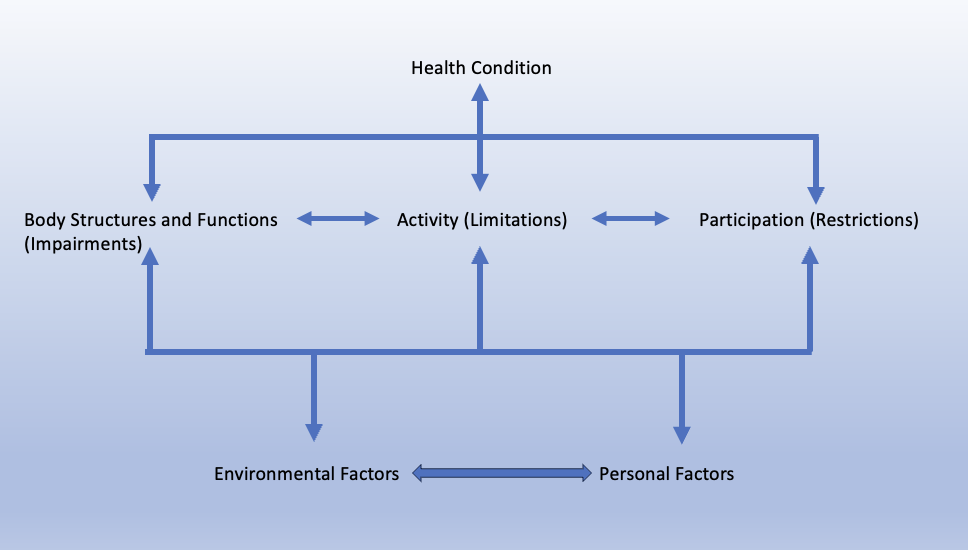
body functions and structures
-Body Functions: physiological functions of body systems (includes psychological functions)
-Body Structures: anatomical parts of the body (organs, limbs, etc)
-Impairment: problems in body functions or structures such as a significant deviation or loss
-Examples:
•Pain in the right knee (“measure” at 4/10)
•Weakness in the elbow flexors (measured at 10# of force)
•Decreased single leg balance (11 seconds on the right leg)
•Decreased range of motion (left ankle DF -10 degrees)

activity (limitations)
-Activity: the execution of a task or action by an individual
-Activity Limitation: Difficulties and individual may have in executing an activity
-Examples: impairment > activity limitation
•Pain in the right knee → Ascending/descending stairs
•Weakness in the elbow flexors → Carrying laundry basket
•Decreased single leg balance → Walking on a balance beam
•Decreased range of motion in ankle → Squatting to pick up a crate
participations (restrictions)
-Participation: Involvement in a life situation
-Participation Restriction – Problems an individual may experience being involved in life situations

ICF Components and Domains: body functions vs body structures
Body Functions
•Mental functions
•Sensory functions and pain
•Voice and speech
•Neuromusculoskeletal and movement-related functions
•Others
Body Structures
•Structure of the nervous system
•Structure of the cardiovascular, immunologic, and respiratory systems
•Structures of the genitourinary and reproductive systems
•Others
ICF Components and Domains: activity limiations vs participations
the “why”
-activity limiation:
•General tasks/demands
•Mobility
•Self-care
-participation:
•Interpersonal interactions and relationships
•Community services, groups
•Participation and role in the bigger picture
ICF Components and Domains: Environmental factors
“prognosis”
•Products and technology
•Home environment
•Natural environment and human-made changes to environment (pollution)
•Services, systems, and policies
•External components
types of personal facotrs
“prognsis”
-age
-gender
-family
-occupation
-genetics
how utilize ICF model as PT
-Identify impairments, activity limitations and participation restrictions
•Can be measured (range of motion, strength, balance, etc)
•Can be observed (bed mobility, transfers, lifting objects, etc)
•Can be reported by the patient (pain, can’t go to work, can’t go to gym class in school, etc)
-Evaluate the environment where the patient is functioning
-Document findings for other professions (and the patient) to utilize as needed
-Identify areas to address
•Can the impairments be improved?
•Complete spinal cord injury (LE weakness) vs. Lumbar radiculopathy (LE weakness)
•Can the environment be modified?
•Installing a wheelchair ramp vs. installing an elevator
connect impairments to ….
functinal limitatins (ADL’s)
connect limitations to….
participation/restrictions
-their identity in a greater context; how they interact with the world/community
you should be able to measure…
impairments!
-ex: strength, ROM, coordination, balance, pain