Cell Biology Exam 2 | Session 12 +13
 Call Kai
 Learn
Learn Practice Test
 Spaced Repetition
 Match
Match Flashcards
 Knowt Play
1/33

There's no tags or description
Looks like no tags are added yet.
Name | Mastery | Learn | Test | Matching | Spaced | Call with Kai | Chat |
|---|
No analytics yet
Send a link to your students to track their progress
34 Terms
Muscle cells express ____ gene(s) but not the ____ gene(s)
Neurons express _____ gene(s) but not the _____ gene(s)
Muscle myosin gene, GPCR genes
GPCR genes, muscle myosin
how is gene expression often controlled through (dna itself)
open/closed chromatin
what amino acid does kinases/phosphatases usually target (3)
Ser, Thr or Tyr
What is RTK and what is special abt it
receptor tyrosine kinase, special bc rtk acts as a kinase but also a receptor
How do all types of RTKs activate
dimerization
How does RTK dimerization work? make sure the specify which part of
ligand binds to ligand-binding region on each RTK (exterior)
The RTKs dimerize and associate w each other
Dimerization causes the activation loops (inside cytosol) to be phosphorylated
Phorsphorylation of one loop causes additional tyrosine residues to be phosphorylated
What is trans-P
when the dimerized RTK’s activate/phosphorylate each others protein tyrosine kinases
why are more tyrosine residues activated
they become binding sites for downstream components of the pathway
What is negative regulation in RTK signal
PTP dephosphorylates tyrosine residues
How is RTK degraded/recycled
RTK uses early and late endosomes to be sent for degradation in lysosome
What is the difference in degradation of ligand bound rtk vs non-igand bound in terms of speed
ligand bound rtk is slower to recycle/degrade and unbpind receptors tend to recycle faster
What is the difference in degradation of ligand bound rtk vs non-igand bound in terms of vesucke
ligand bound - clathrin-mediated endocytosis
nonligand bound - regular vesicles
what is a common domain that proteins have that allow them to bind to RTK kinases (RTK-P)
SH2 domain
what domain in RTK does Sh2 domains bind to
SRC
what is an example of a ligand that uses RTK signaling
FGF (fibroblast growth factor)
What is GRB2
complex of SH2 and Sh3
After FGF binds to the RTKs what happens (3)
GRB2 binds to the phosphorylated SRC domain
SOS binds to CRB2
Sos promotes dissociation of GDP from Ras and GTP binds and Ras dissociates from Sos
After Ras is activated, go through the steps of the pathway (4)
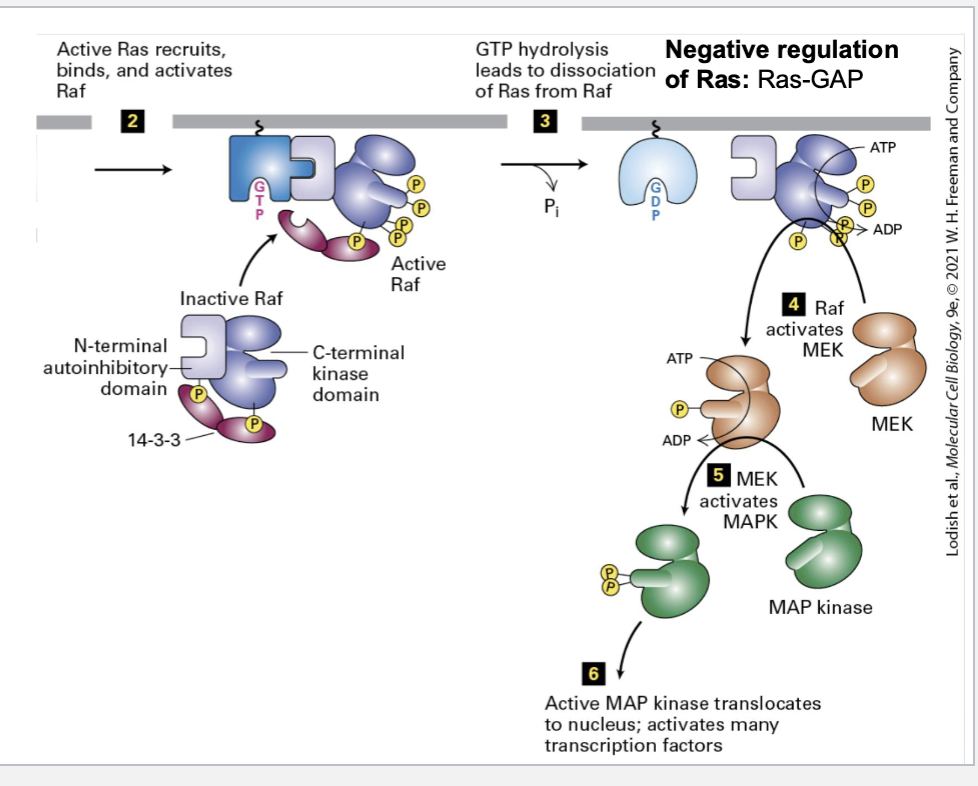
Active Ras recruits and binds to and activates Raf (Raf is phosphorylated, not necessarily through Ras)
GTP hydolysis leadds to Ras (GTP —> GDP) and dissociation from Raf
Raf looses its 14-3-3 binding and activates MEK (Phosphoyrlation)
MEK (kinase) activates MAPK (phosphorylation)
What does MAPK do? (general)
goes to nucleus and activates many transcription factors
what is the example of how MapK activates transcription (done in two steps)
MapK phosphorylates TCF transcription factor
MapK phosphorylates p90 which then phosphorylates SRF factor
what type of protein is ras
monomeric g-protein
What does a Monomeric G-protein need to be activated into its GTP state
GEF proteinWh
In the FGF growth factor pathway with RTK what acts as the GEF
Sos protein
What are two ways that a Ras protein can be made to be constitutively active (2)
Overall hydrolysis of GTP needs to not happen
mutation in Ras and GAP binding (GAP is the one helping with hydrolysis)
Mutation that changes the inactivity of Ras so that even though it binds to GAP —> no hydrolysis
what is wnt signaling used for (4)
bone development, musculoskeletal system, skin/hair, stem cell
how is the Wnt signal modified and how is its structrue maintained through
lipid modified
structrue is maintained through 10+ disulfide bonds
What is the main receptor that we discussed that is associated with Wnt signal and what kind of receptor is it
frizzled, type of GPCR
What makes frizzled different than typical gpcrs
dont interact with heterotrimeric g-proteins
In canonical Wnt signaling what is the role of frizzled and LRP
once wnt binds to frizzled, lrp also binds to Fzd
How do the following proteins work to create B-catenin destruction complex:
Axin
APC
CK1 and GSK3B
BTrCP
Axin and APC bind to eachother
Axin binds to ser-thr kinases (Ck1 and Gsk3B)
Phosphorylated B-catenin is bound by BTrCp and ubiquinated
How does B-catenin bind to the destruction complex (2)
binds to Axin/APC and is phosphorylated by the CK1 and GSK3B
BTrCP binds to phosphorylated B-catenin and ubiquinates it
What does ubiquitation of B-catenin do to it
sends it to be degraded in protosome
when is B-catenin degraded
no wnt signal
what happens to the destruction complex + B-catenin when there is a wnt signal
wnt binds to fzd and fzd binds to DVL
CK1and GSK3B phosphorylates LRP (coreceptor)
B-catenin is able to go to nucleus where it activates transcription factors (TCF/LEF1)