Lecture 7 - DNA & RNA Structures
 Call Kai
 Learn
Learn Practice Test
 Spaced Repetition
 Match
Match Flashcards
 Knowt Play
1/104

There's no tags or description
Looks like no tags are added yet.
Name | Mastery | Learn | Test | Matching | Spaced | Call with Kai | Chat |
|---|
No analytics yet
Send a link to your students to track their progress
105 Terms
Molecular genetics
The scientific study of the structure and function of genes at the molecular level

Central dogma
An explanation of the flow of genetic information within a biological system
first stated by Francis Crick

Central dogma (1970 restatement in Nature)
Deals with the detailed residue-to-residue transfer of sequential information
states that such information cannot be transferred back from protein to either protein or nucleic acid

Flow of genetic information in the central dogma
DNA → (transcription) → RNA → (translation) → protein
DNA also copies itself by replication

Who proposed the DNA double helix model and when?
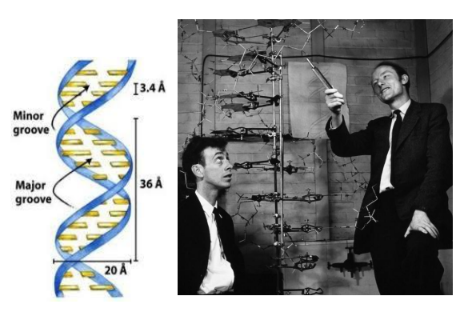
James Watson and Francis Crick in 1953

DNA feature 1
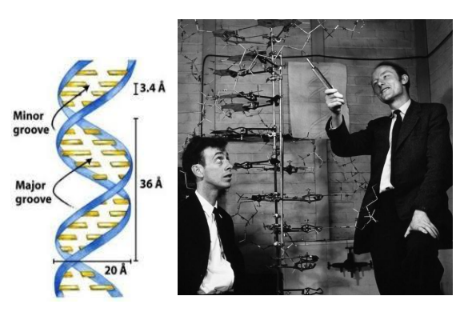
Two polynucleotide chains wound in a right-handed (clockwise) double helix
DNA feature 2
The nucleotide chains are anti-parallel: one runs 5' → 3', the other 3' → 5'

DNA feature 3
Sugar-phosphate backbones are on the outside of the double helix; the bases point toward the central axis
DNA feature 4
Complementary base pairs from opposite strands are held together by weak hydrogen bonds: A pairs with T (2 H-bonds), G pairs with C (3 H-bonds)

DNA feature 5
Base pairs are 3.4 Å apart
one complete turn of the helix is 36 Å (about 10 bases per turn)

DNA feature 6
The sugar-phosphate backbones are not equally spaced, creating major and minor grooves
Four famous experiments in the search for genetic material
Griffith's transformation experiment, Avery's DNA experiment, Hershey-Chase bacteriophage experiment, tobacco mosaic virus (TMV) experiment
Griffith's transformation experiment
Discovered the "transformation principle"
Avery's DNA experiment
Showed that DNA (not RNA) is the genetic material
Hershey-Chase bacteriophage experiment
Showed that DNA (not protein) is the genetic material
Tobacco mosaic virus (TMV) experiment
Showed that RNA can be a genetic material
Chargaff's Rule 1
The amount of adenine approximately equals thymine, and the amount of guanine approximately equals cytosine (so purines = pyrimidines)
Chargaff's Rule 2
The composition of DNA varies from one species to another
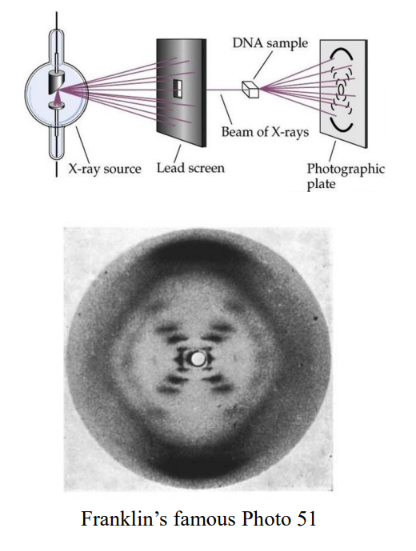
Rosalind Franklin
Worked with Maurice Wilkins at King's College London
used X-ray diffraction to study DNA fibers and made major advances in X-ray diffraction of DNA (1920-1958)

How is an X-ray diffraction pattern used?
It is interpreted using mathematical theory, which can reveal the structure of the molecule

Three DNA features suggested by Franklin's diffraction pattern
1) Helical
2) More than one strand
3) 10 base pairs per complete turn
Nucleotide
The unit (building block) of DNA
Three components of a DNA nucleotide
1) Deoxyribose (sugar)
2) Nitrogenous base
3) Phosphate

Two types of nitrogenous bases
Purines and pyrimidines

Purines
Adenine (A) and Guanine (G); double-ring structure

Pyrimidines
Cytosine (C) and Thymine (T) in DNA (Uracil in RNA); single-ring structure

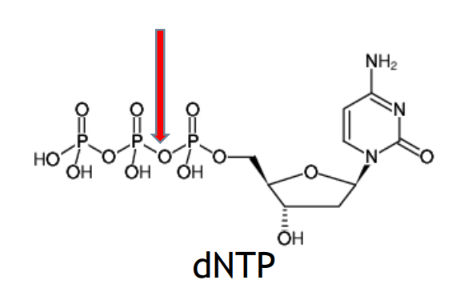
dNTPs
Deoxynucleoside triphosphates (dATP, dTTP, dCTP, dGTP)
the building blocks for DNA synthesis

Energy source for building the DNA backbone
Hydrolysis of dNTPs, which releases energy and pyrophosphate (PPi)
When are dNTPs required?
For both in vivo and in vitro (e.g., PCR) DNA synthesis

Phosphodiester linkage
The covalent bond linking one nucleotide to the next in the DNA (and RNA) backbone

Direction of DNA
Read 5' to 3': starts at the phosphate group (5' end) and runs toward the sugar end (3' end)

5' end vs 3' end of a DNA strand
5' end: phosphate group attached to the 5' carbon of the sugar
3' end: hydroxyl (OH) group on the 3' carbon of the sugar

Where do bases attach in a nucleotide?
To the sugar (deoxyribose)
the bases project out from the sugar-phosphate backbone

DNA strands as templates
Watson and Crick proposed that each strand serves as a template for making a new strand, so DNA can be copied over and over (life requires this)

How are DNA strands copied?
By complementary base pairing: the molecule opens up and bases match with their complements (A with T, C with G)

DNA supercoiling
Over- or under-winding of DNA strands

Why is DNA supercoiling important?
DNA can be thousands of times longer than the cell
supercoiling reduces the space it takes and allows much more DNA to be packaged

Bacterial chromosome compaction
Circular DNA → loop domains formed with associated proteins → supercoiled, looped DNA
compacted about 1000-fold to fit in the cell

Three DNA conformations
A-DNA, B-DNA, and Z-DNA

B-DNA
The most common conformation in most living cells
the structure proposed by Watson and Crick
right-handed

A-DNA
A shorter, wider, right-handed helix
found in dehydrated DNA samples and rarely under normal physiological conditions

Z-DNA
A left-handed helix (unlike A- and B-DNA)
a transient form that exists only occasionally in response to certain biological activity

Discovery and role of Z-DNA
Discovered in 1979
certain proteins bind it very strongly, suggesting it plays a role in protection against viral disease

Open reading frame (ORF)
A span of DNA sequence between a start codon and a stop codon

In how many directions can DNA be read for protein synthesis?
Only one direction
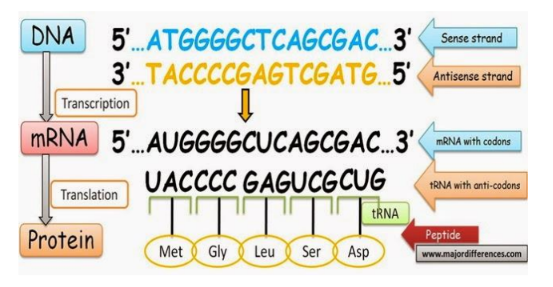
Sense strand
The DNA strand that, read in the right direction, provides the code for a protein
same sequence as the mRNA (with T instead of U); also called the coding strand

Antisense strand
The DNA strand bonded to the sense strand
also called the noncoding strand
it is the template for mRNA synthesis

Relationship between mRNA and the DNA strands
mRNA is made from the antisense (template) strand and has the same sequence as the sense strand (U replaces T)

PCR
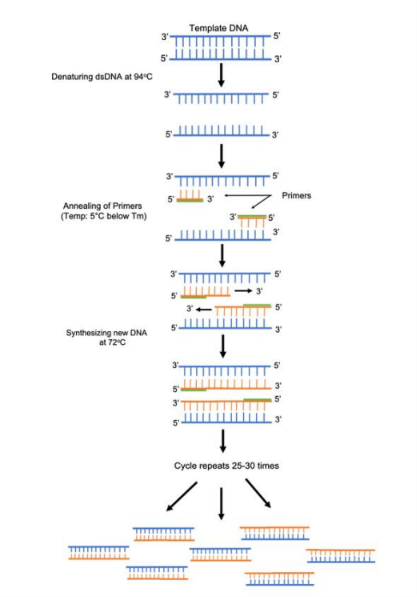
Polymerase chain reaction: a technique to make many copies of a specific DNA region in vitro (in a test tube rather than an organism)

Taq polymerase
The thermostable (heat-resistant) DNA polymerase used in PCR

Primers
Short single-stranded DNA oligonucleotides designed specifically for the DNA region of interest
they bind the template and give the polymerase a starting point

How does PCR make many copies?
The reaction is repeatedly cycled through a series of temperature changes
Common uses of PCR
DNA cloning, medical diagnostics, and forensic DNA analysis

Copies after 30 cycles of PCR
About 1.07 billion (230), because each cycle doubles the DNA

Five ingredients of a PCR mixture
1) dsDNA template
2) a pair of single-stranded DNA primers
3) heat-resistant DNA polymerase
4) dNTPs (dATP, dCTP, dGTP, dTTP)
5) buffer and cofactors (MgCl2)

PCR step 1: Denaturation
96-98°C (diagram shows 94°C) for 30-60 seconds
heat separates the DNA strands, giving single-stranded templates

PCR step 2: Annealing
55-65°C (about 5°C below the primer Tm)
cooling lets primers bind their complementary sequences on the template

PCR step 3: Extension
72°C
Taq polymerase extends the primers, synthesizing new DNA strands

Order of PCR steps
Denaturation → Annealing → Extension (then repeat)

Three categories of PCR applications
Molecular identification, sequencing, and genetic engineering
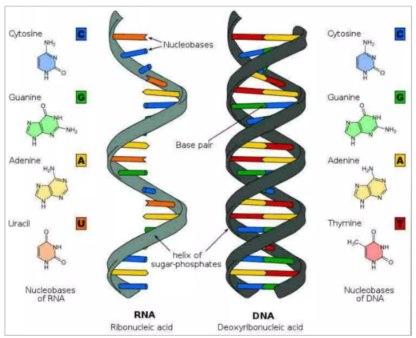
RNA
Ribonucleic acid: a polymer of ribonucleotides linked by phosphodiester linkages
usually single-stranded and helical

Three components of an RNA nucleotide
1) Ribose (sugar)
2) Nitrogenous base (A, U, G, C)
3) Phosphate group

DNA sugar vs RNA sugar
DNA: deoxyribose (H at the 2' carbon)
RNA: ribose (OH at the 2' carbon)

DNA bases vs RNA bases
DNA: A, T, G, C
RNA: A, U, G, C (uracil replaces thymine)

Nucleoside
Base + sugar (e.g., adenine + ribose = adenosine)

Nucleotide (definition)
Base + sugar + phosphate(s) (e.g., AMP, ADP, ATP)

AMP, ADP, ATP
Adenosine monophosphate (1 phosphate), adenosine diphosphate (2), adenosine triphosphate (3)

RNA vs DNA structure
Structurally similar, but DNA is typically long and double-stranded, while RNA is much shorter and typically single-stranded

Main role of RNA
A variety of roles, but mainly protein synthesis (translation) and its regulation

How does single-stranded RNA form a 3D structure?
It folds on itself, and the folds are stabilized by short regions of complementary base pairing within the molecule

Two main classes of RNA
mRNA (messenger RNA) and ncRNA (non-coding RNA)

Two classes of non-coding RNA
Housekeeping ncRNA and regulatory ncRNA

Housekeeping ncRNAs
tRNA (transfer RNA) and rRNA (ribosomal RNA)

Two classes of regulatory ncRNA
lncRNA (long non-coding RNA, 200 or more nucleotides)
small ncRNA (fewer than 200 nucleotides)
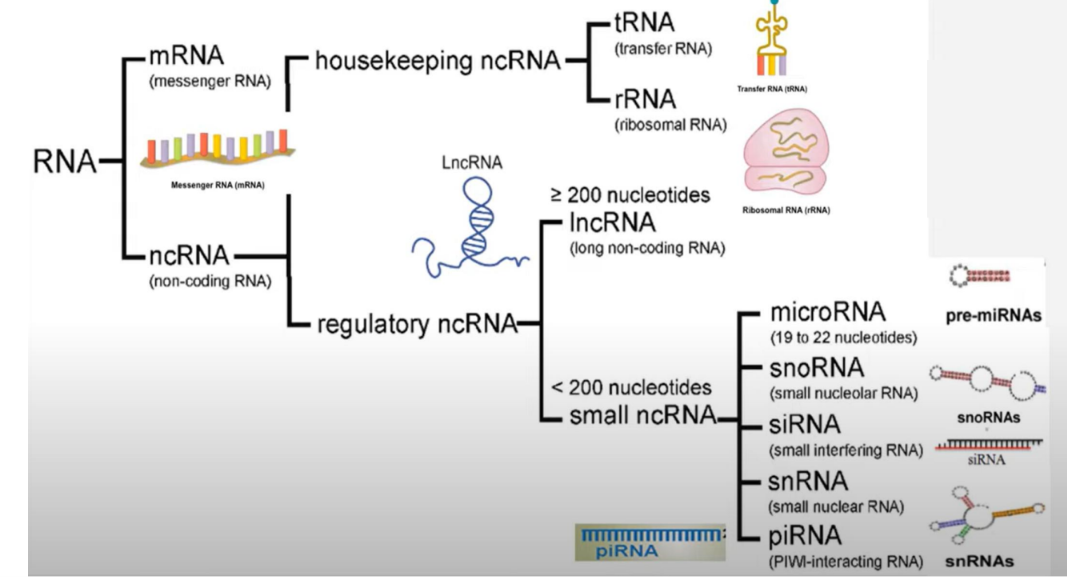
Types of small ncRNA
microRNA (19-22 nucleotides)
snoRNA (small nucleolar RNA)
siRNA (small interfering RNA)
snRNA (small nuclear RNA)
piRNA (PIWI-interacting RNA)

mRNA
Single-stranded RNA that corresponds to a gene's DNA sequence and is read by a ribosome to make a protein (translation)

How much of a cell's total RNA is mRNA?
About 5%

Polycistronic mRNA
mRNA that encodes more than one protein, with multiple translation start sites
typical of many bacterial and chloroplast mRNAs

Monocistronic mRNA
mRNA that encodes only one protein, with a single translation start site
all eukaryotic mRNAs are monocistronic
Prokaryotic vs eukaryotic mRNA structure
Prokaryotic: 5' UTR, several protein-coding regions, 3' UTR; Eukaryotic: 5' m7G cap, UTR, one protein-coding region, UTR, 3' poly-A tail (AAAA(n))

Two special structures of eukaryotic mRNA
5' cap and 3' poly-A tail
Parts of a eukaryotic mRNA (5' to 3')
Cap → 5' UTR (leader) → coding sequence (start codon AUG to stop codon, e.g., UAG) → 3' UTR (trailer) → poly-A tail
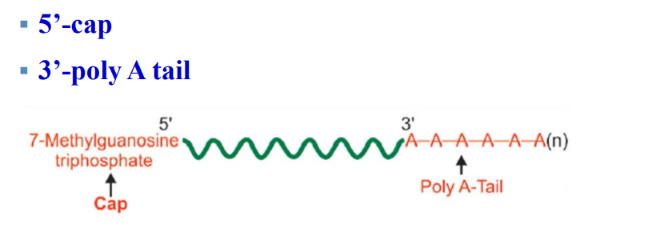
5' cap
7-methylguanosine triphosphate added to the 5' end of the mRNA

Capping
Adding a methyl group (methylated guanosine cap) to the 5' end of the transcribed RNA

Two functions of the 5' cap
1) Protects against degradation by 5' exonucleases
2) Lets the cell's machinery (e.g., nuclear export proteins and ribosomes) recognize the transcript

Polyadenylation
Adding a long chain of adenine nucleotides (poly-A tail) to the 3' end of the transcript

Length of the poly-A tail
About 100-200 adenine nucleotides

Functions of the poly-A tail
Protects the mature mRNA, improves its stability, and helps its export from the nucleus

rRNA
Ribosomal RNA: the RNA component of ribosomes
essential for protein synthesis in all living organisms

Functions of rRNA
Not fully understood, but necessary for ribosome assembly and seems to play key roles in binding mRNA to ribosomes and translating it
Composition of ribosomes by weight
About 60% rRNA and 40% protein

Ribosome contents
Two major rRNAs and 50 or more proteins

Prokaryotic rRNAs and their eukaryotic equivalents
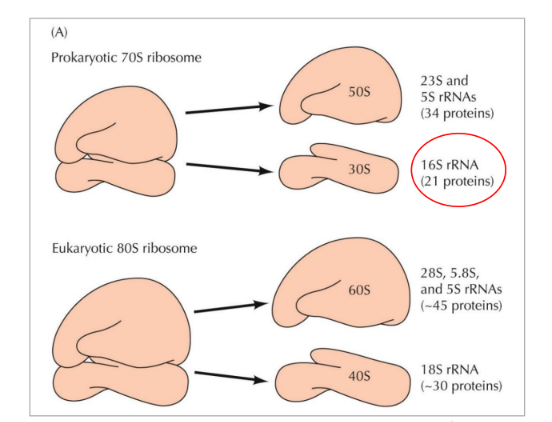
Prokaryotic 23S, 16S, and 5S are equivalent to eukaryotic 28S, 18S, and 5.8S
both come from processing a single pre-rRNA transcript

Prokaryotic 70S ribosome
Large 50S subunit (23S and 5S rRNAs, 34 proteins) + small 30S subunit (16S rRNA, 21 proteins)

Eukaryotic 80S ribosome
Large 60S subunit (28S, 5.8S, and 5S rRNAs, about 45 proteins) + small 40S subunit (18S rRNA, about 30 proteins)

"S" in 16S rRNA
Sedimentation coefficient: reflects how fast a macromolecule moves downward when centrifuged

tRNA
Transfer RNA: the smallest of the three major types of RNA (74-95 nucleotides)
transfers amino acids from the cytoplasm to the ribosome
How many kinds of tRNA are there?
At least 20, one for each of the 20 amino acids used in protein synthesis
tRNA 3' end
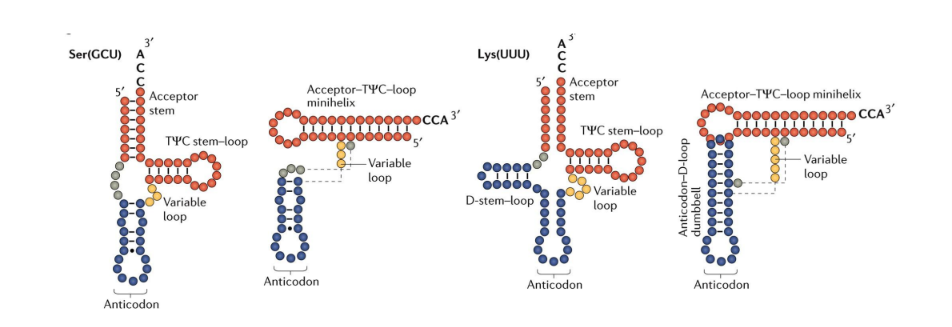
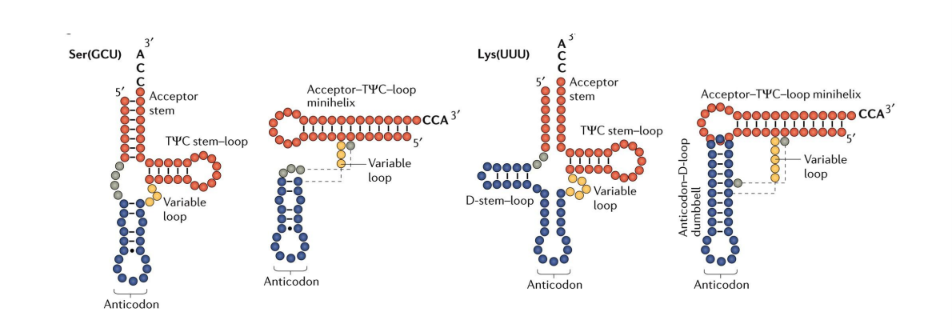
Ends in CCA, with the amino acid attached to the terminal A (A-OH)
tRNA primary structure
The nucleotide sequence, which allows extensive base pairing within the strand to form a secondary structure