BIO-200 EXAM 3
 Call Kai
 Learn
 Practice Test
 Spaced Repetition
 Match
 Flashcards
 Knowt Play
1/99

Earn XP
Description and Tags
Chapter 24: Early Life and the Diversification of Prokaryotes Chapter 25: Protists and the Origin of Eukaryotes Chapters 28.1 and 29.1: Plant Evolution and Diversity: Conquering Land Chapter 30: Flowering Plant Reproduction and Biotechnology Flowers, Co-Evolutionary Partnerships, and Genetic Innovation
100 Terms
Vascular Tissue (Xylem and Phloem)
Evolved allowing plants to transport water and nutrients vertically and grow taller. “Internal plumbing system”
Ferns
Lycopods, ferns, and horsetails, sporophyte (2n), no spores, has vascular tissues
Gymnosperms
conifers, cycads, and ginkgos, Seed-bearing plants, sporophyte (2n)
Gymnosperms
Evolved pollen and naked seeds protected in cones
Angiosperms
Evolved flowers and fruits for advanced pollination and seed dispersal, sporophyte (2n),
Nonvascular Plants (Bryophytes)
Mosses, liverworts, no vascular tissue, low growing, no spores, gametophyte (n)
Terrestrial Challenge
Moving from water to land required plants to overcome desiccation (drying out) and gravity.
Three Major Terrestrial Pressures?
Desiccation (Dehydration), Gravity (Structural Support), Reproduction
Desiccation (Dehydration)
Air lacks the constant moisture of water; cells risk drying out rapidly.
Gravity (Structural Support)
Water provides buoyancy; land requires rigid structural tissues to stand upright against gravity to capture sunlight
Reproduction
Flagellated sperm require a continuous film of water to swim to egg cells for fertilization
The Ancestral Bridge
Green algae (Charophytes) share key traits with land plants showing they branched from a common ancestor over 470 million years ago.
What are the key derived traits of land plants?
The Waxy Cuticle, Stomata, Apical Meristems, Alternation of Generations
The Waxy Cuticle
A waterproof covering of hydrocarbons and waxes on leaves and stems that prevents excessive water loss
Stomata
Specialized pores that allow gas exchange (CO2 in, O2 out) while regulating water evaporation.
Apical Meristems
Localized regions of cell division at root and shoot tips that allow plants to continuously elongate toward resources (light and soil minerals)
Alternation of Generations
A life cycle alternating between multicellular haploid gametophytes (n) and diploid sporophytes (2n)
Gametophyte-Dominant
The leafy green moss is the haploid gametophyte (n; the sporophyte (2n) is small, dependent, and attached to the gametophyte)
Reproductive Constraint
Still completely dependent on water; flagellated sperm must swim through external water droplets to reach the egg
Ecological Dominance
Highly efficient vascular systems and mutualistic animal relationships made angiosperms the dominant flora across nearly all terrestrial bones
Textile Dominance
Vital to the textile industry, providing raw fiber sources, natural dyes, surface motifs, and innovative biomaterials like cotton, hemp, tobacco, flax
How old is the earth?
4.6 billion
When did life on earth originate?
3.8 billion years ago
What were the first life forms on earth?
Prokaryotes
Conditions on early earth made the origin of life possible through:
1. Abiotic synthesis of small organic molecules
2. Joining of these small molecules into macromolecules
3. Packaging of molecules into protocells
4. Origin of self-replicating molecules that made inheritance possible
Miller-Urey Experiment
A groundbreaking scientific test conducted in 1952 by chemist Stanely Miller and his mentor Harold Urey at the University of Chicago. It tested the hypothesis that Earth’s early atmosphere could have spontaneously synthesized the chemical building blocks of life.
The “Ocean”
A flask filled with warm, boiling water evaporated to stimulate the early oceans and cycle water vapor through the system
The “Atmosphere”
The vapor mixed with gases believed to dominate primordial Earth—methane (CH4), ammonia (NH3), hydrogen (H2), and water vapor (H2O)
The “Lightning”
they introduced tungsten electrodes that discharged continuous electrical sparks into the gas chamber to act as an engergy source
The “Rain”
A condenser cooled the gases, causing them to liquefy and drop back into the trap, completing the cycle
Results of the Miller-Urey Experiment
Miller discovered that more than 20 distinct amino acids (the vital building blocks of proteins) had spontaneously formed, along with simple sugars and other organic molecules
Why was the Miller-Urey Experiment unique?
the first study to successfully demonstrate that organic compounds, including amino acids, could be synthesized from inorganic materials under conditions simulating early, prebiotic Earth.
Stromatolites
Layered rocks formed when prokaryotes bind thin films of sediment together (fossil evidence dates back ~3.5 billion years)
The Rise of Photosynthesis and Oxygen
Early prokaryotic photosynthesis (cyanobacteria-like ancestors) produced O2 starting ~2.7 billion years ago, rusting iron in oceans and causing the Oxygen Revolution
Prokaryotes, Two Domains:
Early prokaryotes eventually diverged into two distinct domains of life: Bacteria and Archaea
Prokaryote Structure
Unicellular, 0.5-5 micrometer diameter. Have: genetic material, ribosomes, plasma membrane, cell wall, and plasmids. Lack: membrane-bound nucleus and internal organelles
Cell Wall
a rigid layer that maintains the cell's shape and prevents it from bursting due to osmotic pressure
Gram-Positive
Simpler walls with a thick layer of peptidoglycan; retain crystal violet stain (appear deep purple).
Gram-Negative
More complex walls with a thin peptidoglycan layer and an outer membrane containing lipopolysaccharides; counterstained red/pink. Often more antibiotic-resistant
Prokaryote Structure: Shape
Spherical, Rod-shaped, Spiral
Surface Adaptations: Capsule / Slime Layer
Dense sticky polysaccharide or protein layer protecting against dehydration and immune attacks
Surface Adaptations: Fimbriae & Pili
Hairlike appendages used to stick to substrate or other cells (conjugation pilus)
Surface Adaptations: Motility
About half of all prokaryotes exhibit taxis (directed movement toward or away from a stimulus, e.g., chemotaxis via flagella)
Internal Genome
Circular chromosome located in the nucleoid region (no nuclear membrane)
Plasmids
Smaller rings of independently replicating DNA carrying bonus genes (e.g., antibiotic resistance)
Insulin production via genetic transformation
Scientists use bacterial plasmids to produce human insulin by inserting the human insulin gene into a plasmid, which is then introduced into bacteria, allowing them to replicate and produce insulin
Prokaryotes reproduce via binary fission
Asexual reproduction where a single cell divides into two identical clones. Mutation rates per division are low, but rapid generation times (hours to minutes) produce massive genetic variation across large population sizes.
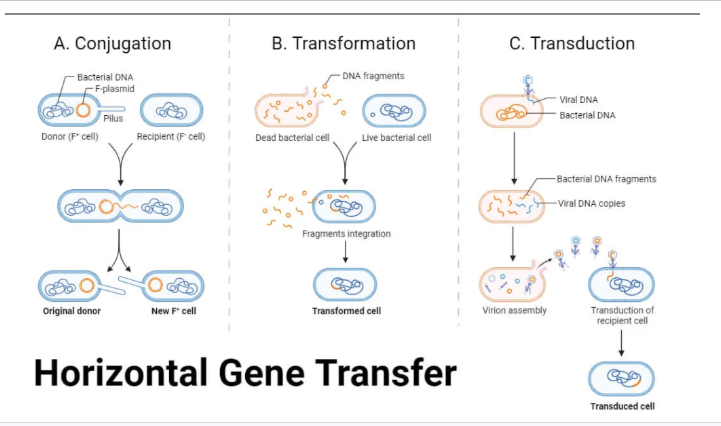
Horizontal Gene Transfer (HGT)
Moving genes between individuals of different species, driving rapid prokaryotic evolution. There are 3 main types of HGT:
Transformation: Uptake of naked foreign DNA from the surrounding environment.
Transduction: Phages (viruses) carry prokaryotic genes from one host cell to another.
Conjugation: Direct transfer of genetic material (usually a plasmid) between temporarily joined bacterial cells.
Domain Bacteria
Encompasses the vast majority of familiar prokaryotes. Key clades include Proteobacteria (gram-negative, diverse metabolisms), Cyanobacteria (oxygenic photosynthesizers), and Chlamydias / Spirochetes.
Domain Archaea
Share traits with both bacteria and eukaryotes, famous for extremophiles
Chemical Recycling (Biogeochemical Roles)
Acting as decomposers (detritivores) to return carbon, nitrogen, and other elements from dead organic matter to inorganic forms.
Nitrogen Fixation
Converting unreactive atmospheric nitrogen (N2) into ammonia (NH3), supplying usable nitrogen to plants.
Mutualism
Human gut microbiome aiding digestion and vitamin synthesis; bioluminescent bacteria in deep-sea squids.
Commensalism & Parasitism
Pathogenic bacteria responsible for zoonotic and human infectious diseases
Animal Traits
Multicellular heterotrophs that ingest food internally; lack cell walls (supported by collagen); possess specialized nervous and muscle tissues; reproduce sexually via embryonic development governed by Hox genes.
Radial Symmetry
Top/bottom structure; ideal for sessile/drifting life (e.g., Cnidarians)
Bilateral Symmetry
Left/right, dorsal/ventral, anterior/posterior; linked to cephalization (concentration of sensory organs in a head) and active movement
Diploblastic
Ectoderm and endoderm layers.
Triploblastic
Adds mesoderm. Triploblasts can be coelomates (true body cavity lined entirely by mesoderm), pseudocoelomates, or acoelomates.
Protostomes
develop the mouth from the embryonic blastopore
Deuterostomes
develop the anus from the blastopore
Porifera (Sponges)
Basal animals lacking true tissues
Cnidaria
Radial symmetry, stinging cells (jellyfish, corals)
Lophotrochozoa & Ecdysozoa
Diverse protostome clades (molluscs, annelids, flatworms, nematodes, and molting arthropods with chitin exoskeletons)
Deuterostomia
Echinoderms and Chordates.
Chordate Defining Traits
(1) Notochord, (2) Dorsal hollow nerve cord, (3) Pharyngeal slits/clefts, (4) Post-anal tail
Vertebrate & Terrestrial Transitions
Evolution of jaws, lobe-finned fish ancestors, tetrapod limbs, and the amniotic egg in reptiles and mammals
Human Evolution
Primates share a common ancestor with chimpanzees (~6–7 million years ago). Upright bipedalism evolved first, followed by tool use and significant encephalization (brain enlargement) in hominin lineages.
Cephalization
concentration of sensory organs/brain at the anterior head) and active directional movement
Coelom
Most bilaterians have a body cavity, a fluid- or air-filled space located between the digestive tract and the outer body wall
Protostome Development
“First Mouth”, Spiral/determinate cleavage; the embryonic blastopore develops into the mouth
Deuterostome Development
“Second Mouth”, Radial/indeterminate cleavage; the embryonic blastopore develops into the anus (and the mouth forms secondarily)
Notochord
Flexible longitudinal rod providing skeletal support
Amniotic Egg
contains specialized extraembryonic membranes—amnion, chorion, yolk sac, allantois—plus a protective shell that retains water
Encephalization
A progressive increase in brain volume relative to body size, supporting advanced toolmaking, social structures, and symbolic language
Evolutionary Innovations of Eukaryotes
Acquisition of a dynamic cytoskeleton, a nuclear envelope, and membrane-bound organelles formed via internal membrane infoldings
Endosymbiotic Theory; Primary Endosymbiosis
An ancestral host cell engulfed an aerobic alpha-proteobacterium (evolving into mitochondria) and later a cyanobacterium (evolving into plastids).
Endosymbiotic Theory; Secondary Endosymbiosis
Heterotrophic eukaryotes engulfed red or green algae, producing complex plastids surrounded by three or four membranes
The Polyphyletic Nature of Protists
Informal grouping of mostly unicellular eukaryotes displaying immense structural and metabolic diversity
The Four Eukaryotic Supergroups
Excavata, SAR (Stramenopiles, Alveolates, Rhizarians), Archaeplastida, Unikonta
Excavata
Modified mitochondria and unique flagella (e.g., Giardia, Trypanosoma).
SAR (Stramenopiles, Alveolates, Rhizarians)
Includes diatoms (silica walls), brown algae, dinoflagellates (red tides), apicomplexans (Plasmodium), ciliates, and forams
Archaeplastida
Red algae, green algae, and land plants (direct descendants of primary endosymbiosis)
Unikonta
Amoebozoans (lobe-footed amoebas, slime molds) and Opisthokonts (choanoflagellates, fungi, and animals)
Ecological Roles
Marine primary producers (performing ~30% of global photosynthesis), coral reef symbionts (zooxanthellae), and human pathogens (Plasmodium).
Endosymbiosis
explains how eukaryotic cells (cells with a nucleus and membrane-bound organelles) evolved from early prokaryotic cells (single-celled organisms without a nucleus)
Secondary Endosymbiosis
Plastid diversity expanded when photosynthetic red and green algae were themselves engulfed by other heterotrophic eukaryotes.
Plastid
A heterotrophic eukaryotic lineage later engulfed a photosynthetic cyanobacterium → evolved into plastids (giving rise to red and green algae)
Polyphyletic
developed from more than one ancestral type, as a group of animals
Four major plant groups
Bryophytes (mosses), Ferns, Gymnosperms, Angiosperms

Basic Flower Structure
Sepals: Leaf-like structures at the base that protect the flower bud before it opens.
Petals: Often brightly colored to attract specific animal pollinators.
Stamens (Male Reproductive Organs): Composed of the filament (stalk) and anther (where pollen grains are produced)
Carpels/Pistils (Female Reproductive Organs): Composed of the stigma (sticky surface receiving pollen), style (tube connecting stigma to ovary), and ovary (base containing the ovules, which become seeds)
Seeds & Fruit
Ovules develop into dormant, nutrient-rich protected seeds, while mature flower ovaries thicken into fruits designed for wind, water, or animal dispersal
Plant Biotechnology & Biofuels
Use of selective breeding and genetic modification (GMOs/CRISPR) for pest resistance and nutrition; development of advanced second-generation cellulosic biofuels from non-food biomass.
Bee-Pollinated Flowers
Often blue or yellow, feature ultraviolet markings (nectar guides), and produce sweet fragrances and nectar.
Bird-Pollinated Flowers (e.g., Hummingbirds)
Typically bright red or orange, tubular in shape (matching beak length), produce copious nectar, and often lack scent (since birds have a poor sense of smell).
Moth/Bat-Pollinated Flowers
Open at night, typically white or pale, and emit heavy, sweet, or musky odors to attract nocturnal flyers
The Ovule → The Seed
Becomes a dormant embryonic plant packaged with a stored food supply (endosperm) inside a protective seed coat.
The Ovary → The Fruit
The ovary wall thickens and develops into a fruit, whose primary biological function is to protect enclosed seeds and assist in dispersal
Genetic Modification (GM / GMOs)
Introducing specific foreign genes into a plant genome using recombinant DNA technology or CRISPR-Cas gene editing