SA solid tumours 3 - sarcomas
 Call Kai
 Learn
 Practice Test
 Spaced Repetition
 Match
 Flashcards
 Knowt Play
1/45

There's no tags or description
Looks like no tags are added yet.
46 Terms
What is the cell of origin of a sarcoma?
Mesenchymal —> cells of connective / structural tissues (subtypes vary by cell origin)

What is the general behaviour of a sarcoma?
Locally invasive
Metastatic risk varies w/ type
Which sarcomas have a higher metastatic risk?
Osteosarcoma
Haemangiosarcoma
Histiocytic sarcoma
Stage vs grade
Stage = clin assessment of current dx burden
Grade = histo features (activity, vascularity, invasion, necrosis, differentiation) i.e. what is the likely behaviour
How can you diagnose a sarcoma case?
Clinical exam & hx
FNA & cytology
FNA —> cheap, quick, done w/o sedation / GA but higher chance of non-representative sample & no grade
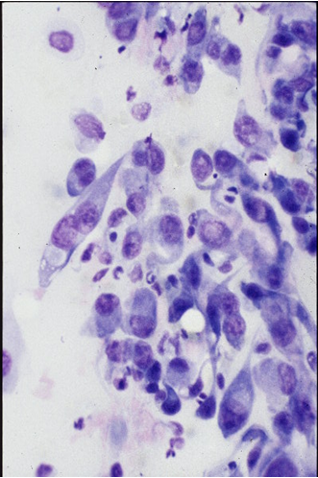
Biopsy & histology (+/- IHC)
trucut biopsy —> small samples
biopsy + histo —> larger samples = better chance of diag & accurate grade but more morbidity & cost, requires GA
How is a sarcoma staged?
Aspiration of local LNs even if palpably normal
Imaging (depending on type)
Rads —> relatively insensitive
CT better —> better to see osteolysis / new bone production
allows surgical & radiation planning
Sample other abnormalities identified on exam —> co-morbidities?
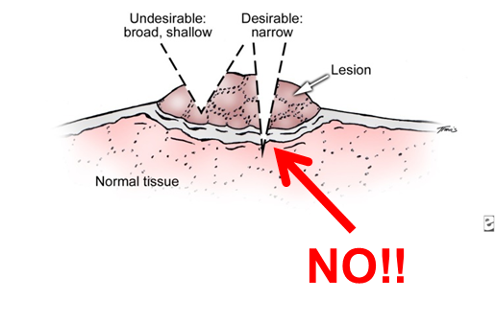
What must you ensure you do not do when taking a biopsy?
Do not expand tumour bed
What metastasis site do sarcomas have a predilection for?
Lungs
most soft tissue sarcomas have relatively low metastatic potential & most metastasise by haematogenous route
What dogs are predisp to soft tissue sarcomas?
Middle to large breeds
Median age 8-11 yo
Breed predil —> fibrosarcomas in retrievers
Younger animals in predisposed breeds
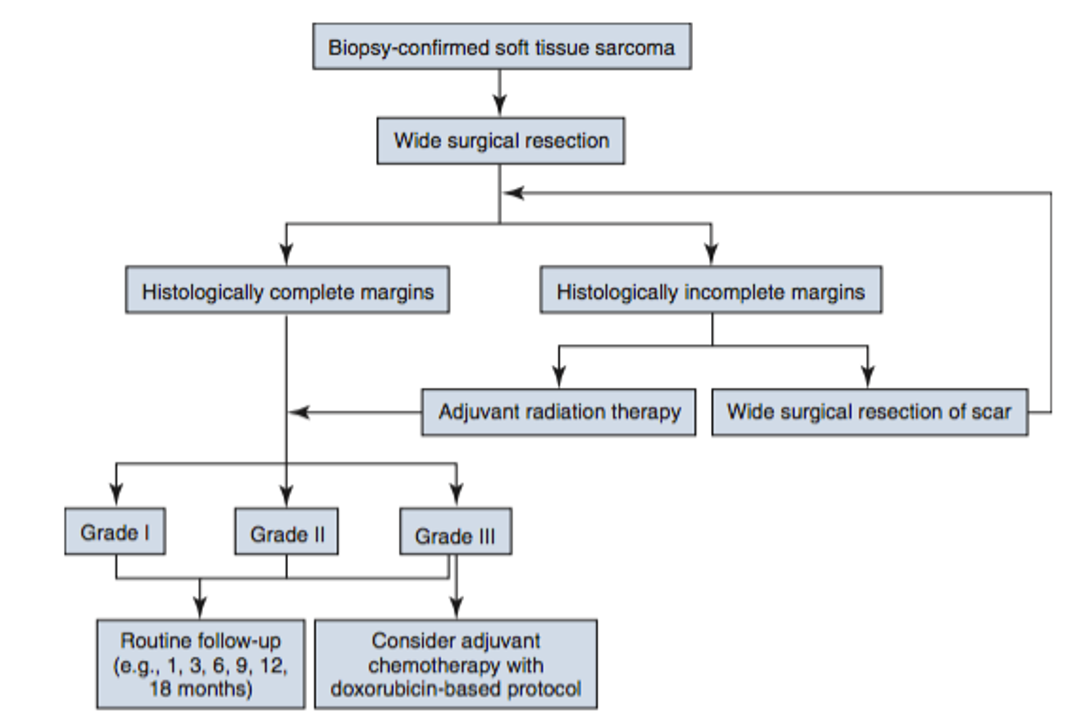
How are soft tissue sarcomas treated?
How do sarcomas grow?
Along path of least resistance & often have pseudocapsule
How should you surgically remove a sarcoma?
DO NOT 'shell out' of pseudocapsule
Complete excision important to outcome
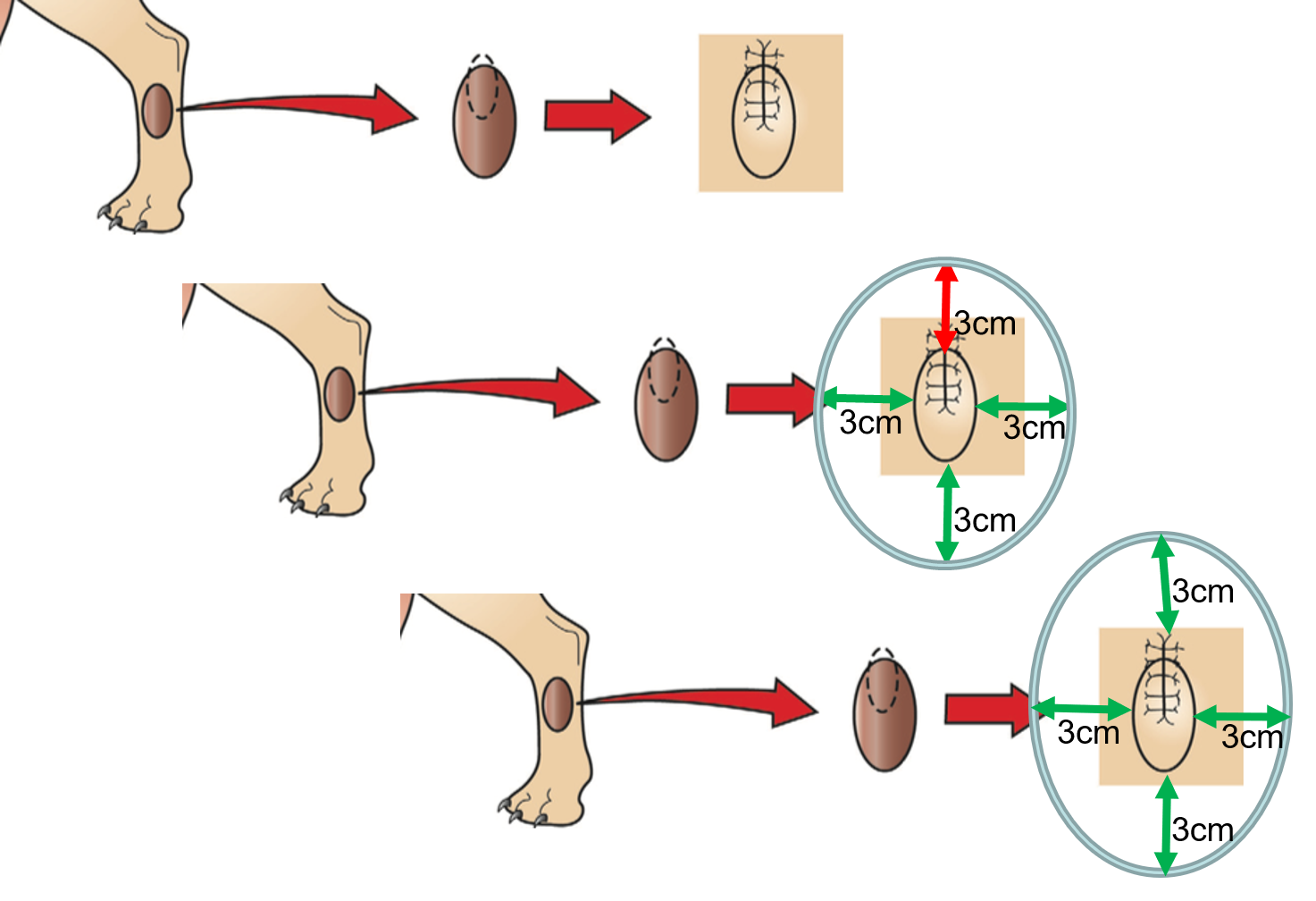
Ideal margins —> 3cm lateral 1 fascial [lame beyond extent of tumour (incl FNA tracts & biopsy scars)
outcomes —> complete excision / incomplete excision / excision w/ narrow margins
What are the methods used to assess margins of excision?
Assessed histologically by pathologist
Cardinal (most common method)
3 sections & relies on mass being spheroid
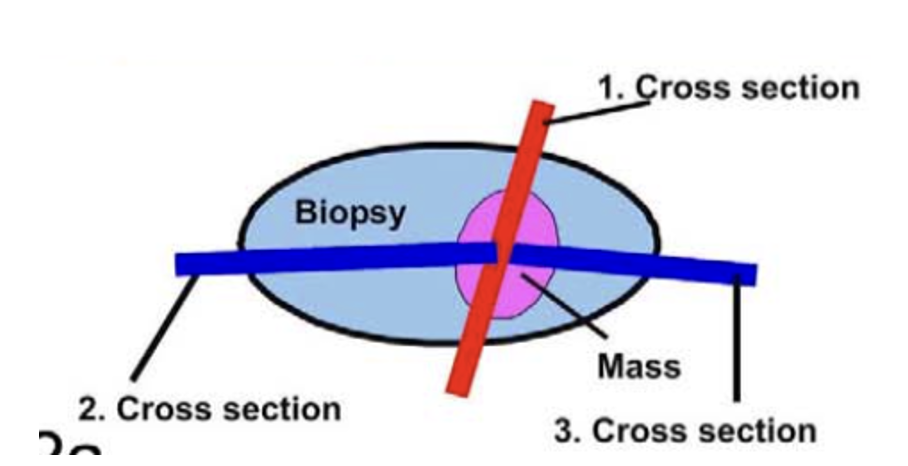
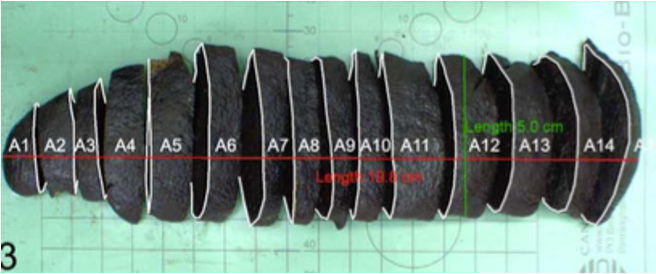
Bread loafing
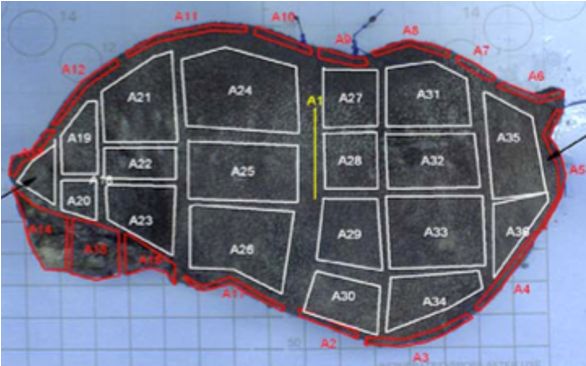
Shaved margins
What are the possible outcomes when margins of excisions are assessed?
Incomplete excision
Likely to recur due to residual tumour tissue
Narrow margins i.e. tumour cells <3mm of tissue edge
Recurrence dependent on type & grade
What are your options if you have not achieved a complete excision?
Further wide surgical excision (treat scar as tumour)
Adjuvant radiation therapy —> fractionated protocol i.e. lots of smaller doses over long period
Metronomic chemotherapy —> low dose therapy of cyclophosphamide with piroxicam/meloxicam
Active monitoring —> high risk but can be considered when chance of recurrence low
When would you consider active monitoring in the case of residual dx?
When chance of recurrence is low
Low grade soft tissue sarcoma of limbs
When a complete excision was expected
When there are questionable margins in one small area
check @ vets monthly for @ least a year
What are the outcomes in patients with resectable tumours without metastatic disease?
What are the prognostic factors?
Successful surgery ± radiotherapy ass. w/ good survival time
Prognostic factors —> tumour grade, mitotic rate, size, location & achieveing local control of tumour
What are your options in the case of a non-resectable tumour?
Reduce w/ surgery then radiotherapy and/ or metronomic chemo
Primary radiation therapy (less efffective than surgery)
Referral to surgery specialist?
When would you suggest anti-metastatic treatment?
High grade soft tissue sarcomas
Not necessarily reccommended as low response rates
How do Feline injection site sarocmas present histologically?
Malignant fibroblasts
Inflam —> often high lymphocyte component

Macrophages taking up foreign material thought to be adjuvant / carrier
What is the rule for investigation of an FISS?
3-2-1 rule for investigation
Any mass present for 3 months or longer
Any mass >2cm diameter
Any mass that continues to incr in size 1 month after injection
How do you diagnose a FISS?
3-2-1 rule strong indicator
FNA may not be diagnostic (bc inflam component & may not exfoliate well)
care w/ dysplastic mesenchymal cells
Incisional biopsy
Excisional biopsy (not recommended as guarantees tx failure?)
Local & distant staging using advanced imagine (CT)
assess size & margins (highly invasive)
tends to metastasise by haematogenous route

How is an FISS treated?
Surgery —> 3-5cm lateral surgical margins, 2 fascial planes deep (can involve removal of spinous processes of vertebrae)
First surgery = best outcome (best for specialist to do)
When would adjuvant therapy treatment be indicated in a case of FISS?
Non resectable tumours —> pre-op radiotherapy & / or chemo useful
For incomplete / marginal resections
Doxorubicin based chemo
risk of nephrotox
How is FISS prevented?
Injections to be given in sites amendable to wide surgical excision e.g. limb or tail
Reduce inflam reactions @ injection sites —> avoid irritating substances where poss
Do not over-vacc
What is the most common skeletal tumour in dogs?
Osteosarcoma
What dogs are predisp to osteosarcomas?
Middle age & older dogs
Large breeds typically >>
Metaphysis of long bones, FL > HL (near knee, away from elbow)
When in small breeds most in axial skeleton
What are the clinical signs of osteosarcoma?
Pain & lameness
Sudden or progressive onset
Localisable to single bone
Swelling
How do you diagnose an osteosarcoma?
Rads
Cytology / histology to confirm diag (esp in countries where fungal osteomyelitis common)
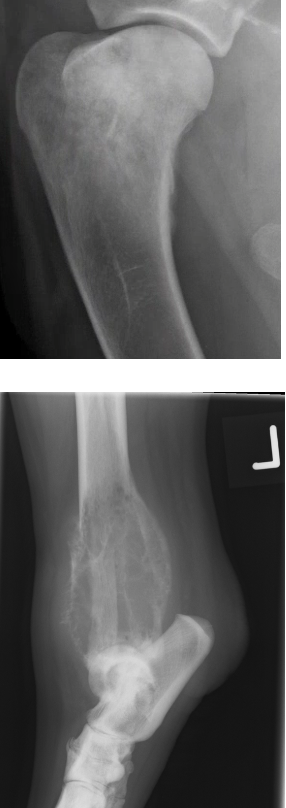
What are the radiographic signs of osteosarcoma?
Bone lysis
Soft tissue swelling
New bone —> palisades perpendicular to bone —> sunburst
Periosteal elevation —> Codman’s triangle
Long zone of transition
Does not cross joint
List some of the differentials for osteosarcomas?
Chondrosarcoma
low metastatic risk
Histiocytic sarcoma
metastatic risk depends upon location
Other primaries incl fibrosarcoma, haemangiosarcoma
Other differentials
Myeloma / lymphoma (round cell tumour)
Fungal osteomyelitis
Metastatic tumours (carcinoma)
Benign tumours / cysts
What are the tx aims for osteosarcomas?
Prevention of pain & delaying development of metastases → extending life
What are your options for treating osteosarcomas?
Amputation —> tolerated well by most dogs
Pain reduction:
Analgesics —> layered, multimodal approach
opioids, NSAIDS, paracetamol, amantidine
Slow bone destruction —> bisphosphonates q 4wks
Radiation therapy
Bone stabilisation & fixation —> limb sparing surgery (high rate of infection & implant failure)
patient unlikely to be pain-free

How can you slow development of metastatic dx in osteosarcoma?
95% have metastatsis at diag but mostly micrometastasis
Chemo if not gross metastasis @ diag
Toceranib w/ gross metastasis
What are the prognostic factors of osteosarcoma?
Location
Appendicular —> humerus poorer prog than others; rib, veterbral, pelvis all have poorer prog
Axial skull has lower met rate, local invasion bigger problem
Persence of mets
Total alkaline phosphatase
What should you do in a case of feline osteosarcoma?
AMPUTATION —> may cure
Much lower metastatic potential
What are the features of haemangiosarcoma?
Tumour of BV walls
Most commonly spleen
also liver, R auricular appendage, m., skin
Highly invasive & metastatic

splenic, intramuscular / subcut & R atrial appendage have poor prog
intramuscular in cats can be less aggressive
dermal have excellent outcome
What are the clinical signs of haemangiosarcoma?
Shock, collapse, haemoabdomen, pericardial effusion
Intramuscular bleeding —> bruising in dependent part of limb
Pericardial effusion if R auricular appendage
How does haemangiosarcoma present on clin path?
Anaemia & sometimes schistocytosis
In early stages of bleeding —> effusion & reduced TP precede measurable anaemia
Low platelet count
Prolonged coag tests & DIC
diag usually requires histo
How is haemangiosarcoma staged?
Performed prior to any splenectomy
Thoracic & abdominal +/- cardiac imaging
In older dogs hyperplastic liver nodules cannot be differentiated from metastasis on appearance alone
requires cytology /histology
What are some poor prognostic factors for haemangiosarcoma?
Tumour rupture & bleeding into abdo
but diagnosis often not known @ this point
Other types of splenic tumour will also rupture
Invasive tumours in other sites
How are primary haemangiosarcomas treated?
Surgery
Splenectomy —> survival depends on stage (short if gross metastases already)
Beware of ventricular arrythmias after splenectomy
Compartmental / wide excision in other sites
Non visceral sites —> mod response to radiation (useful for muscular or dermal tumours)
How is metastatic dx of haemangiosarcoma treated?
Poor prognosis
Systemic chemo w/ anthracycline based protocol (although more useful if no gross metastasis)
Metronomic chemo possible
What are the features of histiocytic sarcomas?
Highly metastatic sarcoma
Arising from histiocytes —> antigen presenting cells of immune system
Can affect lung, spleen, liver, bone, brain & joint
How are histiocytic tumours treated?
Multimodal therapy
Surgery, radiation & lomustine / anthracycline chemotherapy
What is the prognosis of histiocytic sarcomas in dogs?
dogs w/ gross metastasis have short survival
those with complete response to therapy / no metastasis @ diag who have chemo live much longer
those with solitary periarticular sarcoma i.e. no metastasis / dissem dx @ staging can have prolonged survival