Week 11 lab
 Call Kai
 Learn
 Practice Test
 Spaced Repetition
 Match
 Flashcards
 Knowt Play
1/55

Earn XP
Description and Tags
Vocabulary practice flashcards covering muscle interactions, lever systems, muscle attachments, and the functional anatomy of the head, neck, thorax, abdomen, and vertebral column from Week 11 EXSC 223L.
56 Terms
Agonist (Prime Mover)
The muscle responsible for facilitating a specified movement.
Antagonist
The muscle responsible for performing the opposing action to the agonist; resists the agonist and maintains the balance of joint muscle interactions.
Synergist
A muscle that aids the agonist in producing a movement, functioning as a support system for actions.
Fulcrum
The pivot point of a lever system, represented by a joint
First-Class Lever (EFL)
Muscle effort (force) and the load (resistance), act on opposite sides of the fulcrum
see saw in your neck
Second-Class Lever (FLE)
load lies between the fulcrum and the applied force/effort
wheelbarrow, standing on your toes
Third-Class Lever (FEL)
effort is between the fulcrum and the load
Catapult in your bicep
Origin
The proximal attachment site is fixed to a bone that does not move during contraction
Insertion
The distal attachment site on a moveable bone across a joint that the muscle acts on; moves toward the origin during contraction.
Occipitofrontalis (Epicranius)
Muscle that draws the scalp posteriorly, raises the eyebrows, and wrinkles the forehead horizontally.

Corrugator Supercilii
Muscle that draws the eyebrows downward and medially, making angry eyebrows and wrinkling the forehead vertically.

Levator Palpebrae Superioris
Muscle that elevates and retracts the eyelids, keeping the eyelids open.

Orbicularis Oculi
Circular facial muscle surrounding the eye that closes the eyelids.

Orbicularis
superficial portion: closes lips and protrudes lips
deep portion: presses lips against teeth, important for speech
Levator Labii Superioris
raises the upper lip and moves it forward.

Depressor Labii Inferioris
draws the lower lip inferiorly and laterally, exposing the lower teeth while smiling.

Levator Anguli Oris
raises the angle of the mouth.

Depressor Anguli Oris
draws the angle of the mouth downward and laterally.


Buccinator
Muscle that compresses the cheeks during the chewing process.

Risorius
Facial muscle that retracts the angle of the mouth.

Platysma
Superficial neck muscle that depresses the lower jaw (mandible).
Superior Rectus
adducts, elevates, and internally rotates the eye.

Inferior Rectus
depresses and adducts the eyeball.

Medial Rectus
adducts and moves the eye medially.

Lateral Rectus
abducts and moves the eye laterally.

Superior Oblique
medially rotates the eye (intorsion).

Inferior Oblique
Extrinsic eye muscle that laterally rotates the eye (extorsion).

Deep Masseter
Muscle of mastication that raises the mandible against the maxilla with great force.
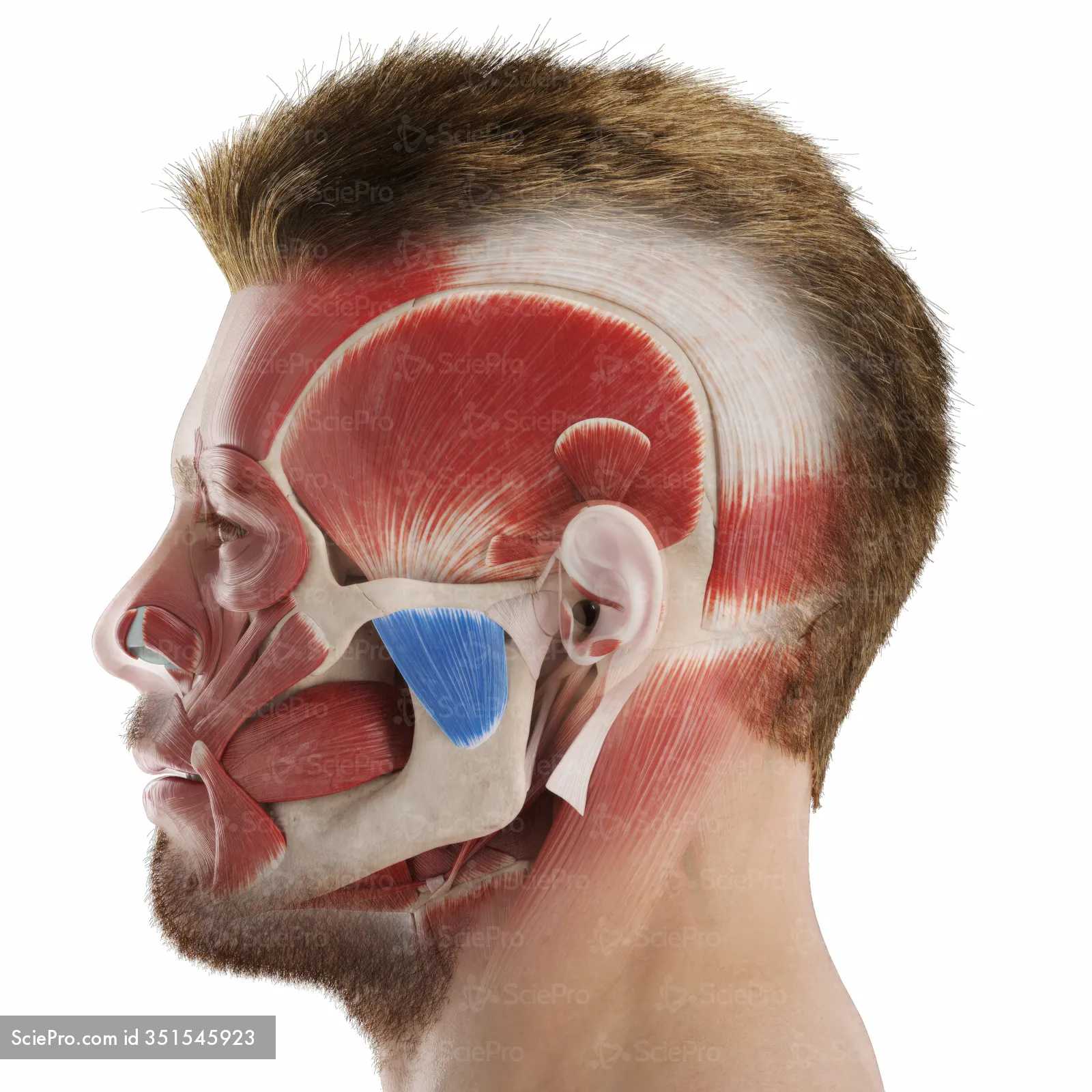
Superficial Masseter
Muscle of mastication that raises the mandible against the maxilla with great force.

Temporalis
Muscle of mastication that elevates and retracts the mandible against the maxilla with great force.
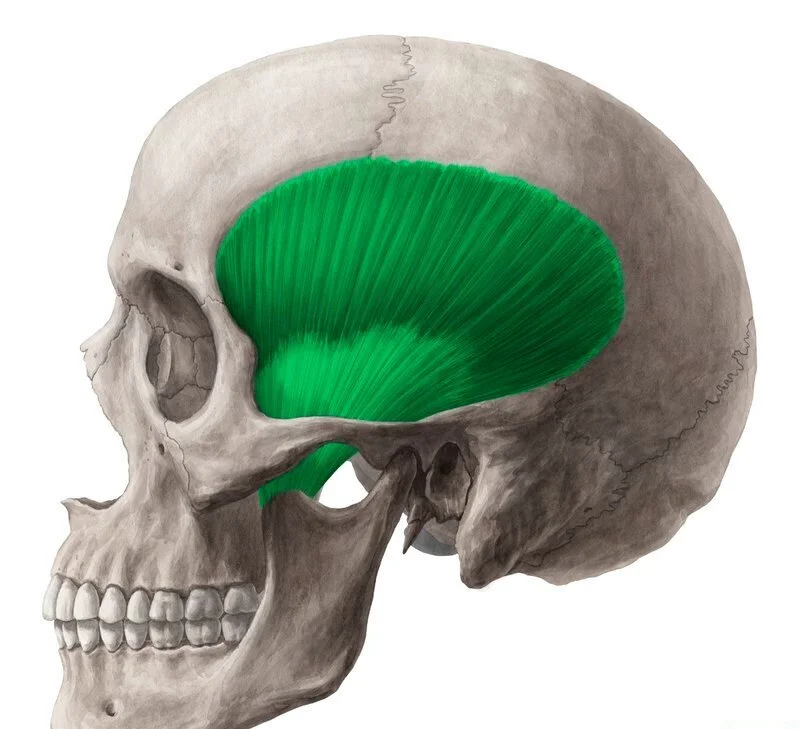
Medial Pterygoid
Muscle of mastication that elevates the mandible.

Lateral Pterygoid
Muscle of mastication that depresses the mandible.

Styloglossus
Tongue muscle that draws the sides of the tongue upward and retracts the tongue.
Hyoglossus
Tongue muscle that depresses and retracts the tongue.
Sternocleidomastoid
Neck muscle that draws the head toward the shoulder of the same side, rotates the head to the opposite side, flexes the cervical spine, and assists in elevating the thorax.

Scalenes (R/L)
Neck muscles that elevate the 1st and 2nd ribs and tilt the neck to the same side.
Diaphragm
Thorax muscle that expands the thoracic cavity and compresses the abdominal cavity.
External Intercostals
Thorax muscles that elevate the ribs and aid in normal inspiration.
Internal Intercostals
Thorax muscles that depress the ribs and aid in forced expiration.
Pectoralis Minor
Thorax muscle that elevates the ribs and draws the scapula down and medially.

Serratus Anterior
Muscle that protracts the scapula (upward rotation where the glenoid cavity moves superiorly), holds the scapula close to the thoracic wall, and elevates the ribs.
Trapezius
Thoracic muscle responsible for rotation, retraction, elevation, and depression of the scapula, extending the neck, and aiding in shoulder stabilization.
Levator Scapulae
Thorax muscle that elevates the scapula medially and upward.
Rhomboid Major
Muscle that steadies the scapula, retracts the scapula, rotates the scapula to depress the glenoid cavity, and moves the inferior angle of the scapula posteriorly and superiorly.

Rectus Abdominis
Abdominal muscle ('6-pack' muscle) that flexes the vertebral column, tenses the abdominal wall, and compresses abdominal viscera.

External Oblique
Abdominal muscle that bilaterally compresses the abdomen and flexes the spine; unilaterally laterally flexes the trunk to the same side and rotates the trunk to the opposite side.

Internal Oblique
Abdominal muscle that bilaterally compresses abdominal viscera and flexes the spine; unilaterally laterally flexes and rotates the spine to the same side.

Transverse Abdominis
The deepest layer of abdominal muscle; compresses abdominal viscera and tenses the abdominal wall.
Splenius
Vertebral column muscle that supports the head while erect, moves the head backwards, draws the head to one side, and slightly rotates it.
Erector Spinae
Muscle group consisting of longissimus, spinalis, and semispinalis.

Longissimus
Component of erector spinae comprising dorsi (thoracis), cervicis (colli), and capitis; extends and laterally flexes spine, aids in rib compression, extends the head bilaterally, and bends/turns the head to the same side unilaterally.
Spinalis
Component of erector spinae comprising thoracis (extends spine) and cervicis/colli (extends head).
Semispinalis
Muscle group comprising capitis, cervicis (colli), and thoracic divisions; together they extend the head, and independently they laterally flex and rotate the head.
Multifidus
Muscle that stabilizes vertebrae in localized movements of the vertebral column.
Rotatores
Vertebral column muscles that extend and rotate the vertebral column.
Quadratus Lumborum
Major stabilizer of the lumbar spine that depresses the 12th rib, unilaterally raises the pelvis, and aids in lumbar spine lateral flexion.