Preparing Powdered Parenteral Medications
 Call Kai
 Learn
Learn Practice Test
 Spaced Repetition
 Match
Match Flashcards
 Knowt Play
1/23

There's no tags or description
Looks like no tags are added yet.
Name | Mastery | Learn | Test | Matching | Spaced | Call with Kai | Chat |
|---|
No analytics yet
Send a link to your students to track their progress
24 Terms
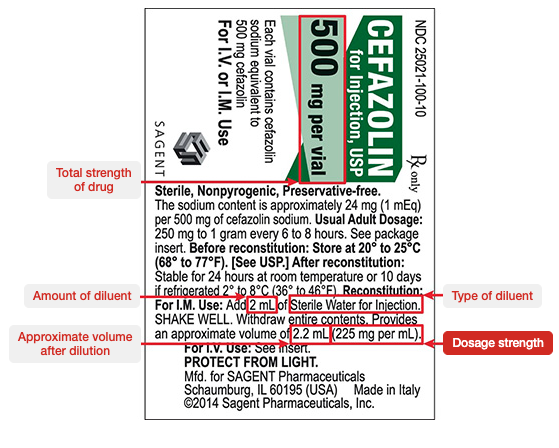
Diluent
The liquid solvent added to a dry medication to dissolve or suspend it.
Reconstitution
The process of preparing a powdered medication involves adding a liquid (diluent) to the powdered medication
Approximate volume after dilution
The total volume of the powder plus the diluent.
could be after reconstitution
after adding more diluent to a medication that has already been dissolved or prepared
Institute for Safe Medication Practices (ISMP)
and
American Society of Health-System Pharmacists (ASHP)
medication preparation standard
Recommends that all medications be supplied in unit-dose and ready-to-administer formats whenever possible.
Nurse's primary responsibilities during reconstitution
Accurately interpreting directions, selecting the appropriate type and amount of diluent, and identifying the correct dosage strength for calculating ordered doses.
Total strength on a powdered drug label
The total strength of drug present in the vial.
500 mg per vile
1 gram per vile
It is not part of the dosage strength and is not used in solving drug dosage problems.
Dosage strength on powdered medications
Dosage strength
The strength of the medication and the dosage form.
(225 mg per 1mL)
for powdered medications it will be located on the back. Usually after reconstitution
Displacement volume
The additional volume in a reconstituted mixture that exceeds the volume of solvent added, caused by the space occupied by the powder.
The difference between the volume of diluent added and the final volume after reconstitution.
Diluent added into a powder vile: 2 mL
Final volume after reconstitution: 2.2 mL
Displacement volume: 0.2 mL
this happens because of the powder that is already in the vile
Role of displacement volume in dosage calculations
It is omitted entirely from formulas; calculations must rely strictly on the dosage strength stated on the label or package insert.
Active ingredient
The therapeutic component of a drug formulation that must be distinguished from inactive additives to correctly identify dosage strength.
Two types of reconstitution
Single-strength
1 diluent amount
1 dosage strength
multiple-strength
several diluent amounts (choice of more dilute or more concentration)
Each diluent amount has its own dosage strength
CDC labeling requirements for reconstituted multi-dose vials
Date and time of reconstitution
Type and amount of diluent added
dosage strength
beyond-use date and time (28 days but could differ by manufacturer)
storage instructions
nurse's initials.
Nurse documentation for multiple-strength vials
Circling the specific amount of diluent added and the resulting dosage strength directly on the container label.
Storage guidance for reconstituted multi-dose vials
Information located on the drug label or package insert, subject to the policies and procedures of the healthcare facility.
bacteriostatic water
Water that has been treated to inhibit the growth of bacteria; often used as a diluent when reconstituting powdered medications.
Two-compartment vial (e.g., Mix-O-Vial or Act-O-Vial)
A specialized container holding powder in one chamber and diluent in another separated by a rubber stopper, activated by depressing the stopper to mix.
ADD-Vantage system
An intravenous drug delivery setup where a powdered medication vial connects directly to an IV bag, activated by pulling an internal plug to mix the components.
Effect of diluent volume on drug concentration
An inverse relationship where adding less diluent yields a higher concentration, while adding more diluent yields a more dilute solution.
forms of reconstitution instructions for multi-strength drug label
narrative
table
combined format
Clinical factors determining diluent volume in multiple-strength reconstitution
The ordered medication/dosage, route of administration, needs of the patient, and other individual factors
NEED TO KNOW how to recognize active ingredients in dosage and calc
need to know the different types of med labels showing reconstitution options/instructions


The nurse is preparing to administer IV cefoxitin. Read the electronic medication order, label, and insert. The nurse adds 10 mL of diluent to the vial. How many milliliters of reconstituted medication will the nurse administer?
ORDERED 1.8 g IV ever 8 hrs
10 mL