regulation of gene expression in eukaryotes: transcription
 Call Kai
 Learn
 Practice Test
 Spaced Repetition
 Match
 Flashcards
 Knowt Play
1/38

There's no tags or description
Looks like no tags are added yet.
Name | Mastery | Learn | Test | Matching | Spaced | Call with Kai | Chat |
|---|
No analytics yet
Send a link to your students to track their progress
39 Terms
prokaryotic vs eukaryotes gene expression regulation levels
prokaryotes
transcription → primary
RNA processing
translational
post-translational
eukaryotes
chromatin structure and epigenetics
transcription → primary
RNA processing
RNA export
RNA stability
translation
post-translational protein modifications
protein stability
prokaryotic vs eukaryotes gene expression regulation
primary control of gene expression is on the transcriptional level for both prokaryotes and eukaryotes
transcription and translation occurs simultaneously in prokaryotes
separation of transcription and translation in eukaryotes allows for additional controls
greater complexity and organisation in eukaryotes
one RNA polymerase transcribes all (?) genes
prokaryotic
(?) factor positions the polymerases at the promoter
sigma
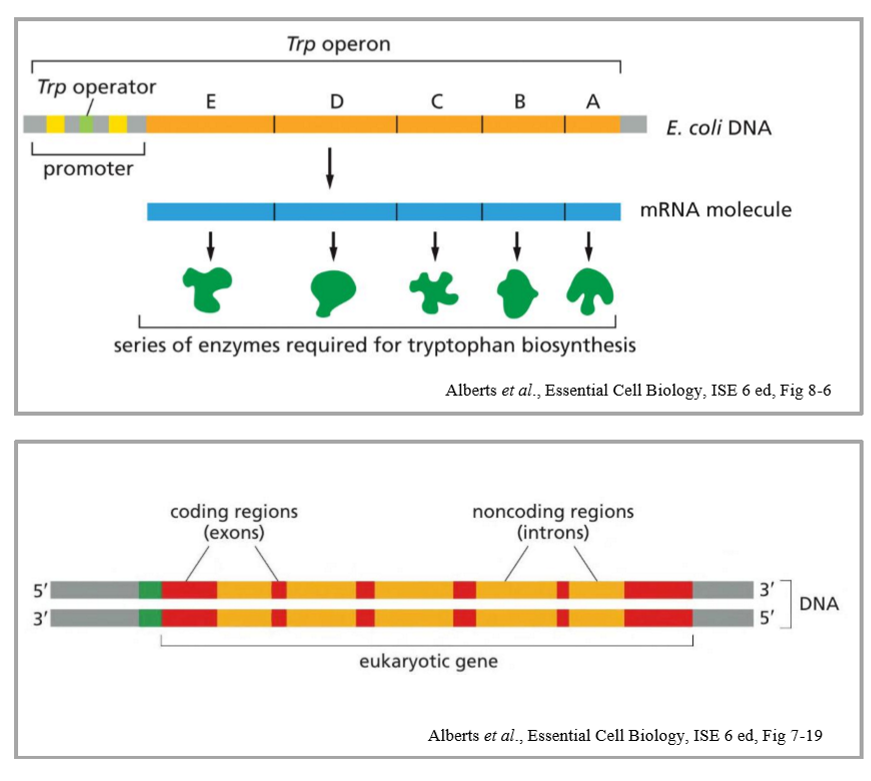
prokaryotic genes are often (?)
polycistronic → encode for multiple proteins
polycistronic genes are expressed under the control of (?) promoter
one
prokaryotic genes often involve simple regulatory sequences consisting of a (a) and a (b)
(a) promoter
(b) operator
eukaryotic genes are usually (?)
monocistronic → encode for one protein
prokaryotic vs eukaryotic genes
polycistronic vs monocistronic
eukaryotic genes have introns
complex vs simple promoters reflecting complexity of organism
coordinated expression of a set of proteins that are required at the same time requires coordinated regulation of those genes
eukaryotes use three different RNA polymerases (name and describe)
RNA polymerase I
transcribes rRNA genes: 5.8S rRNA, 18S rRNA AND 28s rRNA genes
RNA polymerase II
a) transcribes mRNA genes
b) aids mRNA splicing
c) guides chemical modifications of RNAs (e.g. tRNAs)
RNA polymerase III
transcribes tRNA genes: 5S rRNA gene, some snRNA genes
each eukaryotic RNA (?) requires different promoter elements and different transcription factors
polymerase

a composite core promoter containing a TATA box and initiator sequences just upstream of the transcription start site → what binds here?
general transcription factors and RNA polymerase II
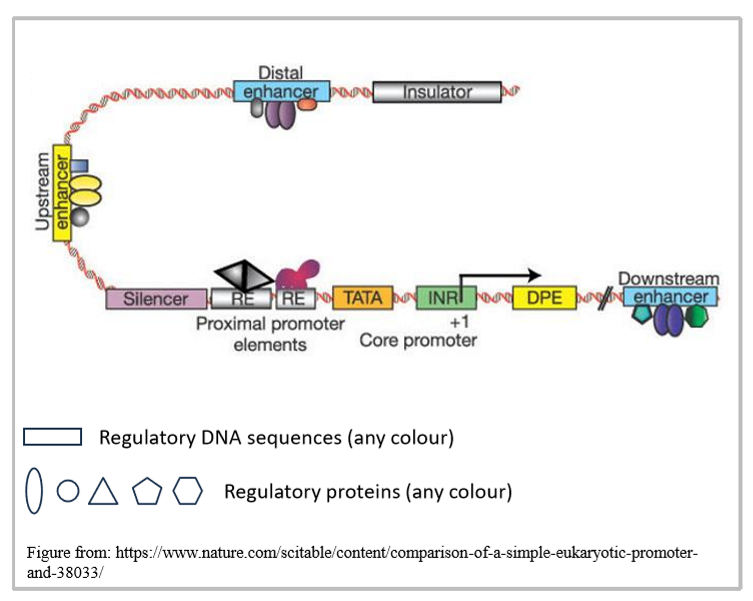
proximal promoter elements within 200 base pairs of composite core promoter → what binds here?
cell or tissue specific transcription factors

downstream promoter elements (DPEs) → what binds here?
some general transcription factors

distal promoter elements → what binds here
enhancers → activating transcription factors bind here
silencers → gene repressing transcription factors bind here

insulator action
prevent distal enhancers from acting on the promoter of neighboring genes or prevent spread of heterochromatin

eve gene expression
eve gene expression is controlled by several regulatory DNA segments → each binding different regulatory proteins
the regulatory segment that directions the formation of stripe two in the embryo (B) can be excised from the DNA and inserted upstream of the E. coli lacZ gene → encodes for B-galactosidase
B-galactosidase can convert a colourless substrate into a blue product → ‘reports’ the regulation of gene expression mediated by segment 2
when the reporter fusion DNA is introduced into the genome of a fly (D), the blue colour shows where the resulting embryo expresses B-galactosidase → precisely in the position of the second eve stripe
general TFs position RNA polymerase (?) close to the transcription site, this is similar to the role of the prokaryotic sigma factor
II
the assembly of general TFs and the eventual RNA polymerase II occurs at what site along the DNA in eukaryotes?
core promoter

the TATA binding protein (TBP), a subunit of TFIID, binds to the (?) in the core promoter and bends the DNA
TATA box

explain what is occurring in this diagram
general TFs position RNA polymerase II close to the transcription site
the assembly of general TFs occurs at the core promoter of protein encoding genes
the TATA binding protein (TBP), a subunit of TFIID, binds to the TATA box in the core promoter → bends the DNA
TFIID also binds the transcription start site and downstream promoter elements
TFIIB, TFIIE and TFIIH sequentially assemble at the core promoter
TFIIF positions the RNA polymerase II at the transcription start site → preinitiation complex
TFIIH binds and uses energy to pull apart the DNA double helix → template strand exposed
TFIIH phosphorylates RNA polymerase II → allows transcription to begin
most of the general TFs dissociate from the core promoter

cell or tissue specific transcription factors
TF DNA binding domain → amino acid sequence that interacts with DNA
cell/tissue specific TFs bind via non-covalent interactions between amino acid side chains and DNA → major groove of DNA
bind to proximal, distal, and downstream promoter elements
often bind as dimers → two TF proteins
the TF dimer also contains an activation or repression domain → amino acid sequence that regulates gene expresion

the regulatory effects of many TFs is mediated by the mediator complex
a multiprotein complex that brings the activities of transcriptional regulator together so that they can aid transcription by helping to assemble:
RNA polymerase II
general transcription factors
chromatin remodeling complexes
histone modifying enzymes

a typical eukaryotic gene is controlled by (?) TFs
many
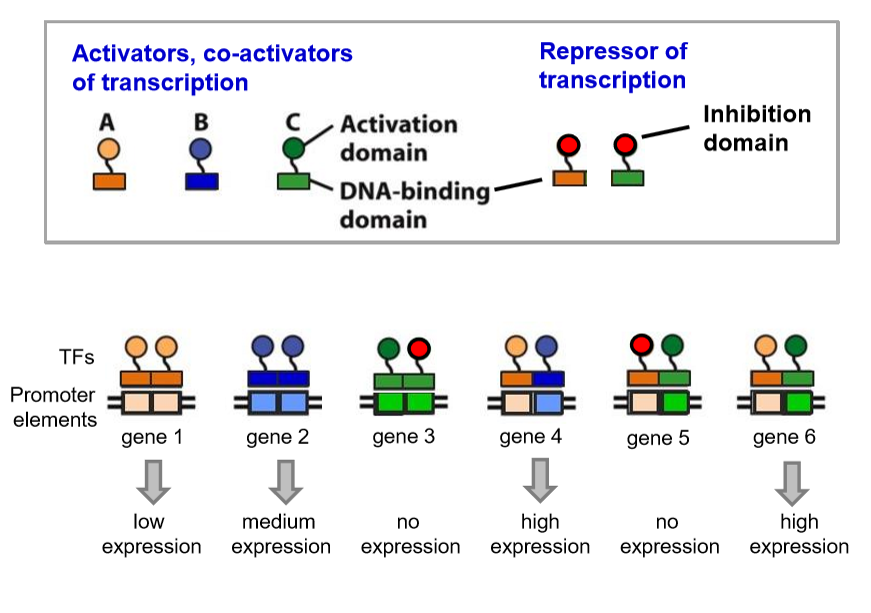
combinational control of eukaryotic gene expression
many transcription factors are active at any one time in a cell and can interact with:
RNA polymerase
each other → homodimer
other TFs → heterodimer
TFs can act as activators, co-activators or repressors of transcription
repressors of transcription interfere with the binding of a TF to DNA elements
the combination of TFs bound to regulatory DNA elements determines the outcome of gene expression


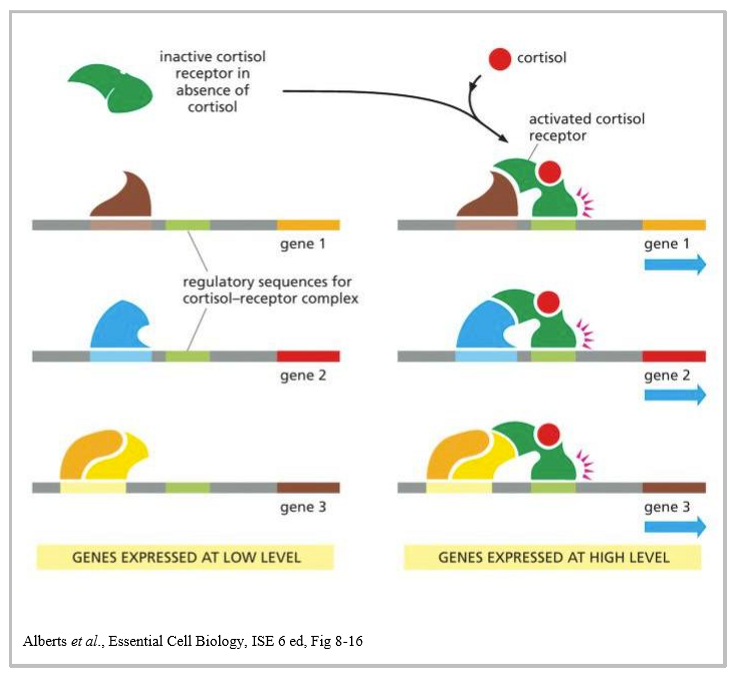
transcription factors can be regulated (explain using cortisol as an example)
gene 1,2 and 3 have TFs bound to their respective promoter elements
these TFs are not sufficient to activate transcription effectively → low gene expression
the presence of cortisol activates the cortisol receptor forming a cortisol receptor complex
activated cortisol receptor complex binds to the cortisol receptor binding sequence
this sequence is found in promoters of the three genes
this activates efficient transcription of the three genes at high levels
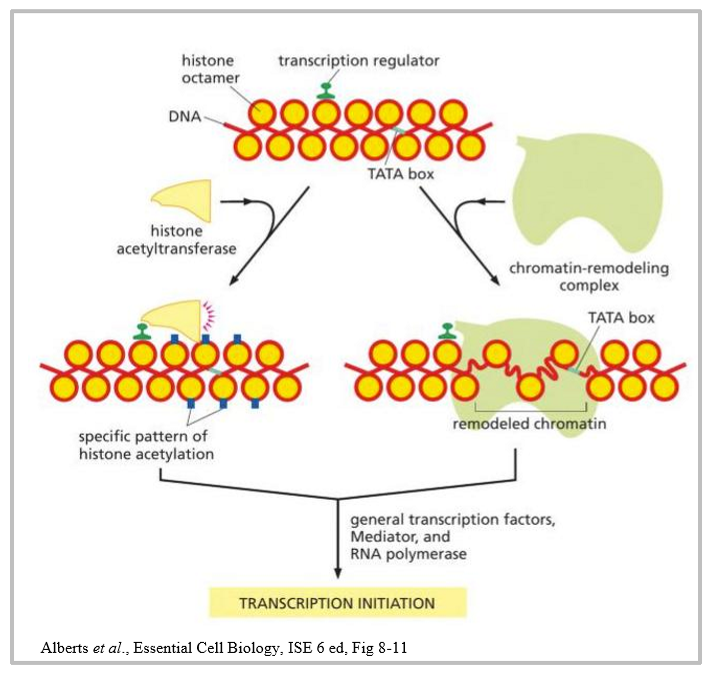
histone modifying proteins can change (?) structure
chromatin → by influencing the accessibility of DNA to transcription factors e.g. exposure of the TATA box

chromatin remodeling complexes can change chromatin structure by:
activating transcription regulators → recruit chromatin modifying proteins via the mediator complex →open up chromatin → transcription
repressing transcription regulators → recruit chromatin modifying proteins via the mediator complex → close chromatin → no transcription
DNA methylation
addition of methyl groups to DNA via DNA methyltransferases

in vertebrates, DNA methylation is confined to selected cytosine nucleotides next to a (?)
guanine

methylation is symmetrical
methyl group added to both DNA strands
methylation of cytosines in gene promoters prevents:
binding of transcription factors
methylation of cytosine recruits (?) modifying enzymes
chromatin → e.g. histone deacetylases which causes condensed chromatin
less methylation results in (?) condensed chromatin
less → therefore gene expression turned on → transcription
de novo methylation
regulate gene expression by methylating non-methylated cytosines on both DNA strands
histone modifications and DNA methylation are examples of:
epigenetic modifications → heritable, reversible and do not change the DNA sequence
epigenetic differences in identical twins
begin life with the same genetic information including epigenetic tags
over a lifetime the twins’ environment will diverge
resulting in individual epigenetic tags forming in each twin
difference in the epigenome is what makes them become different as they age
environment and diets produce (?) changes that affect growth, development and long-term health
epigenetic
DNA methylation in normal vs cancer cells
normal cells → CpG islands residing in promoter regions of genes are often hypomethylated/unmethylated → genes expressed
cancer cells → CpG islands become hypermethylated
which results in silencing of their associated genes → e.g. tumor suppressor genes are often silenced in cancer cells due