9.8 Electron Affinities and Metallic Character
 Call Kai
 Learn
 Practice Test
 Spaced Repetition
 Match
 Flashcards
 Knowt Play
1/12

There's no tags or description
Looks like no tags are added yet.
13 Terms
electron affinity (EA)
energy change associated with gaining of an electron by the atom in a gaseous state

releases, more, decreasing
Electron affinity is usually (not always) negative because an atom or ion usually ________ (gains/releases) energy when it gains an electron. Usually, when an atom or ion gains an electron, it moves to a ___ (more/less) stable state, __________ (increasing/decreasing) its potential energy.

releases, negative
The electron affinity process is analogous to an exothermic reaction, which _____ (gains/releases) heat and therefore has a ________ (positive/negative) change in enthalpy.

release
The coulombic attraction between the nucleus of an atom and an incoming electron usually results in the _____ (gain/release) of energy as the electron is gained.

positive, less
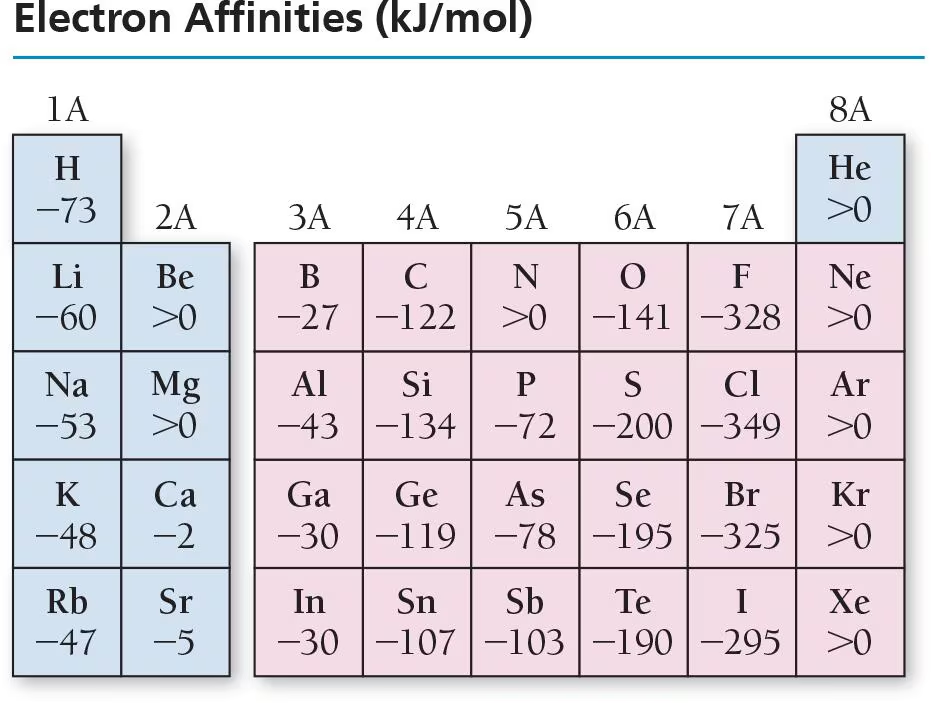
In group 1A metals, as we move down a column, electron affinities become relatively more ________ (positive/negative) because the electron is located in orbitals with successively higher principal quantum numbers and therefore is farther from the nucleus. Thus, the addition of an electron as we move down the 1A column is ___ (more/less) exothermic.

false
(true/false) Electron affinity always becomes more positive when moving down a column.

negative
For main group elements, electron affinity generally becomes more ________ (positive/negative) as we move to the right across a row in the periodic table as the element to the right is closer to noble gas configuration and experiences higher effective nuclear charge.

negative
The halogens (group 7A) have the most ________ (positive/negative) electron affinities.
positive
Elements with full ns orbitals (group 2A) have more ________ (positive/negative) electron affinities than elements in the previous column.

positive
Elements with half-full np orbitals (group 5A) have more ________ (positive/negative) electron affinities than elements in the previous column due to the repulsion which occurs between two electrons when they occupy the same orbital.

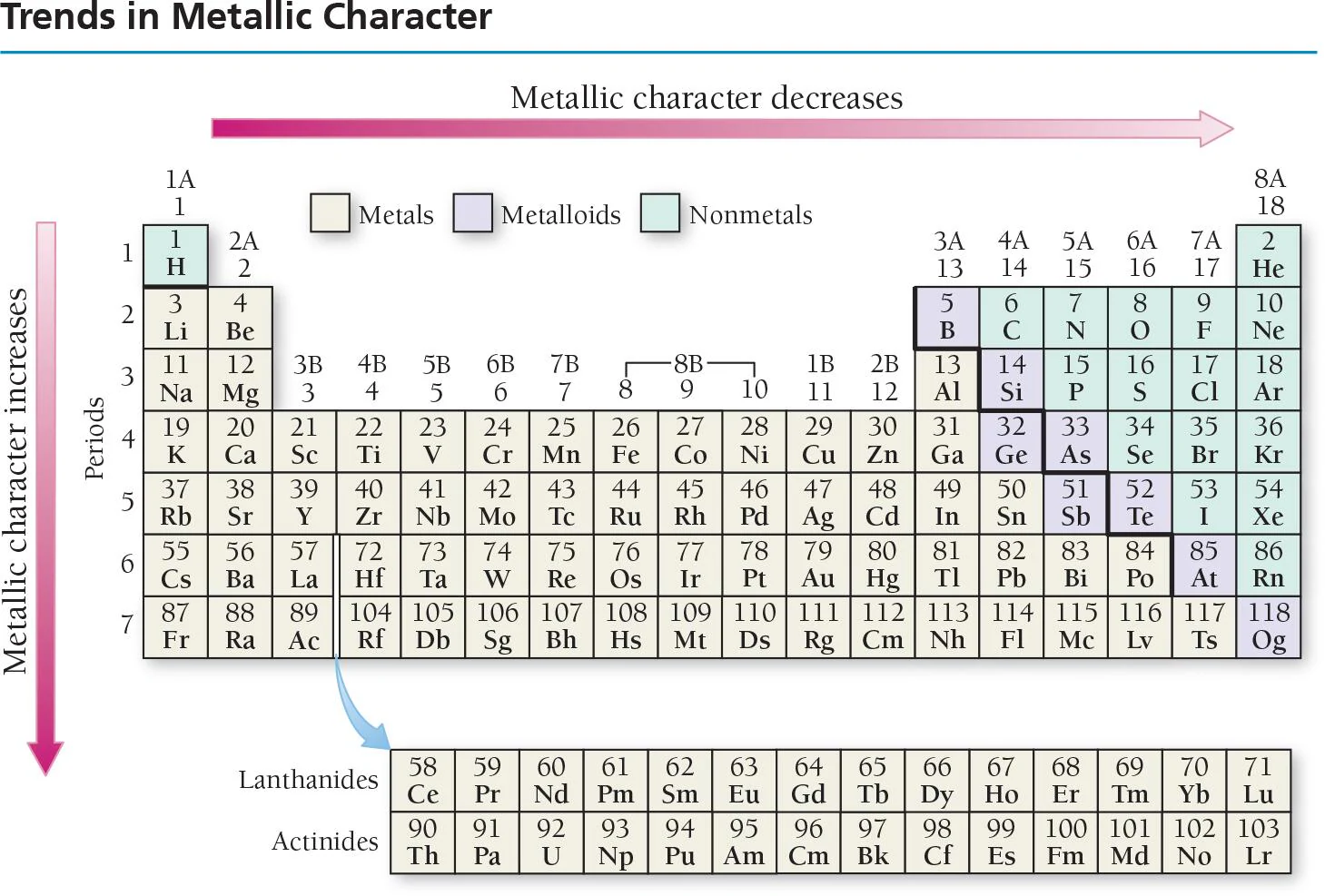
metallic character
how closely an element’s properties match the ideal properties of a metal (more malleable and ductile, better conductors, easier to ionize)

decreases, increases, negative
As we move to the right across a row (or period) in the periodic table, metallic character __________ (increases/decreases): ionization energy __________ (increases/decreases) and electron affinity becomes more ________ (positive/negative).

increases, decreases
As we move down a column (or family) in the periodic table, metallic character __________ (increases/decreases): ionization energy __________ (increases/decreases), making electrons more likely to be lost in chemical reactions.