Biology Lab Part 2
 Call Kai
 Learn
 Practice Test
 Spaced Repetition
 Match
 Flashcards
 Knowt Play
1/78

There's no tags or description
Looks like no tags are added yet.
79 Terms
What is an introduced species?
A plant , animal, or microorganism that is not native to an area.
What is an invasive species?
Introduced species that cause economic environmental, or ecological damage.
What is mechanical control?
involves the physical removal of invasive species from an area.
What is chemical control?
This method utilizes pesticides to kill invasive species and prevent their spread.
What is biological control?
involves the release of natural enemies, such as predators, parasites, parasitoids, or pathogens, to manage invasive species.
What are natural enemies?
an organism that controls the population of another organism by preying on it, parasitizing it, or causing disease
How do natural enemies compete with invasive species and enhance their effectiveness as biological control agents?
They are imported from the native habitat of the invasive species.
What are the advantages and disadvantages of biological control?
It can provide a natural way to get rid of invasive species but then it in itself can become they invasive species.
What are entomopathogenic nematodes (EPN)?
Microscopic, soil-dwelling roundworms that specifically parasitize and kill insects.
How are they used to control invasive species?
They targeted biological control programs that exploit the soil-dwelling life stages of non-native insect pests.
What is a pesticide?
A pesticide is any chemical substance used to kill or prevent the growth of an unwanted or harmful organism.
What is a inorganic pesticides?
These are minerals that are mined from the earth and ground into powder for use; for example, boric acid.
What is a botanicals?
These are pesticides extracted from plants; an example is pyrethrum, derived from chrysanthemum flowers.
What is a microbial pesticides?
These consist of microorganisms or their by-products; for instance, Bacillus thuringiensis (Bt) is used to control mosquitoes and moths.
What do stomach poisons do?
These pesticides are ingested by pests during feeding and cause death through poisoning.
What do contact poisons do?
These enter the pest's body through the skin and lead to death by poisoning.
What do systemic poisons do?
These are absorbed by a host insect or plant and are distributed throughout its tissues.
What do desiccants do?
This type of insecticide abrades the cuticle of insects, leading to loss of body fluids and death by dehydration.
What is diatomaceous earth (DE), and how is it used for biological control?
A desiccant used to control insects like ants and aphids, its used for bio control by absorb fats and waxy oils from insects causing it to dehydrate and die.
What is a compound microscope?
A type of light microscope that has two sets of lenses and is used for the observation of small specimens or section of specimens that are mounted on slides.
What is a dissecting microscope?
A type of light microscope that is used for the observation or manipulation of larger or whole specimens at low magnification (up to 100 times).
How do you calculate total magnification?
Objective lens magnification times ocular lens magnification.
What is total magnification?
The final amount that an object's image is enlarged by a microscope or optical system compared to its actual size.
Define the field of view and photomicrograph.
The total diameter or extent of the circular area of a specimen that is visible through a microscope's eyepiece or camera sensor at a specific magnification.
Describe the steps to prepare wet mounts.
Clean the slide then add your liquid. Next position the specimen and apply the cover slip. then lower the coverslip gently and blot off any excess liquid.
What is the importance of water quality on human health?
Potential presence of pathogens, disease-causing organisms such as bacteria, viruses, and protozoa can greatly damage or cause death to the human body.
What are the uses of freshwater other than human consumption?
Agriculture, Irrigation, Industry, Manufacturing, Thermoelectric Power, and Energy.
How can water resources become contaminated?
Through point source pollution and non-point source pollution.
What is point source pollution?
Occurs when contaminants enter the water supply from a single, identifiable source, such as a water treatment plant or farm operations.
What is non-point source pollution?
Cannot be traced to a single source and may include a septic tank overflow or chemical spills.
Define pathogens.
Any organism or agent—commonly called a germ that causes disease or damage to its host.
Define a bacteria colony.
A visible cluster of millions of identical bacterial cells growing together on or within a solid medium.
What is the maximum allowable number of E. coli colonies in 100 mL of drinking water?
Zero.
How are coliforms used as an indicator of water quality?
They indicate the presence of more harmful microorganisms.
How do you calculate the number of Colony Forming Units (CFUs) and CFUs per 100 ml?
CFU/mL= mean # of colonies/ amount of sample used.
What purification methods were tested in the lab to check their effectiveness on water purification?
UV sterilization, Chemical sterilization, and Filtered sterilization
What is the purpose of adding this treatment (Untreated) to the experiment?
It is the control variable that we compare are methods to.
Which treatment was the most effective in your lab?
The mechanical treatment was the most effective in my lab because it physically filtered out the water and got a lot of the bad material out.
How is the Coliscan medium used to detect coliforms?
It uses chromogenic substrates (sugars linked to specific dyes) that react with bacterial enzymes.
What is the difference between Galactosidase vs. glucuronidase enzymes?
They target different chemical substrates and serve distinct biological and diagnostic roles.
What is the color colony guide?
E. coli: dark blue/purple; other coliforms: pink/red.
Define ecology.
The study of the interactions between organism and their physical environment.
Define abiotic components.
Non-living components that include water, light, soil, nutrients, and weather.
Define biotic components.
Living components of the ecosystem that include animals, plants, bacteria, etc.
What units were used to measure each of the quality parameters evaluated?
Temperature, pH, dissolved oxygen, electrical conductivity, nitrate, and phosphate.
How were the abiotic components used to determine the health of the water habitat?
They were used to the determine the health by showing if the ecosystem had enough of these elements to sustain life.
Explain the process of eutrophication and algal bloom.
Eutrophication is where near by chemicals are introduced into a lake or pond creating an excess of nutrients. These nutrients (like phosphates and nitrates) create a algal bloom.
Define trophic level.
The position an organism occupies in a food chain, food web, or ecological pyramid, categorized by how it obtains its energy.
Define food chain.
The transfer of energy between trophic levels.
Define food web.
Several interconnected food chains.
Which of the following is a trophic pyramid?
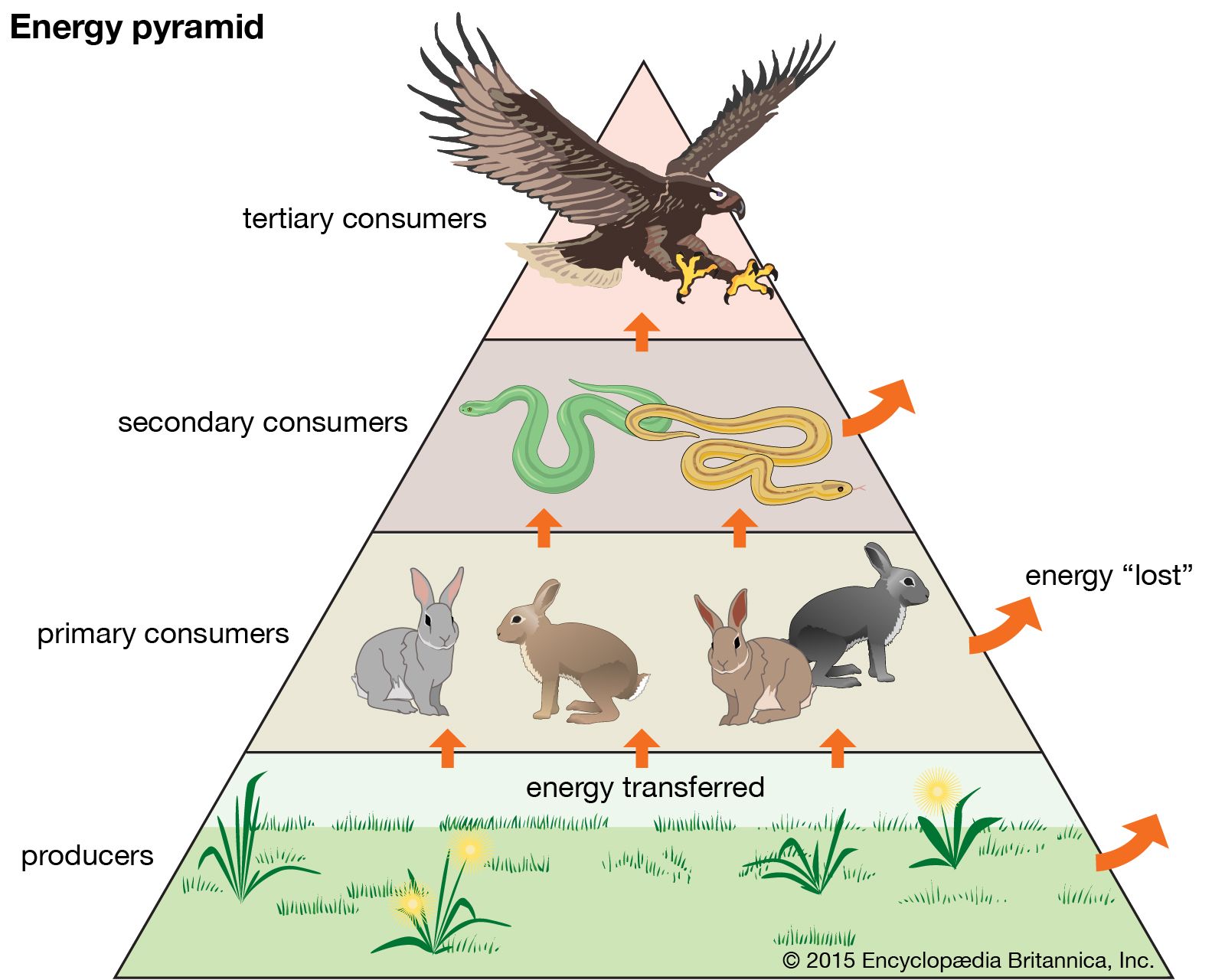
What are producers?
Autotrophic organisms that convert the Sun’s energy into food through photosynthesis..
What are consumers?
Are heterotrophic organism that acquire their food by eating producers or consumers. Can be further divided into herbivores, carnivores, and omnivores.
What are the differences between herbivores, carnivores, omnivores, and detritivores.
Herbivores only eat plant matter; Carnivores only eat animals or meat; Omnivores eat both plants and animals/meat; Detritivores feed on dead and decaying organic matter.
Differentiate between autotrophs and heterotrophs.
Autotrophs and heterotrophs are the two main groups of living things based on how they get their food and energy.
How does the trophic structure determine the health of a water habitat?
Unstable or unhealthy ecosystems have an unbalanced pyramid.
Which biotic components were studied to assess the health of the water habitat?
Plants, macroinvertebrates, and plankton.