Lesson 3 (Fleas & Tree Bugs)
 Note
Note Call Kai
 Learn
Learn Practice Test
 Spaced Repetition
 Match
Match Flashcards
 Knowt Play
1/18

Earn XP
Description and Tags
Flashcards about Fleas (Siphonaptera)
Name | Mastery | Learn | Test | Matching | Spaced | Call with Kai | Chat |
|---|
No analytics yet
Send a link to your students to track their progress
19 Terms
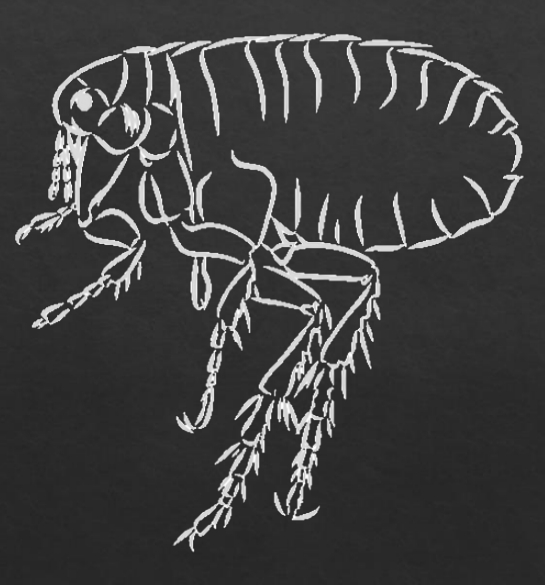
What are the key characteristics of Order Siphonaptera (Fleas)?
Small, wingless, and laterally flattened insects with mouthparts designed for piercing and sucking blood. Both males and females are blood feeders and possess long, strong legs. They have a Holometabolous (complex) life cycle.
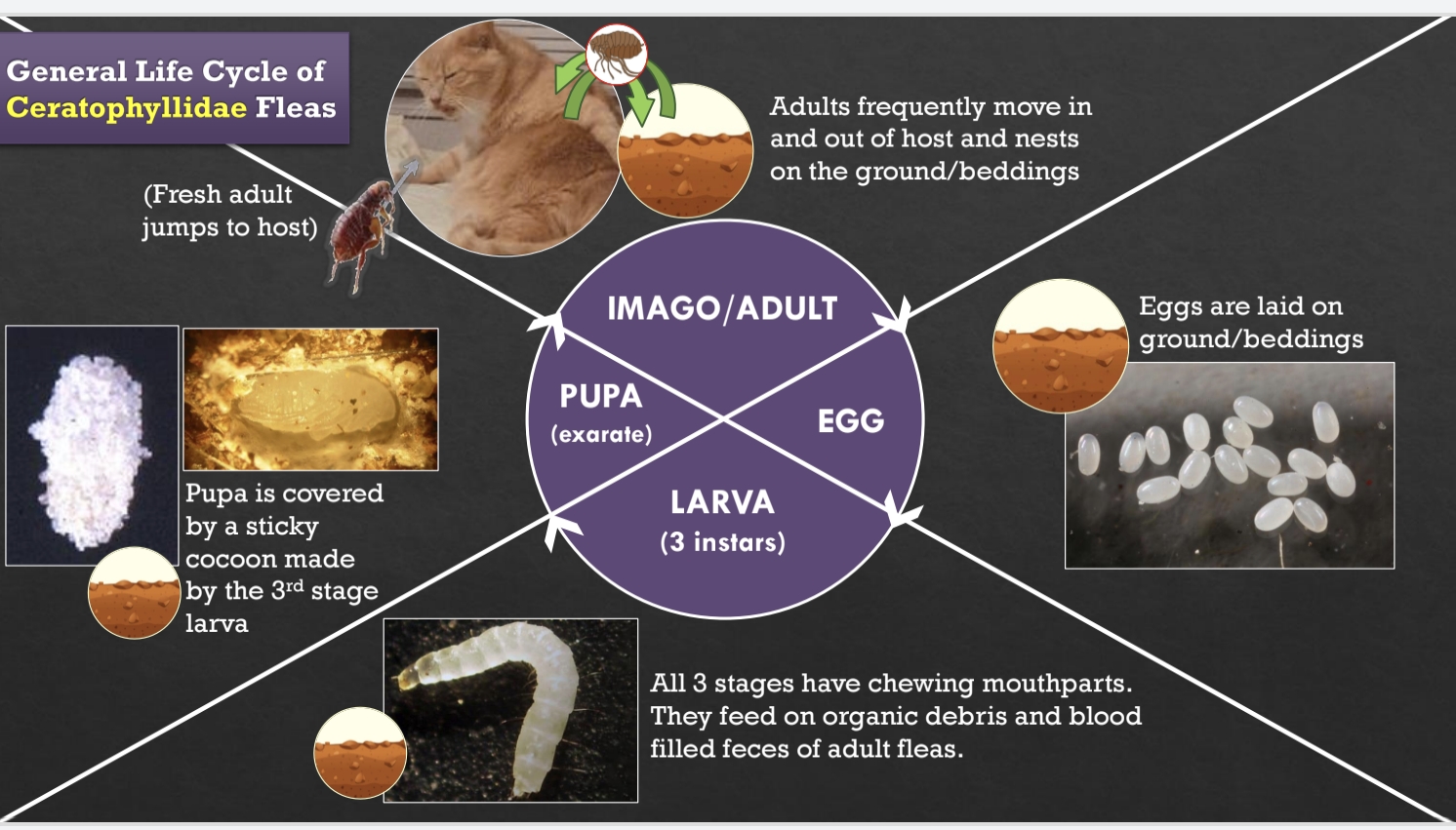
What are the stages in the general life cycle of fleas?
Eggs are laid on nests/beddings/ground, Larvae (3 instars) are maggot-like with chewing mouthparts that feed on blood-filled feces of adult fleas and organic debris, Pupa is an Exarate-type covered by a silk-like cocoon, and Adult females start developing eggs after the 1st blood meal.
What are the important structural features that aid in the identification of fleas?
Genal Ctenidia/Combs (dark spines on the ventral aspect of the head) and Pronotal Ctenidia/Combs (dark spines on the posterior aspect of the prothorax).
What is the primary sexual dimorphism observed in fleas?
Females are larger with rounded ventral and dorsal surfaces, while males have a flatter dorsal surface, a greatly curved ventral surface, and a coiled copulatory structure called aedeagus in the abdomen.
What is the lifecycle trend of fleas in the family Ceratophyllidae (Order Siphonaptera)?
Infrequent and brief associations with the host, adults move between hosts to feed and back to nests to lay eggs.
What is the lifecycle trend of fleas in the family Pulicidae (Order Siphonaptera)?
Adult fleas have prolonged association with the host; eggs are laid on the host and drop off later.
What is 'flea dirt'?
Dark reddish-brown colored, blood-filled feces of fleas, found on the skin/fur and beddings of infested animals.
What is the main characteristic of fleas in the family Ceratophyllidae?
Has no genal combs, but has many pronotal combs.
What are the hosts of Ceratophyllus gallinae (Chicken Flea)?
Domesticated poultry and wild birds.
What are the hosts of Nosopsyllus fasciatus (Northern Rat Flea), and what diseases can it vector?
Rodents and humans. It can vector Rickettsia typhi (murine typhus) and possibly Yersinia pestis (black plague).
What are some common species in the family Pulicidae?
Ctenocephalides spp., Spilopsyllus cuniculi, Echidnophaga gallinacae, Pulex irritans, Xenopsylla cheopis, and Tunga penetrans.
What diseases are associated with Ctenocephalides felis felis (Cat Flea)?
IH of Dipylidium caninum (via accidental ingestion), Transmits Rickettsia typhi (typhus), Transmits Bartonella henselae (Cat-scratch fever)
What are the key identification features of Ctenocephalides felis felis (Cat Flea)?
Pronotal combs: 16; genal combs: 7-8; elongated head, pointed anteriorly; 6 notches w/ setae on dorsal border of hindleg tibia; 1st genal spine is shorter.
What are the key characteristics of Spilopsyllus cuniculi (Rabbit Flea)?
Life cycle is mediated by hormones of the rabbit host. Transmits Francisella tularensis (tularemia).
Where is Echidnophaga gallinacea (Sticktight Flea) commonly found on poultry?
Often found on the head, comb, or wattles of poultry, causing ulcerations.
What are the key characteristics of Xenopsylla cheopis (Oriental Rat Flea)?
No prenatal or genal combs; single ocular bristle in front of eye; row of bristles on posterior margin of head; transmits Yersinia pestis (Bubonic/Black Plague).
What are the key characteristics of Pulex irritans (Human Flea)?
Single ocular bristle below eye; IH of Dipylidium caninum (via accidental ingestion).
What is the unique parasitic behavior of Tunga penetrans (Jigger/Chigoe)?
Females slash the skin of the host and burrows into the wound, leaving only the last abdominal segments on the skin surface.
What are the common methods to prevent and control fleas?
Spot-on treatments (Fipronil, Imidacloprid, Nitempyram) or oral anti-flea medication (Selanomectin) and vacuuming to reduce eggs, larvae, pupae, and unfed adults in the environment.