Water Balance
 Call Kai
 Learn
 Practice Test
 Spaced Repetition
 Match
 Flashcards
 Knowt Play
1/5

There's no tags or description
Looks like no tags are added yet.
6 Terms
How do marine teleost (bony) fish osmoregulate in seawater (hyperosmotic environment)?
The internal body fluids of the bony fish are hyposmotic to the seawater, which means water naturally moves out of the fish’s body acoss permeable surfaces via osmosis. Salts (Na+, Cl-, etc) passively diffuse into the body down their concentration gradient.
To replace the lost water, the marine teleosts constantly drink seawater. However, this brings in excessive amounts of salt. The high salinity water enters the digestive tract, where the epithelial cells actively transport Na+ (and Cl-) from the intestinal lumen into the surrounding tissues. This creates a local osmotic gradient, allowing water to passively flow by diffusion from the intestine into body tissue. Undigested salts and minimal water are excreted in feces.
This creates a high solute conc in the tissue right next to the gut wall, where water then flows into the tissue.

Describe gill excretion and renal excretion in the
Chloride cells in the gills actively pump out excess monovalent ions.
Cl- is actively extruded, while Na+ leaves via active transport or passive outflux.
The kidneys produce only a small volume of urine to conserve water. The urine is nearly isosmotic to blood plasma, and seves as the primary route for clearing divalent ions like Mg2+ and SO42-.
Describe the chloride cell. How is NaCl secreted from the epithelial into the chloride?
The cytoplasm is packed with mitochondria and an extensive tubular netweork. this proves the massive ATP energy supply needed to drive ctive ion transport against steep concentration gradients.
The apical surface of the cell forms pockets (crypts) exposed to ampient seawater, where ions are dumped.
The cell is sandwiched between pavement cells and adjacent epithelial cells, forming tight juncitons between them.
The Na+/K+ ATPase pump actively pumps 3 Na+ ions out of the chloride cell into the blood in exchange for 2K+ ions entering the cell. This keeps intracellular Na+ levels extremely low. It generates a strong electrochemical gradient favoring Na+ influx back itno the cell. Internal K+ diffuses back out to the blood to maintain membrane potential.
Na+-K+-2Cl- cotransporter (NKCC) uses the steep inward Na+ grad to bring NKC from the blood into the cell. The concentrates Cl- inside the cell above its electrochemical equilibrium. Because Cl- has accumulated inside the cell, it passively diffuses out through apical anion channels into the apical crypt down its conc gradient. As negative Cl- accumulate in the apical crypt and seawater, a net negative electrical charge builds up outside. THis negative charge draws positively charged Na+ ions from the blood to pass between the cells (leaky tight junctions) into the ambient water down its electrochemical gradient.

Describe the nasal salt glands in seabirds.
The salt gland contains thousnds of blind-ended secretory tubules that drain into a central duct, which ultimately carries the hypertonic fluid to the nostrils for excretion.
Blood flows through capullaries surrounding the tubules from the central duct end towards the blind end. Where secretory fluid inside the tubule flows in the exact opposite direction, from the blnd end towards the centract duct. This countercurrent exchange maintains a concentratino gradient along the entire length of the tubule, maximising the total amount of Na+ and Cl- transferred from the blood into the fluid.

Describe how freshwater teleost osmoregulate.
The body fluids of the freshwater fish are hyperosmotic to ambient water, where now water constantly flows into th ebody across thin, permeable membranes (mostly the gills). Essential salts constantly leak out into the diluted environment.
Strategy:
They do not drink ambient water because they are already taking in too much water passively.
The kidneys excrete large amounts of very hypoosmotic urine to purge excess water while reabsorbing as many ions as possible.
Specifilised gill epithelial cells actively pull Na+ and Cl- from dilute pond water into the bloodstream.

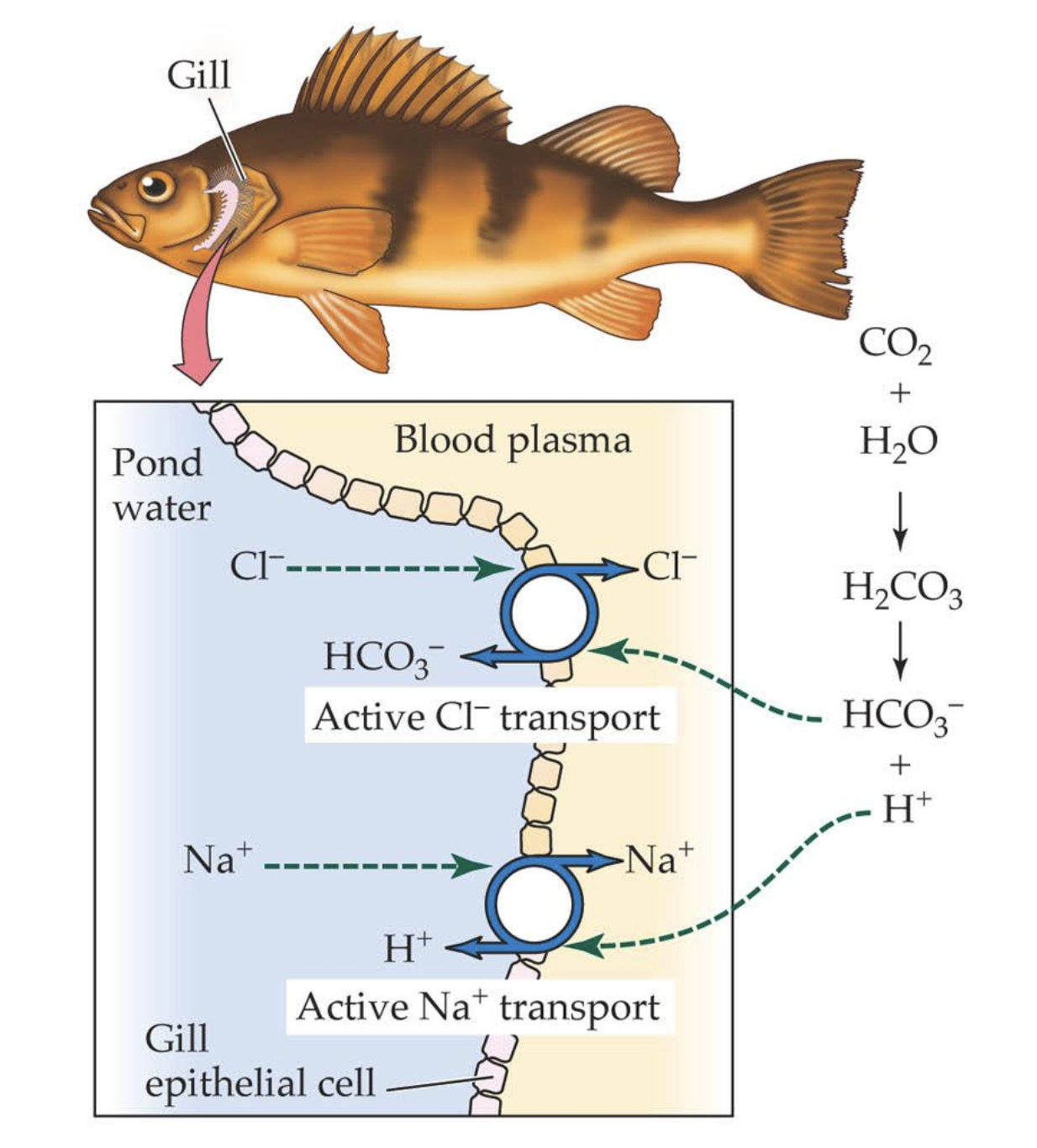
Describe the mechanism of osmoregulation in freshwater teleost in the gills.
Inside the gill epithelial cell, metabolic waste CO2 reacts with H2O to fomr carbonic acid, which dissociates into bicarbonate and proton ions.
The cell actively pumps Cl- in from pound water to blood plasma. To maintain electroneutrality, it exchanges each incoming Cl- by pumping one HCO3- out into the pond water. The cell actively pumps Na+ in from pond water to blood plasma. it exchanges each incoming Na+ by pumping one H+ out into the pond water.