2.3 Functional Groups and Complex Organic Compounds
 Call Kai
 Learn
 Practice Test
 Spaced Repetition
 Match
 Flashcards
 Knowt Play
1/77

There's no tags or description
Looks like no tags are added yet.
78 Terms
Bees live in highly organized communities called-
Colonies
What are some examples of plants that are pollinated by bee colonies?
Beans
Squash
Cucumber
Coffee trees
Cacao trees
Apples/oranges/grapes
Name the 3 types of bees
Worker
Queen
Drone
A bee colony (or hive) is controlled by who?
One female bee- the queen
What is the role of the Queen Bee?
She produces chemical signals that controls the behaviour of the bee colony
What are the Queen’s chemicals called?
Queen Mandibular Pheromones
What is a cool chemical thing about the Queen’s pheromones?
The existence of a tiny functional group containing a double bond or an oxygen atom
It can modify the behaviour of an entire colony of bees
What are some things the Queen pheromones can make the other bees do?
Maintaining the hive
Causing a swarm
Mating
Birth control for female worker bees
The molecules in the Queen pheromones all include what?
Carbon-to-Carbon bonds
Carbon-to-Hydrogen bonds
Oxygen bonded to Carbon with a single or double bond
When a Carbon is bonded to a Hydroxide ion (OH-), the molecule is classified as a what?
An alcohol
In the alcohol molecule, the Hydroxide ion is called what?
A Hydroxyl group

A molecule classified as an alcohol has what?
One Carbon atom bonded to an Oxygen atom through a single bond
A molecule classified as an ether as what?
Two Carbon atoms bonded to an oxygen atom with single bonds
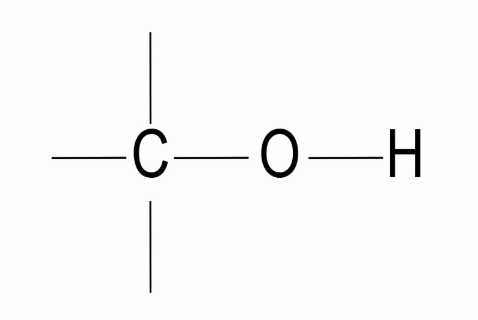
Is this an alcohol or an ether?
Alcohol
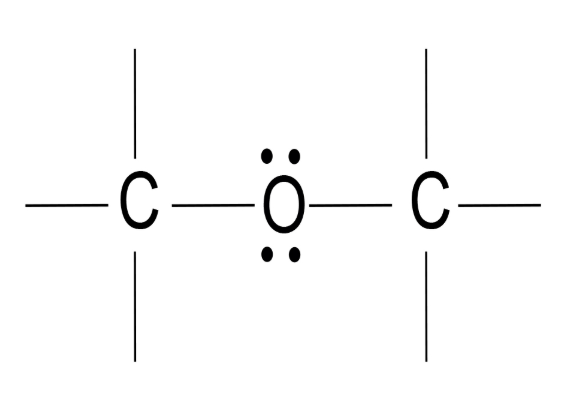
Is this an alcohol or an ether?
Ether
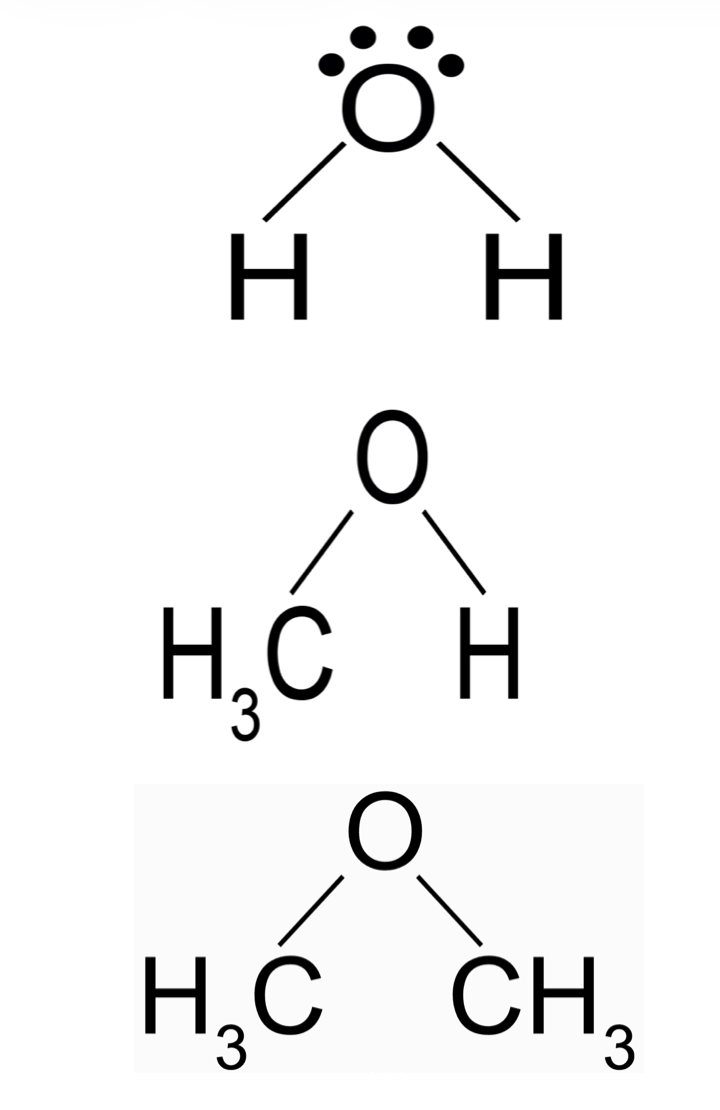
When bonding, if Oxygen has two pairs of non-bonding electrons, what happens to the molecule?
It’s bent
How do the molecules of water, methanol, and dimethylether look similar?
Alcohol: one Hydrogen atom → hydrocarbon chain
Ether: both Hydrogens → two hydrocarbon chains
What is the name of the specific alcohol in wine?
Ethanol
Describe fermentation for wine
Yeast digests sugar in a solution
CO2 is a byproduct; ethanol is a byproduct
We’ve already learned that Ethyl is two Carbon atoms which is the same in this lecture for-
Ethanol
Has 2 Carbons
How do you name alcohols?
Similar to Hydrocarbons we already learned
Alkanes: -ane ending is chaned. -an stays but e become -ol
When alcohols contain more than one alcohol functional group, what are they called?
Polyalcohols
When naming polyalcohols, what must you remember?
To add di/tri befor the -ol ending
How many subclasses of alcohols are there? What are their names?
Primary
Secondary
Tertiary
How are alcohols subclassified?
According to the type of Carbon atom the -OH group is bonded to
Describe primary alcohols
-OH group is bonded to a Carbon atom that is bonded to only one other Carbon atom

Describe secondary alcohols
-OH group is bonded to a Carbon atom that is bonded to two other Carbon atoms

Describe tertiary alcohols
-OH group is bonded to a Carbon atom that is bonded to three other Carbon atoms

What is an anesthesiologist?
Someone who administers a safe and appropriate dose of an anesthetic to relieve pain or render someone unconscious during surgery
Describe the first documented use of a surgical anesthetic
Boston, 1844
A dentist administered Nitrous Oxide (N2O) for a tooth extraction
What is diethylether?
Organic compound whose effects lasted longer than N2O
BUT caused vomiting
Used today as a solvent for fats/oils
An ether is a class or organic compounds where an Oxygen is attached to-
Two alkyl groups
If an ether has Oxygen in it, how can you think about the chain?
The Oxygen atom divides the ether molecule’s Carbon chain into two halves
How do you name ethers?
Attach the suffix -oxy to the name of the shortest chain that flanks the Oxygen atom
The longest chain becomes the parent chain
Just like water, alcohols and ethers are-
Polar solvents
Do alcohols and ethers become more or less polar as the number of Carbon groups in their chains increases?
Less polar
_____ _____ is the primary force responsible for the attraction that occurs among alcohol molecules
Hydrogen bonding
As a result of Hydrogen bonding, the boiling point of an alcohol is _____ than that of an alkane with a similar number of Carbon atoms
Higher
Ethers lack the _____ _____ _____ and are therefore unable to form Hydrogen bonds the way water and alcohols can
Hydroxyl functional group

What is this?
A carbonyl functional group
Aldehyde and Ketone functional groups are based on a _____ _____ _____
Carbonyl functional group
Aldehydes and Ketones have at least one _____ _____ . Which is what?
Carbonyl group
A Carbon atom double-bonded to an Oxygen atom
Describe the main difference of Aldehydes from Ketones?
An Aldehyde’s Carbon in the Carbonyl group has one Carbon on one side and one hydrogen on the other

Describe the main difference of Ketones from Aldehydes?
A Ketone’s Carbon in the Carbonyl group is flanked on either side by Carbons

An Aldehyde parent chain begins where? Where does it terminate?
Parent chain begins with the Carbon atom that is double bonded to Oxygen
Terminates in a single Hydrogen atom
When naming Aldehydes, what does the ending become?
-al
Alkane -ane ending but remove the -e and replace with -al
Ketones are similar to Aldehydes except where is the Carbonyl group?
In the middle
(found at the end for Aldehydes)
For naming Ketones, what does the ending change to?
-one
Keep -an from Alkanes and change -e to -one
Aldehydes and Ketones have _____ boiling points than alcohols with a similar number of Carbon atoms. Why?
Lower
Both lack the Hydroxyl group so they can’t form Hydrogen bonds
Aldehydes and Ketones have a Carbonyl group and the presence of this group makes the molecules quite _____
Polar
The presence of the Carbon chain gives longer-chained Aldehydes and Ketones the ability to do what?
To dissolve non-polar substances
i.e. they are good solvents!
Why when you overdo exercise do you feel muscle cramps and a sharp pain in your abdomen?
Because your body is producing lactic acid more quickly than it can be removed
How does this lactic acid buildup occur?
Need energy for exercise
Body converts glucose in your blood into usable energy and lactic acid
Accumulation of lactic acid occurs when your cells lack enough oxygen to complete cellular respiration
What is a quick way to end cramps and abdominal pain? Why does this work?
Stop the exercise, breathe for a short time
Your body now has enough oxygen to complete cellular respiration which naturally removes lactic acid
A Carboxyl group is a combo of what two other groups?
Carbonyl and Hydroxyl

Compounds containing a Carboxyl group are classified as what?
As Carboxylic Acids
What is the simplest carboxylic acid? What is it used for today?
Methanoic Acid (formic acid)
Used as a preservative
Used in coagulating and recycling latex and rubber
How do you name carboxylic acids?
-an from -ane ending remains
-e gets replaced with -oic acid
Carboxylic acids have _____ boiling points than the similar Alkanes
Higher
Are carboxylic acids polar or non-polar?
Polar
As with other polar organic compounds, the solubility of carboxylic acids _____ as the size of the Carbon chain increases
Decreases
Esters also contain a carboxyl group BUT how has it been changed?
Instead of a Hydrogen atom bonded to an Oxygen atom (-OH), the Oxygen atom is bonded to another Carbon chain

Esters with low molecular weight are easy to synthesize and are commonly used to enhance what?
Fruit drinks
Fragrances
Artificial flavours
What is the ending for esters?
-oate
What are the two parts to name an ester?
The alcohol-derived part
The parent chain
Absence of the Hydroxyl group causes esters to be _____ _____ than similar carboxylic acids and in turn also _____ _____
Less polar
Less soluble
Esters have _____ boiling points when compared to similar carboxylic acids
Lower
The Amine functional group can be found in complex biological molecules like _____ and _____
DNA
Proteins
Amine functional group contains what element? That element is bonded to what?
Nitrogen
At least one Carbon atom/Carbon chain
When are DNA and proteins broken down into Amines?
When living organisms die and decompose
What hormone is also an amine?
Adrenaline
Amines can cause specific odours like-
Ur!ne
Decaying fish
Amines are subclassified according to what?
The number of Carbon-to-Nitrogen bonds that are present
Primary, secondary, tertiary
(bonded to one Carbon, two Carbons, three Carbons)
What is the suffix for amines?
-amine
The presence of the Nitrogen atom allows amines to have _____ boiling and melting points than similar sized hydrocarbons
Higher
Smaller amines are _____ _____ in polar solvents like water
Readily soluble
Nitrogen atoms have _____ electronegativity
High