Membrane transport: Solute Transport
 Call Kai
 Learn
Learn Practice Test
 Spaced Repetition
 Match
Match Flashcards
 Knowt Play
1/28

There's no tags or description
Looks like no tags are added yet.
Name | Mastery | Learn | Test | Matching | Spaced | Call with Kai | Chat |
|---|
No analytics yet
Send a link to your students to track their progress
29 Terms
Benefits of permeability barrier
lipid bilayer is impermeable to most hydrophilic molecules
higher intracellular concentration: faster enzyme reactions and retention of metabolic intermediates
maintenance of the electrochemical potential and sodium ion gradient that drive ATP synthesis, solute transport, and other membrane activities
transport rakes place through proteins integrates in the membrane
by controlling which transporters are expressed the cell selects which solutes it transports→ can exclude toxins and transport linked to metabolic events
cells import
macronutrients
micronutrients
growth factors
macronutrients
nutrients needed in large amounts (not in size)→ carbon, nitrogen, phosphorus, sulfur, potassium and magnesium
micronutrients
nutrients needed in small amounts→ iron, magnesium, cobalt and other metals
growth factors
organic molecules that are needed, but the species can’t make→ amino acids, nucleotides and vitamins (depends on species)
cells export
all have to cross the cytoplasmic membrane
proteins
cell wall/outer membrane components
signal/ internaction molecules
proteins
OM proteins, periplasmic proteins, extracellular enzymes, carrier proteins, toxins, S-layer proteins
Cell wall/outer membrane components
peptidoglycan monomers, LPS components, teichoic acids, capsule polysaccharides, extracellular polysaccharides
signal/interaction molecules
quorum sensing auto inducers, antibiotics
Nonspecific/ general porins
Linear relation between translocation rate and solute concentration gradient (passive diffusion). The inside of the barrel (beta-barrel) is lined with charged residues.
Specific porins
Michaelis-Menten kinetics for the transport of specific solutes. Lining of barrel is different. LamB→maltose
Ligand-gated porins
Highly specific, channel is blocked by an extra protein domain (plug), very specific low concetration nutrients (Fe3+ and B12)
passive/simple diffusion
directly through the lipid bilayers (water, gases,ethanol)→ slow

facilitated diffusion
Needs facilitated protein. For uptake: aquaporin and export: formate

passive transport limitations
most nutrients don’t move freely across the membrane
little control over which solutes enter the cell or leave
in nature most nutrients are present outside the cells in very low concentrations→ must selectively accumulate nutrients against a concentration gradient
primary active transport
uses chemical energy (ATP) to drive the transport
Secondary Active transport
Uses energy from the proton motive force
uniporter
synporters
antiporters
uniporter

Synporter
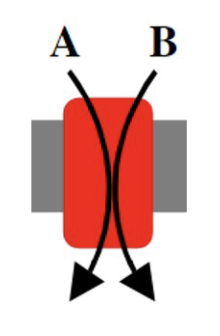
antiporters

Group translocation
Uses energy from an energy rich organic compound other than ATP. The molecule transported is chemically modified during transport (phosphorylated)
undirectional transporters
medium affinity uptake
high affinity uptake
micronutrient uptake
exporters
Medium affinity uptake
Ions, sugars, amino acids, short peptides and oligosaccharides, not very low concentrations
High affinity uptake
Large, low concentration, hydrophobic substrates (iron chelates and B12). Very low concentration molecules
Micronutrient uptake
water soluble vitamins
Exporters
peptides, toxins, other proteins. Flip lipids, LPS components, other polysaccharides
ABC transporters
function in evasion of or resistance to host defenses, as well as helping with host colonization (adhesion and nutrient scavenging)
ABC exporters
LPS (O-antigen), techoic acids, capsule polysaccharides, proteins(toxins, proteases, lipases, S-layer), hemophores and siderophores, xenobiotic (antimicrobials and bile salts)
ABC importers
metal chelates (Fe3+, Mn, Zn2+), hemophores, siderophores, amino acids, osmoproectants