anatomy - muscular system 💪
 Call Kai
 Learn
Learn Practice Test
 Spaced Repetition
 Match
Match Flashcards
 Knowt Play
1/63

There's no tags or description
Looks like no tags are added yet.
Name | Mastery | Learn | Test | Matching | Spaced | Call with Kai | Chat |
|---|
No analytics yet
Send a link to your students to track their progress
64 Terms
What are the types of muscle tissues?
Skeletal muscle
Cardiac muscle
Smooth muscle
Skeletal muscle
attached to bones
voluntary

Cardiac muscle
heart only
involuntary

Smooth muscle
walls of organs and blood vessels
involuntary
ex. lining of intestines

Rank the contraction speed for each muscle type (fastest to slowest)
Skeletal muscle (FAST)
Cardiac muscle (SLOW)
Smooth muscle (MODERATE/RHYTHMIC)
— Skeletal muscles (header)
functions
characteristics
Simply state what the function is for each muscle tissue
Skeletal → movement
Smooth → moves substances
Cardiac → pumps blood
What are the functions of skeletal muscles? (state in point form)
Moves the skeleton (pull tendons that move bones)
Maintains posture and body position (like soft tissues)
Guard entrances and exits
Maintain body temperature (when they contract, they produce heat)
What are the characteristics of muscle tissue?
Contractility (shortens to produce force)
Excitable/Irritable (responds to stimulation)
Extensible (can be stretched)
Elasticity (returns to original shape)

What is the basic muscle structure composed of?
Muscle
Fascicle
Muscle fiber
Myofibrils
Sarcomere
Muscle
→ made of fascicles
Fascicle
→ bundle of muscle fibres
Muscle fiber
= single muscle cell
Myofibrils
→ inside fiber, contain sarcomeres
Sarcomere
→ functional unit of contraction (where the actual shortening of the muscle happens during movement)
What are the connective tissue layers in this structure? And what are these inside of?
Epimysium - surrounds entire muscle
Perimysium - surrounds fascicles
Endomysium - surrounds individual fibers
Tendons - makes these layers continuous
→ these layers are inside of muscle fascicles
Collagen fibers from all three layers of connective tissue come together at the end of the muscle to form..
Tendons
Aponeurosis
Tendon
bundles of fibers
→ attaches muscle to bone
Aponeurosis
broad sheet of fibers
→ connects muscles to each other
Describe what muscle fascicles are..
→ bundle of muscle fibers (cells) within a muscle
surrounded by perimysium (← connective tissue)
functions:
support & protects muscles
plays a role in transmitting force during contraction
Fascicle arrangement affects muscle function and strength (list the different types):
Parallel
Pennate
Convergent
Circular

Parallel
→ fibers run along the long axis (allowing large range of motion)
Pennate
→ fibers at an angle to the tendon (generates more force)
Convergent
→ fibers converge on a single tendon (allowing versatile movements)
Circular
→ fibers arranged in a circle (helps with opening and closing)

Label this diagram

Give a basic description of skeletal muscle fibers
These muscles are long, cylindrical, multinucleated cells. Each fibre is surrounded by a thin layer of connective tissue called the endomysium, which helps support and protect the cell. Inside the muscle fibre are myofibrils, which are packed with repeating units called sarcomeres
What specialized structure does muscle tissue contain? State and describe it.
→ sarcoplasmic reticulum (a modified form of the smooth endoplasmic reticulum)
This is crucial for storing and releasing calcium ions
When a muscle contracts, it’s actually the sarcomeres…
shortening
Describe what myofibrils are
→ Inside a muscle fibre are long, thread-like structures called myofibrils. These myofibrils are made up of protein filaments, primarily actin (the thin filament) and myosin (the thick filament).
→ Myofibrils run parallel to the length of the muscle fiber and are filled with repeating units called sarcomeres
Describe what sarcomeres are..
→ A sarcomere is a repeating segment of a myofibril and extends from Z line to Z line. Containing:
A band = myosin (thick)
I band = actin (thin)
H zone = myosin only
M line = center of sarcomere
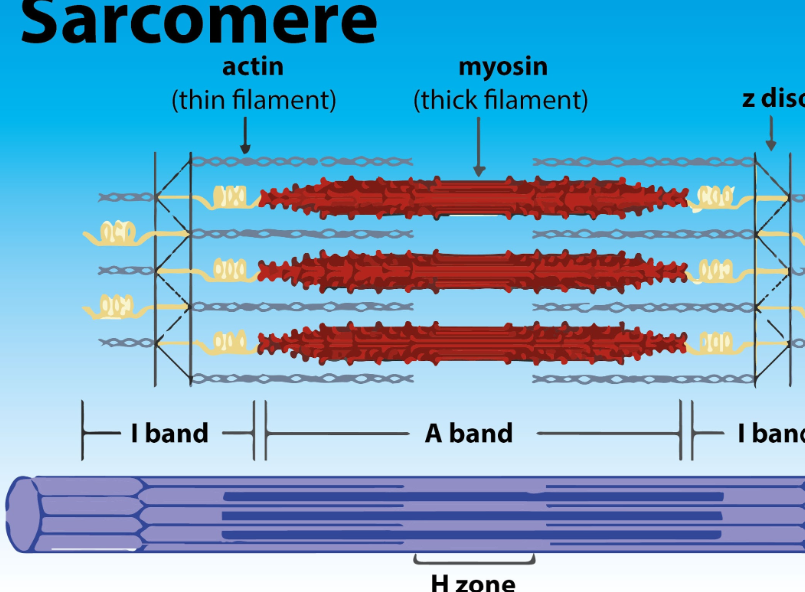
A band & Z zone are made out of what? I band is made out of what?
A = myosin
I = actin
H = myosin
Briefly explain muscle contraction
Nervous system sends signal
Muscle fiber becomes electrically active
Calcium is released
Contractile proteins interact
Muscles shortens

Briefly explain what neuromuscular junction is
→ specialized synapse where a motor neuron communicates with a skeletal muscle fiber
→ contains the following components:
motor neuron axon terminal
synaptic cleft
motor end plate
Motor neuron axon terminal
→ releases neurotransmitter acetylcholine (ACh)
Synaptic cleft
→ tiny gap between the neuron and muscle fiber
ACh crosses synaptic cleft
Motor end plate (on muscle fibre)
→ ACh binds to receptors here
Briefly describe how each component reacts with each other..
→ The motor neuron releases the chemical signal, it crosses the synaptic cleft, binds to receptors on the motor end plate, and that’s what tells your muscle to move
Acetylcholine (ACh)
→ a neurotransmitter released from the motor neuron
binds to receptors on the motor end plate, causing an electrical in the muscle fiber. This electrical signal triggers muscle contraction.
After signaling, what breaks down ACh to stop the signal, and allowing the muscle to relax?
acetylcholinesterase (AChE)
What’s a summary of how all of these work?
Motor neuron → ACh released → binds muscle → contraction → AChE breaks it down → muscle relaxes
What are the steps of muscle contractions?
Step 1: Muscle is activated
Step 2: Signals spreads inside the muscle
Step 3: Muscle Contraction
Step 1: Muscle is Activated
Motor neuron releases ACh
ACh binds to receptors on motor end plate
ACh causes muscle fiber to activate (depolarize)
A signal begins to spread along muscle fibre (potential)
Step 2: Signal spreads in the muscle
Signal travels deeper into the muscle fiber
Reaches the sarcoplasmic reticulum (SR)
SR releases calcium ions
Step 3: Muscle Contraction
Myosin heads grab actin → pull it inward (power stroke)
ATP needed to detach & reset mysoin heads
= many sarcomeres shortening, casuing the whole muscle to contract
Describe the Sliding filament model of contraction
Actin and myosin slide past each other
Sarcomere shortens, generating tension
H zone and I band shrink, A band stays same
ATP is required for myosin to “pull” actin
Describe how muscle relaxation occurs
Nerve signal stops → ACh broken down
Ca²⁺ pumped back into the SR
Actin binding sites covered (myosin can’t attach)
Sarcomere lengthens → muscles relaxes
Muscle contraction requires large amounts of energy in the form of…
ATP
ATP is used to:
Power the myosin pull (power stroke)
Detach myosin from actin
Pump calcium back into the sarcoplasmic reticulum (muscle relaxation)

Resting muscles fibers store _____ _____ ATP
very little
Briefly mention the steps of how muscles make ATP
Creatine Phosphate
Anaerobic glycolysis
Aerobic glycolysis
1. Creatine Phosphate
fastest way to regenerate ATP
uses creatine phosphate stored in muscle
lasts about 10-15 seconds
used in explosive movements (jumping, sprinting)
(lowk why gym ppl buy creatine powder for workouts)
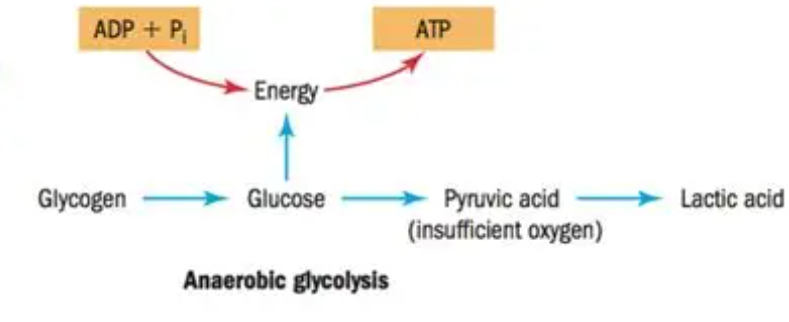
Anaerobic glycolysis
breaks down glucose without oxygen
produces ATP quickly
generates lactic acid → fatigue
supports short, intense activity (30-60 sec)
Aerobic glycolysis
uses oxygen to make ATP
occurs in mitochondria
slower, but produces large amounts of ATP
supports long-duration, low intensity activity

Twitch
→ single, quick contraction
latent → contraction → relaxation
Summation
→ repeated signals before relaxation
contractions add together = stronger tension

Tetanus
→ very rapid signals
no relaxation
smooth, sustained contraction

Describe motor units
motor units = motor neuron + muscle fibers it controls
small motor units = fine control (eyes, fingers)
large motor units = big powerful movements (legs, back)
Recruitment
more motor units activated = more force
What are the two types of contractions that are used by muscles in order to generate force?
Isotonic contraction
Isometric contraction
Isotonic contraction
→ muscle changes length
concentric: muscle shortens (lifting a weight)
eccentric: muscle lengthens under tension (lowering weight)
Isometric contraction
→ muscle develops tension but does not change length (holding weight still)