PCTH 325 Final Master Deck
 Call Kai
 Learn
 Practice Test
 Spaced Repetition
 Match
 Flashcards
 Knowt Play
1/265

Earn XP
Description and Tags
Emergency Med Pharm*, Endocrine Pharm*, Pharm of Neurodegenerative Disorders*, Drug Comp Bio*, Cardiovascular Pharm, Pulmonary Pharm, GI Pharm, Experimental Therapeutics 1 & 2, Pharm of Mental Disorders, Pharmacogenomics, Pharm of Antidiabetics
266 Terms
what is the name for cocaine in its not native form?
cocaine hydrochloride
what was the first local anethestic?
cocaine
describe the absorption of cocaine hydrochloride
hydrophillic so can easily cross membranes including blood brain membranes
can be administered in many diff ways including inhalation, intranasal, intravenous and other mucosal routes
what are the bioavailability percent for the different ways to administer cocaine?

describe the distribution of cocaine hydrochloride including the Vd and the half life, what in binds to and where highest concentrations are found?

high Vd so it can go everywhere
binds to albumin in the blood and a peptide the liver makes
have high tissue affinity
describe how cocaine hydrochloride is metabolized/eliminated? 2 metabolites?
many ways to metabolize cocaine
but primarily metabolized by plasma cholinesterase (enzyme in the blood) and carboxylesterase type 2 (liver enzyme)
this creates two metabolites:
Benzoylecgonine (BE)
Ecgonine methyl ester (EME)
why is mixing alcohol and cocaine problematic? what specific metabolite does it create?
cocaethylene: a active metabolite that is common when people mix alcohol and cocaine
this sticks around for over 2 hours
so it enhances the effects of cocaine and makes it last longer
how is cocaine hydrochloride commonly excreted?
mainly excreted in the urine
EME and BE are the primary metabolites excreted
describe the detection of cocaine hydrochloride metabolites in the body (for drug testing; clinical useful and for regulating). how long can it be detected, primary detection methods, where it can be detected
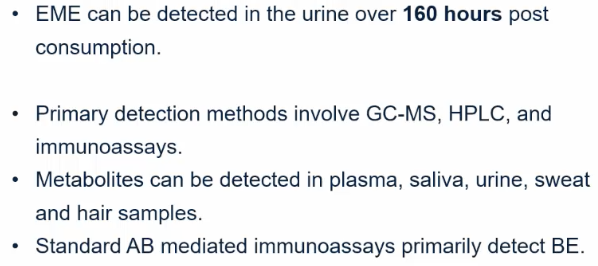
in hospitals we ususally use immunoassays (pee stick that turns color)
list the varied ways that cocaine hydrochloride affects a person’s base state?
monamine reuptake inhibition (more good feelings)
blocks sodium channels
how does cocaine hycrochloride cause someone to get “high”
cases an increase in monamines such as dopamine, serotonin epinephrine and norepinephrine (through monamine reuptake inhibition) which enhances stimulation of the brain’s reward pathway as a result of increased dopaminergic and serotonin pathway
what are monamines and how does cocaine affect them
molecules like dopamine, adrenaline, epinephrine, noreepinephrine, serotonin
cocaine interferes with a person’s ability to reuptake these molecules from the synaptic cleft (the actual physical gap or space between communicating neurons)
so the affects of inhibting reuptake of these molecules is that the molecules persist longer and cause more intense effects

how do voltage gated ion channels work?


description: Voltage-gated ion channels open and close in response to changes in membrane potential to control the flow of ions (like sodium and potassium), and while they are essential for generating action potentials in excitable cells (such as neurons and muscle cells), not all voltage-gated ion channels cause action potentials—some regulate resting membrane potential, trigger hormone secretion, or modulate cellular excitability without firing a full action potential.
how does blocked sodium channels through cocaine affect a person?
it completely blocks neurotransmission
because the sodium channel is blocked, action potential can not potentiale past that point
blocked sodium channels at cardiac myocites interrupt regulated heartbeat (disrupted cardiac action potential)
causes faster heart rate or irregular heart rate (overworked)
what is cocaine induced hypothermia and what are the two mechanisms of action
Your core body temperature dangerously shoots up because your body is burning energy much faster (making internal heat) while simultaneously squeezing your skin's blood vessels shut so that heat can't escape.
what are the two mechanisms of action for cocaine induced hypothermia?

hypermetabolic state is caused (more adrenaline, dopamine, etc) - over stimmed/ also directly affects medulla
vasoconstriction that impairs heat loss
what are some negative consequences that are cocaine induced?
cocaine induced hypothermia
cocaine induced thrombosis
cocaine induced myocardial injury
how does cocaine induced a1 adrenergic receptor mediated vasoconstriction work? what are the physiological effects?
Mechanism: alpha_1 adrenergic receptors are G_q-coupled receptors that activate phospholipase C to release calcium ions from storage structures.
Physiological Effects: This surge in intracellular calcium triggers smooth muscle contraction, leading to intense peripheral vasoconstriction, as well as the contraction of sphincters (such as the pyloric and urinary sphincters) and pupillary dilation.
what is cocaine induced thrombosis? list the 3 mechanisms of action
The drug makes your platelets (blood cells) sticky and triggers your clotting pathways when you don't need them to, causing unexpected blood clots to form.
increased platelet activation (causing a change in shape and the release of sticky granules) which leads to increased
expression of vWF from endothelial cells (anchors platelets at injury and stabilizes clotting factor VIII)
modulation of procoagulant activity (biological processes or states that promote blood clotting)
explain how increased platelet activation and aggregation promotes cocaine induced thrombosis

Mechanism: Cocaine blocks the serotonin transporter (SERT), which increases plasma serotonin levels and stimulates platelet 5HT_2 receptors.
Result: This receptor stimulation triggers the release of alpha-granule adhesive proteins like P-selectin, leading to abnormal platelet activation, aggregation, and thrombosis.
what is thrombosis?
the formation of a blood clot inside a blood vessel (either an artery or a vein that obstructs the normal flow of blood)
(How it happens: It typically occurs when the body's clotting mechanisms are triggered inappropriately (such as through abnormal platelet activation or shifts in procoagulant activity). Why it's dangerous: If a clot blocks a blood vessel supplying vital organs, it can cause severe medical emergencies like a heart attack (myocardial infarction) or a stroke.)
explain how expression of vWF from endothelial cells promotes cocaine induced thrombosis
Mechanism: Cocaine, BE, and CE dose-dependently increase the expression of von Willebrand factor (vWF) from endothelial cells—with the highest expression in the brain.
Result: vWF binds exposed subendothelial tissue to platelet glycoprotein 1b and stabilizes coagulation factor VIII, promoting thrombosis.
explain cocaine induced modulation of procoagulant activity causes cocaine induced thrombosis?
Mechanism: Cocaine stimulates adrenergic pathways to increase the expression of tissue factor (TF)—which binds clotting Factor X to start the fibrin pathway—while simultaneously inhibiting natural anticoagulants like Protein C and Tissue Factor Pathway Inhibitory (TFPI).
Result: This modulation shifts the balance to promote uninhibited, procoagulant activity and thrombosis.
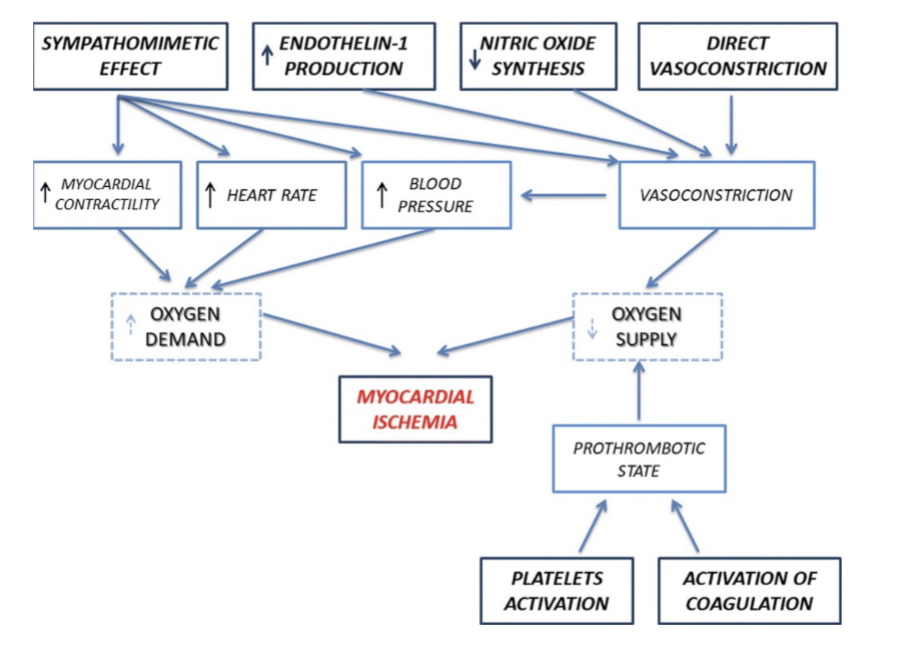
describe cocaine induced myocardial injury. what are the main mechanisms
cocaine-induced myocardial injury refers to damage to the heart muscle (myocardium) caused by cocaine use
Can happen through several mechanisms:
Increased myocardial oxygen demand (↑ heart rate, ↑ contractility, ↑ blood pressure).
Direct coronary vasoconstriction via α₁-adrenergic stimulation.
Increased endothelin-1 production causing vasoconstriction.
Decreased nitric oxide synthesis reducing vasodilation.
Prothrombotic effects (platelet activation and coagulation), with chronic use also promoting atherosclerosis.
Bottom line: Cocaine damages the heart by making it work harder while simultaneously reducing coronary blood flow and increasing clot formation, ultimately causing myocardial ischemia and infarction.
what do monamines include?
(catecolamines and more)
dopamine
norepinephrine
epinephrine
serotonin
is there an antidote for cocaine toxicity, what is the treatment for it
no there is no antidote, therapy involves symptom management
benzodiazepines for neurological symptoms to decrease sympathetic affects
ASA, Benzodiapines, nitroglycerine, phentolamine for cardiac symptoms
Thrombolysis, ASA, Endovascular clot retrieval for blood clots
what are the symptoms of cocaine toxicity?
neurological symptoms
psychosis, agitation
cardiac symptoms
chest pain, tachycardia, hypertension
blood clots
which neurotransmitters are affected by cocaine’s monoamine reuptake inhibition?
Dopamine
Norepinephrine (noradrenaline)
Serotonin
how does cocaine act as a local anesthetic?
It blocks voltage-gated sodium channels, preventing action potential propagation in nerves.
why can cocaine cause arrhythmias?
Sodium channel blockade slows cardiac depolarization and electrical conduction, disrupting normal cardiac rhythms and potentially causing tachyarrhythmias or fibrillation.
what are the major routes of cocaine administration?
Smoking (crack cocaine)
Intranasal use (snorting)
Intravenous injection
Other mucosal absorption routes (e.g., gums)
what metabolite is commonly detected in urin drug screens?
Benzoylecgonine (BE). [PCTH 325 -...final (1) | PDF]
what is the function of von Willebrand factor (vWF)
It promotes platelet adhesion to damaged endothelium and stabilizes clotting factor VIII.
How does cocaine affect vWF expression?
Cocaine, benzoylecgonine, and cocaethylene increase endothelial vWF expression in a dose-dependent manner.
In which organ is cocaine-induced vWF expression highest?
The brain.
What clotting factor is most affected by cocaine's procoagulant effects?
Tissue Factor (TF), also known as Clotting Factor III
How does cocaine alter coagulation?
It:
Increases Tissue Factor expression
Inhibits Protein C
Inhibits Tissue Factor Pathway Inhibitor (TFPI)
Promotes clot formation
How does cocaine affect nitric oxide?
It inhibits nitric oxide synthase, reducing vasodilation
How does endothelin-1 contribute to myocardial injury?
Endothelin-1 is a potent vasoconstrictor that further reduces coronary blood flow.
Why can cocaine cause myocardial infarction even in young individuals?
Because it simultaneously:
Increases myocardial oxygen demand
Decreases coronary blood flow
Promotes thrombosis
leading to ischemia and infarction.
Why did the 78-year-old patient develop a basilar artery stroke?
Cocaine-induced thrombosis caused vascular occlusion in the basilar artery, likely worsened by alcohol use and cocaethylene formation.
What is the first-line treatment for cocaine-induced agitation, psychosis, and sympathetic excess?
Benzodiazepines.
They enhance GABA activity and reduce excessive sympathetic stimulation.
Why is nitroglycerin useful in cocaine-induced cardiac toxicity?
It restores vasodilation and improves coronary blood flow.
What is the role of phentolamine in cocaine toxicity?
It blocks α₁ receptors and reverses cocaine-induced vasoconstriction.
What toxic metabolite causes acetaminophen toxicity?
NAPQI (N-acetyl-p-benzoquinone imine).
Under normal circumstances, how is NAPQI detoxified?
Through glutathione (GSH) conjugation.
When does NAPQI begin to accumulate?
When glutathione stores fall to approximately one-third of normal levels.
Which liver cells are most vulnerable to NAPQI toxicity?
Hepatocytes containing CYP2E1.
What are the four major mechanisms of NAPQI-induced cell death?
Inhibition of mitochondrial ETC complexes I and II
Formation of superoxide and peroxynitrite
JNK pathway activation with ROS generation
Opening of mitochondrial permeability transition pores leading to necrosis
What is the antidote for acetaminophen overdose? how does it work?
N-acetylcysteine (NAC).
Replenishes glutathione
Supplies cysteine
Scavenges ROS
Enhances NAPQI detoxification
Reduces inflammation
What clinical tool is used to determine the need for NAC therapy?
The Rumack-Matthew nomogram.
What acetaminophen level does the Rumack-Matthew nomogram use?
The serum acetaminophen concentration measured 4 hours after ingestion
A patient presents with tachycardia, hypertension, mydriasis, hyperthermia, and agitation after drug use. What receptor pathway is largely responsible?
Excess sympathetic stimulation and α₁ adrenergic receptor activation.
what central principle defines toxicology?
the dose determines toxicology: essentially any drug or substance can become a poison at a sufficiently high dose
Q: What is the endocrine system?
A: A collection of glands that produce hormones and secrete them directly into the circulatory system.
Q: What do hormones do after entering the bloodstream?
A: They travel through the bloodstream to reach target tissues.
Q: What major role does the endocrine system play?
A: Maintaining homeostasis.
Q: Endocrine vs. exocrine glands: what is the key difference?
A: Endocrine glands secrete hormones into the circulation. Exocrine glands secrete substances onto epithelial surfaces through ducts.
Q: Can a gland be both endocrine and exocrine?
A: Yes. The pancreas has both endocrine and exocrine functions.
Q: What 4 pharmacologically important properties differ between hormone types?
Degradation/clearance
Circulating half-life
Receptor type
Mechanism of action
Q: Which hormones are specifically marked to know for the exam?
Cortisol, estrogen, progesterone, insulin, and oxytocin.
Q: What are steroid hormones derived from?
Cholesterol
Q: Are steroid hormones hydrophobic or hydrophilic?
Hydrophobic
Q: How do most steroid hormones circulate in the blood?
A: Bound to carrier proteins. [2026W Endo...gy (notes) | PDF]
Q: Can steroid hormones cross cell membranes? Why?
A: Yes. Their hydrophobic structure allows them to pass through the lipid bilayer.
Q: Where are steroid hormone receptors located?
A: Inside the target cell, meaning they are intracellular receptors.
Q: What happens after a steroid hormone binds its receptor?
A: The hormone-receptor complex interacts with DNA and changes transcription of target genes.
Q: Why are steroid hormone responses slow?
A: Because they require changes in gene transcription, which takes minutes to hours.
Q: Why are steroid hormones broken down slowly?
Much of the hormone is bound to carrier proteins, creating a large circulating reserve that takes longer to break down and excrete.
Q: Do steroid hormones generally have relatively long or short half-lives?
Relatively long, because their carrier-protein binding slows breakdown.
What 2 important domains do steroid hormone receptors have?
Hormone-binding domain
DNA-binding domain
Q: Summarize steroid hormone signaling in one pathway.
Steroid hormone → crosses membrane → intracellular receptor → hormone-receptor complex binds DNA → altered gene transcription → response
Q: Are peptide hormones hydrophobic or hydrophilic?
hydrophillic
how do most peptide hormones circulate?
unbound to carrier proteins
for peptide hormones what does the circulating concentration generally reflect?
the active concentration of the hormone
can peptide hormones cross the cell membrane?
no the lipid bilayer is impermeable to most proteins
where do peptide hormones bind receptors?
cell-surface receptors
Q: Why can peptide hormones produce very fast responses?
A: They rapidly activate intracellular signaling pathways and do not require changes in gene transcription.
Q: Why are peptide hormones broken down quickly?
A: Specific enzymes cleave and inactivate them.
Q: Do peptide hormones generally have relatively long or short half-lives?
A: Relatively short, because they are rapidly broken down.
Q: Summarize peptide hormone signaling in one pathway.
Peptide hormone → cell-surface receptor → receptor conformational change → intracellular signaling cascade → response.
Q: Compare steroid vs. peptide hormones in carrier-protein binding. Compare their receptor locations.
Steroid: Usually bound
Peptide: Usually unbound
Steroid: Intracellular
Peptide: Cell surface
Q: Compare steroid and peptide’s membrane permeability.
Steroid: Membrane permeable
Peptide: Not membrane permeable
compare steroid and peptide response speed and breakdown speed
response:
Steroid: Slow
Peptide: Fast
breakdown:
Steroid: Slow
Peptide: Fast
compare steroid and peptide main mechanism of action
Steroid: Alters gene transcription
Peptide: Alters intracellular signal-transduction pathways
Q: What 2 major cell-surface receptor types are discussed for peptide hormones?
G-protein-coupled receptors
Receptor tyrosine kinases
Q: What happens when a peptide hormone activates a GPCR?
The conformational change causes dissociation of heterotrimeric G proteins and activation of downstream signaling cascades.
Q: What receptor type does oxytocin use?
G-protein-coupled receptor.
Q: What receptor type does insulin use?
Receptor tyrosine kinase.
Q: What happens when a receptor tyrosine kinase is activated?
Dimerization → autophosphorylation → recruitment and activation of downstream signaling molecules.
What is feedback regulation?
A hormone or its physiological response feeds back on an upstream control mechanism to regulate further hormone release.
Q: What type of feedback controls most hormone secretion?
negative feedback
Q: Why is negative feedback important?
A: It helps maintain homeostasis. [2026W Endo...gy (notes) | PDF]
Q: What is the basic idea of negative feedback?
A: The hormone or its effect reduces the original stimulus for further hormone secretion. [2026W Endo...gy (notes) | PDF]
Trace the HPA axis controlling cortisol.
Hypothalamus → CRH → anterior pituitary → ACTH → adrenal cortex → cortisol. [2026W Endo...gy (notes) | PDF]
Q: How does cortisol exert negative feedback?
A: Cortisol inhibits CRH release from the hypothalamus and ACTH release from the anterior pituitary. [2026W Endo...gy (notes) | PDF]
Q: What is the principal regulator of the HPA axis?
CRH
Q: What influences CRH release?
Stress
Circadian rhythm
Blood cortisol levels
Q: What stimulates insulin secretion?
A: Increased circulating blood glucose. [2026W Endo...gy (notes) | PDF]
Q: Trace the negative feedback regulation of blood glucose.
↑ glucose → pancreatic β-cells → insulin secretion → glucose uptake/storage → ↓ blood glucose → ↓ stimulus for insulin release. [2026W Endo...gy (notes) | PDF]