BIOL 438 exam 2 lecture 22
 Call Kai
 Learn
 Practice Test
 Spaced Repetition
 Match
 Flashcards
 Knowt Play
1/44

There's no tags or description
Looks like no tags are added yet.
45 Terms
What are mutations
a heritable change in the sequence of the genetic material

What can count as a mutation?
single bp changes,
deletions or insertions
chromosomal rearangements
gain or loss of plasmids

When can mutations occur
they can occur in any cell at any time
What can the cause of a mutation be
internal, spontaneous (e. g. mistakes during replication of DNA).
external, mutagen-induced (e. g. radiation, chemicals).
do all mutations have phenotypic consequences
no, Occationally, mutations can be beneficial
What mutations are acted on by natural selection
deleterious (decreases an organism's fitness) and beneficial mutations

Where can mutations be
in protein-coding genes or in regulatory sites (then they have important consequences) , or in non functional parts

What do mutations offer to species
the ability for species to adapt to changing conditions and challenges
they in turn serve as the as the driving force for evolution and biological diversity

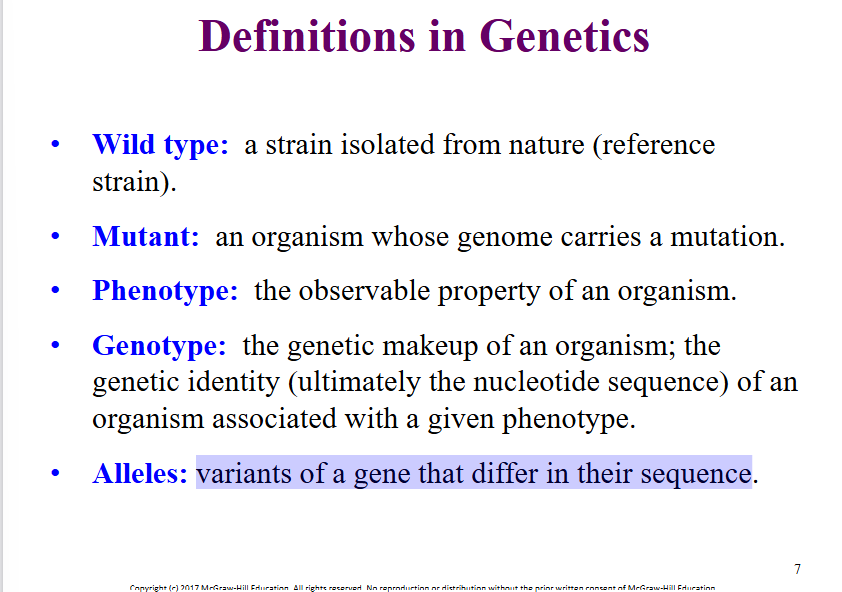
Wild type
a strain isolated from nature (reference strain).

Mutant
an organism whose genome carries a mutation

Phenotype
the observable property of an organism

Genotype
the genetic makeup of an organism; the genetic identity (ultimately the nucleotide sequence) of an organism associated with a given phenotype.

Alleles
variants of a gene that differ in their sequence

What are the causes of Spontaneous mutation
result of exposure to natural radiation (cosmic rays, etc.) or oxygen radicals.
When do the majority of spontaneous mutations occur
during DNA replication as a result of errors in the pairing of bases.
Spontaneous mutation rate
frequency of mutation within a gene per cell division.
WHat is the typical frequency of a mutation occurring in a given gene
in the range of 10 -4 to 10-8 per generation.
when do the majority of mutations occur
during DNA replication as a result of errors in the pairing of bases.
Induced mutations
caused by mutagens (chemical, physical, or biological agents that increase the mutation rate).
Chemical induced mutations
nucleotide base analogs, intercalating agents
physical induced mutations
nonionizing radiation (ultraviolet radiation), or ionizing radiation (X-rays)

Forward mutation
wild type sequence → mutant sequence
Reversion
restoration of a mutant sequence to the wild-type sequence
Suppressor mutation
correction of the effects (phenotypes) of one mutation by a second mutation at some other site, which could be in the original gene or in another gene
What are the types of mutations
forward,
reversion
supressor
What are point mutations
Single base-pair change mutations
silent point mutations
point mutations with no phenotypic effect
missense point mutations
point mutations with a single amino acid substitutions; may or may not have phenotypic effects.
nonsense point mutations
point mutations that cause premature translation termination; these usually cause drastic defects in the affected proteins.
frameshift point mutations
point mutations that cause insertion or deletion of a single base pair; these are also usually cause drastic defects in the affected protein.
What are essential genes
genes that encode for proteins that are essential for growth,
e.g. cells cannot exist without DNA polymerase, RNA polymerase, ribosomal proteins
how much essential genes does ecoli have
about 400 essential genes (out of a total of about 4400 genes)
Can you isolate a mutation that inactivates an essential gene at all times
no, because such a cell would be dead
how can you isolate conditional mutations in essential genes
by having mutations that inactive the protein under some conditions, the so called non-permissive conditions but permit function under others, the so-called permissive conditions.
permissive and non-permissive conditions
When trying to isolate a conditional mutation in essential genes, mutations that inactive the protein under some conditions, the so called non-permissive conditions but permit function under others, the so-called permissive conditions.
What are the most well known conditional mutations
temperature sensitive mutations
what are Temperature sensitive mutations
special missense mutations that inactivate (unfold) the affected protein at one temperature (the non-permissive temperature) but do not interfere with its structure/function at some other temperature (the permissive temperature)
What are the two types of temperature sensitive mutations
heat sensitive (hs), which unfold or otherwise inactive the protein at high temperature (say 42o C) but permit protein function at a lower temperature (say 30o C)
cold sensitive (cs), which inactivate the protein at a low temperature (say 30o ) but permit function at a higher temperature (say 42o )
How can ts mutations in essential genes be observed
the mutant phenotype can be analyzed by shifting to the non-permissive temperature

What are the types of Base Substitutions
Transitions and Transversions
transtions
base substitution in which one purine (A or G) is substituted by another purine, or one pyrimidine (C or T) is substituted for another pyrimidine.

Transversions
base substitutions in which a purine is substituted by a
pyrimidine or vice versa

Base analogs
cause of induced mutations,
structurally similar to normal bases
mistakes occur when they are incorporated into growing polynucleotide chain

DNA modifying agents
cause of induced mutations,
alter a base causing it to mispair
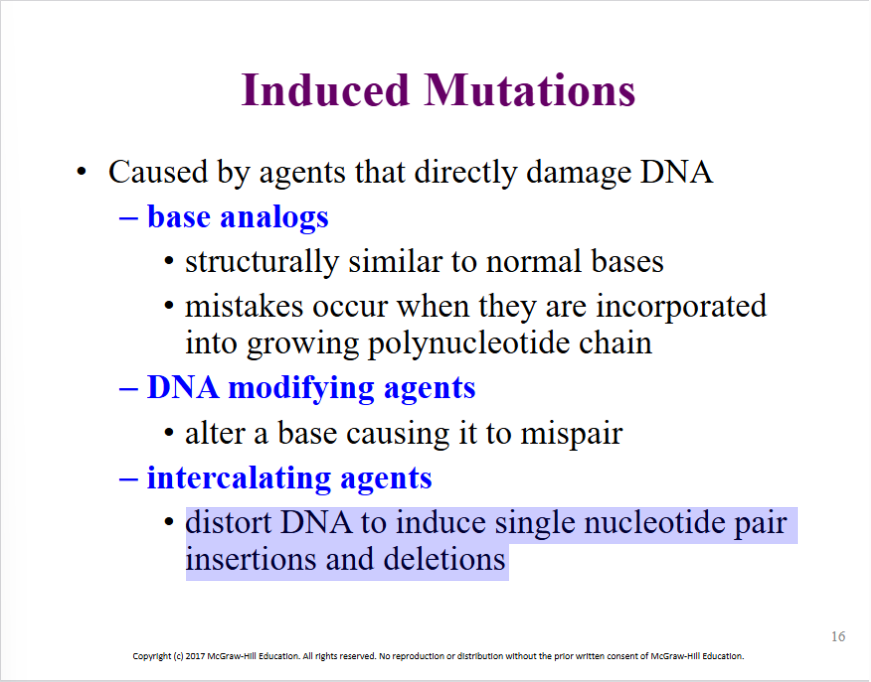
intercalating agents
cause of induced mutations,
distort DNA to induce single nucleotide pair insertions and deletions
