Bio short answer exam 2 (A, B, C, C)
 Call Kai
 Learn
 Practice Test
 Spaced Repetition
 Match
 Flashcards
 Knowt Play
1/90

There's no tags or description
Looks like no tags are added yet.
91 Terms
What is the main function of a chloroplast?
photosynthesis
What are thylakoids?
disc-shaped membrane structures inside chloroplasts

Why do chloroplasts have so much thylakoid membrane surface area?
To maximize the number of chlorophyll molecules that capture light energy
What is the main function of mitochondria?
produce ATP
What are the two mitochondrial membranes?
The outer membrane and the inner membrane.

What is the intermembrane space?
The space between the inner and outer mitochondrial membranes.

What is the mitochondrial matrix?
inside body of mitochindria

Why does the inner mitochondrial membrane have a large surface area?
To hold more electron transport machinery
electron transport machinery =
more ATP produced
What does the electron transport chain do?
It uses energy from moving electrons to pump H+ from the matrix into the intermembrane space
What particle builds up in the intermembrane space?
H+
What gradient is created by the electron transport chain?
A H+ gradient
explain the H+ gradient
a higher concentration of H+ in the intermembrane space, and a lower concentration H+ in the matrix
the H+ gradient has…
stored energy
What is the ATP synthase?
the spinning part that moves H+ from the interspace membrane into the matrix
when the ATP synthase moves H+ from the interspace membrane into the matrix, what happens?
ATP is made
Why does ATP synthase spin?
The flow of H+ through it provides the energy that it spin
Explain the full process of ATP synthesis involving the electron transport chain.
Electron movement → H+ pumped into intermembrane space → H+ gradient → H⁺+ flows through ATP synthase → ATP synthase spins → ATP is made.
What is the main similarity between chloroplasts and mitochondria regarding membrane surface area?
Both have big membrane surface area to hold more molecular machinery and increase their performance
What is the function of the nucleus?
It contains the cell's DNA and chromosomes.
What is the function of the nucleolus?
Synthesis of ribosomal RNA
What is chromatin?
DNA combined with proteins that contains the cell's genetic information

What is the function of the nuclear envelope?
It surrounds the nucleus, and its pores control what enters and leaves

What is the function of ribosomes?
make proteins

free ribosomes
makes intracellular proteins (inside the cell)
ER-bound ribosomes
makes extracellular proteins (outside of cell)
What is the functional difference between free ribosomes and ER-bound ribosomes?
Free ribosomes make proteins used inside the cell. ER-bound ribosomes make proteins for secretion or the cell membrane.
What is the function of the rough endoplasmic reticulum (rough ER)?
Makes and processes proteins

How can you identify rough ER in an image?
ER covered with tiny ribosome dots.
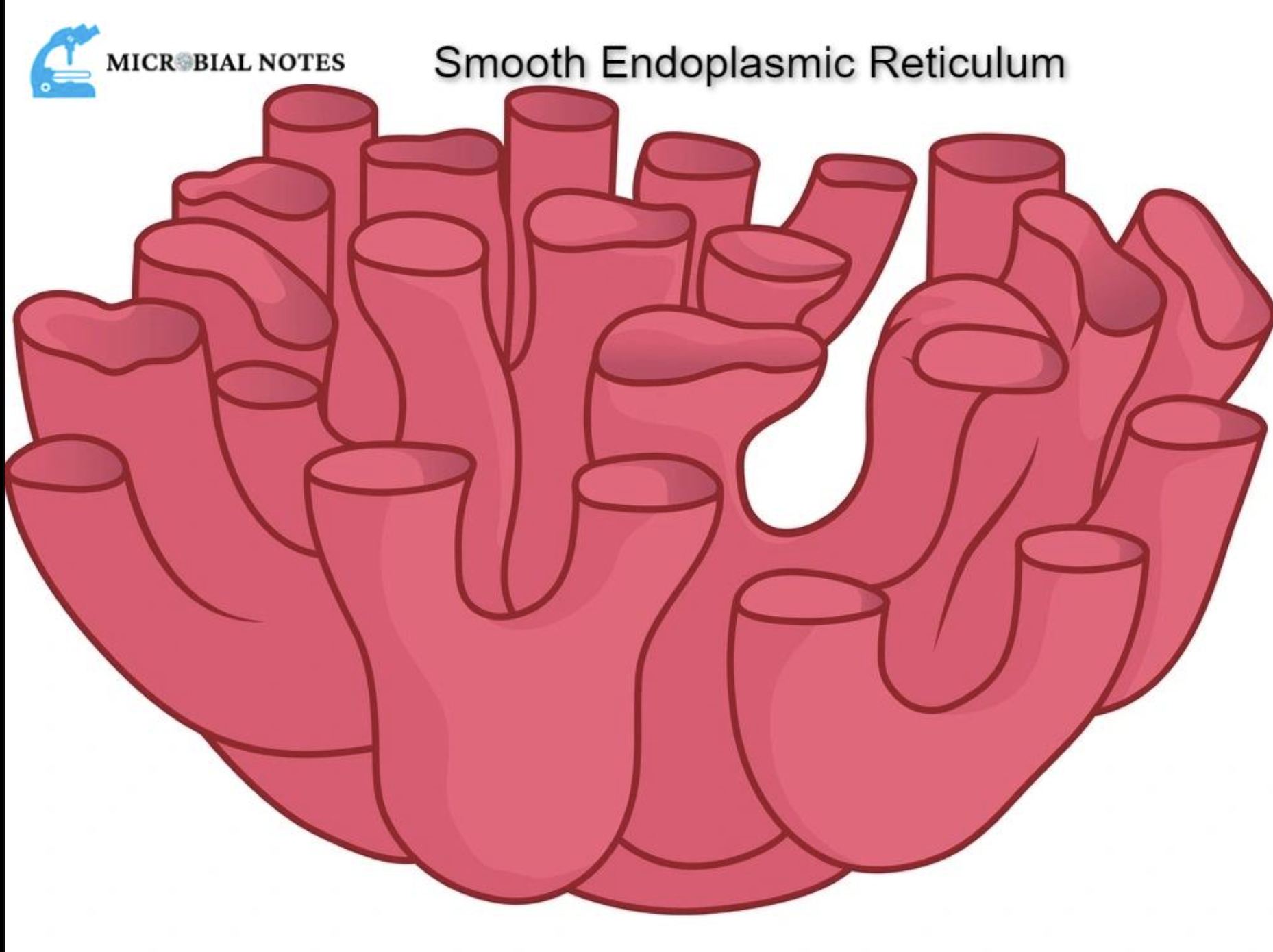
What is the function of the smooth endoplasmic reticulum (smooth ER)?
Lipid synthesis
How can you identify smooth ER in an image?
ER without ribosomes attached.
What is the function of the Golgi apparatus?
Sorts and packages proteins for transport.

How do the rough ER and Golgi apparatus work together?
Rough ER makes and processes proteins. The Golgi packages them for transport.
What is the function of a mitochondrion?
It produces ATP through aerobic respiration.
How can you identify a mitochondrion in an image?
It is usually bean-shaped, with folds inside.

What is the function of a chloroplast?
performs photosynthesis

What is the function of a lysosome?
Degrades and recycles waste using acid hydrolases

What is the function of a peroxisome?
performs oxidation reactions
What is the function of the plasma membrane?
controls what enters and leaves the cell

glyocogen granules
stores glucose
What is the function of the cell wall, and where is it located in plant cells?
It provides protection and is located outside the plasma membrane.
What is the function of the centrosome?
It organizes microtubules and helps form the spindle

What are plasmodesmata, and what is their function?
channels connecting neighboring plant cells

plasmodesmata function
allows materials and signals to pass between plant cells

What is the cytoskeleton?
An internal framework that helps maintain cell shape
What protein makes up actin microfilaments
actin
are actin microfilaments big or small
small
actin filaments: what are their main functions?
They help maintain and change cell shape, movement, and help with cell division in animal cells
How can you recognize actin microfilaments in an image?
looks swirley

Which motor protein works with actin?
Myosin
myosin function
interacts with actin to produce movement
What protein makes up microtubules, and what are their main functions?
Tubulin.
tublin functions
maintain cell shape, are core of cilia and flagella, and interact with dynein & kinesin motor proteins
How can you recognize microtubules in an image?
hollow tubes.

Which motor proteins move along microtubules?
Kinesin and dynein
What is the structural difference between actin microfilaments and microtubules?
Actin microfilaments are thin strands made of actin. Microtubules are hollow tubes made of tubulin.
are microtubules big or small
big
The core of the motile structures, cilia and flagella
microtubules
Interact with dynein & kinesin motor proteins.
microtubules
Interact with myosin motor proteins to produce movement or contraction.
actin (microfilaments)
Tugging on this filament can cause a cell to divide.
actin (microfilaments)
What are cilia, and what is their function?
Fuzzies that move materials across the cell's surface.

What is a flagellum, and what is its function?
Tail that propels cells

What are microvilli
Finger looking divisions of the cell membrane
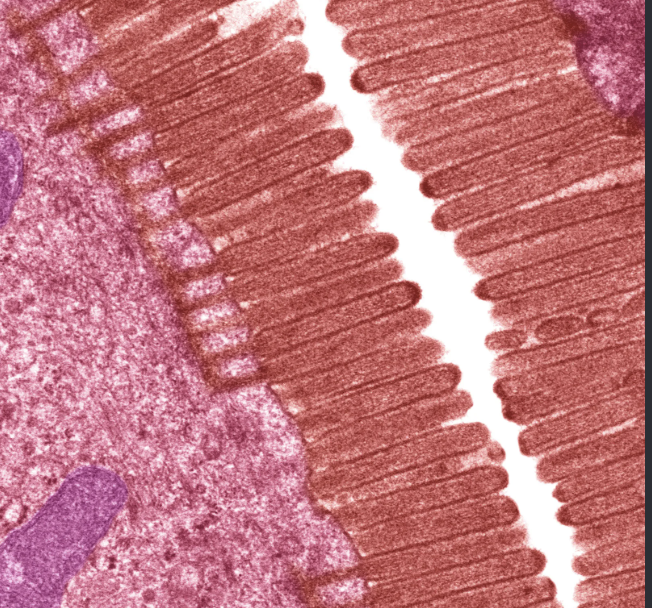
microvilli function
increase surface area for absorption
metaphase
chromosomes meet in the middle

anaphase
sister chromatids move towards opposite sides

What is the formula for surface area-to-volume ratio (SA:V)?
SA / V
The cell with the higher surface area-to-volume ratio has _______ exchange of materials with its external environment.
MORE efficient
Numerator of Fick Equation
SA x P x C x T
Denominator of Fick Equation
D x MW
What does SA stand for in the Fick equation?
Surface area
What does P stand for in the Fick equation?
Permeability
What does ΔC stand for in the Fick equation?
Concentration gradient
What does T₀ stand for in the Fick equation?
Temperature
What does D stand for in the Fick equation?
Distance
What does MW stand for in the Fick equation?
Molecular weight
What is the relationship between substrate concentration [S] and reaction rate?
increases up to a point.
shape of substrate concentration [S] vs reaction rate curve?
increases, then flattens

Why does the Rate vs. [S] graph flatten at higher substrate concentrations?
Enzyme saturation
What is enzyme saturation
When the enzymes are working at capacity and cannot process substrate any faster under those conditions
What is the typical shape of an enzyme Rate vs. temperature (T°) graph?
sigmoid curve

What happens in the linear region (going up) of a Rate vs. T° graph?
As temperature increases, kinetic energy increases, therefore rate increases
What causes the reaction rate to plummet above a certain temperature in a Rate vs. T° graph?
denaturation, temp gets too high
What is denaturation
when an enzyme loses its proper shape
what does denaturation cause in a Rate vs. T° graph?
plumet down
Frogs don’t run marathons because their lungs have much less ___________ for gas exchange.
surface area
Why will cortisol diffuse through the membrane at a higher rate than methylene blue? (What parameter in the Fick equation?)
cortisol is fat soluble, so it can pass through the membrane more easily. permeability.
What parameter in the Fick equation is increased in the pneumonia patient?
distance
How can we help this patient by increasing a different parameter in the equation?
By increasing concentration gradient.