response to stimuli
 Call Kai
 Learn
Learn Practice Test
 Spaced Repetition
 Match
Match Flashcards
 Knowt Play
1/123

There's no tags or description
Looks like no tags are added yet.
Name | Mastery | Learn | Test | Matching | Spaced | Call with Kai | Chat |
|---|
No analytics yet
Send a link to your students to track their progress
124 Terms
what is a stimulus?
a detectable change in the internal or external environment of an organism that leads to a response in the organism
what does the ability to respond to stimuli?
a characteristic of life and increases the chances of survival for a organism
example:
to be able to detect and move away from harmful stimuli, like predators and extremes of temperature, or to detect and move towards a source of food clearly aid survival
what do organisms that survive have a greater chance of?
raising offspring and of passing their alleles to the next generation
what is the favouring of organisms with more appropriate responses?
a selection pressure
what are stimuli detected by?
receptors, which are specific to one type of stimulus
what does a coordinator formulates?
a suitable response to a stimulus - may be at the molecular level or involve a large organ like the brain
what is a response produced by?
an effector - may be at the molecular level or involve the behaviour of a whole organism
what is one means of communication in organisms?
chemicals called hormones, which is a relatively slow process found in plants and animals
what is a more rapid means of communication?
the nervous system - usually has many different receptors/ control effectors
what is each receptor and effector linked to?
a central coordinator of some type, which acts like a switchboard, connecting info from each receptor with the appropriate effector
sequence of events:
stimulus → receptor → coordinator → effector → response
what is a taxis?
a simple response whose direction is determined by the direction of the stimulus
what happens as a result of a taxis?
a motile organism responds directly to environmental changes by moving its whole body either towards a favourable stimulus or away from an unfavourable one
what are taxes classified according to?
whether the movement is toward the stimulus (positive) or away from the stimulus (negative) and also by the nature of the stimulus
some examples of taxes?
single celled algae will move towards light (positive phototaxis). this increases their chances of survival since, being photosynthetic, they require light to manufacture their food
earthworms will move away from light (negative phototaxis). this increases their chances of survival because it takes them into the soil, where they are better able to conserve water, find food and avoid predators
some species of bacteria will move towards a region where glucose is more highly concentrate (positive chemotaxis). this increases their chances of survival as they use glucose as a source of food
what is a kinesis?
a form of response in which the organism doesn’t move toward or away from the stimulus, instead changing the speed at which it moves and the rate at which it changes direction
what would happen if an organism crosses a sharp dividing line between a favourable and an unfavourable environment?
its rate of turning increases, raising its chances of a quick return to a favourable environment
what would happen if it moves a considerable distance into an unfavourable environment?
its rate of turning may slowly decrease so that it moves in long straight lines before it turns, often very sharply - this type of response tends to bring the organism into a new region with favourable conditions
why is it less important when a stimulus is less directional (example?)
humidity and temperature, eg, don’t always produce a clear gradient from one extreme to another
example of a kinesis: woodlice:
woodlice lose water from their bodies in dry conditions
when they move from a damp area into a dry one, they move more rapidly and change direction more often
this increases their chance of moving back into the damp area
once back in the damp area, they slow down and change direction less often, meaning that they are more likely to stay within the damp area
if after some time spent changing direction rapidly they are still in the dry area, their behaviour changes
instead they move rapidly in straight lines, which increases their chances of moving through the dry area into a new damp one
in this way they spend more time in favourable damp conditions than in less favourable drier ones
this prevents them drying out and so increases their chances of survival
what is a tropism?
the growth of part of a plant in response to a directional stimulus, either toward (+) or away from (-) the stimulus. the type of response is named after the stimulus
examples of tropisms and the survival value of the response:
plant shoots grow towards light (positive phototropism) and away from gravity (negative gravitropism) so that their leaves are in the most favourable position to capture light for photosynthesis
plant roots grow away from light (negative phototropism) and towards gravity (positive gravitropism). in both cases the response increases the probability that roots will grow into the soil, where they are better able to absorb water and mineral ions
what do plants respond to?
light: shoots grow towards light as light is needed for photosynthesis
gravity: plants need to be firmly anchored in the soil. roots are sensitive to gravity and grow in the direction of its pull
water: almost all plant roots grow towards water in order to absorb it for use in photosynthesis and other metabolic processes, as well as for support
what do plant responses to external stimuli involve?
hormone like substances - plant growth factors
plant growth factors:
they exert their influence by affected growth and, they may be made by cells located throughout the plant rather than in particular organs
unlike animal hormones, some plant growth factors affect the tissues that release them rather than acting on a distant target organ
what is an example of a plant growth factor?
indoleacetic acid (IAA), which belongs to a group of substances called auxins. IAA controls plant cell elongation
positive phototropism:
a young shoot will grow towards light that is directed at it from one side (unilateral light)
the response of shoots of flowering plants to unilateral light:
cells in the tip of the shoot produce IAA, which is then transported down the shoot
the IAA is initially transported evenly throughout all regions as it begins to move down the shoot
light cases the movement of IAA from the light side to the shaded side of the shoot
a greater concentration of IAA builds up on the shaded side of the shoot than on the light side
as IAA causes elongation of shoot cells and there is a greater conc of IAA on the shaded side of the shoot, the cells on this side elongate more
the shaded side of the shoot elongates faster than the light side, causing the shoot tip to bend towards the light
what else does IAA control?
the bending of roots in response to light
what does a high conc of IAA do to roots?
inhibit cell elongation
therefore, where is elongation of cells in roots greater?
on the light side than on the shaded side and so roots bend away from light (negatively phototropic)
diagram to show relationship between cell elongation and IAA concentration in shoots and roots:
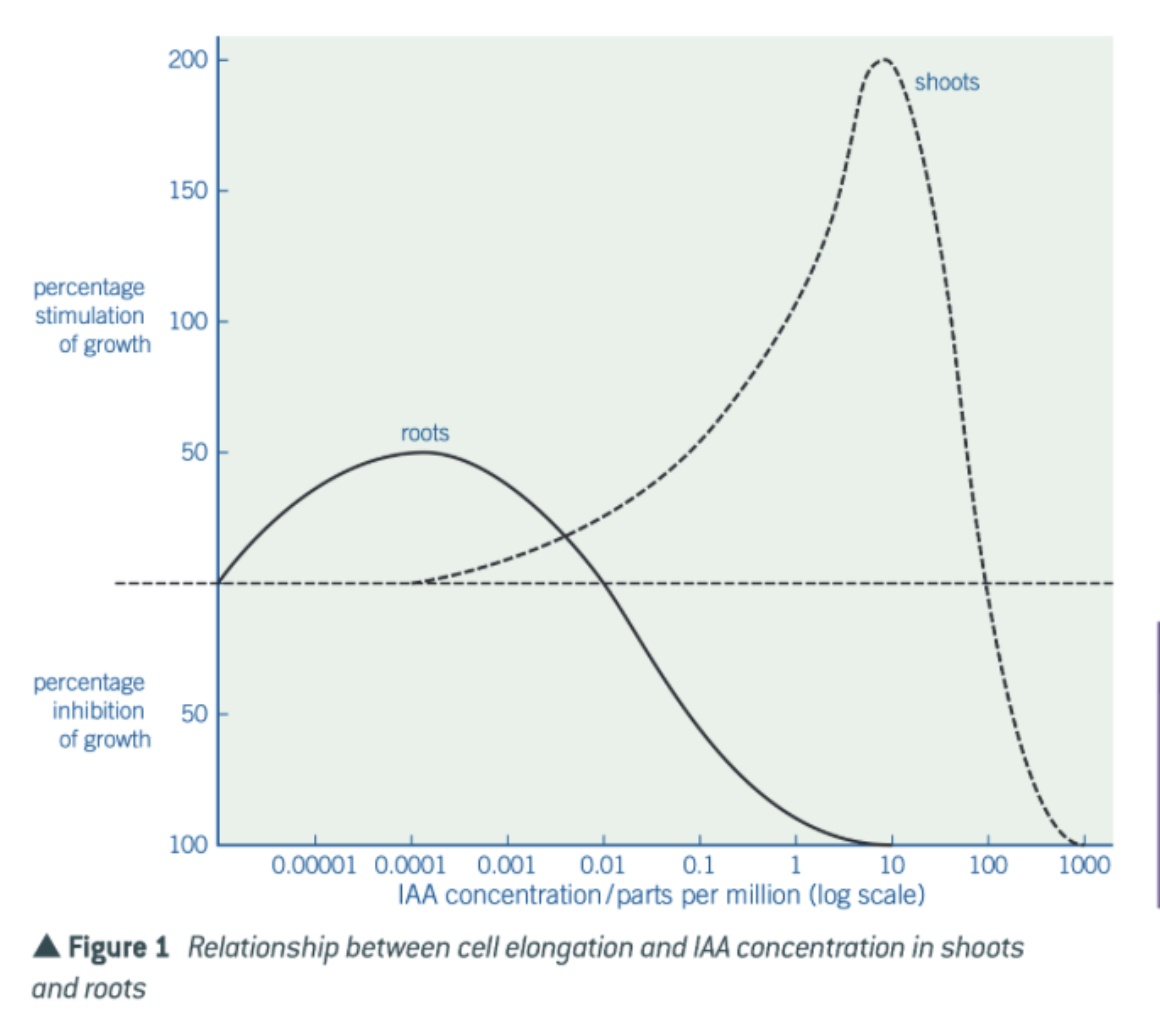
the response of a horizontally growing root to gravity:
cells in the tip of the root produce IAA, which is then transported along the roots
the IAA is initially transported to all sides of the root
gravity influences the movement of IAA from the upper side to the lower side of the root
a greater concentration of IAA builds up on the lower side of the root than on the upper side
as the IAA inhibits the elongation of root cells and there is a greater concentration of IAA on the lower side, the cells on this side elongate less than those on the upper side
the relatively greater elongation of cells on the upper side compared to the lower side causes the root to bend downwards towards the force of gravity
in shoots, the greater the concentration of IAA on the lower side increases…
cell elongation and causes this side to elongate more than the upper side. as a result the shoot grows upwards away from the force of gravity
diagram to show the mechanism of IAA action in the phototropic and gravitropic responses of shoots and roots:

where is the transport of IAA?
in one direction, away from the tip of shoots and roots where it is produced
what effects does IAA have on plant cells?
increases the plasticity (stretch ability) of their cell walls - but this only occurs on young cells where cells are able to elongate
what happens as the cells mature?
they develop rigidity, so older parts of the shoot/ root won’t be able to respond
what is the proposed explanation of how IAA increases the plasticity of cells called?
the acid growth hypothesis
what does the acid growth hypothesis involve?
the active transport of hydrogen ions from the cytoplasm into spaces in the cell wall causing the cell wall to become more plastic and allowing the cell to elongate by expansion
what can cause bending?
the elongation of cells on one side only of a stem or root
what does bending mean?
the plants respond quicker to environmental stimuli like light and gravity
what can explain this bending?
the stimuli causing uneven distribution of IAA, as described earlier, as it moves away from the tip of the stem or root
extra info: discovering the role of IAA in tropisms:


further info:

what is the simplest type of nervous response to a stimulus called?
a reflex arc
what are the 2 major divisions of the nervous system?
the central nervous system
the peripheral nervous system
CNS:
made up of the brain and spinal cord
PNS:
made up of pairs of nerves that originate from either the brain or the spinal cord, divided into sensory neurones and motor neurones
sensory neurones:
carry nerve impulses (electrical signals) from receptors towards the central nervous system
motor neurones:
carry nerve impulses away from the central nervous system to effectors
what can the motor nervous system be further subdivided into?
the voluntary nervous system
the autonomic nervous system
voluntary nervous system:
carries nerve impulses to body muscles and it under voluntary (conscious) control
autonomic nervous system:
carries nerve impulses to glands, smooth muscle and cardiac muscle and is not under voluntary control - subconscious
diagram to show nervous organisation:

what is the spinal cord?
a column of nervous tissue that runs along the back and lies inside the vertebral column for protection. emerging at intervals along the spinal cord are pairs of nerves
diagram to show section through spinal cord showing the neurones of a reflex arc:

reflex arc background:
don’t consider any alternative actions
response is rapid, short lived, localised and involuntary
in a reflex arc, what already happens by the time the brain has received nerve impulses from certain receptors?
muscles have already acted to clear out of danger
reflex:
type of involuntary response to a sensory stimulus
reflex arc:
the pathway of neurones involved in a reflex
diagram to show the main stages of a spinal reflex arc, such as withdrawing a hand from a hot object:
stimulus: heat from the hot object
receptor: temp receptors in the skin on the back of the hand, which generates nerve impulses in the sensory neurone
sensory neurone: passes nerve impulses to the spinal cord
coordinator(intermediate neurone): links the sensory neurone to the motor neurone in the spinal cord
motor neurone: carries nerve impulses from the spinal cord to a muscle in the upper arm
effector: the muscle in the upper arm, which is stimulated to contract
response: pulling the hand away from the hot object

why are reflex actions important?
they are involuntary and so don’t require the decision making powers of the brain, leaving it free to carry out more complex responses. in this way, the brain isn’t overloaded with situations in which response is always the same. some impulses are still sent to the brain, so its informed of what’s happening and can sometimes override the reflex if necessary
protect the body from harm. they are effective from birth and don’t have to be learnt
fast, as the neurone pathway is short with few synapses where neurones communicate with each other (synapses are the slowest link in a neurone pathway). this is important in withdrawal reflexes
the absence of any decision making process also means the action is rapid
what is the function of receptors?
sensory information
what does sensory perception involve?
making sense of the information from receptors, which is largely a function of the brain
what do pacinian corpuscles respond to changes in?
mechanical pressure
pacinian corpuscle being specific to a single type of stimulus:
It responds to only mechanical pressure. it won’t respond to other stimuli, like heat, light or sound
pacinian corpuscle producing a generator potential by acting as a transducer:
all stimuli involve a change in energy
its the role of the transducer to convert the change in form of energy by the stimulus into a form, namely nerve impulses, that can be understood by the body
the stimulus always involves a change in some form of energy: heat, light or mechanical energy
the nerve impulse is also a form of energy
receptors therefore transduce one form of energy into another
receptors in the nervous system convert the energy of the stimulus into a nervous impulse known as a generator potential
where do pacinian corpuscles occur?
deep in the skin and are most abundant on the fingers, soles of the feet and the external genitalia, and also in joints, ligaments and tendons, where they enable the organism to know which joints are changing direction
where is the single sensory neurone of a pacinian corpuscle?
at the centre of layers of tissue, each separated by a gel (sort of like an onion)
what do plasma membranes contain?
channel proteins that span them. these proteins have channels along which ions can be transported - eg. sodium ions
what does the sensory neurone ending at the centre of the pacinian corpuscle have?
a special type of sodium channel in its plasma membrane - a stretch mediated sodium channel
why are they called stretch mediated sodium channels?
their permeability to sodium changes when they are deformed, eg. by stretching
diagram to show the structure of a pacinian corpuscle:

function of the pacinian corpuscle:
in its resting state, the stretch mediated sodium channels of the membrane around the neurone of a pacinian corpuscle are too narrow to allow sodium ions to pass along them. in this state, the neurone of the pacinian corpuscle has a resting potential
when pressure is applied, it is deformed and the membrane around its neurone becomes stretched
this stretching widens the sodium channels in the membrane and sodium ions diffuse into the neurone
the influx of sodium ions changes the potential of the membrane (depolarised) thereby producing a generator potential
the generator potential in turn creates an action potential (nerve impulse) that passes along the neurone, and then, via other neurones, to the central nervous system

where are the light receptor cells of the mammalian eye found?
on its innermost layer, the retina
what are the 2 main types of light receptor cells found in the retina?
rod cells
cone cells
these both act as transducers by conserving light energy into the electrical energy of a nerve impulse
rod cells:
can’t distinguish different wavelengths of light and so lead to only black and white images
more numerous than cone cells -120mil in each eye
what are many rod cells connected to?
a single sensory neurone in the optic nerve, and are used to detect low intensity light
when is a generator potential created in the bipolar cells to which they are connected?
a certain threshold value
what is the case as a number of rod cells are connected to a single bipolar cell (retinal convergence)?
there is a much greater chance that the threshold value will be exceeded than if only a single rod cell were connected to each bipolar cell - due to summation
what must happen in rod cells in order to create a generator potential?
the pigment in the rod cells (rhodopsin) must be broken down, and there is enough energy from low intensity light to cause this breakdown, explaining why rod cells respond to low intensity light
what is a consequence of many rod cells being linked to a single bipolar cell?
light received by rod cells sharing the same neurone will only generate a single impulse travelling to the brain regardless of how many of the neurones are stimulated
what does this mean?
in perception, the brain can’t distinguish between the separate sources of light that stimulated them, eg. 2 dots close together can’t be resolved and so will appear as a single blob - give low visual activity
cone cells background:
of 3 types, each responding to a different range of wavelengths of light
depending on the proportion of each type that is stimulated, we can perceive images in full colour
6 million cone cells in each human eye, often with their own separate bipolar cell connected to a sensory neurone in the optic nerve
what does the fact that each cone cell have their own separate bipolar cell connected to a sensory neurone in the optic nerve mean?
means that the stimulating of a number of cone cells can’t be combined to help exceed the threshold value and so create a generator potential - as a result cone cells only respond to high light intensity and not low
pigment in cone cells:
iodopsin requires a higher light intensity for its breakdown
therefore, what will only the light of high intensity be able to provide?
enough energy to break it down and create a generator potential
what does each cone cell have?
its own connection to a single bipolar cell
what does this mean?
if 2 adjacent cone cells are stimulated, the brain receives 2 separate impulses, therefore being able to distinguish between the 2 separate sources of light that stimulated the 2 cone cells
therefore, can 2 dots close together be resolved?
yes, as cone cells give very accurate vision
is the distribution of rod and cone cells on the retina even?
no.
light is focused by the lens on part of the retina opposite the pupil (the fovea)
the fovea therefore receives the highest intensity of light - cone cells, not rod cells, are found here
the concentration of cone cells diminishes further away from the fovea
at the peripheries of the retina, where light intensity is lowest, is where rod cells are found
what do these 2 cells explain?
how by having different types of light receptor, each responding to different stimulus, mammals can benefit from good all round vision day and night
diagram to show the microscopic structure of the retina:

diagram to show difference between rod and cone cells:

what happens although we aren’t aware of it?
much of the sensory info reaching out CNS comes from receptors within our bodies responding to internal stimuli
what must happen to all the internal systems of our body?
they need to operate efficiently and be ready to adapt to meet the changing demands made upon them, which requires the coordination of lots of information
autonomic:
self governing. the autonomic nervous system controls the involuntary activities of internal muscles and glands
the sympathetic nervous system:
stimulates effectors and so speeds up any activity
acts like an emergency controlller
controls effectors when we exercise strenuously or experience powerful emotions
helps us cope with stressful situations by heightening our awareness and preparing us for activity (fight or flight)