Lecture 8-Salmonella Species
 Call Kai
 Learn
Learn Practice Test
 Spaced Repetition
 Match
Match Flashcards
 Knowt Play
1/76

There's no tags or description
Looks like no tags are added yet.
Name | Mastery | Learn | Test | Matching | Spaced | Call with Kai | Chat |
|---|
No analytics yet
Send a link to your students to track their progress
77 Terms
Main Causes of Diarrhoeal Disease
poor personal hygiene
poor food hygiene
lack of clean drinking water
Lack of education
Killing Organism that Cause Diarrheal disease
Treating water
Boiling
How do diarrhoeal organisms end up in the water supply?
secreted in the faeces of infected individuals and ends up in the water supply if sewage is untreated
Centers of Typhoid Fever
Asia
Middle East
Latin America
Salmonella
Gram-negative rod-shaped bacteria
Motile
Enterobacteriacea
One species with many serotypes
serotypes have unnique names
What is the only location of salmonella typhi?
the human intestinal tract
How is S. Typhi ingested?
faecally-contaminated food and water
What types of salmonella cause typhoid in humans?
S. Typhi
S. paratyphi
What serotypes of salmonella cause gastroenteritis?
S. enteritidis
S. typhimurium
Major Cell Wall Antigen in Enterobacteriaceae
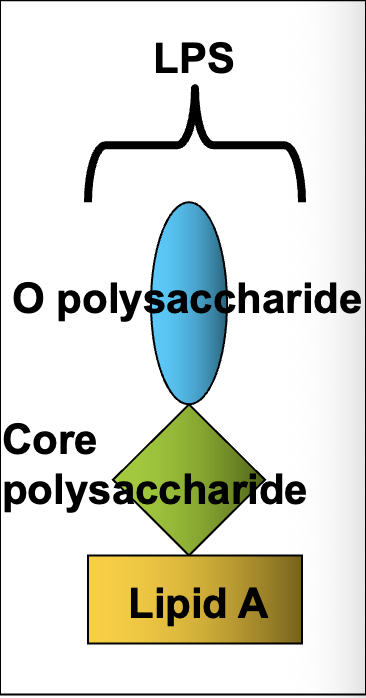
Lipopolysaccharide (LPS or endotoxin)
What components make up LPS?
O polysaccharide
common core polysaccharide
Lipid A
How Enterobacteriaceae serologically classified?
Based on 3 major groups of antigens
O polysaccharide
Capsular K antigens (protein/polysaccharide)
Flagellar H protein
How are antigens detected?
Agglutination by specific antibodies
MacConkey Agar
Selective between Gram-negative and most Gram-positive bacteria
Gram positives are inhibited by bile salts and crystal violet
Differentiates between lactose-fermenting and lactose nonfermenters
Lactose Positive turn pH indicator red
XLD Agar
Isolation and differentiation of Salmonella and Shigella from other gram negative enterics
Gram positives inhibited
Yellow colonies indicate lactose fermentation
Salmonella Disease Process
Bacteria ingested
Bacteria adhere to epithelial cells or M cells
Salmonella induces degeneration of microvilli followed by frpofound membrane ruffling
Salmonella multiply in vesicles, lyse the cell, and replicated in the lamina propria
Induce inflammatory Response with abdominal pain and inflammatory diarrhoea
Diarrhoea caused by ion imbalance from cytokine production
What is the infectious dose of Salmonella?
Greater than 10⁵ bacteria must be ingested.
Are Salmonella bacteria invasive?
Yes, Salmonella are invasive bacteria.
Which intestinal cells do Salmonella adhere to?
Enterocytes and M cells
What is the function of M cells?
They sample antigens from the intestinal lumen and deliver them to macrophages via transcytosis
Where are M cells located?
In the epithelium of Peyer’s patches in the small intestine
What structural change does Salmonella induce upon adhering to epithelial cells?
Degeneration of microvilli
What is membrane ruffling in Salmonella infection?
Localized distortion of the host cell membrane at the site of bacterial contact
What cellular process accompanies membrane ruffling?
Macropinocytosis
What does macropinocytosis lead to in Salmonella infection?
Internalization of bacteria into endocytic vesicles
What happens to Salmonella inside endocytic vesicles?
They multiply within the vesicles
What occurs after Salmonella multiply in the vesicles?
The host cell lyses, releasing bacteria
Where do Salmonella replicate after cell lysis?
In the lamina propria
What immune response is triggered by Salmonella in epithelial cells?
Inflammatory Response
How do Salmonella spread systemically?
Via M cells, surviving and multiplying inside unactivated macrophages before entering the bloodstream
Why can Salmonella survive inside macrophages?
They are resistant to oxidative killing
What role does LPS play in Salmonella infection?
It induces inflammation, causing abdominal pain and inflammatory diarrhea
Is Salmonella diarrhea caused by enterotoxins?
No, it is not caused by enterotoxin release
How do Salmonella disrupt intestinal cells?
By injecting proteins that interfere with host cell functions
What is the result of cytokine release during infection?
Attraction of neutrophils
What do neutrophils release that contributes to diarrhea?
Prostaglandins
How do prostaglandins contribute to diarrhea?
They activate adenylate cyclase, increasing cAMP
What is the final effect of increased cAMP in intestinal cells?
Ion imbalance and water secretion → diarrhea
What may result from the invasion of lymphoid tissue in the intestinal tract?
Necrosis
Ulceration
Intestinal haemorrhage from erosion of blood vessels in the lesions
Salmonella Virulence Factor: Adherence
Plasmid-encoded fimbriae mediate binding of bacteria to microvilli of enterocytes
Genes encoding fimbriae are located on virulence plasmid pSLT
Salmonella Virulence Factor: Membrane Ruffling
induce host cell to form pseudopods to engulf bacteria via actin cytoskeletal rearrangements
Salmonella Virulence Factor: Pathogenicity Islands
SPI 1,2,3,4,5 contain many virulence genes
SPI1
contains the inv genes which cause membrane ruffling
Encodes type 3 protien secretion system that injects sptP into host cells
sptP
econdes tyrosine phosphatase that affects host signal transduction pathways affecting cell response to outside stimuli
Causes diarrhoea
SopE
injected and induces cytoskeletal arrangements that induce membrane ruffling
pSLT
carries spv genes which are important for survival and killing of macrophages
Typhoid Fever Pathogenesis
S. typhi invade the intestinal mucosa, pass through endothelial cells to the sub-mucosa where they are taken up by macrophages.
The organisms survive inside the macrophages and are taken via the lymphatic system to the lymph nodes.
The organism replicates and causes a transient bacteraemia before they are cleared and carried to the liver and spleen.
The organisms multiply in the macrophages of the liver, spleen and lymph nodes.
The organisms are released into the blood, initiating continuous bacteraemia. This results in the start of clinical illness – daily high fevers.
Secondary bacteraemia results in invasion of the gallbladder, kidney and re-invasion of the gut mucosa at Peyer’s patches (a group of lymph nodes found in the ileum) – inflammation, ulceration, bloody diarrhoea.
There may be long-term colonisation of the gallbladder which results in the Typhoid carrier state. The organism can be continually secreted in the faeces by the convalescent host.
What is the first step in S. typhi infection?
Invasion of the intestinal mucosa
How does S. typhi reach the submucosa?
It passes through endothelial cells into the submucosa
What happens to S. typhi in the submucosa?
It is taken up by macrophages
Can S. typhi survive inside macrophages?
Yes, it survives and replicates inside macrophages
How does S. typhi spread after entering macrophages?
Via the lymphatic system to lymph nodes
What occurs after replication in lymph nodes?
Transient bacteraemia
Where do the bacteria go after transient bacteraemia?
To the liver and spleen
What happens in the liver, spleen, and lymph nodes?
Bacteria multiply inside macrophages
What triggers the onset of clinical illness in typhoid fever?
Continuous bacteraemia
What is a key symptom of continuous bacteraemia in typhoid fever?
Daily high fevers
What is secondary bacteraemia?
Further spread of bacteria to other organs after initial infection
Further spread of bacteria to other organs after initial infection
Gallbladder, kidneys, and intestinal mucosa
What happens when S. typhi reinvades Peyer’s patches?
Inflammation, ulceration, and bloody diarrhoea
Where are Peyer’s patches located?
In the ileum
What is the typhoid carrier state?
Long-term colonisation of the gallbladder by S. typhi
How is S. typhi shed in carriers?
Continuously secreted in faeces
Why are carriers important in disease transmission?
They can spread infection even after recovery
Symptoms of Typhoid Fever: First Week
Headache
Increasing fever
malaise
Abdominal pain
constipation
Symptoms of Typhoid Fever: Second Week
Fever increases
Diarrhoea becomes prominent and bloody
Weakness
Profound fatigue
Lethargy
Delirium
Ill appearance
Rose Spots
Symptoms of Typhoid Fever: Third Week
Febrile
Exhaustion
Weakness
Rose Spots
Small maculo-papular lesions that blanch on pressure
Diagnosis of Typhoid Fever
Rose spots on abdomen
Blood examination: elevated white blood cell count of S. typhi bacteria during first week of fever
Faecal examination: stool culture of S. Typhi, bloody faeces, leukocytes
Urine Examination: proteinuria, S. typhi culture
Typhoid Fever Treatment
Iv fluids and electrolytes
Antibiotics: ciprofloxacin or chloramphenicol
Typhoid Fever Prevention
Avoid high-risk food and drinking water
Reservoir of Salmonella
GI tract of wild and domestic animals
brids
reptiles
amphibians
Cause of Salmonellosis
Penetration and passage of Salmonella organisms from gut lumen into epithelium of small intestine where inflammation occurs. In healthy human volunteers, a median dose of 1 million to 1 billion organisms is necessary to produce symptoms.
Salmonellosis Symptoms
Incubation of 8-48 hours
nausea and vomiting
Fever
Abdominal cramping and diarrhoea
Salmonellosis Diagnosis
based on isolation of the infecting organism from stool
Salmonellosis Treatment
Replace fluids and electrolytes
Antibiotics for those with strong symptoms
Salmonellosis Prevention
Proper hygiene and food storage
Education
Cleaning cooking utensils
Adequate cooking temps to kill bacteria