Teeth: Human Osteology
 Call Kai
 Learn
 Practice Test
 Spaced Repetition
 Match
 Flashcards
 Knowt Play
1/37

There's no tags or description
Looks like no tags are added yet.
38 Terms
Dental formula
2:1:2:3—2 incisors, 1 canine, 2 premolars, 3 molars
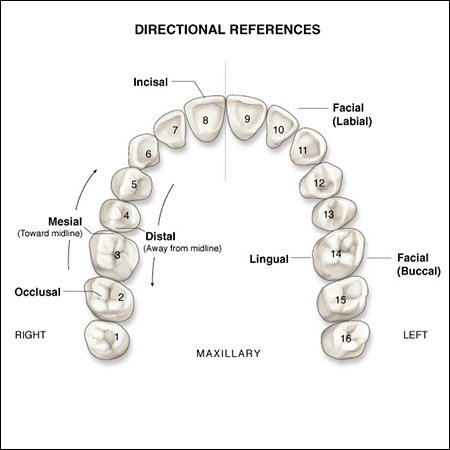
Directional terms: occlusal
Chewing surface of tooth; broad/flat
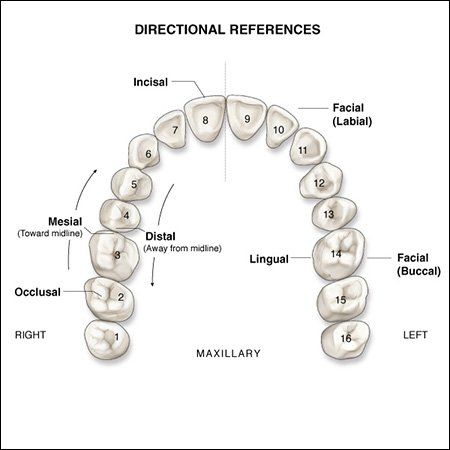
Directional terms: lingual, labial, buccal
Lingual: facing tongue; labial: facing lips; buccal: facing cheeks

Directional terms: mesial and distal
Mesidal: between teeth, towards midline; Distal: between teeth, facing outward
Crown
Part of tooth covered with enamel

Root (1) & apex (2)
(1) Anchors tooth into the bone of maxilla/mandible; (2) root tip

Enamel
Specialized hard tissue covering crown, mostly mineralized when formed

Cementum
Tough tissue covering the outside of the tooth roots
Cemento-enamel junction
Line where enamel meets cementum
Dentin
Tissue inside crown of tooth, softer than enamel, houses odontoblasts (cells that form/protect teeth)

Pulp chamber
Area within dentin and enamel crown, filled with pulp, which is soft tissue filled with nerves and blood vessels

Interproximal contact facets (IPCF)
Smoothed/worn areas between teeth where they touch each other
Occlusal contact facets
Worn areas on the chewing surface of teeth from touching the teeth above/below
Tooth category: shape
Incisors: flat and bladelike
Canines: conical and pointed
Premolars: short and round, 2 cusps
Molars: large and square, more cusps than other teeth, multiple roots
Nomenclature
Right vs Left
Tooth type: I,C,P,M
Maxillary (superscript) vs mandibular (subscript)
Canines: U (upper) or L (lower)
Incisors: maxillary
Wide relative to height, have lingual topography, root is circular in cross section

Incisors: mandibular
Narrower compared to height, smooth lingual surface, root is mesio-distally compressed in cross section

Incisors: 1st vs 2nd maxillary
1st: larger, more symmetrical, wider compared to height, root is shorter/wider compared to crown
2nd: smaller, narrower compared to height, root is longer/narrower compared to crown
Incisors: left vs right maxillary
Distal corner is more rounded than mesial
The long axis of the root angles distally
The distal root surface is more deeply grooved than the mesial root surface
Incisors: 1st vs 2nd mandibular
1st: smaller, more symmetrical, narrower compared to height, shorter
2nd: larger, wider compared to height, longer
Incisors: left vs right mandibular
The distal corner is more rounded than mesial
The long axis of the root angles distally
Canines: maxillary
Wide relative to height, lingual topography, lingual wear

Canines: mandibular
Narrower compared to height, smooth lingual surface, labial wear

Canines: left vs right
Mesial occlusal edge is shorter than distal occlusal edge
Long axis of the root angles distally
The distal interproximal facet (for the premolar) is larger/broader than the mesial facet (for the 2nd incisor)
The distal root surface is more grooved than the mesial root surface
Grooves
Large “troughs” between cusps on molars, fissure between cusps

Cusps
Occlusal projection on crown, gives molars their distinctive shapes, vary in size and #
Premolars: maxillary
Two cusps of nearly equal size, prominent occlusal grooves between the two cusps, oval in occlusal outline

Premolars: mandibular
Buccal cusps taller and larger than lingual cusps, shallow grooves, ciruclar in occlusal outline
Premolars: maxillary 3rd vs 4th
3rd: lingual cusp small compared to buccal cusp, less symmetrical (triangular outline), double root (fused/separate)
4th: cusps more equivalent in size, rounder occlusal outline, single root
Premolars: mandibular 3rd vs 4th
3rd: lingual cusp small compared to buccal cusp, less symmetrical, mesial fovae placed very mesially, close to the mesial occlusal edge
4th: cusps more equivalent in size, more symmetrical, mesial fovae are more distally placed

Premolars: left vs right
Lingual cusp is centered mesially relative to buccal cusp
The long axis of the root(s) angles distally