Biotechnological production of food ingredients and high-value products (with engineered microorganisms)
 Call Kai
 Learn
 Practice Test
 Spaced Repetition
 Match
 Flashcards
 Knowt Play
1/46

There's no tags or description
Looks like no tags are added yet.
47 Terms
What is the main motivation for replacing plant-derived food ingredients using fermentation?
To replace non-sustainable ingredients derived from deforestation (oil palm), restricted areas (cocoa), small amounts in plants (saffron), or those difficult to chemically synthesize (vanilla).
What are the four example ingredients driven by the need to replace non-sustainable plant sources?
Oil palm, cocoa, saffron, and vanilla.
What is the primary motivation for replacing animal-derived food products?
Environmental and ethical considerations (such as replacing milk and meat).
How can you replace plant-derived food ingredients that are produced in non-sustainable ways?
Through a fermentation based production using engineered microorganisms
What is Option 1 in fermentation-based production with engineered mm of animal-derived foods?
Using the entire microorganism as the product.

What is the problem with using the entire mm as the product?
If the mm is genetically engineered the GMO rules apply to it.
What is Option 2 in fermentation-based production of animal-derived foods using engineered mm?
Using microorganisms to produce specific components like proteins, lipids, or heme.

What is the advantage of using Option 2?
GMO rules do not apply if only the product is used as an ingredient.
What are the four phases of the Design-Build-Test-Learn (DBTL) cycle in metabolic engineering?
Design → Build → Test → Learn

What are the steps involved in the 'Design' phase of the DBTL cycle?
Selection of product
Selection of chassis strain*
Selection of biosynthetic pathway and engineering strategy
Selection of pathway enzymes
Design of synthetic genes
*is a standardized, living biological platform used as a host to house engineered genetic material
What are the key criteria for selecting a chassis strain?
Well-characterized
High growth rate
Amenable to genetic engineering / tools available
Compatible with desired culture conditions.
What are examples of chassis strains for specific products?
Amino acid producer → Corynebacterium glutamicum
Protein producer → Komagataella phaffii, Bacillus subtilis
Lipid producer → oleaginous yeast (Yarrowia lipolytica, Rhodosporidium toruloides).
What are the main engineering strategies in the 'Build' phase?
Introduction of heterologous genes
Deletion of competing pathway genes
Downregulation of genes (e.g. essential genes leading to byproduct formation)
Overexpression of genes (e.g. genes leading to increased precursor supply)
Potential inclusion of strain evolution.
What does the 'Test' phase involve in the DBTL cycle?
Phenotypic characterization through small-scale cultivation, shake-flask cultivation, and bioreactor cultivation to measure growth rate and product formation.
What does the 'Learn' phase involve in the DBTL cycle?
Detailed physiological characterization including -omics information and integration into in-silico models.
What are the two major classifications of microbial food ingredients based on product class?
Primary metabolites and Secondary metabolites.
What are primary and secondary metabolites?
Primary: metabolites supporting growth
Secundary: metabolites unrelated to growth

What are the main challenges in microbial production of milk proteins?
Sufficiently high production (and secretion) rates, correct folding, and correct post-translational modifications.

How do bacterial hosts differ from yeast/fungal hosts in milk protein production?
Bacteria usually do not secrete proteins and lack post-translational modifications, whereas yeast and filamentous fungi secrete proteins (requiring protease-negative strains and glyco-engineering).
What are Triacylglycerols (TAGs)?
Also known as triglycerides, they consist of a glycerol backbone esterified with three fatty acid acyl chains.
What are the four structural parameters that determine lipid/TAG product properties?
Chain length (nº of carbons, side chains) → more carbons increase the melting point
Number of double bonds (saturation/unsaturation ratio) → saturate (straight chains more packed together, more solid), unsaturate (double bonds prevent tight packing, more oily)
Positioning of fatty acids (sn-1, sn-2, sn-3) → specific location where the fatty acid is attached to the glycerol.
The sn-1 and sn-3 sites are the outer positions, while sn-2 is the middle position. Where a specific fatty acid sits heavily influences how the fat crystallizes, melts, and is digested by the body.
Acyl-chain composition → refers to the overall profile and combination of fatty acid chains integrated into the TAG structure.
By altering this composition through metabolic engineering, biotechnologists can synthesize tailored fats.

What enzyme catalyzes the rate-limiting step in fatty acid biosynthesis?
Acetyl-CoA carboxylase (ACC).

What is the function of Fatty Acid Synthase (FAS)?
A large protein complex that extends acyl-chains with two-carbon units at a time, defining the acyl-chain length.

What is the f(x) of Elongases?
Can further extend the chain lenght.

What is the f(x) of Desaturases?
They determine the amount and postion of double bonds.

What is the f(x) of acyl Transferases?
They determine which acyl-residues are incroporates into TAG.
They are usually quite promiscous.

What are the steps for microbial production of food lipids?
Choose a chassis strain:
Use an oleaginous organism
Engineer a model organism to accumulate high amounts of TAG
Modulate acyl-chain composition of TAG to mimic the food oil you want to produce:
Change the chain lenght of acyl residues
Change the desaturation pattern of acyl residues
Change the specificity of acyl transferases
Choose a chassis strain → what is an oleaginous organism? give an example:
Oleaginous microorganisms are those naturally capable of accumulating high amounts of lipids.
E.g. Rhodosporidium toruloides = R. toruloides
Choose a chassis strain → give an example on how you can engineer a model organism to accumulate high amounts of TAG.
Example: engineering of S. cerevisiae
Overexpression of genes encoding rate-limiting enzymes (in green)
Deletion of genes encoding enzymes of competing pathways (in red)

Change the chain lenght of acyl residues → how is fatty acid synthesis in prokaryotes?
Catalyzed by distinct enzymes
Product specificity determined by thioesterase (TE)
TE can be exchanges to change product profile
Change the chain lenght of acyl residues → how is fatty acid synthesis in eukaryotes?
Catalyzed by large, multifunctional and multimeric enzymes
Product specificity can be changed by introducing mutations in certain domains
Product specificity can be changed by incorperating TE into the enzyme

What is vanillin?
It is a flavouring agent
What is the main challenge in natural vanillin production?
Low concentration in the natural producer (less than 1% obtained from the vanilla orchid).
What is the solution to compensate the low concentration of vanillin?
Biotransformation, using mm to convert precursor molecules (such as isoeugenol or ferulic acid derived from plant cell walls) into vanillin via different metabolic pathways.

What is another solution to compensate for the low concentration of vanillin?
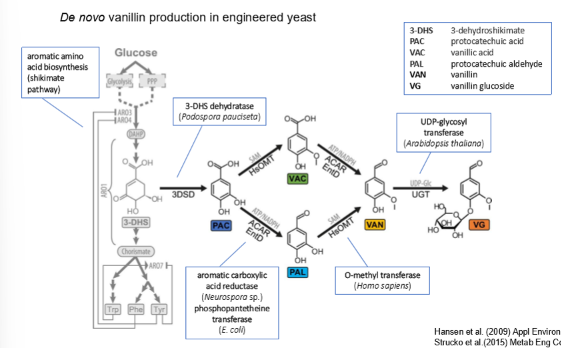
De novo vanillin production in engineered yeast
What is the aim of de novo vanillin prodution in engineered yeast?
To produce vanillin glucoside
Why is vanillin-glucoside produced instead of vanillin in engineered yeast?
Vanillin-glucoside is less toxic to yeast cells compared to free vanillin.
What is the challenge of the vanillin glucoside production?
Catabolism by endogenous enzymes → the vanillin glucoside is degraded inside the cell.
What test was done to identify the responsible genes?
A knock-out test with the candidate genes
Which endogenous yeast genes were identified as responsible for catabolizing vanillin into vanillyl alcohol or breaking down vanillin-glucoside?
ADH6 and BGL1 → solution: knockout
What is the next step?
Screening of potential pathway genes from different sources → because yeast does not have all the required enzymes for the vanillin glucoside metabolic pathway, scientists assembled a de novo pathway by sourcing enzymes from diverse organisms.
What are the two major upstream pathways for microbial terpenoid production?
The MEP pathway and the MVA (mevalonate) pathway.
What general engineering strategies are used to enhance terpenoid production?
Increase precursor supply
Overexpress/engineer rate-limiting enzymes
Downregulate/delete competing pathways
Use enzyme fusion/scaffolding
Transfer entire heterologous pathways
Give an example of mircrobial production of terpenoids:
Nootkatone* production in yeast
*Nootkatone is a naturally occurring sesquiterpenoid ketone responsible for the characteristic aroma, flavor, and bitter profile of grapefruit
What specific genetic modifications were used for nootkatone production in yeast?
Expression of valencene synthase (CnVS), expression of truncated HMGR (tHmg1), downregulation of ERG9, expression of an HPO variant with cytochrome P450 reductase (ATR1), and screening of short-chain dehydrogenases/reductases (like ZSD1 or ABA2).
What are the current technological developments in microbial food ingredient production?
High-throughput engineering and testing via automation
Biosensors for screening/regulation
Distributing pathways over several cells using synthetic microbial consortia.
What are the future challenges in microbial food ingredient production?
Cost-competitive production of low-value ingredients
Feedstock supply
Consumer acceptance.