2.4 Bioeconomy Resources STARCH AND CELLULOSE
 Call Kai
 Learn
 Practice Test
 Spaced Repetition
 Match
 Flashcards
 Knowt Play
1/71

There's no tags or description
Looks like no tags are added yet.
72 Terms
Plants commonly have 2 forms of abundant polymers from glucose (polyssacharides):
starch and cellulose
Plants commonly have 2 forms of abundant polymers from glucose: Starch and Cellulose
Starch is known as a energy reserve polymer for plants
→ must have some reversible nature to “unzip” back into glucose.

Plants commonly have 2 forms of abundant polymers from glucose: Starch and Cellulose
Cellulose is known as a structural polymer for plants
→ Must meet demanding mechanical performance for plant survival.

Starch and Glucose:
What type of glycosidic linkage is found in starch?
Alpha (α) linkages.
How do α-linkages affect the structure of starch?
They allow the polymer backbone to bend and form a helical structure.
What type of glycosidic linkage is found in cellulose?
Beta (β-1,4) linkages
How do β-linkages affect the structure of cellulose?
They create straight, extended polymer chain
What is the main chemical structural difference between starch and cellulose?
Starch has α-linkages; cellulose has β-1,4 linkages between glucose units.
Why do starch and cellulose have different properties?
Their different linkages create different molecular shapes and structures.
What is the carbohydrate made of?
carbon + hydrate
hydrates (H2O) of carbon (C)
Cn(H2O)n, where n is > or = than 3
How are the carbohydrates with 3-6 carbons called?
3C = Triose
4C = Tetroses
5C = Pentoses
6C = Hexoses
Carbohydrates
What are Aldoses?
Carbohydrates in which the 1-carbon is in the aldehyde.
Carbohydrates
What are Ketoses?
Carbohydrates in which the 2-Carbon is in the ketone
ex: fructose
Fischer projection to ring form
Most structured of carbohydrates come in 6C ring bonds.

What is the most abundant polymer on Earth?
CELLULOSE
Cellulose = glucose + linear chains + fibrils + semi-crystalline + structural support.
What type of polymer is cellulose?
A linear homopolymer.

What is the monomer of cellulose?
Glucose
What does it mean that cellulose is a homopolymer?
It contains only one type of monomer: glucose
How are cellulose chains organized?
Into highly organized fibrils.
Is cellulose crystalline, amorphous, or semi-crystalline?
Semi-crystalline: it has ordered and disordered regions.
Why is cellulose nearly insoluble in water?
ts chains pack tightly and form many hydrogen bonds
Name some uses of cellulose.
Paper, textiles, toothpaste, and computer-screen materials.

Repeat unit:
Linkages:
Homopolysaccharide:
Repeat unit: cellobiose → 2 glucose links = repeating units of cellobiose
Linkages: B-4, 4-glycosidic bond
Homopolysaccharide: no branching, no other monomers
Cellulose molecular weight—what does DP mean?
Degree of polymerization
Cellulose molecular weight—The longer the polymer, the … to dissolve?
The longer the polymer, the HARDER to dissolve?
Cellulose is found in nature as a microfibril

Sources of cellulose examples:
Hardwood
Softwood
Cotton
Bagasse
Coconut fibre
Corn cobs
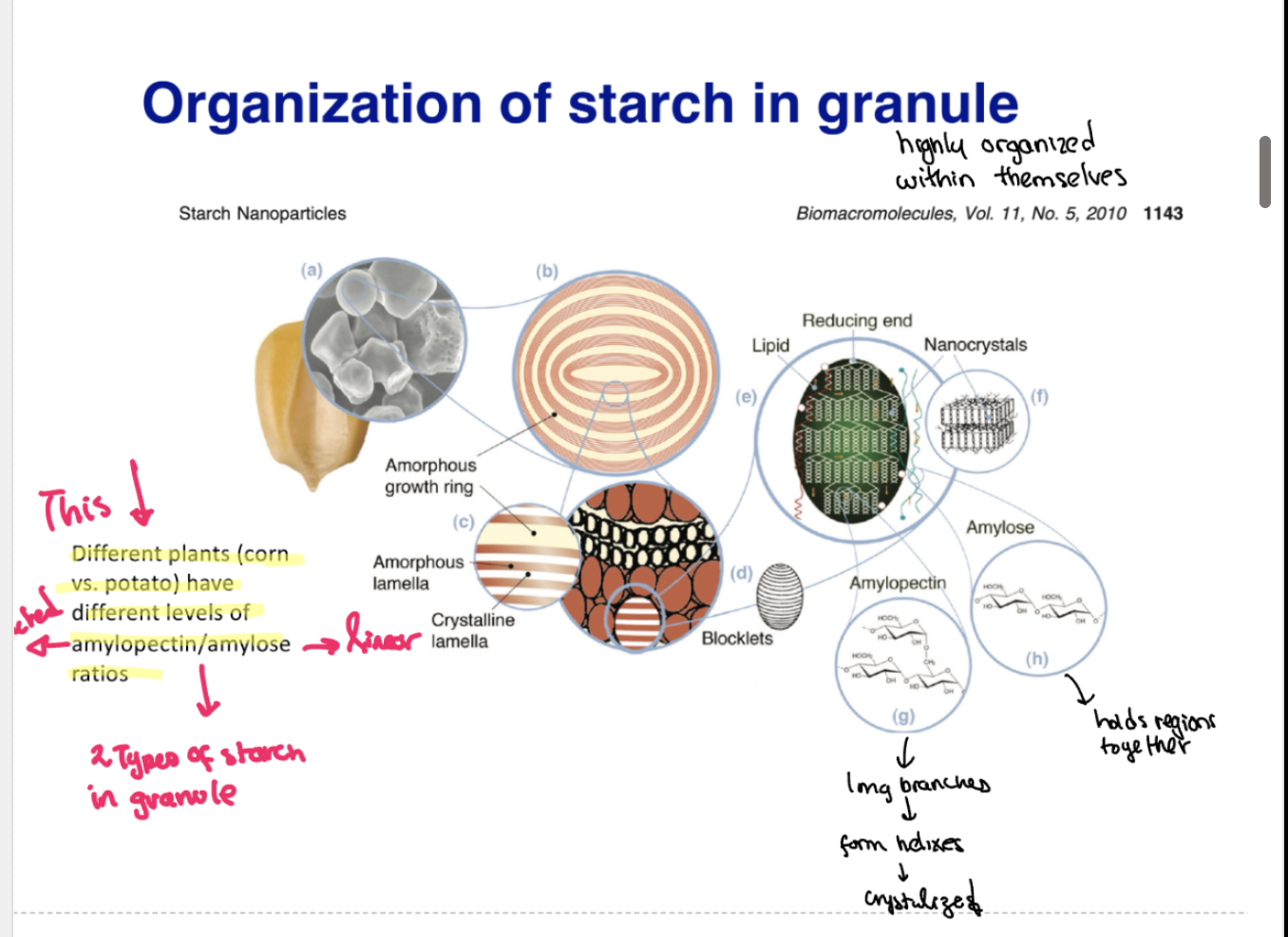
STARCH is a combination of:
combination of 2 different glucose polymers.
What are the two forms of starch in granule? (important)
Linear amylose
Branched amylopectin
(highly crystalline branches)

What is the main difference between glucose and heteropolyssacharides?
The extra C
Enzymes can readily break down chains of starch into:
can readily break down chains of starch into glucose.
How is starch found in grains?
as granule
Endosperm = starch granules interdispersed in protein

Organization of starch in granule
They are highly organized within themselves.
Different plants have different levels of amylopectin (branched) /amylose (linear) ratios.
Amylopectin forms helixes that are crystalized.
Amylose holds regions together.
Hetero-polysaccharides
Hetero (different) made up of more than one type of monosaccharide unit.

Difference between Hetero-polysaccharides and cellulose
Cellulose is only made up of glucose units.
In wood Hetero-polysaccharides are referred to as:
Hemicelluloses
Example of a complicated carbohyrate
Pectins
What are pectins in primary cell walls of plants?
Hetero-polysaccharides
What is the most abundant pectin?
Homogalacturonan
What are some characteristics of pectin?
High in molecular weight
high solubility
other polysaccharides
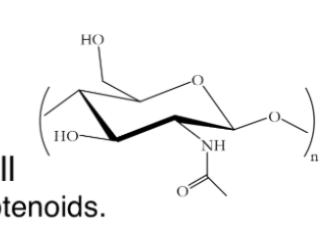
CHITIN
Natural sources: crustaceans, arthropods, fungi
Serves as a structural matrix polymer in these organisms as cellulose does in plants
Essentially a homopolymer of D-2-amino-2-deoxyglucose → linkage is exclusively beta
Semicrystaline morphology
hard to dissolve
Separation is required
33% of the shell of a crustacean
Pure chitin is expensive
CHITIN and CHITOSAN
Chitosan is produced from chitin
→ Chitin is partially hydrolized to produce chitosan
→ Chitosan is a broad term meaning any partially hydrolyzed chitin; almost always semisynthetic (less common in nature)

CHITIN and CHITOSAN
What is unique about chitin relative to other polyssacharides and lignocellulosic materials?
It contains nitrogen in its monomers; nitrogen containing modified glucose that provides structural support.
Seaweed — polysaccharide
Where are alginates found?
In brown seaweed.
Seaweed — polysaccharide
What are alginates made of, and what is their structure?
A block copolymer of mannuronic acid (M) and guluronic acid (G).
Seaweed — polysaccharide
What are key properties and applications of alginates?
Water-soluble, anionic polysaccharides used in biomedicine, compostable plastics, and the food industry.
What sulfated polysaccharide comes from red seaweed, and what is it used for?
sulfur like in keratin!!
Carrageenan; used for thickening, gelling, and stabilization.
What sulfated polysaccharide comes from brown seaweed?
Fucoidan; a bioactive polysaccharide used in medicinal and nutraceutical applications.
What sulfated polysaccharide comes from green seaweed, and what are its applications?
Ulvan; used for antioxidant, anticoagulant, and tissue-engineering applications.
LIGNIN
What is lignin?
A complex natural aromatic polymer found in plant cell walls.
LIGNIN
What are the main functions of lignin?
Protects cell walls, binds cells together, and provides mechanical strength.
LIGNIN
Why is lignin hydrophobic?
Its hydrophobic nature helps regulate liquid transport and prevent cell wall swelling.
LIGNIN
What are the building blocks of lignin?
Aromatic compounds containing phenylpropane units.
LIGNIN
What type of polymer is lignin structurally?
A heterogeneous, amorphous phenolic polymer.
Heterogeneous = different components.
Amorphous = disorganized.
Phenolic = aromatic rings.
LIGNIN
What types of chemical linkages are found in lignin?
Ether linkages (C–O–C) and carbon–carbon linkages (C–C).
LIGNIN
When is lignin extracted industrially?
During papermaking and partially during cellulosic bioethanol production.
What is unique about lignin's aromatic structure compared with other natural polymers?
It contains aromatic phenylpropane units connected through irregular C–O–C and C–C bonds, forming a complex network.
Complex, irregular network containing aromatic rings and different linkages. |
Cellulose = repeating sugar units. vs Lignin = irregular aromatic network.

Lignin content of different trees:
More lignin in softwoods
More hemicellulose in hardwood
More lignin in juvenile wood
Natural Rubber
What is the monomer of natural rubber/chemical functionality?
Isoprene

Natural Rubber
What polymer is formed when isoprene molecules join together?
Polyisoprene.
Natural Rubber
Why is stereochemistry important in natural rubber?
It influences chain arrangement, flexibility, and elasticity.
Natural Rubber
In what form is natural rubber obtained from plants?
As a colloidal latex emulsion containing rubber particles dispersed in water.
Natural Rubber
What other components in latex can influence rubber properties?
Proteins and other non-rubber substances.
Natural Rubber
What is vulcanization?
it was developed to create rubber as a solid material at room temperature. It improves rubber’s strength, elasticity, and stability.
Natural rubber is hard and stiff at low temperatures and too soft at room temperature.
Natural Rubber
What is the main chemical structure of natural rubber?
Highly regular cis-1,4-polyisoprene.
Which material dominates commercial rubber production
Hevea b. 500-3000 kg/year ha
Seeds have been taken from the Amazon to UK, then planted in India.
SUMMARY
What are natural polymers?
Large molecules of repeating units connected by covalent bonds.
SUMMARY
How does chemical functionality influence natural polymers?
Functional groups create interactions that influence secondary and tertiary structures.
SUMMARY
Can chemically similar natural polymers have different properties?
Yes. Small structural differences can produce very small different properties.
SUMMARY
How does starch differ from cellulose despite both being made of glucose?
Different glycosidic linkages create different structures and properties.
SUMMARY
Why do natural polymers have unique structures?
Their structures provide specific functions and material performance.
SUMMARY
What does nature’s performance engineering mean?
Evolution has favored polymer structures suited to specific biological functions.