Language and Communication
 Call Kai
 Learn
 Practice Test
 Spaced Repetition
 Match
 Flashcards
 Knowt Play
1/108

Earn XP
Description and Tags
weeks 1 - 5
109 Terms
how many languages are there and how often do they ‘die’
3 000 to 8 000
die out at a rate of 1 every 2 weeks
what are the most common languages
chinese, spanish, english
what constitutes a communicative act
transmitter who encodes information into a signal
physical transmission of a signal
receiver who decodes the signal to recover information
what is communication
“when one organism (the transmitter) encodes information into a signal which passes to another organism (the receiver) which decodes the signal and is capable of responding appropriately”
what can communication failure occur from
faulty encoding (slip of tongue/cannot remember)
faulty transmission (cannot make out what is being communicated)
faulty decoding (misreading/hearing)
mismatch between encoding processes of transmitter and decoding of receiver
what is verbal communication
spoken/written transmission of a message (dialects and regiolects, group language, constructed language)
what is nonverbal communication
non-linguistic aspects (body language, gestures, emotions)
what is a language
a type of communication made up of a structured system of symbols/words and rules/grammar by which they are combined
Communication ≠ language, language = communication
how is the production divided
conceptualisation - deciding what to express, composed of semantic and pragmatic features of lexical concepts
word sel- determining how to express lemmas an lexical entries
sound processing
what are some language design features of humans
Semanticity: words are symbols/signs that express meaning
Arbitrariness: no intrinsic relation between most words and their meaning (only onomatopoeia)
Displacement: not tied to here and now, talk about the future/past/somewhere else/hypotheticals
Productivity/generativity: new language can be generated
Finite collection of sounds and words -> infinite number of messages
Must obey rules of the language
Prevarication: ability to lie
Reflexiveness: use language to talk about language
what are the 4 elements that make human language uniqie
Displacement - can discuss past, future or distant events
Productivity - generate completely new sentences
Traditional transmission - language is learned from others rather than being genetically inherited
Duality of patterning - small meaningless sounds combine into meaningful words
what are some suggestions for language evolution
larger brains
social cooperation
advancing learning and teaching
cultural transmissions
human vs ape communication
Apes have a very rich communication system (95-98% overlap and highly social)
Similar brain asymmetries as humans
Enlarged Broca's area
Cannot teach them to speak - different articulatory apparatus (throat) from humans

what are some chimp studies and what did they show
Kellog & Kellog (1933) raised chimp with their infant son (“cross- fostering”) - learned to understand a few words but never produced any.
Keith & Kathy Hayes (1952), after 6 years chimp could understand words and some word combinations, also learned to articulate a few words (mama, papa, up, cup), but with difficulty.
Garner & Garner (1969) taught chimp ASL - by 4 years she had acquired 85 signs (e.g., more, eat, listen, gimme, you, me, hurry), and also produced sign combinations such as you-drink, baby-mine. (some sensitivity to word order and some new combinations, taught sign)
Terrace et al. (1979), chimp learned about
125 ASL signs and made sign combinations (e.g. play-
me). Longer combinations heavily redundant:
Give orange me give eat orange me eat orange give
me eat orange give me you.
40% simple repetitions; rarely signed spontaneously.
No novel combinations (unlike children)
what is the Sapir-Whorf hypothesis
language shapes our thoughts through determinism and relativism
what is linguistic determinism
thoughts are limited, constrained by language - language determines thinking
Impossibility of translation
Language-less adults - can they not think?
Debatable topic
what is language relativism
people who speak a different language perceive and experience the world differently - language influences thought but does not determine it
Critiques - equating language with thought, thoughts precedes language
If thoughts depends on words how can new words be coined
does the gender of word affect language used
Boroditsky et al. - German and Spanish speakers describe words, if the object has a masculine gender they used more masculine terms and vis versa
Carmichael et al. - how an ambiguous object is described affects later recall//memory
Glucksberg & Weisberg - the way an object is described affects how we think about its use
how does language affect encoding in space
Egocentric language: relative frame of reference (left, right, front, back)
Allocentric language: absolute frame of reference (north, south)
Different languages use different types - can experience the world differently
Boroditsky - English speakers think of time horizontally whereas Mandarin speakers think of time vertically
what is the debate about the origin of speech
The comparative method of historical linguistics reaches only the level of proto‑languages, which already exhibit full linguistic complexity, thus cannot reach the origin of speech.
what are the 13 universal design features of humans
Vocal auditory channel - communication is primarily through spoken sounds and hearing.
Broadcast transmission and directional perception - Signals spread out and can be heard by multiple listeners, who can usually locate the source.
Rapid fading (transitoriness) - Speech signals disappear quickly after being produced
Interchangeability - Individuals can both send and receive the same kinds of messages.
Total feedback - Speakers can hear and monitor their own utterances.
Specialization - Speech sounds are produced primarily for communication rather than as a by-product of another activity
Semanticity - Signals are associated with specific meanings
Arbitrariness - The form of a signal is generally unrelated to its meaning (for example, the word "dog" does not resemble a dog)
Discreteness - Language uses distinct, separable units (such as phonemes) rather than continuous gradations
Displacement - Language can refer to things not present in the immediate time or place.
Productivity - Speakers can create and understand novel utterances that they have never heard before
Traditional transmission - Language is learned socially and culturally rather than being wholly genetically programmed.
Duality of patterning - Meaningless sounds combine to form meaningful units (words), which in turn combine into larger meaningful structures
how is language structured
honetics (speech sounds)
Describes and classifies speech sounds that occur in languages
Articulatory: how sounds are produced
Auditory: how they are perceived
Acoustic: physical properties of sound
Phonology (sound system)
Concerned with the way speech sounds form systems in languages
Phones: the inventory of phonetic segments that occur in your language; the instantiations (physical
characteristics) of a phoneme
Phonemes: the sounds in your language that can distinguish between words
Uses minimal pairs to determine the phonemes of a language
Languages differ in which phones they choose to use as phonemes
Allophones: different realisation of same phoneme
Morphology (word formation)
Syntax (sentence structure)
Semantics (meaning)
Pragmatics (language context)
how are spoken words produced
Conceptualisation, preverbal - what to express
Message planning
Pre-linguistic
Language is neutral
Formulation - how to express it
Lexicalisation
Two stage retrieval process
Meaning -> lemma + form -> lexeme
2 different word substitution errors
Semantic and phonological
Syntactic planning
Phonological encoding
Phonetic planning
Uses word selection (lemmas) and sound processing (lexemes)_
Articulation - expressing it
Pronunciation
Self-monitoring (from the Weaver++ model)
Internal monitoring of what you're going to say
External monitoring during speech

what evidence is used to develop spoken word production
speech errors
tip of the tongue
picture naming
picture word interference
what are speech errors
Automatic
Less attention to speech production than comprehension
1-2 errors for every 1000 words
Errors do not occur at random
8 types of speech errors
Shift: an exchange of one element to a different place
Exchange: an exchange of two elements to different places
Anticipation: already knowing upcoming sounds and so saying it
Perseveration: saying previous sounds
Addition: adding an element
Deletion: dropping an element
Substitution: word is substituted by a word that is not in the same sentence/context
Blend: two words are activated and related to each other, and so are combined together
Exchange of phonemes in similar positions
Consonants swap with consonants, vowels swap with vowels
Novel words follow the phonological rules of the language
Databases of spontaneous errors
Errors indicate two different processes
Retrieving words
Constructing a syntactic frame in which the words are slotted
Word errors: not restricted by distance and always of the same type
Sound errors: close together and can cross word type, happens later
what is Garrett's model of speech production
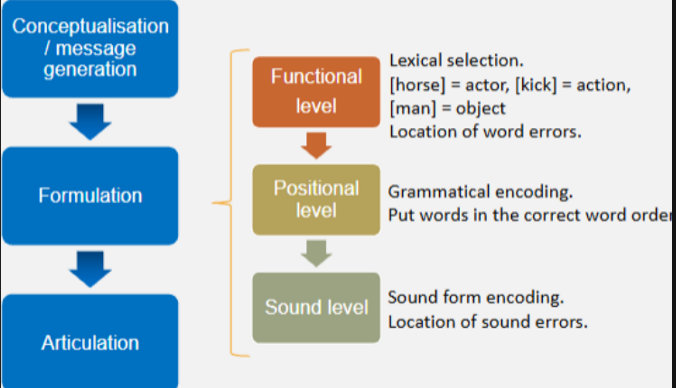
what is tip of the tongue
Often comes with partial information
Initial sounds
Number of syllables
Correct stress pattern
Phonologically related words get activated
Evidence for 2-stage model of lexicalisation
Completed first stage, can't completed second -> retrieval of meaning is independent of its sound
lemma (meaning and syntactic information) → lexeme (word form/sound)
Provides two theories
Blocking hypothesis (Jones and Langford) - interlopers prevent activation of the right word
Transmission-deficit hypothesis - due to weak links between the meaning and the word form, only limited activation of the target word forms

what is picture naming
Part 1 - generation
Part 2 - picture naming
Results in
Long-term facilitation for naming lasting over trials
Homophone priming does not persist
No facilitation across languages
what is picture word interference
Naming a picture as quickly as possible whilst ignoring distractor words
If words are semantically related -> slower than control group
If words are phonologically related -> faster than control group
what does lexicalisation entail
Discrete (step by step)
Semantic -> phonological
First a single item is selected based on semantic information, then phonological form is revealed
Interactive (activation flows between)
Cascading process (Levelt et al) - mediated priming
Early inhibitory priming of semantic -> at lemma level
Late priming of phonological -> at lexeme level
No priming of goal -> evidence against cascading/feedback
Feedback activation
Errors are not random
Lexical bias: sound-level speech errors result in words more often than by chance
Similarity effects: mixed substitution errors (both semantically and phonologically related to target) more than chance
Use output monitor rather than feedback

how does speech impact reading
Fixations and saccades made when we read - jumping from word to word, skipping words
Information taken in in first 50-60ms of fixating
what cognitive factors affect reading out loud
Frequency
Morphology
Phonology
Use subvocalization (inner speech)
Predictability
Reading skill
what is the first stage of reading processes
getting from letters to meaning of word
Orthography -> phonology -> semantics
how does reading work
mental lexicons activate the intended word
what factors affect word recognition speed
frequency
age of acquisition effect
orthography
morphology
compound decomposition
semantics
how does frequency affect word recognition speed
High frequency words recognised fast then low
More frequent -> faster/more accurate
General information retrieval mechanism
Less frequent words tend to be less familiar, less meaningful
how does the age of acquisition effect (AoA) impact word recognition speed
Words that are learned at a younger age are recognised faster
how does orthography affect word recongition speed
Transposed letters - same letters of the words but switched
Substituted letters - different letters
Parafoveal processing of letter information leads to a boundary change paradigm
Parafoveal processing: processing is complete even before we look at a word
what did Rayer et al discover about orthography and word recognition

how does morphology affect word recognition speed
Morphemes: the smallest meaningful unit of a language
Can be a word itself or part of a word
Made up of roots and affixes (prefixes and suffixes)
Compound decomposition
Pseudo-affixes: look like they have an affix
how does semantics affect word recognition speed
Words that are recognised faster are semantically richer
More semantic features -> more semantic neighbours -> higher imageability -> more concrete -> easier to bodily interact with
Degree of emotional valence (positive/negative/neutral) and a degree of arousal (high/low)
what did Juhasz discover about the interaction of lexical variables and eye fixation durations during natural reading
Length influences later processing, evident after readers make additional fixations on longer words.
Concrete words and early‑acquired words receive shorter fixations than abstract or late‑acquired words, confirming that these variables impact real‑time reading.
Frequency and subjective familiarity are robust, independent predictors of fixation times across all stages of word processing.
Word length influences later‑stage measures (gaze, total‑fixation), reflecting increased refixation probability for longer words.
what do the models of word recognition investigate
How words are searched in the mental dictionary
Word entries are searched one at a time
In series
Word entries are search all at once
In parallel
How information flows
Strictly one way
Letters -> words
Interactive
Letters <-> words
what are the models of word recognition
Foster’s search model
Morton’s logogen model
R and M interactive Activation Model
Dual route model

what is Foster’s search model
Recognise letters -> access unit -> get some initial units -> chooses a 'bin' -> once in a 'bin' entries are searched one by one
Bins are ordered by frequency
Several units are possible
Word entries are searched one by one - serial processing
a simple model
what is the Morton’s Logogen Model
Parallel - sends information about letters to all word detectors/logogens at once
information only feeds forward from letters to words
each logogen has a threshold level based on (eg) frequency
when activation passes threshold → fire → word recognised
information accumulates from bottom up in one direction: features → letters → words
when enough information accumulates a threshold is passed and letter is recognised (not enough information → no recognition)
high frequency words have lower thresholds for recognition as are recognised faster

what is R and M Interactive activation and competition model
uses parallel activation of letters and words
feedback from words to letters
high frequency words have higher resting levels of activation
all words have the same threshold to cross for recognition

What is the Dual Route Model
Word and letter recognition
Reading regular words out loud
Regular words: use most predictable pronunciation based on spelling
Reading irregular words out loud
Irregular words: pronunciation is not predictable based on how the word is spelled
whaReading new words
'nonwords' used in experiments (strings of letters)

what happens if there is damage to the lexical system
Leads to difficulty in reading all words but specifically irregular words
Reading occurs via Grapheme Phoneme Conversion
Ability to read non-words will remain normal
Expected errors - impairment of irregular words
Percent correct - non-word/regular word reading is good
Regularisation errors
what are the 4 types of dyslexia
Surface dyslexia: an acquired type resulting from a brain injury
Phonological dyslexia: acquired from a brain injury
Deep dyslexia: semantic paralexia and damage to semantic system
Developmental dyslexia: learning difficulty affecting skills involved in accurate and fluent word reading and spelling
what does developmental dyslexia involve
Poor reading - slow and inaccurate
Poor spelling
Poor comprehension
A secondary consequence - due to not being able to read fluently
Reading reducing experience
A continuum
Not related to intelligence
Has common co-occurring conditions - ADHD, dyscalculia
10% world-wide, occurs in all languages
Can be more apparent in languages inconsistent with orthographies (eg English)
what is the aetiology of developmental dyslexia
Neurobiological origin
Moderate heritability
Twice as common in males
Cause - multifactorial, associated with multiple genes and environmental risk factors
Children at genetic risk who later become dyslexic look at less books and avoid reading
what is the treatment for developmental dyslexia
Intensive instruction in phonics, phoneme awareness, word analysis and reading
Intervention better than remediation
Alternative therapies lack evidence on effectiveness
what are the theories of developmental dyslexia
phonological deficit
double deficit
magnocellular deficit
cerebellar deficit
what is the phonological deficit theory
Most widely accepted
Poor phonological awareness (ability to manipulate sounds)
Poor verbal short term memory - remembering sequences of sounds or letters
Slow lexical retrieval - ability to name aloud letters or objects rapidly
what is the double deficit theory
Extension of phonological
2 deficits
Phonological deficit - related to accuracy
Naming speed deficit - related to fluency
Naming speed measured by Rapid Automatized Naming
Used to diagnose children
what is the cerebellar deficit
Cerebellum not only for motor skills but also cognitive, including language
Reduced activation in right cerebellum
Temporal processing deficit
Poor naming speed, time estimation, balance
what did Morton and Frith (1995) propose
a causal model that integrates biological, cognitive, and behavioural levels to explain dyslexia and reconcile competing theories.
what did Morton and Frith conclude about developmental dyslexia
four essential components for DD: persistent literacy difficulties, exclusion factors, exposure to evidence based instruction, inclusionary factors
four causal theories: phonological, double, magnocellular, cerebellar deficit
genetic studies identify dyslexia related genes - DYX1C1, KIAA0319, DDC2, ROBO1
neuroimaging showed abnormal magnocellular pathways and cerebellar structures
includes phonological processing deficits
double deficit theory extends the phonological view by adding rapid automatised naming
Both phonological and magnocellular theories are compatible within the three‑level model, indicating that multiple biological and cognitive mechanisms can co‑occur.
what did the psycholinguist Chomsky propose
distinguishes between competence and performance and that grammar is generative
what is competence
speaker-hearer's knowledge of the language
Allows for grammaticality judgments
Grammaticality judgments: capability of saying whether the sentence is grammatically correct or not
Not equal to sensicality judgments
Not based on rules learned from prior experience or meaning
Based on implicit knowledge of the syntactic rules of your language
what is performance
the actual use of language in concrete situations
Not the same as what is in our competence due to memory limitations
if there are a finite number of rules to generate an infinite number of sentences, what does this mean about grammer
Cannot store all possible sentences in our heads and can always come up with new ones -> rule governed creativity
Grammar should be able to generate all possible grammatical sentences but not more
Each sentence of a language can be described in terms of hierarchical groupings of its constituent words labelled for syntactic category
Phrase structure tree
On-line incremental parsing - the parser constructs a syntactic structure on the basis of the words as they arrive, based on our syntactic knowledge
What is the Parsing Model
Question of encapsulation: are different sources of knowledge separat components or do they interact?
the Parsing model is made of two parts
Modular: serial processing
interactive: interactive processing
what is the modular model and accounts
Syntactic information first and on its own
Subsequent processing takes other kinds of information into account -> 2 stage

what is the interactive model and accounts
All information at the same time

how would the parsing model be tested
Garden path sentences
Test sentences that can be misinterpreted -> see which structure takes longer -> indicates that a different structure was built first -> shows biases in syntactic processing
why does semantic processing need to be flexible
so it can deal with the variety of input quickly
There are an unlimited number of semantic possibilities
what is lexical ambiguity
a word with multiple meanings
what is a homonym
word with 2 unrelated interpretations
what are the older models of lexical ambiguity
Selective access - context restricts access to contextually appropriate meaning
Ordered access - activation on basis of meaning frequency, tried against context
Parallel access - all meanings activated
what do older experiments of lexical ambiguity show
some evidence for multiple access, some for selective access but highly dependent on task

what does the newer research of lexical ambiguity show
Reordered Access Model (Duffy)
hybrid of exhaustive and selective access models
prior context can give a contextual boost and increase activation level of one meaning
homonyms can be biased or balanced, depending on relative frequencies of meaning
subordinate bias effect
what is lexical polysemy
multiple senses
Mild case of one to many mapping
One word, multiple interpretations (semantically related)
Most words
Comes about due to metonymy: one salient part of an entity is used to refer to the entity as a whole
Access procedures
Literal-first
Figurative-first
Parallel models
Unranked parallel: no hierarchy in activation
Ranked parallel: activation level depends on frequency, saliency, basicness
what are pragmatics
the distinction between what a speaker's words literally mean and what the speaker might mean by his words
Combination of
Word meaning for individual words
Principle of compositionality
Word meanings and how they are combined
Inferences
Own skill
what assumptions do listener/reader makes assumption about the text
Coherent - not random words thrown together
Cohesive - characters/objects remain the same
what are inferences
the process of developing information that goes beyond the literal meaning of text
what inferences are made
Logical - based on word meaning
Bridging/backwords inference - related new information to previous information in order to maintain coherence
Elaborative/forward inference - extend the text with own world knowledge
Becomes part of our memory of the text
Indistinguishable from original material
what are the approaches about inferences
constructionist: lots of inferences made automatically
minimalist: only a few inferences made automatically
hybrid: search after missing, depends on aim as reader
good enough: a mental shortcut or rule of thumb where the brain stops searching for a solution or choice the moment it finds an option that is “good enough” to meet its immediate goals
what does the constructionist approach suggest
reader tries to make text coherent both locally (between adjacent clauses) and globally (across whole text)
Reader explains why actions/events are mentioned
Numerous elaborative inferences are drawn during reading
what does the minimalist approach suggest
Only two inference kinds are encoded during reading automatically
Those needed for local coherence - connections between sentences that are close together
Those based on quickly and easily available information
what does the hybrid approach suggest
Combination of reading more minimalist or more constructionist
Depends on reading goals
More cursory, faster reading -> minimalist
More in-depth, slower -> constructionist
Drawing inferences can be strategic and might depend on individual differences
what does the good enough approach suggest
use this rather than obtaining an in-depth understanding
language comprehension relies on shallow representations - which are shaped by factors such as sentence frequency, word order, disfluencies, and early infant perceptual abilities, rather than by fully detailed syntactic analysis.
what did Ferreira research about the good enough heuristic suggest
Initial misinterpretations of garden‑path sentences persist even after syntactic reanalysis, producing contradictory representations
Approximately 25 % of participants judge implausible passive sentences as plausible, relying on world knowledge rather than syntactic cues.
Reaction‑time priming studies show that semantic activation can be “good enough” to ignore crucial structural differences.
what individual differences impact comprehension skills
Less skilled
Draw fewer inferences
Poorer integration of meaning across sentences
Related to
Differences in verbal working memory
Attention
Suppression of irrelevant material
Suppressing the inappropriate meaning of homonyms
Rejecting the incorrect form of homophones
Understanding of puns - it hinges on the ability to suppress the contextually more predictable meaning (more difficult for less skilled comprehenders)
what is essentialism
two words with the same referent
Natural kinds - identity judgments based on innate, essential underlying qualities
Artefacts - identity judgments based on superficial, perceptual features
what is the theory of mind
the ability to understand that other people can have different views and that their mental representation of the world can be different from the actual ones
Emerges around 3-4 years old
Crucial for communication and understanding of language
at what age do children develop languages
12 mo: production of first word
15 mo: about 25 words or word fragments
2 yo: about 300 words
5 yo: 10,000-15,000 words
10-20 new words a day
Vocabulary spurt, naming explosion
18 yo: 60,000 words
what are the 4 stages of vocabulary growth
babbling: 4-9 mo
one word (holophrastic): 9-16 mo
two ord stage: 18-24 mo
telegraphic stage: 24-30 mo
what is the babbling stage
Meaningless, speech-like vocalisations
Simple structure - CV syllables, often reduplicated
Change in sound discrimination skill: first sounds are universal, not language specific
Not independent of later speech development
Phonetic content found in babbling overlaps with phonetic preferences in later meaningful speech
what is the one word stage
Names objects in baby's life
Early word features:
Nouns - concrete, refer to physical objects they can see/touch
Easy to produce
CV easier than CVC
Deletion and substitution
Finaly consonant deletion (dog -> do)
Consonant cluster deletion (stop -> top)
Stop substitution - replace a fricative with a stop (zebra -> debra)
Fricative: consonant produced with continuous air flow
Stop: consonant where air flow is completely stopped
Fronting - replace a sound with a sound that is made more towards front of mouth (ship -> sip)
High frequency
Say the most relevant words in environment
Important role of demonstrative words amongst the earliest words in most languages
Relation with establishing joint attention with caregivers
what is the two word stage
Different from idiomatic/unanalysed chunk expressions
Most often nouns, some nouns and some verbs
Lack of grammatical markers
Beginning of syntax
Combining words together -> able to express more ideas at the same time
what is the telegraphic stage
Approximately 3 word expressions
Absence of function words (the, a), auxiliary words (is, are), prepositions (in, on) and tense morphemes (-ed, -ing)
Very quick progression
what is phonology like before birth
Foetuses hear (impoverished) sounds in the womb
High frequencies blocked by amniotic fluid
Cannot hear individual words but can hear prosody
Rhythm, stress, intonation, duration

how is early speech percepted
Very young infants are predisposed to listen to speech sounds and are aware of fine distinctions between them

how is early speech produced
Crying, cooing, laughing
Involuntary response to emotional states
Universal, containing all possible sounds
Cooing of deaf children = cooing of hearing children
Vocal play occurs (4-7 months)
Speech like sounds
Vowels before consonants
Babbling - repetition of syllables
Deaf children exposed to sign language babble with hands
Babbling is the first universal sound, becomes more language specific later
Easy sound (front of mouth) is learned earlier than hard sounds
Probably uniquely human
One word stage (9-18 mo)
Slow at first, rapid explosion from 18 mo
Children can learn new words for objects after only 1 exposure -> fast mapping
how do infants communicate through ages
Newborn
Head turning to noise
Calmed by voice
Can discriminate between sounds
Prefers mothers voice??
1-4 months
Smiles, cooing, comfort sounds
Laughter at about 4 mo
3-9 months
Different responses to different intonations
Vocal play
Babbling - syllable like sequences
8-12 months
Intentional communication emergers
Linked with cognitive development
Interpretable reaction to some words
Showing, giving, pointing
At 12 months they recognise about 50 words

how does parent contribution affect infant communication
Child-directed speech (CDS)/Motherese