Myocyte contraction coupling
 Call Kai
 Learn
Learn Practice Test
 Spaced Repetition
 Match
Match Flashcards
 Knowt Play
1/46

There's no tags or description
Looks like no tags are added yet.
Name | Mastery | Learn | Test | Matching | Spaced | Call with Kai | Chat |
|---|
No analytics yet
Send a link to your students to track their progress
47 Terms
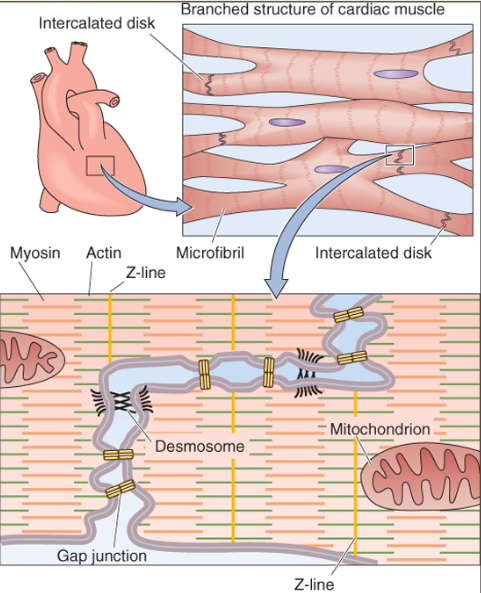
Describe key components of cardiac muscle structure
syncytium ie one cell multiple nuclei so beats as one unique unit made up of 2 types of links:
mechanical: intercalated disks ie junctional complexes made up of desmosomes and fascia adherens
electrical through gap junctions
What are some key structures required for excitation contraction coupling?
structure unit - sarcomere
actin and myosin cross bridges - overlap important
calcium dependent
additional proteins eg troponin and tropomyosin

Describe the relationship between calcium and cardiac contraction
longer Ca2+ transient compared to the electrical activity, and the later tension development

What are 2 ways in which calcium flows into cardiac muscle? Which is the largest contribution?
Influx from ECF via L – type Ca2 channels (Cav1.2), Release from SR via activation of ryanodine receptor type 2 - CICR
Both sources – contraction
RYR2 largest contribution – open for longer
Absolute requirement for Ca2+ influx via L type channels (unlike skeletal muscle)
Once calcium enters cardiomyocytes, how is muscle contraction triggered? Which receptors are involved?
Calcium coming in activates sar2 receptors so calcium leaves SR = increase in IC Ca = increase tension and contraction

Describe calcium efflux leading to myocyte relaxation
Efflux – plasma membrane
H+/ Ca2+ exchanger - PMCA
3Na+ / 1 Ca2+ exchanger - NCX1 – note importance Na+/K+ ATPase

How is calcium stored following myocyte contraction?
Sarcoplasmic reticulum - H+/ Ca2+ exchanger SERCA2
Mitochondria – MiCa channels
Mitochondrial membrane potential is -160 mV

What underlies strength/velocity of contraction in myocyte?
Calcium increases and sensitivity contractile proteins to calcium
What underlies strength/velocity of contraction in muscle?
pre-load/EDV and afterload/arterial pressure
Define isometric
held at a specific length, tension changes eg plank
Describe passive tension.
tension generated @ set sarcomere length - no APs or muscle stimulation, just a change in tension
Which molecules are involved in passive tension?
titin and desmin (connects sarcomeres) - cardiac has shorter titin
Describe active tension. How does it differ between cardiac vs skeletal myocytes?
tension generated by stimulation of the muscle @ set sarcomere length
Skeletal muscle has a wider range of lengths over which its tension is near-optimum. At about 75% of the optimal length, skeletal muscle tension is close to maximum already, whereas for cardiac muscle the active tension is zero at that length

What does proteins being closer in cardiac muscle fibre increase?
probability of an X bridge formation
What is the impact of increased tension on stretch-activated calcium channels?
more calcium enters from ECF
What is the amount of stretch equal to?
pre-load and EDV
Which law underlies amount of stretch/pre-load/EDV?
Starling’s law
Describe Starling’s law
the mechanical energy set free on passage from the resting to contracted state depends on the length of the fibres
i.e. the strength of contraction depends on sarcomere length
What is the effect on contraction when a sarcomere has a larger length?
greater contraction
What is the relationship between diastole and systole in starlings law?
they have to match
Are diastole vs systole passive or active?
diastole passive, systole active
What intrinsic autoregulatory mechanism ensures cardiac output matches venous return?
force of ventricular contraction is directly proportional to the initial length of cardiac muscle fibers, meaning a greater filling (stretch) of the ventricle during diastole leads to a stronger contraction and higher stroke volume
More blood in ventricles =
greater contraction
What is set and differs in isometric shortening?
length set, tension differs
What is set and differs in isotonic shortening?
tension set, muscle length differs
Describe the set up to measure velocity of shortening
tension generated first, adjustable stop sets length/preload
stop removed, muscle shortens and velocity depends on afterload/arterial pressure

What does the isometric phase of contraction modulate in vivo?
isovolumetric contraction phase (valves closed)

What does the isotonic phase of contraction modulate in vivo?
ejection phase


What does the slope represent?
velocity of shortening

What type of tension is left vs right?
left is passive tension vs right is active tension
What is the impact of afterload changes on shortening velocity ?
muscle lifting lightest afterload = faster shortening
muscle lifting heaviest afterload = slower shortening

At a given afterload, velocity of shortening is greater if … is greater
a pre-load
once contraction starts greater tension generation capacity actually helps speed things up
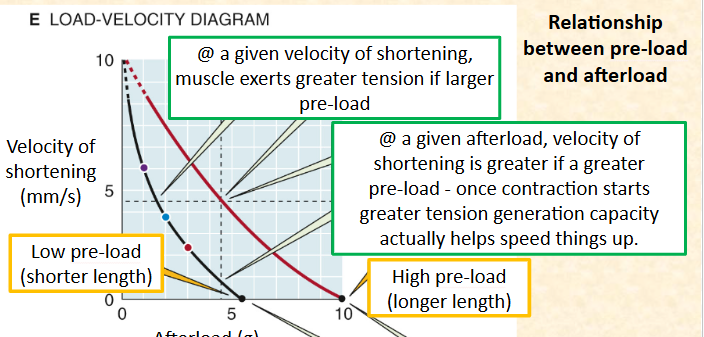
High pre-load impact on length
= longer length

Low pre-load impact on length
= shorter length
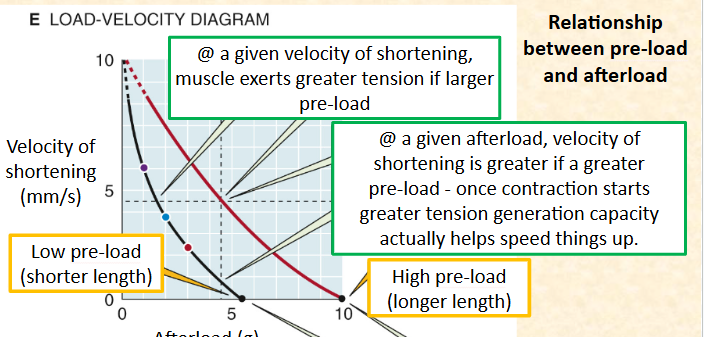
Contraction is isometric when velocity =?
0! indication maximum tension that can be generated

At a given velocity of shortening, muscle exerts greater tension if larger
preload
Impact of large volume and high arterial pressure on contraction
strong and slow
Impact of large volume and low arterial pressure on contraction
strong and fast
Impact of low volume and high arterial pressure on contraction
weaker and slow
Impact of low volume and low arterial pressure on contraction
weaker and fast
What is a difference in contractility vs rate termed?
inotropic vs chronotropic
Impact of high HR on tension and calcium availability
increased tension and calcium availability
What is there less time for during high HR?
for efflux to occur: HR = SERCA2a to take calcium into SR rather than efflux into ECF = more calcium released from SR
What is the impact of an increase in heart rate on calcium release?
hr higher so tension generated higher - increase in contraction tension due to faster heart rate - less time for calcium efflux so calcium taken into SR instead of effluxed across membrane of cells so next HR signal has more calcium in SR than usual so release of IC calcium is going to be higher = higher hr/contraction

What are 2 possible factors impacting strength of contraction?
IC Calcium increases and protein sensitivity
Pre load vs afterload impact ?
contraction strength vs velocity shortening
Define the Bowditch staircase phenomenon
an increase in HR increases the force of contraction generated by the myocardial cells with each heartbeat, despite accounting for all other influences due to increased calcium sensitivity of muscle cell