Anal Canal Cancer
 Call Kai
 Learn
 Practice Test
 Spaced Repetition
 Match
 Flashcards
 Knowt Play
1/27

There's no tags or description
Looks like no tags are added yet.
28 Terms
The anal canal extends from the _____ to the _____ at the junction of the ____ and ______.
Anal verge
Anorectal ring
Anus
Rectum
The anal canal is lined with _____ from the anal verge to the dentate line
Mucosa then becomes ______ in transition to _____ in the rectum
Stratified squamous epithelium
Cuboidal
Columnar epithelium
Lymphatic spread is common into ____ or _____: about 10-30% of patients have involved nodes at diagnosis
Pelvis or inguinal nodes
Canal DISTAL to the dentate line, anal verge, perianal skin drains into?
Superficial inguinal nodes
Around and PROXIMAL to the dentate line drains into?
Internal iliacs and lateral sacral nodes
____ is the preferred method of treatment (with concurrent chemo)
Radiation therapy
Etiology
Sexually transmitted infections
Immunosuppression
Smoking
Clinical presentation
Bleeding or anal discomfort
Anal mass
Itchyness (pruritis)
Change in bowel habits
Pathology
Squamous cell carcinoma (80%)
Basaloid carcinoma
Adenocarcinoma
Natural history
____ into adjacent soft tissues is common
50% of patients have spread into rectum or perianal skin
Lymphatic spread can occur early into ____ or ____ nodes
Doesn't really spread through the blood
Direct extension
Inguinal or pelvic
Which is more predictive, histologic subtype or grade?
Grade is more predictive, histologic subtype is not typically predictive
Prognosis (due to chemo)
2-3% mortality rate
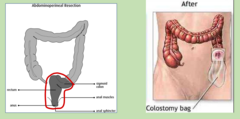
AP resection
Chemoradiation typical regimens
5-FU and mitomycin C
5-FU with cisplatin (easier to tolerate, less effective)
Continuous infusion
Combined chemoradiation can cause bone marrow suppression, _______ should be monitored
blood counts
What is the primary CTV margin?
Tumour + 2-3cm
Nodal CTV margin?
Nodes + 1cm
PTV = CTV + ______
0.5-1cm
Superficial, well differentiated tumours < 2cm in the distal canal are low risk for ______.
Lymphatic involvement
RT fractionation with chemo
Nodal area and primary tumour
Nodal area = 45 Gy
Primary tumour given 54-59.4Gy
Fractionation for RT only
Very involved nodes may require boosts up to ____ Gy
Nodal: 45-50.4 Gy
Primary tumour: 60-65 Gy
54
Scan borders
_____ past area of treatment
Top of _____ down to _____.
5cm
L4
Mid-femur
Prone vs supine positioning
Prone: Allows visualization of any perianal disease for bolus, difficult for patients to achieve, uncomfortable
Supine: Difficult to place bolus, easy and comfortable for patients
APPA field borders
Superior
Inferior
Lateral
L5/S1 interspace
3cm distal to primary tumour
Depends on treatment of inguinal nodes
Lateral field borders
Anterior
Posterior
Lateral
Posterior to the pubic symphysis
Anterior to pubic symphisis if treating external iliac nodes
Past sacrum
Inguinal nodes not typically treated
OARs
Bowel
Femoral heads
Iliac crest
External genitalia
Bladder
Acute effects
Skin reactions (perineum/anal verge)
Diarrhea
Bone marrow suppression
Nausea/vomiting
Fatigue
Chronic effects
Urgency and frequency of defecation
Anal discomfort
Perineal dermatitis
Fibrosis
Dyspareunia
Sexual impotence
Cardiac toxicity due to chemo