neurobio exam 1
 Call Kai
 Learn
Learn Practice Test
 Spaced Repetition
 Match
Match Flashcards
 Knowt Play
1/183

There's no tags or description
Looks like no tags are added yet.
Name | Mastery | Learn | Test | Matching | Spaced | Call with Kai | Chat |
|---|
No analytics yet
Send a link to your students to track their progress
184 Terms
What even is the example of the zebra fish?
that the nervous system (NS) react rapidly to sensory stimuli. The fish responds to pulse in water quickly—>escape behavior—> speed is a crucial evolutionary selection
what are channels
aqueous pore that allows specific solutes to pass
what are transporters
2 separate gates that open/close, allowing movement from one side to another
which is faster, channels or transporters?
channels faster
what do channels and transporters support?
support net movement in one direction across the membrane
what is electrochemical gradient
combo of both electrical and chemical gradient, determines direction and magnitude of net solute movements
what is the chemical gradient and what does it determine
a difference in the [ ] of a chemical substance (like an ion, molecule, or nutrient) between two areas. Determines the direction of ion movement (H—>L [ ])
what is the electrical gradient
difference in electrical potential across the membrane
what is passive transport
solutes down their chemical gradient, req no external energy
what is active transport
against electrochem gradient (L—>H), using external energy
what if chem gradient alone
no membrane potential
what if both chem + e- gradient
driving ion force in same direction larger magnitude in driving force
what if chem grad + e- grad in opp directions
driving ion movement in opp directions, lowest magnitude of DF
Active transport (AT) type 1
ATP-driven pump where transporter is ATPase, chem E from ATP drives
AT type 2
light-driven pumps, Light E derived from photon absorption
AT type 3- Coupled transporters
symporter moves solutes in same direction, antiporter moves solutes in opp directions
nernst eq
calculates the cell potential (or electrode potential) of an electrochemical reaction under non-standard condition

calculates the membrane potential of a cell by taking into account the concentrations and relative permeabilities of multiple ions

transporter Na-K ATPases do what
pump Na out and K in against gradient
what is Ek
equilibrium potential is when electrical and chemical forces balance out so net net K flow. (-) charge increases electrical potential differences, stops K diffusion because K is (+)
What is driving force?
push ions in/out. equal to the difference between membrane potential (MP) and equil potential (Ek)
in electrical circuit what is a resistor (R)
opposes passage of e- current, produces a voltage across it’s 2 terminals when current flows thru
± on circuit
battery maintains voltage (electrical potential difference) across 2 terminals
what is capacitor
A capacitor is a device that stores electrical energy by holding opposing charges on two close surfaces separated by an insulator
what does I represent
current: flow of e- charge per unit time that passes thru resistor
in the cell what does the resistor represent
Cell Membrane. stores charge, keeping (+)/(-) ions separated on either side of cell wall
what does battery represent in the cell (E)
Ion concentration gradient, drives ion flow
in the cell what does the current represent
stream of ions, actial flow of charged ions crossing the membrane
Ohms law
I= V/ R. V is voltage across resistor, R is how hard it is for current to pass
what would happen if Resistance increases
Current decreases
what is the formula for conductance
g= I/R. measure of a resistor, the inverse of resistance. A good conductor decreases resistance
I = V x g
how easy current passes increased conductance = increased current
what da lipid bilayer do
its an insulator, a resistor w/ infinite resistance, no e- current thru
what happens when you have 2 resistors connected in a series
the current passing thru both is the same. V is the sum of V1 and V2, same for resistance, so when 2 1/g= 1/gi +1/g2: conductance decreases
what is the time constant
t= RC
time constant
gradually increase to approack max value of It. Ic is the exponential decay, witgh t equal to the product RC. V changes simalrly to IR
what does conductance represent
how easily it si for ions to flow across Pm but this depends on the permeability + presence of ions
I = gX ( Vm - EX)
( Vm - EX) is the driving force. I is a product of conductance and driving force
in these circuits why is Cm (+)
because the equil of K is - inside
intracellular circuits
only permeable to K, has 2 paths, membrane capacitance and K+
time constant and circuits
is current flow thru R + C changes over time
what happens when circuit switched on
transient current charges capacitor until voltage across is the same as voltage across from the battery
what is the length constant eq

Experiment where you have a stim electrode, recording electrode a, b, c
t1 gradually depolarized @ beginning of current pulse. Membrane potential changes are gradual, magnitude and speed of MP changes decay across distance
what if you have a smaller t
faster membrane potential changes. Becuase of capacitance e- signals evolve over time
extracellular circuit series
Li magnitude decreases because of the leaky transmembrane current (im)
what happens to L constant when you decrease diameter (d)
Diameter and resistande are related in a forward direction. SO when diameter increases, resistance decreases
what happens if the length constant is longer
further distance equals decay of signals
what happens if you decrease Rm
more current flow down axial path so L with increase. RI decr diamter= incr current = L
what are the key properties of neurons
T for the temporal spread of a signal, and L for attenuation across distance
what type of experiment is it if you have mV in Y axis and time on X
current clamps. controls (or "clamps") the electrical current injected into the cell. This current can be kept at zero (to observe natural resting state activity) or injected in specific pulses to stimulate the cell.
what happens in current clamp exp
use stim electrode to inject current w/ varying magnitude. Start iwth (-) inward current to hyperpolarize. Magnitude changes in MP proportional to mag of (-) current opposite is depolarization.
what are Na-K ATPases
they maintain [ ] of Na/K + resting potential by counteracting leak, against chemical gradient. reach treshold for stimulus
how are APs initiated by Depolar-induced inward flow of Na
If extracellular [Na] is reduced, based on nerst eq, that magnitude of AP would decrease with decreased external [Na] because depolarization could induce membrane permeability to Na—> influx—> depolar
what does the peak of AP show
membrane permable to Na @ peak inward flow that is responsible for rising phase. MP during rising phase of AP exceeded ) so AP not caused by transient breakdown of membrane
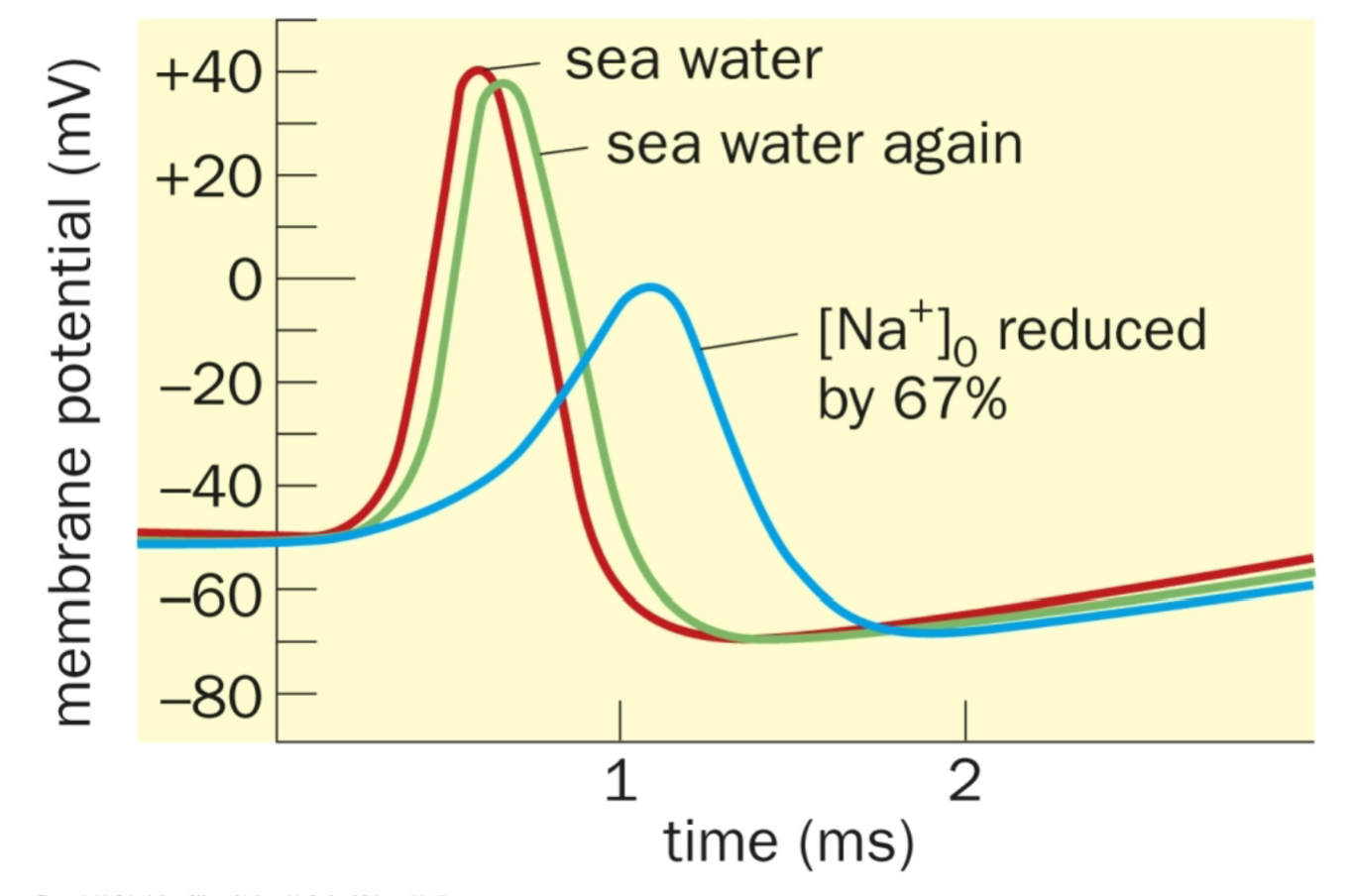
the green line increases once you add Na back in, the blue line is reduced when Na reduced. Basically tested the rising phase of AP is caused by Na+ influx
what is voltage clamp experiments
to measure ion flow in response to voltage changes. Compares intracellar MP with command voltage that is set.
what happens when feedback current is injected
when back into oscillator, rapidly changes intracel MP to the value of command ion flow change measure by how much current must be injected to keep MP @ certain point. This eliminated capacitive current (current that charges membrane in response to V)

the green initial inward current and then increase, the red is deducted Na current. Depolarization also increases K conductange by laggs behind NA. both depend on MP—>ion channels selectively permeable. conductance incr when axon depolar, now VGion channels becuase conductances change as a function of MP
Sequence of Na/ K conductance accounting for action potentials
V-gated Na channels activate, depolarization @ rising phase, Na down echem gradient
V-gated K channels activate during falling phase —>repolar. becuase increased K efflux
V-gated Na channels inactivate during falling phase
V-gated K channels deactivate. Na efflux > K = AP
what does all or none mean for APs
only after treshold constant waveform, shape determined by timing of Na/K conductance changes
what does regenerative mean for AP
Propogate w/o attenuation in amplitude. The rising phase depolarization that spreads down and brings adjacent region to treshold
what does unidirectional refractory period mean
Actoin potential, while depolarization is spread to other regions. delayed activation of K and inactivation of Na combine for refractory period, time when no ap appeared
Action potentials propagate rapidly with larger diameters and myelination why
Larger diameter = lower axial resistance = larger proportion of current moving forward, increase diameter = increase in length= further depolariszation at supratreshold to produce next AP. Myelin provides low capacitance for instant V and high resistance to prevent large current leakage
what does increase in Rm do
also increases t required to charge MP = slower AP—> compensate by dec Cm, membrane capacitance (myelination)
what does patch clamp do
form high resistance seal with smaller patch, clamps voltage, correspond for extracellular
what does TTX do
blocks VGNa channels
what does TEA do
selectively blocks VGK channels
what does the inward current represent in the patch clamp recordings
represents Na channels opening bc (+) Na flow inside
what does cloning of genes do
cloning genes that encode ion channels allows their structure function relationship to be studied
ball and chain model
voltage gated na channel inactivation, depolarization opens channel at same time moves AA so that inner poer more - , binding site for ball (+charge)
how is neurotransmitter release controlled at the presynaptic terminal
AP at presyn terminal triggers NT release
what does the ionophoresis experiment do
you inject current that depolarized motor axon and then apply positive current that deives + ACh out of th epipetter into the surface close to NMJ. The point is to measure depolarization of muscle fiber in response to nerve stim or ACh ionophoresis
what did the ionophoresis experiment show
for nerve stimulation, transient depolar is EEP, ionophoresis mimics motor nerve stim. when use TTX block VGNa channels but in ACh ionophoresis evokes EPP even when AP blocked—> AP in motor neurons is to trigger ACh release bind ACh to muscle membrane to cause depolarization in form of EPP
NT released in discrete packets
The experiment had low Ca activation and it sometimes produced depolarization (spontaneous). lower [Ca] reduced frequency of EPP but did not dec amplitude. shows that EPPs under normal conditions caused by many mEPPs—> NT released in uniform size
How does NT release @ presyn terminal occur
when a single presyn vesicle fuses with the PM—> dump NT content into the synaptic cleft and producing depolarization in the cell
How is NT release controlled at the presyn terminal: Ca2+ entry into presyn terminal
in exp used voltage clamp, @-70 mV a depolarizing step to -25mV applied to presyn terminal—> triggered Ca influx resulted in synaptic transmission. voltage at 50 no presyn Ca influx. at this point VGCa channels are open but since close the equil potential of Ca little driving force for Ca influx
what does the Ca2+ Nt experiment show
normal synaptic delay between Presyn and post syn response consist of delay due to time it takes VGCa channels (bypassed in tail condition bc channels alr open) and a delay between Ca entry and NT triggered post syn response
whats makes Ca entry also important
the short latency between Ca entry into presyn terminal + post syn events implies theres a pool of readily available vesicles ready to fuse with PM immidiately upon rise in intracellular Ca
sequence of events for NT and Ca
AP from axon—>depolarizaion of presyn terminal—>opening of VGCa channels—>Ca entry into presyn terminal—> fusion of SV with presyn PM—>NT release
what mediates synaptic vesicle fusion
SNARE and and SM proteins
what does synaptobrevin do and what is it
vesicle associated membrane protein that is a part of the SNARE complex.
what does syntaxin do and what is it
located on target membrane for vesicle fusion (t-SNARE), a part of the SNARE complex for vesicle fusion
what is SNAP-25 and what does it do
a t-SNARE attached to the cytoplasmic phase of PM via lipid modification
how does the SNARE complex work
the vsnare bends alpha helix releasing a lot of energy as well as the tsnares—>fuse membrane across
what blocks NT release
proteases that cleave SNARE proteins, it inhibits attachment of 4-helix to membrane blocking NT release
whats the partner to SNARE
munc18—>binds to SNARES throughout fusion
what does synaptotagmin do
serves as a Ca2+ sensor to trigger synaptic vesicle fusion
Syt experiment
knockout mice had syt-1 disrupted, in these mice, depolarization of presyb neuron had smaller post-syn response—> syt-1 req for normal synaptic transmission
why syt req
normally depolarization of presyn terminal causes AP to be fired resulting in inward current in post syn responses= success, a mutation decreases Ca binding. point mutations of Ca binding afficiency of single protein was able to move the ability of Ca to act to activate release
what does complexin do
activates both snare complex and blocking it at an intermediate step
syt binding affinity
needs lower binding affinity bc binds < time, has many of these so multiple sites needed to bind to Ca —> NT release
what impacts speed of Ca release
proximity of the VGCa channels. increased Ca in resp to depolar restricted to microdomains in AZ—> transiently to facilitate binding of Ca to multiple binding sites on syt
unc 13
binds and activates t-snares, tethers vsnares and SV to the releasing site
RIM
binds to RAB-3 (vesicle gtpase) bringing SV closer to VGCa channels
lifecycle of a NT ACh
made in cytoplasm, packaging requires 2 transporters: one is an V-ATPase to help acidify the vesicle and the other uses proton gradient to take in NT and placed into the SV. for release opening of VGCa channels—>Ca entry into presyn terminal—> fusion of SV with presyn PM using SNARE complex—>NT release. degraded
lifecycle of a NT GABA
made in cytoplasm, packaging requires 2 transporters: one is an V-ATPase to help acidify the vesicle and the other uses proton gradient to take in NT and placed into the SV. for release opening of VGCa channels—>Ca entry into presyn terminal—> fusion of SV with presyn PM using SNARE complex—>NT release. reuptake
LC of vesicle — kiss and run
form a pore, release NT—>membrane recloses—> vesicle pinches off
LC SV - full fusion
uses clatherin mediated endocytosis to remove the vesicle and its components has to use adaptor proteins
Bulk endocytosis
take of a huge portion of the PM, reclaim it , and sort out huge endosome the pieces that are needed using clatherin mediated endocytosis