A-Level Psychology Research Methods: AQA Sections 3.2.3.1–3.2.3.2
 Call Kai
 Learn
 Practice Test
 Spaced Repetition
 Match
 Flashcards
 Knowt Play
1/284

There's no tags or description
Looks like no tags are added yet.
285 Terms
What percentage of the overall assessment of Psychology at AS Level contains mathematical content?
At least 10%
What percentage of the overall assessment for A Level is made up by Research Methods?
At least 25-30%
What are the types of experiments in the experimental method?
Laboratory experiments, field experiments, natural experiments, and quasi-experiments.
What are the types of observational techniques?
Naturalistic observation, controlled observation, covert observation, overt observation, participant observation, and non-participant observation.
What are the two types of self-report techniques?
Questionnaires and interviews (structured and unstructured).
What does correlation analysis examine?
The relationship between co-variables.
What is the difference between aims and hypotheses?
An aim is a general statement of what the researcher intends to investigate, while a hypothesis is a specific prediction about the relationship between variables.
What is a directional hypothesis?
A hypothesis that predicts the specific nature (direction) of the difference between two or more variables.

What is a non-directional hypothesis?
A hypothesis that predicts a difference will exist between two or more variables without specifying the direction of the difference.
What is the independent variable (IV)?
The variable that the researcher manipulates, assumed to have a direct effect on the dependent variable (DV).
What is the dependent variable (DV)?
The variable that the researcher measures, which is affected by changes in the independent variable.
What are extraneous variables (EVs)?
Nuisance variables that are not the independent variable but might affect the dependent variable and results.
What are situational variables?
Variables connected with the research situation, such as temperature, time of day, and lighting.
What are participant variables?
Variables connected with research participants, such as age, intelligence, and gender.
What is operationalisation in research?
The process of clearly defining variables by the researcher.
What is the purpose of pilot studies?
To test and refine research methods before the main study.
What are the types of experimental designs?
Repeated measures, independent groups, and matched pairs.

What are behavioral categories in observational design?
Defined categories used to record specific behaviors during observation.
What is the significance of demand characteristics?
They are cues that may inform participants about the study's purpose, potentially affecting their behavior.
What is the role of ethics in psychological research?
To ensure the welfare of participants and the integrity of the research process, guided by the British Psychological Society's code of ethics.
What is the difference between primary and secondary data?
Primary data is collected firsthand for the specific study, while secondary data is previously collected data used for analysis.
What are measures of central tendency?
Mean, median, and mode.
What is the range in statistics?
The difference between the highest and lowest values in a data set.
What is standard deviation?
A measure of the dispersion of a set of data points around the mean.
What is a sign test in statistical testing?
A non-parametric test used to determine if there is a significant difference between two related samples.
What is the importance of peer review in the scientific process?
It ensures the quality and credibility of research before publication.
What are the implications of psychological research for the economy?
Psychological research can inform policies and practices that impact economic behavior and decision-making.
What is the purpose of assigning participants to groups in research?
To decrease the possibility that participant variables, such as individual differences, affect the results.
What are researcher variables?
Variables connected to the researcher that can affect participants or research outcomes, such as age, status, or body language.
How can researcher variables be controlled?
By carefully selecting researchers who are unrelated to the participants.
What are demand characteristics?
When participants change their behavior to align with what they believe are the aims of the research.
What is the 'screw-you' effect?
When participants deliberately try to disrupt the results of the research.
How can demand characteristics be controlled?
By using a single-blind experimental technique where only the researcher knows the true aim of the experiment.
What are investigator effects?
When a researcher acts in a way that supports their prediction, consciously or unconsciously influencing the results.
How can investigator effects be minimized?
By using a double-blind experimental technique where neither the participants nor the researcher knows the aim of the research.
What is randomization in research?
The use of chance in setting up the investigation to avoid bias in the order of trials.
What is standardization in research?
Keeping all situational variables of a procedure identical to ensure changes in data can be attributed to the independent variable.
What is an independent groups design?
An experimental design where two separate groups of participants are used, with each group experiencing a different condition.
What is the advantage of independent groups design?
No order effects occur since participants are only tested once, preventing practice or fatigue from influencing results.
What is a disadvantage of independent groups design?
Participant variables may differ between groups, potentially affecting the validity of the results.
What is random allocation?
A method to control participant variables in independent groups design, ensuring each participant has an equal chance of being assigned to any group.
What is a control group?
The group of participants in an experiment that receives no treatment, serving as a baseline for comparison.
What is the purpose of using a double-blind technique?
To prevent both participants and researchers from knowing the aims of the research, minimizing bias.
How can investigator effects be reduced in interviews?
By using interviewers who do not know the study's aims and employing standardized scripts.
What is the importance of using open-ended questions in interviews?
To allow participants to provide detailed and accurate answers in their own words without leading.
What is the role of video recording in interviews?
To allow another investigator to analyze the interviews, improving objectivity in the results.
Why is it important to standardize instructions in research?
To ensure all participants receive the same information, making results more reliable and replicable.
What is the effect of using a structured interview?
It prevents the investigator from altering questions, ensuring consistency across interviews.
What is the significance of using a questionnaire in research?
It allows data collection without face-to-face interaction, reducing the influence of the researcher's presence.
What is the main goal of minimizing extraneous variables?
To ensure that any observed effects can be attributed to the independent variable rather than other factors.
What is the potential impact of participant variables on research?
They can introduce bias and affect the validity of the study's conclusions.
What is the benefit of using a placebo in medical trials?
It helps control for demand characteristics by ensuring participants do not know if they are receiving the treatment or not.
What is the relationship between randomization and bias?
Randomization helps prevent bias in participant selection and the order of trials, enhancing the validity of the results.
What is the purpose of a baseline in an experiment?
To measure the effect of the independent variable (IV) against a comparison group.
What role does a placebo serve in drug testing?
It acts as a control to determine if the new drug therapy is effective.
What is a repeated measures design?
An experimental design where the same participants take part in each condition.
What is one advantage of repeated measures design?
It controls participant variables since the same individuals are used in all conditions.
What is a potential problem with repeated measures design?
Order effects, where participants may perform differently due to practice or fatigue.
What is counterbalancing in repeated measures?
A method to control order effects by splitting participants into groups that experience conditions in different orders.
What is a matched pairs design?
Participants are paired based on relevant variables, with one in the experimental group and the other in the control group.
What is a key advantage of matched pairs design?
It controls participant variables, enhancing the validity of results.
What is a disadvantage of matched pairs design?
It requires more participants, as each pair needs to be matched.
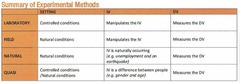
What is a laboratory experiment?
An experiment conducted under controlled conditions where the researcher manipulates the IV.
What is a strength of laboratory experiments?
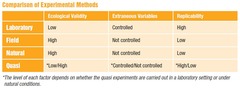
They allow for high control over extraneous variables, enhancing internal validity.
What is a limitation of laboratory experiments?
They may lack ecological validity due to the artificial nature of the environment.
What is a field experiment?
An experiment conducted in a natural setting where the researcher manipulates the IV.
What is a key advantage of field experiments?
They often have higher ecological validity due to the natural environment.
What is a disadvantage of field experiments?
There is less control over extraneous variables, which can distort findings.
What is a natural experiment?
An experiment where the researcher examines the effect of an existing IV without manipulation.
What is a key characteristic of natural experiments?
The IV is naturally occurring, such as a disaster or event.
What ethical issue is associated with field experiments?
Participants may not give informed consent as they are unaware they are being studied.
How can order effects be minimized in repeated measures?
By using counterbalancing to alternate the order of conditions for different participant groups.
Why might a repeated measures design be preferred over independent groups?
It controls for individual differences, making it easier to attribute effects to the IV.
What is the purpose of using a control group in an experiment?
To compare the effects of the IV against a group that does not receive the treatment.
What is the difference between independent groups and matched pairs?
Independent groups use different participants for each condition, while matched pairs use pairs of similar participants.
What is the ABBA technique?
A counterbalancing method where participants experience conditions in alternating orders.
How does a laboratory experiment impact internal validity?
High control over variables allows for stronger conclusions about cause and effect.
What is the main goal of all experiments?
To find a cause-and-effect relationship between an independent variable (IV) and a dependent variable (DV).
What is the significance of demand characteristics in laboratory experiments?
They can lead participants to alter their behavior based on cues about the study's purpose.
What does ecological validity refer to?
The extent to which findings can be generalized to real-world settings.
What is the main challenge of matching participants in matched pairs design?
It can be time-consuming and may not control all relevant variables.
How does a natural experiment compare to laboratory experiments in terms of validity?
Natural experiments often have a higher level of external validity and ecological validity.
What is a strength of using natural experiments?
They provide unique insights into real-life situations and may be the only ethical way to study certain topics.
What is a limitation of natural experiments?
Natural events may occur rarely, limiting the ability to generalize results.
What is a quasi-experiment?
An experiment that contains a naturally occurring independent variable (IV) that already exists, such as age or gender.
What is a key characteristic of quasi-experiments?
Participants cannot be randomly allocated to conditions due to pre-existing differences.
What is a strength of quasi-experiments conducted in a laboratory?
They have a high level of control and allow for replication of the study.
What is a limitation of quasi-experiments?
They may lack ecological validity and findings may not generalize to real-life settings.
What is sampling in research?
Sampling involves selecting participants from a target population to represent the larger group.
What is a target population?
The specific group that research findings will be generalized to.
What are the common types of sampling methods?
Random, systematic, stratified, opportunity, and volunteer sampling.

What is random sampling?
A method where every member of the target population has an equal chance of being selected.
What is a strength of random sampling?
It is free from researcher bias, making the sample likely to be representative.
What is a limitation of random sampling?
It can be time-consuming and may result in a sample that is not fully representative.
What is systematic sampling?
A method where participants are selected using a set system, such as every 5th person.
What is a strength of systematic sampling?
It reduces researcher bias by following a predetermined selection system.
What is a limitation of systematic sampling?
It may not be truly unbiased if every nth person shares a common characteristic.
What is stratified sampling?
A method where subgroups within a population are identified and participants are obtained from each stratum in proportion to their occurrence.
What is a potential problem with sampling in research?
Samples can be biased, leading to issues with generalizing findings to the target population.
What is ecological validity?
The extent to which research findings can be generalized to real-world settings.