MCB 2000 Chapter 17
 Call Kai
 Learn
 Practice Test
 Spaced Repetition
 Match
 Flashcards
 Knowt Play
1/30

There's no tags or description
Looks like no tags are added yet.
31 Terms
the glucose problem
some tissues need glucose every minute of every day, but stores run out fast
brain:
~ 120 g/day
prefers glucose use under normal. about 60% of the body’s resting glucose budget
red blood cells:
no mitochondria
obligate glycolysis. no choice but to burn glucose to lactate
liver glycogen
~ 100g stored
enough to cover roughly 12 to 18 hours of fasting. then it’s gone
within a day of fasting, glycogen is gone but glucose demand keeps going. something has to make more

making new glucose
gluconeogenesis: the synthesis of glucose from non-carbohydrate precursors
where: mostly the liver
over 90% of glucogenesis happens in hepatocytes (especially overnight and short-term fasting). the kidneys do the rest, around 10% (prolonged fasting)
not in muscle. muscle lack the final bypass enzyme (glucose 6-phosphatase), so it can never release free glucose to the blood. can break down glycogen and use it for itself, but it can’t even export that carbon as free glucose for the brain
when: wherever glycogen can’t keep up
overnight fasting. sustained exercise. prolonged starvation. stress states
all situations where blood glucose is falling and the brain still need to be fed
glucogenesis is a liver job. run mostly when food has stopped coming in
three carbon sources
different precursors, different tissues, all converging on the gluconeogenic pathway
lactate
alanine
glycerol
three small carbon 3-molecules, each marking the tissue and condition that produces it
lactate
C₃H₆O₃
from working muscle and RBCs
anaerobic glycolysis produces lactate
haring working muscle, where O2 supply is outpaced, and red blood cells which have no mitochondria, are the main exporters
working muscle produces lactate when glycolytic flux outruns mitochondrial oxidation and red blood cells produce lactate continuously because they don’t have any mitochondria
lactate is sent to the blood then to the liver to be converted back to pyruvate
alanine
C₃H₇NO₂
from muscle protein breakdown
during fasting, muscle proteins are degraded
the amino acid alanine carries both the carbon skeleton and waste nitrogen from muscle to liver
muscles transfer nitrogen onto pyruvate, making alanine which travels to the liver
in the liver, alanine donates its nitrogen for urea synthesis and its carbon skeleton becomes pyruvate for gluconeogenesis
glycerol
C₃H₈O₃
from fat tissue (adipose) triacylglycerols
when fat stores are mobilized, triacylglycerols are cleaved into three fatty acids and one glycerol
the fatty acids fuel β-oxidation; the glycerol comes here to gluconeogenesis
where each precursor enters the pathway
lactate and alanine enter at the bottom (as pyruvate)
glycerol jumps in halfway up (as DHAP)
Lactate:
in the liver, lactate dehydrogenase runs in the oxidative direction so in reverse
this converts lactate back to pyruvate and produces cytosolic NADH
Alanine
transamination removes the amino group from alanine leaving us w/ pyruvate
other glucogenic amino acids can enter as oxaloacetate or other TCA intermediates but alanine is the clean pyruvate example
glycerol:
its phosphorylated and oxidized DHAP which joins the pathway about halfway up
skips the most expensive lower bypass steps

why not just reverse glycolysis
three steps in glycolysis release so much energy they cannot be reversed under cellular conditions (extremely exergonic)
function as one way steps and pushing them backwards directly would require unrealistic metabolite concentrations
reversing glycolysis means climbing back over these three cliffs.
the cell uses different enzymes instead for gluconeogenesis to get around those thermodynamic barriers
central design principle of the pathway: use the reversible steps of glycolysis but bypass the irreversible ones

the bypass strategy
four unique gluconeogenic enzymes replace the three glycolytic steps
glycolysis: forwards, downhill
glucose → G6P (hexokinase/ glucokinase)
F6P → F-1,6-BP (phosphofructokinase-1)
PEP → pyruvate (pyruvate kinase)
gluconeogenesis: reverse, with bypasses
G6P → glucose (glucose-6-phosphatase (bypass 4))
F-1,6-BP → F6P (fructose-1,6-bisphosphatase (bypass 3))\
major cytosolic control point for gluconeogenesis
pyruvate → OAA → PEP (pyruvate carboxylase + PEPCK (bypass 1+2))
three glycolytic barriers, four gluconeogenic bypass enzymes. the three pyruvate-to-PEP barrier needs two steps to cross
bypass 1: pyruvate carboxylase
adds a CO2 (supplied as bicarbonate) to pyruvate. mitochondrial matrix. ATP-consuming. biotin-dependent
converts pyruvate (3C) to oxaloacetate (4C)
cost: 1 ATP per pyruvate
where: mitochondrial matrix
pyruvate enters from cytosol via the pyruvate transporter
the reaction happens inside the matrix
oxaloacetate is made inside the mitochondria and cannot simply diffuse out
cofactor: biotin
covalently linked to the enzyme on a flexible arm
the biotin arms picks up CO2 from bicarbonate (HCO₃⁻) and swings it onto pyruvate
activator: Acetyl-CoA
allosterically activates by acetyl-CoA
signal: TCA is saturated
send pyruvate to glucose synthesis instead
high acetyl-CoA tells the mitochondria that fuel is abundant and that pyruvate should be diverted towards glucose synthesis rather than further oxidation
step 1: add a carbon. mitochondrial. costs 1 ATP per pyruvate

bypass 2: PEPCK (phosphoenolpyruvate carboxykinase)
removes a CO2 and adds a phosphate. the rate-limiting, committed step of gluconeogenesis
converts oxaloacetate to phosphoenolpyruvate (PEP) by removing Co2 and using GTP to install a phosphate
cost: 1 GTP per oxaloacetate
pyruvate carboxylase just added CO2, but that add and remove strategy is how the cell crosses the pyruvate kinase barrier
where: cytosol
once oxaloacetate is in the cytosol (via the shuttle)
PEPCK takes over here
oxaloacetate must get here from the matrix back out into the cytosol before PEPCK is going to be able to use it
chemistry: decarboxylation drives it
releasing CO2 generates a high-energy enol intermediate. GTP donates its phosphate to trap the enol as PEP
helps dive formation of the high- energy enol phosphate in PEP
regulation
committed step
rate-limiting for the whole pathway
strongly regulated by hormones at the gene-expression level
when fasting, glucagon promotes PEPCK expression and in the fed state, insulin suppresses it
step 2: remove the carbon you just added, but trap a phosphate in the process. costs 1 GTP per OAA

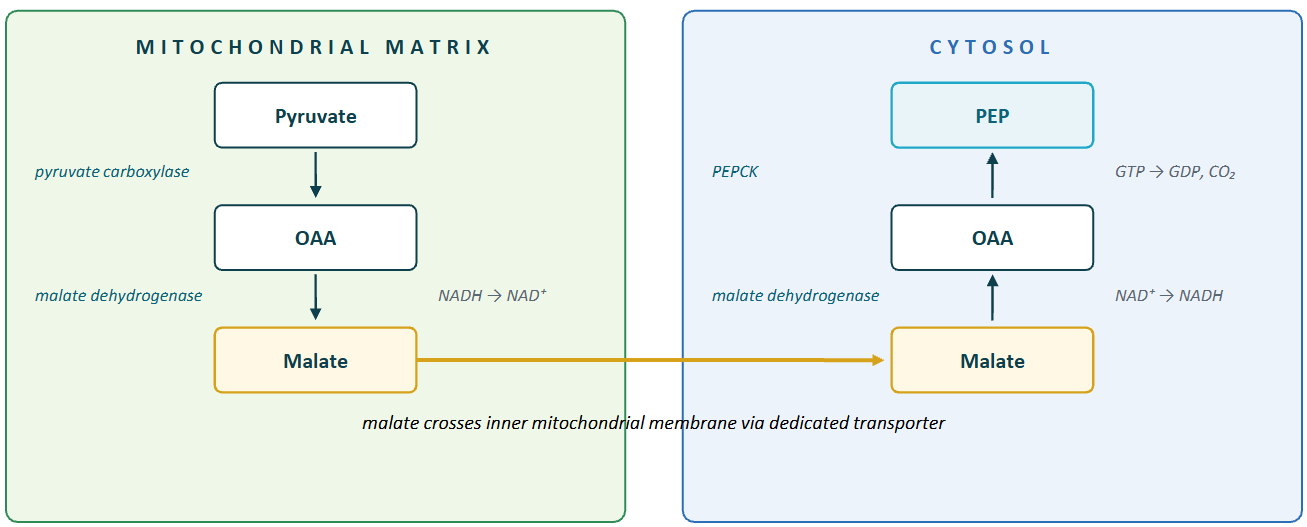
the oxaloacetate shuttle
OAA can’t cross the inner mitochondrial membrane. malate can
OAA hitches a ride as malate. NADH made in the matrix is effectively delivered to the cytosol as a bonus
the shuttle does two jobs: moves the OAA out of the mitochondria and helps supply cytosolic NADH needed later in gluconeogenesis
NADH matters especially when the starting precursor is pyruvate or alanine
if the starting precursor is lactate, lactate dehydrogenase already produces NADH directly
why two steps for one bypass?
PK’s huge ΔG°′ broken into two manageable carboxylation/ decarboxylation steps
splitting the climb into two smaller, ATP-paid steps is how the cell scales the -31 kJ/mol cliff
so, the net cost is 2 high energy phosphate bonds per pyruvate, or 4 per glucose just to get from pyruvate back to PEP.
why the bottom of gluconeogenesis is the most is the most expensive part of the pathway

bypass 3: F-1,6-BP (fructose-1,6-bisphosphatase)
hydrolyzes as phosphate off F-1,6-BP. cytosolic. major allosteric regulation point
where: cytosol
reverse the PFK-1 step of glycolysis (which adds a phosphate to F6P using ATP)
FBPase-1 does not reverse that by making ATP, instead it hydrolyzes the phosphate from F1,6BP and releases and inorganic phosphate as a product
chemistry: hydrolysis, not transfer
the phosphate is hydrolyzed off as inorganic phosphate
this hydrolysis helps to drive the gluconeogenic direction but it also means the energy originally spent by PFK-1 is not recovered
no ATP is generated; this drives forward vias mass action and ΔG° loss
regulation: F-2,6-BP master switch
inhibited by fructose 2,6-bisphosphate and by AMP
activates by citrate
both enzymes coexist in the cytosol of liver cells — so, potentially futile cycle point
if both ran strongly at the same time, the cell would spend ATP adding a phosphate, and then would immediately hydrolyze it off
F2,6BP activates PFK-1 and inhibits FBPase-1 pushing the pathway decisively in one direction based off of its presence or absence
step 3: a simple hydrolysis. cytosolic. the cells main lever for switching between glycolysis and gluconeogenesis

bypass 4: glucose 6-phosphate
releases free glucose into the blood. only in liver and kidney. ER lumen, not cytosol
another hydrolysis reaction
G6P+ H2O → Glucose + Pi
no ATP made
where: ER lumen (liver, kidney)
embedded in the ER membrane with its active site facing the lumen
so G6P needs to be transported into the ER, hydrolyzed there and then glucose and phosphate are transported back out
muscle and brain lack this enzyme — mainly expressed in liver and kidney
this is why glycogen is for muscle use only
muscle can generate G6P from glycogen but without G6-phosphatase, it can’t be released into the bloodstream
transport: G6P must be imported
a transporter shuttles cytosolic G6P into the ER
after hydrolysis, free glucose and Pi are exported back out
consequences: why only liver and kidney release glucose
without this enzyme, G6P stays trapped in the cell
muscle uses its own G6P locally; only liver and kidney can resupply blood glucose
step 4: hydrolyze the last phosphate. only liver and kidney can do this, which is why they’re the only blood-glucose suppliers

glycolysis vs gluconeogenesis: where they differ
three barriers in glycolysis. four enzymes in gluconeogenesis. three different compartments

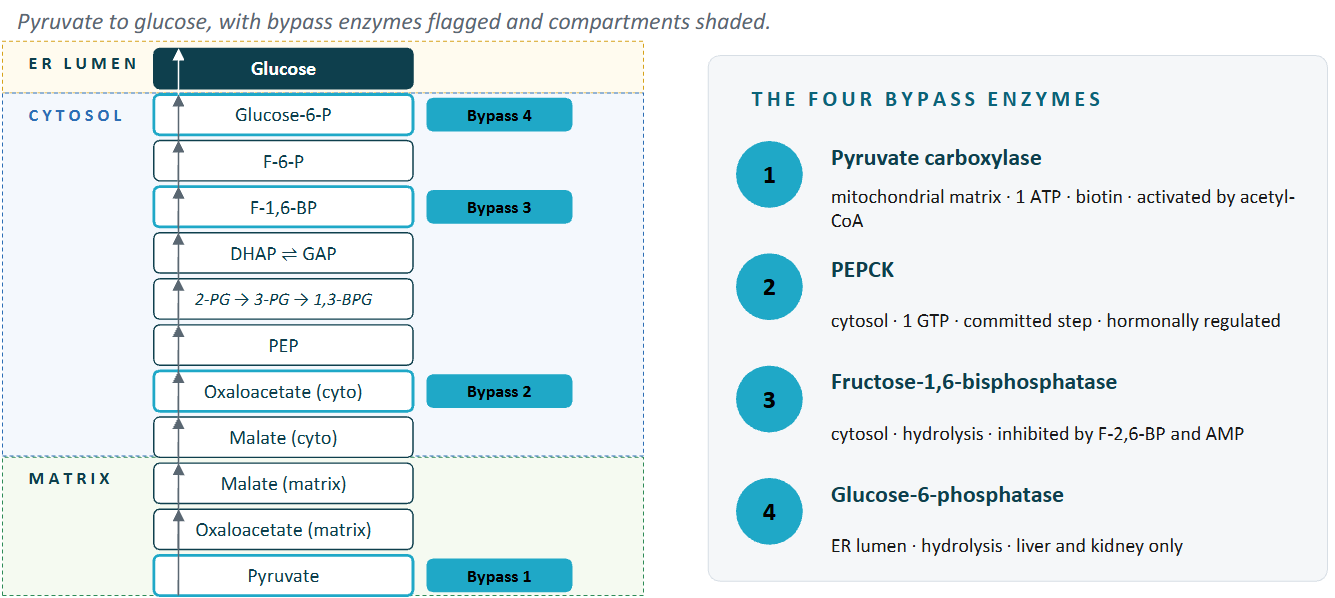
the complete gluconeogenic pathway
from pyruvate at the bottom to glucose at the top, with 4 bypasses across the three compartments
the bill: making one glucose from two pyruvates
three reactions each happen twice (once per pyruvate)
each row is per-pyruvate. doubling gives the per-glucose cost
three reactions x 2 = 6 ATP equivalents

where the cost lands along the pathway
2 ATP and 2 GTP at the bottom, 2 ATP plus 2 NADH in the middle. Glucose at the top costs nothing more
two-thirds of the cost lives in the bottom of third of the pathway: the pyruvate-to-PEP crossing

compared to glycolysis
glycolysis yields 2 ATP per glucose. gluconeogenesis costs 6 ATP equivalents. A round trip loses 4
going glucose → pyruvate gives you 2 ATP. coming back costs you 6.
the 4 ATP differences is the price of irreversibility

precursor matters: glycerol is cheap
glycerol enters at DHAP, skipping the most expensive part of the pathway
Lactate: enters at pyruvate
full bill
pays for PC, PEPCK, PGK reverse, GAPDH reverse
3 ATP eq. per lactate
6 ATP eq per glucose
alanine: enters at pyruvate (after transamination)
full bill
same path as lactate, plus nitrogen of offloaded for urea synthesis
additional cost, separate budget
glycerol: enters at DHAP
discounted
skips PC, PEPCK, PGK reverse
costs only 1 ATP per glycerol at glycerol kinase
about 2 ATP per glucose from glycerol
same destination, very different fares. where you enter the pathway determines what you pay
why both pathways cannot run at once
without reciprocal regulation, the cell would burn ATP in futile cycles
futile cycle: if both enzymes are active:
F6P + ATP → F1,6BP
F1,6BP +H2O → F6P +Pi
net effect: ATP is hydrolyzed to ADP+ Pi. nothing is built. the cell heats up
the cell solves this by ensuring that when one enzyme is active, the other is shut down

three regulatory pairs
each irreversible glycolytic enzyme is reciprocally regulated against its gluconeogenic counterpart
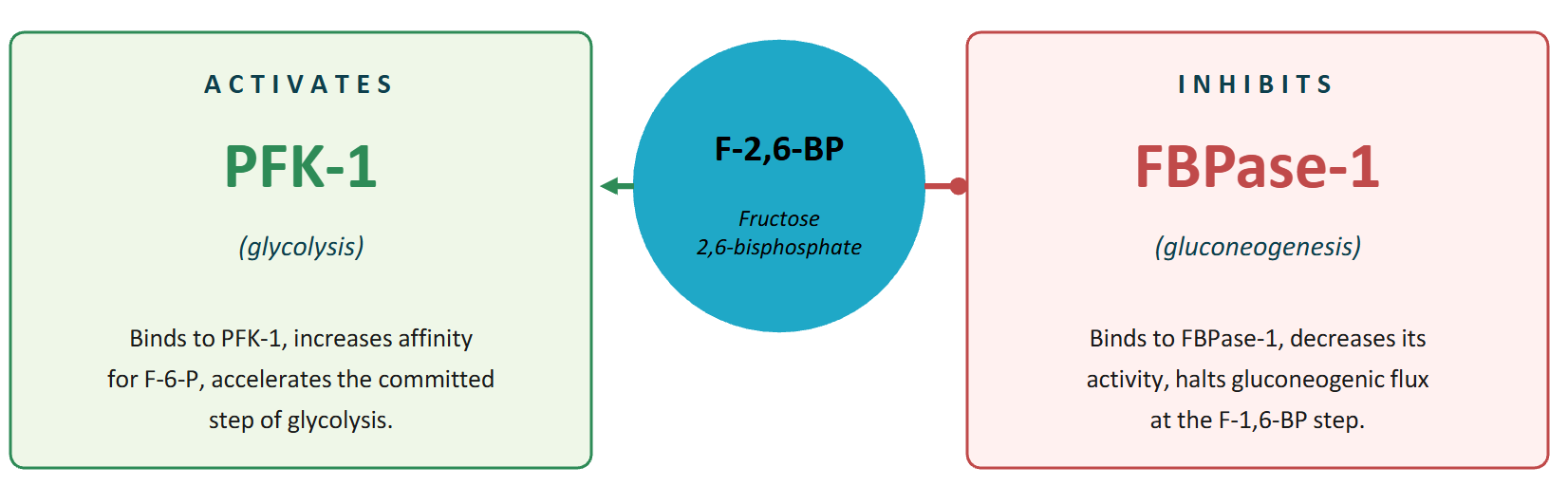
pair 2 is the master switch. F2,6BP activates PFK-1 and inhibits FBPase-1 at the same time

spotlight: F2,6BP
one small molecule, two opposite effects on two enzymes
when F2,6BP is HIGH: glycolysis runs, gluconeogenesis stops. when it’s LOW: the reverse
hormonal control: the switch you already know
same PFK-2/FBPase-2 cascade as the glycolysis chapter — both hormones, side by side
glucagon and insulin are opposing signals at every level: receptor, second messenger, phosphorylation state, gene expression

allosteric fine tuning by small molecules
beyond hormones: the cell’s own metabolite adjust flux in real time
acetyl-CoA — mitochondrial fuel is high
activates pyruvate carboxylase
diverts pyruvate to gluconeogenesis
citrate: TCA cycle is saturated
inhibits PFK-1, activates FBPase-1
slows glycolysis, speeds gluconeogenesis
AMP: ATP is being used up
activates PFK-1, inhibits FBPase-1
speeds glycolysis, slows gluconeogenesis
ATP: energy charge is full
inhibits PFK-1 and pyruvate kinase
slows glycolysis when ATP is plentiful
local metabolites tune the pathway in real time . high fuel → make glucose. Low ATP → burn glucose
the integrated picture
fed and fasted states have completely opposite enzyme activity profiles
every layer is reciprocal. one state’s ON the other state’s OFF at every level of the control system

the Cori cycle: muscle and liver in partnership
lactate goes to liver. glucose comes back. the blood is the highway
muscle exports the problem; liver pays the bill. the cycle keeps muscle running even when it can’t use oxygen fast enough

why doesn’t the cycle violate thermodynamics
muscle gains 2 ATP; liver pays 6 ATP. the net 4 ATP comes from liver oxidation of fatty acids
muscle: burns 1 glucose, gains 2 ATP
glucose → pyruvate via glycolysis
pyruvate reduced to lactate to regenerate NAD+
net muscle: +2 ATP
lactate is exported because muscle cannot oxidize it further without enough O2
liver: spends 6 ATP equivalents per glucose rebuilt
2 lactate → pyruvate → 1 glucose via gluconeogenesis
net for liver: -6 ATP equivalents
those ATP are supplied by mitochondrial oxidation of fatty acids in hepatocytes, which yields plenty of ATP from β-oxidation
whole body: net cost is 4 ATP per cycle
the cycle is energetically expensive overall (-4 ATP per loop)
but it lets muscle keep contracting when O2 runs short, and the energy bill is paid from fat stores via the liver
the cost is acceptable because the alternative is stopping work
muscle borrows energy from liver. liver borrows energy from fat. fat muscle work via the liver as middleman
starvation timeline: how the body adapts
days 1 to 3: gluconeogenesis carries the load. After day 3: ketone spare glucose and protein
day 1- 3: glycogen depletion, gluconeogenesis dominants
Hepatic glycogen runs out in t12 to 18 hours. gluconeogenesis ramps up to maintain blood glucose
precursors: lactate from RBCs and working muscle, glycerol from fat mobilization and amino acid carbon from muscle protein breakdown
the brain runs on glucose, muscle is being slowly consumed
day 3 onward: ketone bodies enter the picture
liver starts producing ketone bodies ( acetoacetate, β-hydroxybutyrate) from fatty acid oxidation
brain shifts gradually ketone as fuel, reducing glucose demand from ~120 g/day to as little as 40 g/day
gluconeogenesis still runs, but at a lower rate
weeks 1+: protein sparing
with ketones covering most brain fuel, the rate of muscle protein breakdown drops sharply
this is the body’s adaptation to extend survival; preserving muscle protects organ functions and lets the person liver for weeks on fat reserve alone
glucose demand drops as ketone bodies take over brain fuel. that’s what lets humans survive prolonged fasts
type 2 diabetes: gluconeogenesis is stuck on
insulin resistance breaks the off-switch. the liver keeps making glucose even when blood glucose is already high
normal physiology: after a meal
insulin rises _> suppresses hepatic gluconeogenesis → blood glucose stabilizes
fasting blood glucose: <100 mg/dL
type 2 diabetes: insulin resistance
insulin signal weakened gluconeogenesis not suppressed → liver keeps exporting glucose even after eating
fasting blood glucose: ≥ 126 mg/dL (diabetic range)
T2D fasting hyperglycemia is largely a gluconeogenesis problem. metformin lowers hepatic glucose output
