409 Quiz 3- Testudines
 Call Kai
 Learn
 Practice Test
 Spaced Repetition
 Match
 Flashcards
 Knowt Play
1/16

There's no tags or description
Looks like no tags are added yet.
17 Terms
Turtle Evolution
-Extensive fossil record, owing to their heavy, bony skeletons, and aquatic or marine habits.
-The earliest-known turtle fossils are from the Late Triassic (ca. 220–210 MYA).
-Yet, early evolution is still elusive, partly because of shell convergence
-Pan-Testudines are anapsids, and lead to turtles, starting with Milleretta that however looks like a lizards (thus ancestor reptile looks like lizards) Next branch shows how more turtle like traits came to be. Where characteristics associated evolved.
—-Broadening of the ribs before evolution of the shell
Eunotosaurus
-Flat, broadened ribs
Odontochelys
-Broadened ribs
-Plastron present (underside of shell)
-Carapace absent (consists of neural plates only, no osteoderms)
-Still had teeth
Proganochelys
-Both plastron and carapace
-No teeth
-Beak
-Most ancient turtle was on 15cm
-Use to have turtles 15 feet long
-The ancestor was terrestrial, however aquatic transition in the triassic, some decided to come back up (reversal evolution)
Now 2 main groups
-Sight neck
-Hidden neck: much more widespread and diversified

Distribution
Turtles are cosmopolitan in terrestrial, freshwater, and marine habitats, except at extremely high latitudes and elevations.
-Only not found in extreme cold such as super high elevations as well as extreme desert conditions
-Turtles are found in a wide variety of habitats: dry landscapes (deserts, savannas), grasslands, mesic woodlands, mountains, and aquatic habitats (ponds, lakes, creeks, tropical rivers, marshes, brackish waters, oceans).
-—Green is fresh, red is terrestrial, and blue is salt: Most are freshwater
-Regions of exceptionally high turtle diversity are the southeastern United States (primarily Emydidae) and Southeast Asia (primarily Geoemydidae)
Phylogeny of Turtle Families
-Had not many, then huge peak, then not many again
-Major diversification in Eocene−Oligocene transition about 30 million years ago
-Most extant families were once more widespread than their present distributions.
-The 7 species of modern Sea Turtles are a small remnant of the variety that existed in the past.
-The 3 monotypic Families Carettochelyidae, Dermatemydidae, and Dermochelyidae were once much more diverse
-Testudinoidea (like water but not completely), Chelonodea (salt water), Chelydroidea (freshwater). All tortoises are turtles but not all turtles are tortuous

Two Clades
Side Neck: Pleurodira retract their necks sideways.
Hidden: Cryptodira retract their necks backward
-Sea Turtles (Cheloniidae, Dermochelydae) and Snapping Turtles (Chelydridae) have lost the ability to retract their neck completely.
Pleurodira
-All extant pleurodires (106 species) are freshwater species;
-They have a Gondwanan distribution (southern continents).
-Sideways
Cryptodira
Extant cryptodires (257 species) may be freshwater, marine or terrestrial turtles; collectively they are a cosmopolitan group
-Soft shelled turtle chart shows they are cosmopolitan as well
-Tortoises: very widespread
-Outwards
Shell
The shell completely encases the body
-Composed of dermal ossifications that incorporate the ribs, most vertebrae, and parts of the sternum and pectoral and pelvic girdles.
-The shell has two parts, a dorsal carapace, and a ventral plastron, which are joined laterally by a bridge.
-The pectoral and pelvic girdles of turtles lie inside the rib cage. All vertebrae, except those of the neck and tail, are fused into the carapace.
-In most turtles, both the carapace and the plastron are rigid structures, but several lineages have independently evolved the ability to close the body within the shell.
-In most cases there is a hinge on the front or rear lobe of the plastron.

Scutes
-Bony elements of the shell are usually covered externally by keratinous scutes (modified scales).
-The scutes do not have the same patterns as the underlying bony elements, and this misalignment (like alternating bricks in a wall) adds strength to the shell, which protects against predation.
-Components of the Turtle Carapace Bony components are shown on the left. The overlying epidermal scutes are shown on the right. A similar relationship between dermal and epidermal components exists in the plastron.
-Three lineages of aquatic and marine turtles (i.e., soft-shelled turtles, Trionychidae; Pig-nosed Turtle, Carettochelys insculpta, Leatherback, Dermochelys coriacea) are covered by leathery skin instead of a bony shell.
-Can be used to age a scute, looking at the bony elements

Shell-Body Forms (Shape)
-The overall shape of the shell varies greatly, with relatively high domes being characteristic of many terrestrial turtles, and relatively flat, streamlined forms characteristic of aquatic and marine turtles
—Body forms of turtles reflect their habitats—
-The carapace of many tortoises, like that of the Charles Island Giant Tortoise (Chelonoidis niger) is domed, which allows for greater lung capacity.
-The shells of aquatic swimmers such as the Loggerhead Sea Turtle (Caretta caretta) are flatter and hence more streamlined. However, that relationship is variable
-Tortoises that construct burrows like the Florida Gopher Tortoise (Gopherus polyphemus) have relatively low carapaces.
-Aquatic turtles that walk on the bottom of the ponds, like the Musk Turtle (Sternotherus odoratus) have domed shells.
-Shell reduction has occurred in some turtles, most peculiarly in the African Pancake Tortoise (Malacochersus tornieri), which has a flat, and flexible shell that allows it to get into crevices in the rocky outcrops it inhabits.
Limbs
-The structure of turtle limbs is highly variable, reflecting the environment and mode of locomotion of different species.
-Marine species and the freshwater Pig-nosed Turtle (Carettochelys insculpta) have flippers with extremely elongated digits that are not independently movable.
-Most aquatic species have webbing between the digits, which still retain some independent mobility.
-Terrestrial turtles (and some aquatic species) generally have stout, clublike limbs capable of lifting their heavy bodies off the substrate.
-Their digits are usually reduced, and the feet are equipped with thickened pads (elephantine feet).
Respiration
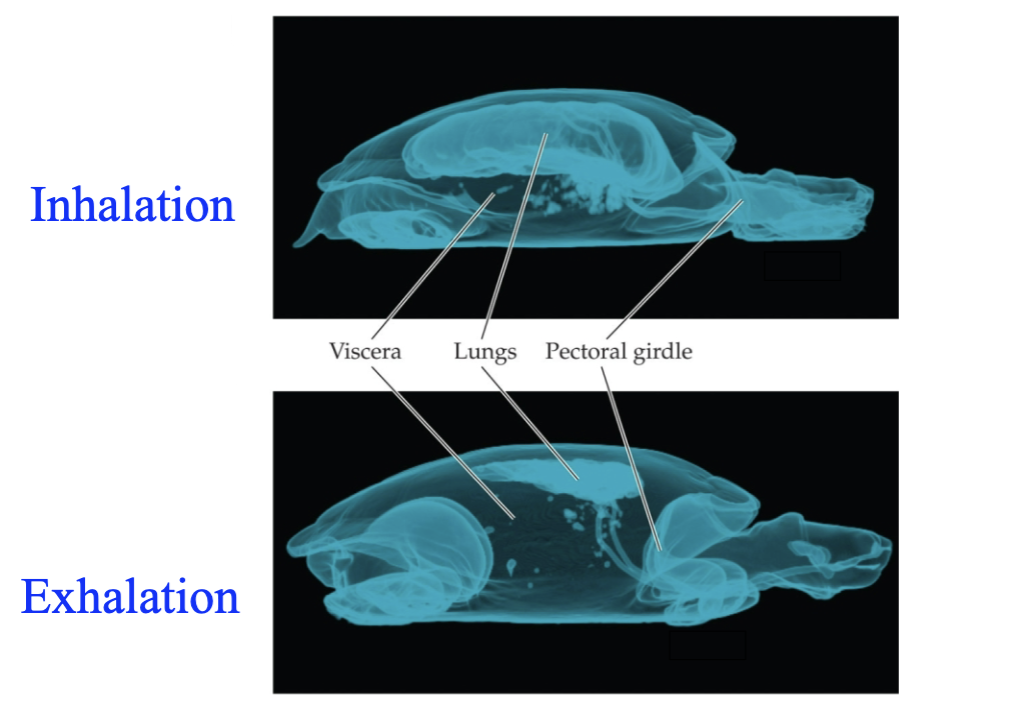
-The complete enclosure of the internal organs of turtles within a rigid shell means that the animals cannot breathe by expanding and contracting the rib cage.
-The lungs of a turtle, which are large, are attached to the carapace dorsally.
-Ventrally, the lungs are attached to a sheet of connective tissue that in turn is attached to the viscera (=internal organs).
-During inhalation, muscle contractions allow the viscera to slump downward.
-The tissue connecting the viscera to the lungs pulls the ventral surface of the lungs down, increasing their volume and drawing air inward.
-Turtles exhale by contracting other muscles that force the viscera upward against the lungs, driving air out.
-Most aquatic turtles have some capacity for pharyngeal underwater respiration.
-These species exchange gases by using the lining of the pharynx; water is pumped in and out using movements from the hyoid apparatus.
—The soft-shelled turtles of the family Trionychidae have a characteristic habit of lying partly buried in the muddy bed or rivers and ponds, using their ability to obtain oxygen through their skin to reduce the need to come to the surface to breathe.
-Cloacal respiration. Some turtles will expand their cloacal opening and draw water into the cloaca and shunt it into the bursae where gases are exchanged
-Ex. Pleurodire Turtles The Australian Fitzroy River Turtle (Rheodytes leukops). Rheodytes keeps its cloaca open while diving and respires by pumping water in= and out of its cloacal bursae
Glands
-Many aquatic turtles (e.g., Pelusios, Pelomedusidae; American Mud and Musk Turtles, Kinosternidae) have musk glands that secrete strong smelling secretions that deter potential predators.
—The Common Musk Turtle (Sternotherus odoratus) has 2 musk glands, known as Rathke's glands, on each side of the body. These glands secret phenylalkanoic acids that produce such a noxious odor, the turtle is regarded as "Stinkpot" and is the basis of their Latin name odoratus.
-The Neotropical Scorpion Mud Turtle, Kinosternon scorpioides. On the edge of the carapace, kinosternids have two pairs of glands that secrete repellent substances.
Feeding Biology
-Teeth are present in some fossil turtles.
-Extant turtles are completely toothless.
-The jaws are covered by a tough keratinous beak
-In carnivorous turtles, keratinous beaks are knife-sharp and work like shears.
-In herbivorous turtles, the outer edge of the keratinous beaks are serrated, making it easier to bite off sections of plants.
-Land tortoises are predominantly herbivorous, but will eat invertebrates (insects, mollusks, worms) and even dung of hoofed animals.


Drinking
-Water is essential for life, and some non-avian reptiles have structures and behaviors that enhance collection of water.
—During rainfall events, the African Hinge-back Tortoise (Kinixys homeana) raises the rear of its carapace and extends its neck and forelegs. Rain runs off the carapace into the gutter formed by the marginal scutes and flows to the front of the shell, where the forelegs direct it to the mouth.
—The Desert Tortoise (Gopherus agassizii; Testudinidae) either drinks from natural depressions or constructs shallow water-catchment basins in the desert floor following periodic rainstorms.
Reproduction
-Turtle life histories are characterized by slow growth, late maturity, repeated reproduction, and long lives
Male tortoises usually inhabit overlapping home ranges, but agonistic interactions between males take place almost exclusively during the breeding season, and in the presence of females.
-Males of some species of turtles have gular horns, elongated, forked projections on the front of the plastron.
-These projections are used to ram opponents in fights and to flip them over on their backs
-When searching for mates is costly, a male may enhance his reproductive success by investing time in guarding individual females and preventing other males from mating with them
-Males have a penis that is an outgrowth of the cloacal wall.
-The penis contains erectile tissue and a groove in the dorsal surface through which sperm flows during copulation.
All have internal fertilization
-Courtship in turtles is often elaborate, involving prolonged interactions between the sexes before copulation.
—African Spurred Tortoises (Centrochelys sulcata).The male butts the female’s shell until she responds by becoming quiescent, enabling him to mount her.
—Red-eared slider(Trachemys scripta) The male brings his forelimbs forward, and wave or rapidly vibrate his claws in front of female’s face.
-All turtles are oviparous and lay eggs in a nest dug in the ground, or on the surface with no nest (e.g., the South American Yellow-footed Tortoise, Chelonoidis denticulatus, Testudinidae).
-Spatial arrangement of hatchlings of Painted Turtles, Chrysemys picta in the nest during winter.
—Most widespread native turtle of North America (Canada to northern Mexico)
—Some species or population exhibit delayed emergence, where the hatchlings stay in nest over the winter
-Green Sea Turtles (Chelonia mydas, Cheloniidae) mating These marine turtles sometimes migrate thousands of miles to breed. The sexes rendezvous to mate at sea near the nesting beaches, but no pair bond is formed, and male and females may mate with different individuals.
-Egg clutches of most turtles: 1–6 eggs.
-Egg clutches of larger species, including sea turtles: 1–150 eggs.
-Shortest incubation period is ca. one month for a trionychid, but the average incubation time is 2–3 months.

Climate Change
In August 2022 it was reported that the 2018–2021 summers in Florida have been the hottest summers on record.
-The sand on some beaches got so hot that nearly every turtle born
was female.
-An Australian study showed similar statistics: 99% of new sea turtle babies are female.
Harvest
-In 2022, researchers estimated that ca. 1.1 million sea turtles were illegally harvested between 1990 and 2020. Nearly 90% of them were funneled into China and Japan.
-Encouragingly, the researchers also found that the illegal catch from 2010 to 2020 was nearly 30% lower than that in the previous decade.
—Threats to regional populations cannot be ignored, but the overall numbers signal that conservation efforts could be working.