OER-Ch1: Power Points PPt 1
 Call Kai
 Learn
Learn Practice Test
 Spaced Repetition
 Match
Match Flashcards
 Knowt Play
1/50

There's no tags or description
Looks like no tags are added yet.
Name | Mastery | Learn | Test | Matching | Spaced | Call with Kai | Chat |
|---|
No analytics yet
Send a link to your students to track their progress
51 Terms
What does Psych stand for?
Soul
What does ology stand for?
Scientific study of
What is psychology?
is the scientific study of the mind and behavior.
What does psychology study?
Psychology studies the human experience, including the brain, consciousness, memory, language, reasoning, personality, behavior, and mental health.
What is structuralism?
Structuralism attempted to understand the structure and characteristics of conscious experience, particularly through introspection.
Who is associated with structuralism?
Wilhelm Wundt
What is introspection?
The process of examining one's own conscious experience and attempting to break it down into its component parts.
Why is Wilhelm Wundt important to psychology?
Wundt is considered one of the founders of psychology and created the first laboratory for psychological research.
A researcher asks someone to carefully describe the sensations, thoughts, and feelings they experience while looking at an object. Which historical approach does this resemble?
Structuralism
What is functionalism?
focused on how mental activities helped an organism adapt to its environment.
Who is associated with functionalism?
William James.
Why is William James important in psychology?
He was the first American psychologist and helped establish functionalism by drawing from the functionality of cognitive processes
A psychologist asks how memory helps a person survive and function effectively in everyday life. Which perspective does this most closely represent?
Functionalism
Who founded psychoanalytic theory?
Sigmund Freud
What did Freud emphasize?
Freud emphasized the importance of the unconscious mind and early childhood experiences in influencing behavior.
What is psychoanalytic theory?
A perspective emphasizing the role of unconscious processes and early experiences in influencing conscious behavior.
What reason did Freud theorized for his patient’s problems?
Theorized that many of his patients’ problems arose from the unconscious
mind.
How did Freud attempt to access the unconscious?
One method was dream analysis.
What did Freud's work influence?
His ideas dominated clinical psychology for many decades. Studied “hysteria” and neurosis.
A therapist explores a client's childhood experiences and dreams to understand current problems. Which historical perspective does this resemble?
Psychoanalytic theory.
What does “Gestalt” mean?
Whole
What is the basic idea of Gestalt psychology?
People tend to experience things as organized wholes, rather than simply as separate individual parts.
Who are the major figures associated with Gestalt psychology?
Max Wertheimer, Kurt Koffka, and Wolfgang Köhler.
What area of psychology has been especially influenced by Gestalt ideas?
Sensation and perception.
Who were Kohler, Koffka and Wertheimer?
were German psychologists who immigrated to the U.S. to escape Nazi Germany.
What is Gestalt Psychology based on?
Based on the idea that although a sensory experience can be broken
down into individual parts, how those parts relate to each other as a
whole is often what the individual responds to in perception
What is behaviorism?
Behaviorism focuses on observable behavior and how behavior can be observed, predicted, and controlled.
Who are the major figures associated with behaviorism?
Pavlov, Watson, Skinner
Who was Ivan Pavlov?
Pavlov was a researcher who discovered classical conditioning.

What is classical conditioning?
Classical conditioning occurs when an organism learns to associate one stimulus with another, eventually producing a response to a previously neutral stimulus.
A dog naturally salivates when presented with food. After repeatedly hearing a bell before receiving food, the dog begins salivating when it hears the bell. What is this?
Classical conditioning
Who is known as the father of behaviorism?
John B. Watson.
Why did Watson reject focusing primarily on the mind?
He believed that the mind could not be objectively analyzed, so psychology should focus on observable behavior and ways to bring that behavior
under control.
Today what do we use behaviorism?
is used in behavioral and cognitive-behavioral therapy.
What is operant conditioning?
modifying behavior through reinforcement and punishment
Who is strongly associated with operant conditioning?
B. F. Skinner.
What did Skinner study?
Concentrated on how behavior was affected by its consequences.
A student receives extra credit for completing homework and therefore becomes more likely to complete homework. What concept does this illustrate?
Behaviorism - operant conditioning
What is humanism?
Humanism emphasizes human potential, personal growth, free choice, and the potential for good within people.
Who are two major figures associated with humanism?
Abraham Maslow and Carl Rogers
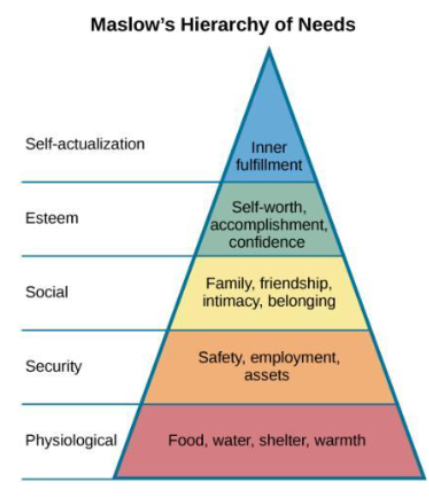
What is Maslow known for?
His hierarchy of needs, which proposes that human needs range from basic survival needs to higher-level psychological needs would begin to
motivate behavior.
According to Maslow, why might a person have difficulty focusing on higher-level goals when they lack food, water, or shelter?
Basic survival needs must be addressed before higher-level needs become strong motivators
What did Carl Rogers contribute to psychology?
He developed client-centered therapy.
What is client-centered therapy?
A therapy approach in which the client takes a leading role in the therapy process.
What three qualities did Rogers believe therapists should have?
Unconditional positive regard
Genuineness
Empathy
What was the cognitive revolution?
By the 1950’s, new disciplinary
perspectives in linguistics, neuroscience,
and computer science were emerging.
The mind became the new focus of
scientific inquiry.
When did the cognitive revolution develop?
It became especially influential during the 1950s.
Who was an important figure in beginning the cognitive revolution?
Noam Chomsky
Why did Chomsky believe psychology needed to study mental functioning?
He believed psychology needed to incorporate mental functioning into its
focus in order to fully understand human behavior
A researcher studies how people process information, remember events, and solve problems. Which modern perspective does this represent?
Cognitive psychology.
Who was Margaret Floy Washburn?
She was the first woman to earn a doctorate in psychology and conducted important research on animal behavior.