geochemistry exam 1
 Call Kai
 Learn
 Practice Test
 Spaced Repetition
 Match
 Flashcards
 Knowt Play
1/29

There's no tags or description
Looks like no tags are added yet.
30 Terms
What is nucleosynthesis
natural process that creates new atomic nuclei from pre-existing protons, neutrons, and lighter nuclei, occurred within a few minutes of the Big Bang. At that time, a quark-gluon plasma, a soup of particles known as quarks and gluons, condensed into protons and neutrons
When did the big bang happen
13.8 billion years ago
what is nuclear fusion
two light atomic nuclei combine to form a single heavier nucleus, releasing a massive amount of energy
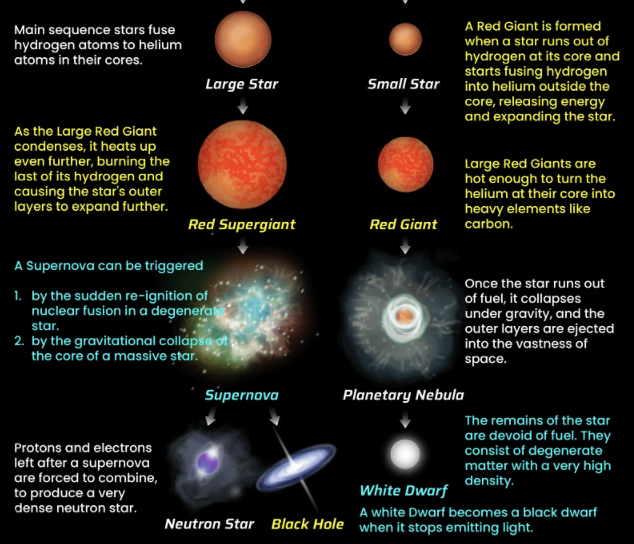
What is the evolution of a small and large star (draw it)
what are the stages of stellar nucleosynthesis
hydrogen, helium, carbon, oxygen (small stars will stop here because they don’t get hot enough to fuse C and O),
in large star: C fuses into neon, sodium, and magnesium, O fuses into silicon and sulfur, silicon fuses into iron and nickel
fusing iron requires more energy than it releases, so the star can no longer generate outward pressure to fight gravity, the core will collapse into a supernova, the extreme heat and energy will form gold, silver, platinum, and uranium
When will a reaction occur?
Gibbes free energy below 0, spontaneous, exothermic (releases heat)
What does the VSEPR model do
products molecule shape + behavior
What is a polar molecular bond
type of chemical bond where two atoms share a pair of electrons unequally (high electronegativity difference)
what are ionic bonds
usually between metal (electron donor, becomes a positive cation) and nonmetal (electron acceptor, becomes a negative anion)
what are covalent bonds
usually between two nonmetals, shared electron cloud
what is advection
the transport of a substance, property, or heat by the bulk motion of a fluid
what is diffusion
Solutes move spontaneously from areas of high concentration to low concentration due to random thermal motion
what is dispersion
Solutes spread out due to localized obstacles, friction against surfaces, or turbulent mixing, causing some fluid pathways to move faster than others
what is the reason for radioactivity
competition between strong force (holds protons and neutrons together) and electromagnetic force (pries positive protons apart)
what are stable isotopes and core principles about them
do not break down, necessary for tracing element sources,
isotopes: different number of neutrons but same number of protons
heavy isotopes have more mass, chemical bonds stronger + require more energy to break, evaporate more slowly + react at different rates than lighter isotopes
ratio of O-18/16 used as a climate proxy, colder climate= O-18 precipitates and a lower amount of 0-18 in atmosphere → compressed in Antarctica ice sheets
plants take C12 over c13 levels, where high levels of vegetation, ocean carbon pool and atmospheric CO2 enriched in C13
what is the van’t hoff equation
The van 't Hoff equation relates the temperature (T) of a chemical system to its equilibrium constant (Keq) using the standard enthalpy change (Δ𝐻∘) of the reaction
what is an equilibrium constant (K)
a number that expresses the ratio of product concentrations to reactant concentrations for a reversible chemical reaction at equilibrium

What is the Haber Bosch process
industrial method used to synthesize ammonia from atmospheric nitrogen and hydrogen, exothermic and reversable
what is isotopic fractionation and what are the 2 major types we went over
partial separation of isotopes of the same element due to small differences in their physical, chemical, or biological properties
equilibrium fractionation: reversible, thermodynamically driven, decreases as temp increases, heavier isotopes concentrate in stronger, stiffer bonds
kinetic fractionation: occurs in irreversible/incomplete reactions, diffusion and rapid transport. tied to rate, lighter isotopes react and move faster because weaker bonds broken more easily
what is the Rayleigh distribution
continuous probability distribution for non-negative, right skewed random variables
describes a one way, irreversible fractionation process where a tracking component (like heavy isotopes of water) is preferentially removed via condensation and rainout
Radioactive isotopes concepts and applications, what is a closure temperature, fossils vs sedimentary rocks, radon 222
natural alarm clock due to half life
closure temperature: threshold below which a mineral cools enough to become a “closed system”, at high temps newly formed daughter isotopes easily diffuse and escape, once it cools diffusion stops
allows for geologists to date when a rock crystallized and when a mountain range uplifted and cooled past a thermal milestone
Radiocarbon dating applies to organic matter (shells, coal, bones) up to 50,000 years old
date sedimentary rocks by finding tuff layers between sedimentary strata and zircon dating or using fossil biostratigraphy
use radon 222 (radioactive gas with half life of 3.8 days) to trace submarine groundwater discharge into coastal waters, hidden leaks, ect. radon trapped in bedrock and soil + escapes into groundwater (higher concentrations in subterranean water)
What is the importance of silicate weathering
earths geological thermostat, atmospheric CO2 dissolves in rainwater to form weak carbonic acid, which is transported into oceans and used by marine organisms to build shells, organisms die locking away carbon in limestone
what are the 2 hypothesizes of global cooling
uplift of Tibetan plateau: collision of India and eurasian plate created Himalayas and Tibetan plateau, exposed fresh unweathered silicate minerals to surface, silicate weathering increased and triggered long term Cenozoic global cooling trend that led to modern ice ages
meteorite impact: major meteorite impact pulverize continental crust and ejects silicate dust across earth, leading to large scale silicate weathering
what is an isochron line
isochron line: line plotting different mineral samples from same geologic body, measures ratio of parent isotope to daughter isotope against a stable isotope
slope proportional to age, y intercept gives initial isotopic composition of system when formed
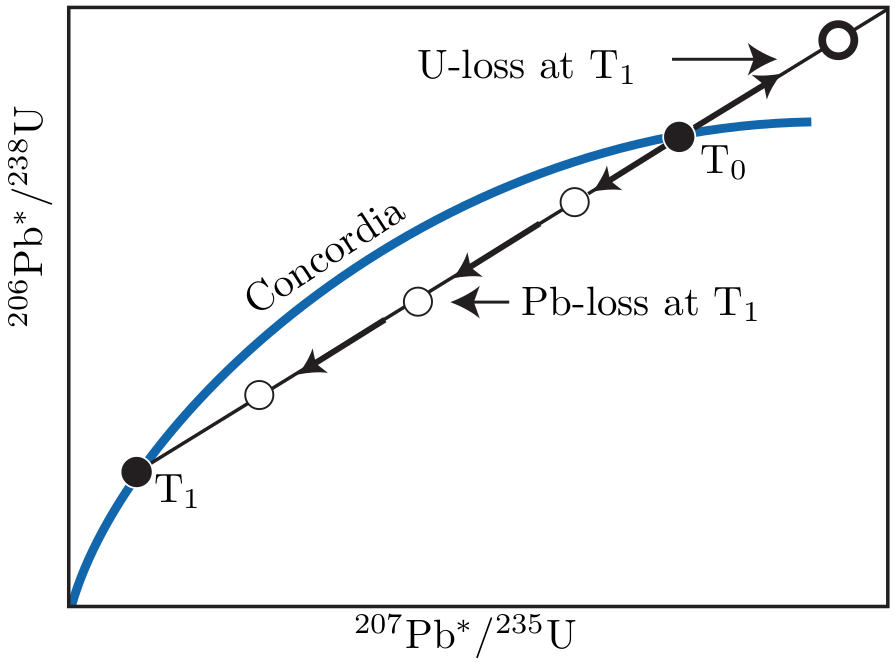
What is a Concordia curve?
Used in Uranium Lead dating to determine age of rocks
curved due to difference in half lives (U-235 decays faster than U-238)
Upper intercept, marks original crystallization date of zircon crystal)
lower intercept, marks time when a later geological/thermal event occurred resetting the system
If point below curve, zircon crystal lost lead over time
what does element compatibility mean
how readily a trace element substitutes for a major element in a mineral crystal lattice
subduction zone melting and melting dynamics
as oceanic slab subducts, increasing heat and pressure releases volatiles into mantle wedge, melting the slab above
leftover mantle rock in mantle wedge after partial melts extracted and gone off to form island/continental arcs
Fractional crystallization & element compatibility
as magma chamber cools, early forming minerals (olivine and pyroxene) crystallize + strip out compatible elements, remaining liquid becomes enriched in incompatible elements
Rubidium cannot comfortable fit into tight lattices of magic minerals so it stays trapped in liquid melt, and finds a home in granites and substitutes for Potassium in late stage minerals like K-feldspar and micas
What is collision theory
for a reaction to occur, reactant particles must collide with sufficient energy and proper orientation
limited by slowest step, temp (Arrhenius equation) and concentrations of reacting species
what is true about water in chemical reactions
water acts as an acid (proton donor) in a basic environment, and as a base (proton acceptor) in an acidic environment