All Prelab/Postlab Questions
 Call Kai
 Learn
 Practice Test
 Spaced Repetition
 Match
 Flashcards
 Knowt Play
1/98

There's no tags or description
Looks like no tags are added yet.
99 Terms
a) Which part will inform you of the temperatures of the melting range that you have to record?
b) Which part would you need to manipulate when adjusting the heating rate of the melting of a solid sample?
A) D
B) B

Prelab Question:
Where do the following items need to be disposed after carrying out the melting point experiment?
1)Melting Point Capillary after use
2)Disposable Test tube
3)Used weighing paper
4)Leftover solid organic compound
1)Sharps Container
2) Broken Glass Container
3)Regular Trash
4)Solid Chemical Waste
Order the steps for PACKING a solid sample in a melting point capillary BEFORE placing it in the melting point apparatus.
1)Ensure sample is dry and finely powdered
2)Create a pile on sample
3)Force open end of melting point capillary into sample
4)Tap closed end of melting point capillary on hard surface
5)Ensure sample height is 2-3 mm
Order the steps for DETERMINING a melting range for a solid sample AFTER placing it in the melting point apparatus.
1) Increase heating rate
2)Slow heating rate
3)Note first drop of liquid
4)Note lower temperature
5) Note when entire sample is melted
6)Note higher temperature
Select the appropriate choice for the blanks in the question below:
When comparing 2 hydrocarbons, the larger, higher molecular weight molecule would have ____________ melting point because of _______________
higher, increased attractive forces
You come across a white solid and take its melting point and find it to be 104-107°C. You decide to identify it.
a) If the thermometer is calibrated, compounds of what general melting point range can you automatically eliminate?
b) What is the reason you can eliminate the range you indicate in part (a) ?
A) Above 107ºC
B) Impurities can only lower melting point
Melting Point Composition Graph
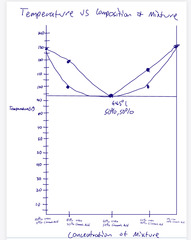
The fast determination of the first sample of your unknown shows the unknown melting around 50∘C.
a)At what temperature should you slow down the rate of heating to 1∘C/min?
B) You have to pick two standards that could be your unknown because you don't know if thermometer calibration is an issue - the first standard MUST be listed alphabetically before the second standard :
C) If your unknown is indeed the alphabetically second standard that you chose, what would happen to the mixed melting point of your unknown +this standard?
D) Based on the result above, what would happen to the mixed melting point of your unknown + the alphabetically first unknown that you picked?
What is the identity of your unknown?
A) 30ºC
B) benzophenone, 4-nitrotoulene
C)Melting point stays the same
D) melting point goes down
E) 4-nitrotoulene

SOE of Melting Point
Sources of Error:
moisture in the air
contamination of the sample
thermometer in Mel-temp not calibrated
determination made too fast
criteria for filling melting point capillaries not adhered to
(a) What is the function of the part labeled B?
(b) How do you increase heat to the part of the test tube labeled A?
A) Prevent superheating
B)Move test tube deeper into the sand bath

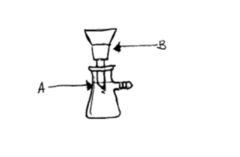
(a) Which part of the labeled apparatus would contain the frit?
(b) Which part of the labeled apparatus would be clamped?
(c) Which part of the labeled apparatus would hold the filter paper?
A) B
B) A
C) B
In the solvent pair experiment that is being carried out with the solid that is being recrystallized, why do you NOT have to worry about sudden vigorous boiling of crystal solution when you add the second solvent to the solution?
Second solvent has higher boiling point than first solvent
Where do the following items need to be disposed after carrying out the recrystallization experiment?
A)Glass pipette after use
B)Disposable Test tube
C)Used filter paper
D)Ethanol filtrate
A)Sharps Container
B) Broken Glass Container
C) Regular Trash
D) Solvent?Liquid Waste
Order the steps of the DISSOLVING THE SOLUTE stage of the recrystallization of a solid in a single solvent
1) Boiling Solvent
2) Add 2-3 drops of hot solvent to solid in test tube
3)add boiling stick to test tube with crystal solution
4)Heat solution with boiling stick while adding solvent until solid fully dissolves
5) remove boiling stick
Order the steps of CRYSTALLIZING THE SOLUTE stage of the recrystallization of a solid in a single solvent
A)Wrap test tube with paper towel in order to insulate and allow solution to slowly cool down to room temp
B)Let crystal solution cool down to room temp
C)Place crystal solution on ice
Order the steps of COLLECTING AND DRYING THE SOLUTE stage of the recrystallization of a solid in a single solvent
A) Filter formed crystals
B) Wash crystals with ice-cold solvent
C) let crystals dry on hirsh funnel
D)Squeeze crystals with filter paper
E)Let crystals air-dry on watch glass
The solubility of solid W in water is: 1.93 g/100 mL at 0°C, 21.5g/100 mL at 100°C.
How many mL of boiling water are required to dissolve 151.0 g of W?(report to the nearest mL) If solution were cooled to 0°C, how many grams of W would crystallize out? (report to one decimal place) What is the percent recovery? (report to one decimal place) (Show calculations) Type calculations in textbox - please DO NOT upload a file.
How many mL of boiling water are required to dissolve 151.0 g of W?
151.0 g*(100 ml/21.5 g)=702 ml
If solution were cooled to 0°C, how many grams of W would crystallize out?
702 ml*(1.93 g/100 ml)=13.5 grams
151.0 grams-13.5 grams=137.5 grams
What is the percent recovery?
(137.5 grams/151.0)*100%=91.1%
You dissolve an amount of solid Q in 209.0 mL solvent, forming an unsaturated solution. The solubility of Q at 0°C is 1.79 g/100 mL. The amount of solid remaining in solution at 0°C is 26.0% of the original amount of solid dissolved . What is the original amount of solid that was dissolved (report to 1 decimal place)?
You dissolve an amount of solid Q in 209.0 mL solvent, forming an unsaturated solution. The solubility of Q at 0°C is 1.79 g/100 mL. The amount of solid remaining in solution at 0°C is 26.0% of the original amount of solid dissolved . What is the original amount of solid that was dissolved (report to 1 decimal place)?
1.79g/100 ml=x g/209
x=3.7 g
Original amount
x(.26)=3.7 grams
x=14.2 grams
You are given a unknown white solid to recrystallize in lab. The white solid could be Compound A (melting point 110-112°C), Compound B (melting point 165-166°C) or Compound C (melting point 156-157°C). Compound A, B and C are significantly soluble in butyl acetate (bp: 126°C), even at room temperature and not very soluble in water (bp: 100°C) or n-butanol (bp: 125°C) (difference in solubility of solid in water and ethanol is not significant) . Butyl acetate is miscible with n-butanol but not with water.
a) If you decide to use butyl acetate (must use this solvent) and choose between n-butanol and water as the solvent pair for the unknown white solid, describe which solvent you would heat up and dissolve the solid in initially
B) and which solvent you would add second
C) and at what point would you stop adding the second solvent
A) hot butyl acetate
B) n-butanol
C) first signs of cloudiness
D)if you could use butyl acetate as the single recrystallization solvent for the solid, which compound might have a problem of oiling out?
D) A
SOE of Recrystallzation
Sources of Error:
-Technique errors
-If minimum amount of hot solvent was not used
-if wet, crystals could adhere to filter paper
-if the solvent was not completely removed
-material left behind after transfer
-if impurities can't be removed from the solvent
-if impurities are not fully removed
-if solvent and solute mixture is not completely removed from transferring
Consult Appendix Figure A.1 under the Appendix Glossary of Glassware in the textbook to provide names of the parts of the microscale kit for the labeled parts of the apparatus.
Copyright 2024. Govindarajoo, G. Rutgers, The State University of New Jersey
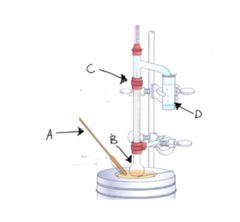
Part A: Long-necked flask
Part B: Connector with support rod
Part C: Thermometer adapter
Part D: Claisen adapter/distillation head with air condenser

a) What are the functions of the following parts in the apparatus?
b) Consult Appendix Figure A.1 under the Appendix Glossary of Glassware in the textbook to provide names of the parts of the microscale kit for the labeled parts of the apparatus.
Part A:To regulate temperature of the mixture in reaction flask
Part D: Receiver vial
Part B: Short-necked flask
Part C: Connector only
What is the vapor pressure of a sugar solution dependent on?
Order the steps to construct the simple distillation apparatus for the experiment you are carrying out, starting from the first step (ASSUMING THAT YOU WON'T DISCONNECT ANY PART OF THE APPARATUS AS YOU PUT THE APPARATUS TOGETHER, UNLIKE WHAT WAS SHOWN IN THE EXPERIMENT VIDEO) and constructing it from BOTTOM TO TOP. Consult Appendix Figure A.1 under the Appendix Glossary of Glassware in the textbook for parts of the microscale apparatus.
1st: Add mixture of cyclohexane and toluene and boiling chips to part(r)
2nd: Attach part(m) to part(R)
3rd: Attach part(h) to part(m)
4th: Attach part(c) to part(h)
5th:Insert thermometer to correct position through part(c)
You have a 1:1 mixture of 2,2,4-trimethylpentane (boiling point: 99∘C) and methoxybenzene (boiling point: 154∘C) that you wish to separate.
a) What common criteria would this mixture have to satisfy in order to be separated by either simple or fractional distillation?
b) What kind of distillation (between simple and fractional) would be efficient for this mixture?
c) Why would the distillation type chosen in question b) be ideal for this mixture?
A) homogenous
B) fractional
C)boiling point difference and composition
From figure 5.8 on (Chap. 5: Sect 5C), you distill a liquid mixture of 50% ethanol: 50% water. What would the temperature when the distillate begins to condense in the sidearm (the distillate's boiling point) be? (Select the best representative answer).
79ºC
Look at Fig. 5.7 (Chap. 5 Sect 5C): If you boiled the liquid mixture of 40%cyclohexane and 60% toluene, condensed the vapor mixture it generated and then redistilled that condensed mixture, what would the vapor composition of the mixture resulting from the 2nd distillation be? (Select the best representative answer).
75% cyclohexane: 25% toluene
Calculate the mole fraction of B (XB) in the vapor if a mixture of liquids is 58%A and 42%B. The vapor pressure of pure A (PA∘) is 810 torr and the vapor pressure of pure B (PB∘) is 759 torr. Show calculations and give answer to 2 decimal places.
Pa= .58*810=470 torr
Pb=.42*759=319 torr
Ptot=789 torr
Xb=319/789=.40
The mole fraction of A (XA) in the vapor of a mixture is 0.57 and the sum of the partial pressures is 770 torr. Calculate the mole fraction of A (NA) in the liquid if the vapor pressure of pure A (PA∘) is 673 torr. (Hint: Find PA first) Show calculations and give answer to 2 decimal places (if not reporting as a percentage):
Pa=.57*770=439 torr
Na= 439/673=.65
What is the character of the vapor after each condensation-vaporization cycle in a fractional distillation of a mixture?
Vapor is richer in the more volatile fraction
What specifically causes the vaporization of the lower boiling liquid on the packing in a fractional distillation? Select the appropriate answers for the blanks below
Heat ____________________ released by _________________ of _________________ boiling vapor.
1st: released
2nd: condensation
3rd: higher
In vacuum distillation, how you do ensure that the liquid does not boil too suddenly upon reduction of pressure?
Heat flask only after system has been evacuated
Why would boiling stones not be able to control the bumping of liquids in vacuum distillation as they are able to for simple and fractional distillations?
Boiling stones lose their activity in an evacuated system
What aspect of water makes it favorable to use in steam distillation?
Its low molecular weight
SOE Distillation
Source of error:
1. Positioning of sidearm
2. Connectors and adapters loose
3. Significant amount of distillate left adhering to glass surfaces of apparatus
4. Not using fractional distillation as boiling point and composition would be suitable for it
5. T emperature change due to airflow of hoods
6. Distilled too fast
7. Counted incorrect amount of drops
Define the term adsorbed it relates to the states individual components can exist in for the TLC process.
Adsorb is when the individual component is sticking to the surface of the solid stationary phase
What is the purpose of having very small bores on the spotters?
So liquid does not flow out as a drop once it is drawn in
Besides a large spot and the TLC sample being too concentrated, what two other factors can cause the developed spots to appear as a streak?
Two other factors which might cause the spot to appear as a streak is if the sample contains too many compounds and the solvent as some solvents can cause pure compounds to streak.
-Other than solubility of sample in the solvent, what is the criteria for the solvent (other than cheap and nontoxic) used for preparing the sample that impacts the experiment?
-Why would this criteria be important in the spotting phase if you have to make repeated applications of the sample? (Use the multiple drop down to fill in the blanks in the statement below to answer this question) So that the solvent __________________Dries easily between applications to ensure the spot of the sample is ________________
1) Volatile
2) Dries easily between applications
3) is not too big
Why would water not be used to elute a column (besides it polarity) in column chromatography?
It would dissolve the silica gel in the column
-In column chromatography (microscale), after loading it with solvent and adsorbent and prior to loading the sample, what level should you allow the solvent to drop to?
-What features will appear in the column if you allow the column to run dry?
-What is the consequence if you do allow the column to run dry?
A) What is the consequence if you do allow the column to run dry?
B) formation of air bubbles and channels
C) Poor separation
Assume that spotting line was drawn 1.0 cm from the bottom of the plate
Assume the solvent front was drawn 0.5 cm from top of the plate
Plate 1:
Distance from spotting line to solvent front: 6.0 cm
Distance from spotting line to:
Spot 1: 2.4 cm
Spot 2: 4.2 cm
Spot 3: 0.6 cm
Plate 2:
Distance from the spotting line to solvent front: 6:1 cm
Distance from spotting line to:
Spot 4: 0.7 cm
Spot 5: 2.5 cm
Spot 6: 4.3 cm
Spot 7: 4.2 cm
Spot 8: 2.6 cm
Spot 9: 0.6 cm

Rf Calculations of all spots from data provided above: (Show calculations):
Plate 1:
Spot 1: 2.4/6=.4
Spot 2: 4.2/6=.7
Spot 3: .6/6=.1
Plate 2:
Spot 4: 0.7 cm/6.1cm=.11
Spot 5: 2.5 cm/6.1cm=.41
Spot 6: 4.3 cm/6.1cm=.70
Spot 7: 4.2 cm/6.1cm=.69
Spot 8: 2.6 cm/6.1cm=.43
Spot 9: 0.6 cm/6.1cm=.098
Rank standards from Plate from Least to Most Polar:
Least polar: aspirin
2nd most polar: acetaminophen
Most polar: caffeine
Let's consider that ethyl acetate is the ideal solvent for this TLC experiment. What might have happened to the spots if you had used t-butyl methyl ether (MTBE) as the eluent instead of ethyl acetate.
Why?
1) Spots remain towards bottom of TLC plate
2) t-butymethyl ether less polar, cannot overcome attractions of sample to adsorbent
Let's consider that ethyl acetate is the ideal solvent for this TLC experiment. What might have happened to the spots if you had used acetone as the eluent instead of ethyl acetate. Spots move towards top of TLC plate
Why? acetone more polar, overcomes attractions of sample to adsorbent better
1) Spots move towards top of TLC plate
2) acetone more polar, overcomes attractions of sample to adsorbent better
-The reason the TLC could not be visualized by UV is because:
-The reagents KMnO4 in base forms the less polar diol - what is the product?
1) The products are not conjugated
2) cis-diol
SOE- Thin Layer Chromatography
Source of Error: -Contamination and error in technique is the main source of error
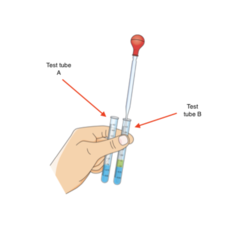
a) The reason both Test Tubes A and B should be held in the same hand is: avoid losing any of the solution
b) The challenge with using a pipette bulb to separate layers using the technique shown in the diagram is that the _______________________ of the solvent may cause it to _______________________
1) avoid losing any of the solution
2) high vapor pressure
3) dribble out

Match the procedural step/question to the correct answer for the NaHCO3 (sodium bicarbonate) extraction on Tube 1 (after mixture is completely dissolved in ether)
1) Place Tube 1 on ice
2) Add sodium bicarbonate to tube 1 on ice
3) Wait for bubbling to subside
4) Mix layers in Tube 1 using pipette for required time
5) Transfer bottom layer from Tube 1 to Tube 2
-What species is in Tube 2 after transfer from this extraction? Sodium benzoate
-What species is in Tube 1 after sodium bicarbonate extraction? 4-tertbutylphenol and biphenyl
Match the procedural step/question to the correct answer for the NaOH (sodium hydroxide) extraction on mixture in Tube 1 AFTER sodium bicarbonate extraction
1st) Add NaOH to Tube 1
2nd) Mix layers in Tube 1 using pipette for required time
3rd) Transfer bottom layer from Tube 1 to Tube 3
-What species is in Tube 3 after this extraction?) Sodium 4-tertbutyl phenoxide
-What species is in Tube 1 after sodium hydroxide extraction?) Biphenyl
a) The reason both Test Tubes A and B should be held in the same hand is: avoid losing any of the solution
b) The challenge with using a pipette bulb to separate layers using the technique shown in the diagram is that the _______________________of the solvent may cause it to _______________________
A)Avoid losing any of the solution
B) High vapor pressure
C)dribble out
Match the procedural step/question to the correct answer for the NaHCO3 (sodium bicarbonate) extraction on Tube 1 (after mixture is completely dissolved in ether)
1st) Place tube 1 on ice
2nd) add sodium bicarbonate to tube 1 on ice
3rd) wait for bubbling to subside
4th) Mix layers in Tube 1 using pipette for required time
5th) transfer bottom layer from tube 1 to tube 2
What species is in Tube 2 after transfer from this extraction? sodium benzoate
What species is in tube 1 after sodium bicarbonate extraction? 4 tertbutylphenol and biphenyl
Match the procedural step/question to the correct answer for the NaOH (sodium hydroxide) extraction on mixture in Tube 1 AFTER sodium bicarbonate extraction
1) Add NaOH to tube 2)Mix layers in tube 1 using pipette for required time
3) transfer bottom layer from tube 1 to tube 3
What species is in Tube 3 after this extraction? Sodium 4 tertbutyl phenoxide
What species is in Tube 1 after sodium hydroxide extraction? Biphenyl
Para-Cyanobenzoic acid has a pKa of 3.55. 2-Chlorophenol has a pKa of 8.56. 4-Nitrophenol has a pKa of 7.15. You will need the following information: The pKa of HCl is -7; pKa of carbonic acid (H2CO3) is 6.52 and the pKa of water is 15.
Mixture A is a mixture of 2-Chlorophenol and 4-Nitrophenol.
Mixture B is a mixture of Para-Cyanobenzoic acid and 2-Chlorophenol.
Mixture C is a mixture of Para-Cyanobenzoic acid and 4-Nitrophenol.
All mixtures are dissolved in methylene chloride
a) Why would reacting Mixture A with an aqueous solution of NaHCO3 (sodium bicarbonate) NOT separate one substance from the other?
Answer: The acidity of _______________________ carbonic acid is _____________________ Stronger than both components so __________________ will be extracted into the aqueous layer.
1)Carbonic Acid
2)stronger
3)neither
4)
5)
6)
7)
8)
Para-Cyanobenzoic acid has a pKa of 3.55. 2-Chlorophenol has a pKa of 8.56. 4-Nitrophenol has a pKa of 7.15. You will need the following information: The pKa of HCl is -7; pKa of carbonic acid (H2CO3) is 6.52 and the pKa of water is 15.
Mixture A is a mixture of 2-Chlorophenol and 4-Nitrophenol.
Mixture B is a mixture of Para-Cyanobenzoic acid and 2-Chlorophenol.
Mixture C is a mixture of Para-Cyanobenzoic acid and 4-Nitrophenol.
All mixtures are dissolved in methylene chloride
b) Why would reacting Mixture B with an aqueous solution of NaOH (sodium hydroxide) NOT separate one substance from the other?Answer: The acidity of _______________________is _____________________than both components so_________________ will be extracted into the aqueous layer.
c) What species (among HCl, sodium hydroxide and sodium bicarbonate) could you use to separate the components of Mixture C?
4)Water
5)Weaker
6)Both
7)Sodium Bicarbonate
8)What species would exist in the aqueous layer AFTER the extraction?Sodium salt of para-cyanobenzoic acid
The distribution coefficient between methylene chloride and water for solute Y is 12. An amount of 63.0 g of Y is dissolved in 120 mL of water.
a) What weight of Y would be removed from water with a single extraction with 120-mL of methylene chloride? Show calculations and report to 1 decimal place.
Copyright 2023. Govindarajoo, G. Rutgers, The State University of New Jersey. All rights reserved.
b) What weight of Y would be removed from water (the original solution) with twosuccessive extractions with 60-mL portions each of methylene chloride? Show calculations and report to 1 decimal place.
A) 12= (Y/120)/[(63-Y)/120]
12=Y/(63-Y)
756-12Y=Y
756=13Y
Y=Y removed from water=58.2 grams
B)12=(Y/60)/[(63-Y)/120)
12= 2Y/ (63-Y)
756-12Y=2Y
756=14Y
Y 1= 54 grams of solute in organic solvent
12=(Y 2/60)/[(9-Y 2)/120]
12=2Y 2 /(9-Y2)
108-12Y 2 =2Y 2
108=14Y2
Y 2 = 7.7 grams of solute in organic solvent
Y= Y 1 + Y2 = weight of y removed from water= 61.7 grams
Why did you have to carry out the extractions in the sequence you did - i.e. weak base first then strong base? See how to answer in
You have to add the weak base first and then the strong base because if you add the strong base first then it will react with both benzoic acid and 4-tertbutylphenol at once which causes both anions to go to the aqueous layer. With both in the aqueous layer, the two can not be separated out and the extraction would go poorly. That is why the weak base has to be added first so it only reacts with the stronger acid which is benzoic acid. Then you can use the strong base to react with the weaker acid which is 4-tertbutylphenol and that way you can carry out the extractions step by step removing it one by one.
Why was NaCl solution added to ether layer in Tube 1?
NaCl was added to the ether layer in tube 1 because it removes any traces of water from the ether layer to the aqueous layer and this is because NaCl has a stronger attraction to water than organic solvents.
Why was drying agent added?
Drying agent was added to the the ether layer because it helps remove the water from the organic solvent. This is incredibly important because the water can still remain in the ether even if if NaCl was used before hand. This is to ensure a pure product.
What problem would arise if NaCl and drying agent (sequentially) were not added to the ether layer?
There were be water left in the ether layer if NaCl and drying agent was not added to the ether layer.
SOE of Extraction
Extraction Errors:
Incomplete acid-base reactions
Not all ion formed will transfer to the aqueous layer.
Recrystallizations error:
Loss of crystallization during filtration or transfer
solubility issues(too much compound dissolving in solvent)
Improper cooling(too fast or too slow)
Excessive washing leads to product loss
You have a mixture of 2-chlorobenzoic acid (pKa 2.92) and 4-Bromophenol (pKa 10.2) dissolved in ether. You will need the following information: The pKa of HCl is -7; pKa of carbonic acid (H2CO3) is 6.52 and the pKa of water is 15.
Copyright 2023 Govindarajoo, G. Rutgers, The State University of New Jersey. All rights reserved.
Which species do you use to separate the mixture? sodium bicarbonate
Copyright 2023 Govindarajoo, G. Rutgers, The State University of New Jersey. All rights reserved.
Which species will remain in the ether layer? 4-Bromophenol
1) sodium bicarbonate
2) 4-Bromophenol
Esterification* Consult Appendix Figure A.1 under the Appendix Glossary of Glassware in the textbook to provide names of the parts of the microscale kit for the labeled parts of the apparatus.
Part A: Distillation column/ air condensor
Part B: Connector only
Part C: Distillation head with 105 degree connecting adapter
Part D: Connector with support rod
Part E: Short-necked flask

Esterification*
a) Which of the options in the drop down menu should NOT be in the reaction flask when assembling the apparatus for the azeotropic distillation of n-butyl acetate that you set up?
b) The apparatus should lean _________ 10 degrees and the sidearm of the distillation head should be pointing _________ and place a ________ in the end of the sidearm.
c) Which of the modifications in the drop down menu should you employ to make sure the azeotropic distillation of n-butyl acetate proceeds smoothly? Wrapping distillation head with wet paper towel
A)Drying Agent
B) 10, down, cork
C)Wrapping condensor with wet paper towel
Esterification*
The following lactone was formed in a intramolecular acid-catalyzed esterification of a hydroxy carboxylic acid.
Which of the following represents the starting material that undergoes intramolecular acid-catalyzed esterification to form the product shown above?
C

What are the intensity of the IR absorption bands proportional to?
change in dipole moment a bond undergoes when it stretches
Why do the NaCl plates used for IR need to be handled with care? What precautions need to be taken when handling them?
NaCl plates used for IR need to be handled with care because they are fragile and easily attacked by moisture. You must keep them dry away from water and aqueous solutions and also handle them gently by the edges
Why are glass, quartz and plastics not used as IR sample holders?
They are _________ opaque to IR radiation and ____________ absorb it.
opaque, absorb
Match the problems that arise when a particular situation is present when running a spectrum of a neat liquid:
Using a viscous liquid: Peaks are too intense
Using a low viscosity liquid: Weak peaks arise
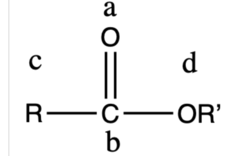
A) Which letter, in the diagram below, represents the location of the δ+ on an ester, especially if considering hydrolysis of the ester?
A) B
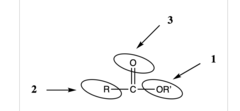
In an ester, what circled feature in the diagram below, further increases the electrophilicity of the carbonyl carbon (other than the feature that is present in ALL carbonyl carbons?
1
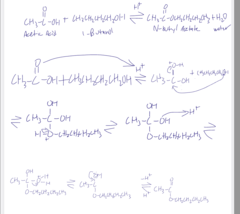
Equation and Mechanism for Esterification: Acetic Acid, 1-Butanol, N-butyl Acetate, water
a) What was the purpose of adding CaCl2 to product?
b) What was the role of the resin?
c) How was product separated from the resin?
Copyright 2023 Govindarajoo, G. Rutgers, The State University of New Jersey.
A) The purpose of adding CaCl2 to the product is to ensure that all of the water is removed and that the product is as pure as possible.
B) The resin is an acid catalyst and speeds up the reaction so more acetic acid molecules can react with the H protons in order to start the reaction.
C)The product was separated from the resin when the product was pipetted from the round bottom flask and placed in the disposable test tube.
SOE of Esterification
Sources of Error for % Yield:
- Drying agents, not enough drying agents were added and that could cause more water
to be left in the product
- Glassware was not dry, which would have caused water to be in the product
- Not enough catalyst is used
- Wet towel used to cover the condenser was not cold enough
- You can't get 100% yield ever as this is an equilibrium reaction
Sources of Error for Purity:
- Azeotropic Distillation and superheating, the reaction mixture could have superheated
and gotten some resin and boiling chips into the mixture in the side arm.
- Starting materials get into the product or are not completely reacted
- Accidentally bumping or tipping the sidearm so the reaction mixture gets into the
sidearm.
Consider the mixed aldol condensation reaction of 1-(1-methylcyclopentyl)ethanone (shown below) and 2,2-dimethylpropanal (shown below) in the presence of sodium hydroxide.

A) In order to minimize forming a mixture of products in the reaction in the question above, which reactant would you use an excess of?
Why? B)
A) 2,2-dimethylpropanal
B) It has no alpha hydrogens
In the citric acid cycle when an aldol addition occurs in a biological system, how do the amino acids contained in the Citrate Synthase enzyme help facilitate the reaction?
They protonate and deprotonate
An amount of the dibenzalacetone crystals formed are recrystallized using 70:30 ethanol/water solution. What are the next 2 immediately sequential actions AFTER a boiling stick is added to the test tube once a few drops of solvent is added to the solid? (Don't skip steps).
1) Heating solution with boiling stick and adding hot solvent until dissolved
2) Removing boiling stick
a) If your reaction produced only benzalacetone (side product), how would you distinguish it from the major product using the physical properties?
b) Would you be able to distinguish it from major product using IR? Why or why not?
a) If your reaction produced only benzalacetone (side product), how would you distinguish it from the major product using the physical properties?
- You could distinguish the benzalacetone and the major product using melting point and boiling point as the melting point and boiling point of benzalacetone is 38-39 and 260-262 respectively. On the other hand, the major product, dibenzalacetone, has a melting point and boiling point of 107-114 and 130-131 respectively. You could find the melting point of the product and compare to distinguish what was formed.
b) Would you be able to distinguish it from major product using IR? Why or why not?
- No, It would be incredibly difficult to distinguish benzalacetone from the major product, dibenzalacetone, as the functional groups of both benzalacetone and dibenzalacetone are essentially the same. There is no functional group difference and so it is not possible to distinguish one from another.
A) If you wish to form product B, to which starting carbonyl would you add a strong base such as LDA in order to form the enolate? 1-(1-methylcyclopentyl)ethanone
B) Which carbonyl would you then add slowly to the enolate of the first carbonyl? propiophenone
A) 1-(1-methylcyclopentyl)ethanone
B) propiophenone

Equations and Mechanisms of Aldol Condensation for formation of benzalacetone
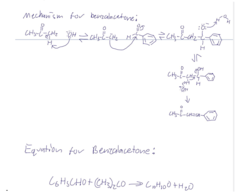
Equations and Mechanisms of Aldol Condensation for formation of dibenzalacetone

Equations and Mechanisms for Aldol Condensation: Formation of side products such as Benzalacetone and 4
hydroxy-4-methyl-2-pentanone

Pure R,R-hydrobenzoin (side product of meso-hydrobenzoin) has a melting point of 148°C.
Copyright 2024 Govindarajoo, G. Rutgers, The State University of New Jersey.
a) What do you expect the melting point of pure S,S-hydrobenzoin (another side product of meso-hydrobenzoin) to be?
b) Do you expect the racemic mixtures of these enantiomers to have the same or different melting points as the pure enantiomers?
A) 148 degrees
B) different
If you had carried out a TLC on the reaction mixture in this experiment, you would have used a 2:1 mixture of hexanes/ethyl acetate as your eluent.
a) From Table 8.1 in the TLC chapter, is your eluent made up of mostly polar or nonpolar solvent?
b) From the the TLC background and theory lecture, besides proper balance of polarity, what is the requirement for the pair of solvents?
c) You are using 2:1 hexanes/ethyl acetate to develop the TLC plate and measure the distance the sample(s) travelled. Would the distances travelled by the sample(s) increase or decrease if you:
i) added more ethyl acetate to the eluent
ii) added more hexanes to the eluent
A) nonpolar
B) miscible
C) increase
D) decrease
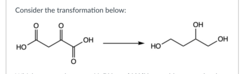
Which reagent, between NaBH4 and LiAlH4, would you use for the transformation and why?
LiAlH4, because it reduces all the carbonyl functional groups present
Besides controlling the rate of the reaction (this would include the minimizing of side products and minimizing NaBH4 decomposition), you used an ice-bath for two other purposes (specifically in the recrystallization process) in the reduction experiment you carried out. List these two purposes.
Two purposes for the ice-bath:
- To maximize the amount of crystals that are recrystallized
- To cool down the water that is used to wash the crystals in order to ensure that there is a minimization of the crystals lost when washing the crystals
Why would IR and TLC not be useful for differentiating between meso-hydrobenzoin and its diastereomers?
IR would not be useful for differentiating between meso-hydrobenzoin and its diastereomers because they have the same functional groups. Meso-hydrobenzoin has an alcohol group and alkenes which is the same as the R,R-hydrobenzoin and S,S-hydrobenzoin. IR would thus show up the same for these compounds due to the same functional groups. TLC would be useful in differentiating between meso-hydrobenzoin and its diastereomers as they have different polarities and thus will have different Rfs.
Since benzoin and meso-hydrobenzoin have similar melting points, how would you confirm that the product you obtained from this reaction is indeed meso-hydrobenzoin using only melting point techniques? Describe briefly how you would carry out this experiment.
Your Answer:
Theory:
- In order to confirm that the product obtained from this reaction is indeed meso-hydrobenzoin you could the mixed melting point. When you mix two different compounds together, the melting point of the mixture is lower than either melting point of a pure compound.
How the experiment could be carried out:
- Obtain pure meso-hydrobenzoin
- Mix a little bit of the product obtained with the pure meso-hydrobenzoin and take the melting point of the mixture. If the melting point of the mixture is lower than the melting point of pure meso-hydrobenzoin than the product obtained is not pure meso-hydrobenzoin. If the melting point of the mixture is the same as the melting point of pure meso-hydrobenzoin then the mixture is indeed pure meso-hydrobenzoin.
Why was partial recrystallization necessary for this experiment?
Partial Recrystallization was necessary for this experiment because we had to isolate the meso-hydrobenzoin from its diastereomers. Using recrystallization, the diastereomers were able to be removed and the product was able to be purified as diastereomers can be separated using recrystallization. This is due to the differences in solubility
Equation and Mechanism for Reduction: Sodium Borohydride, Benzil
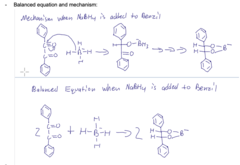
Equation and Mechanism for Reduction: Water added to Borate Ester

Equation and Mechanism for Reduction: Formation of side products such as R,R-hydrobenzoin;
S,S-hydrobenzoin;
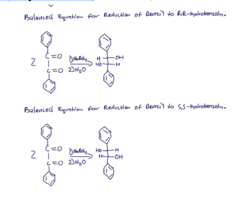
Equation and Mechanism for Reduction: Formation of side products such as R-benzoin, S-benzoin

1) What is part A?
2) What is the function of part A?
3) What is layer B?
4) What is the requirement for layer B?
5) What is layer C?
6) How far below the neck should the top of layer C be?
7) What is layer D?
8) How much of a layer of D should be placed over layer C?
9) What is E?
10) What should you be careful about when adding E?
1)cotton
2)To stopper the end of the column
3)sand
4)Must be above the taper of the pipette
5) silica gel
6) 5 mm
7) sand
8) 2 mm
9) solvent
10) Do not disturb layer D

Why can you not selectively epoxidize an alkene with MCPBA in the presence of a ketone?
Ketone will be converted to an ester
Compare and contrast the travelling of eluent in TLC versus column chromatography.
TLC: Solvent rises up the plate by capillary action
Column chromatography: Solvent flows down the column filled with adsorbent