Functionalist Explanations for inequalities
 Call Kai
 Learn
 Practice Test
 Spaced Repetition
 Match
 Flashcards
 Knowt Play
1/15

Earn XP
Description and Tags
SAGE (Social Class, Age, Gender, Ethnicity)
16 Terms
Parsons - SOCIAL CLASS
→ Social class inequality is inevitable and necessary for the smooth running of society
→ SC inequality is an inevitable feature of a social system that requires order and ranking
→ ranking in society is based on a value consensus about what society values, and thus there is generally agreement about who deserves the highest rewards
→KAPPA Values: Kinship (family), Achievement, Possessions, Personal qualities, Authority
→ more of these qualities = higher in the system of stratification
→ as a society, we are fine with this, because we ALL AGREE these are high value
→ those who are highly valued and rewarded (in the labour market (employment)); those who are not are not
Durkheim - SOCIAL CLASS
→ Social class inequalities create social order
→ specialised division of labour in which people have different functions, skills and abilities - characterised by social divisions
→ people are content to take their positions because they believe in its moral worth
→ this value consensus also means members accept the legitimacy of stratification
→ stratification sets limits on competition on aspirations
→ we cannot all compete for everything, and therefore order is maintained
→ professions rely on each other to function, e.g. surgeon - anesthesiologist
Davis and Moore - SOCIAL CLASS
→ Social class inequalities are functional for soiety
→ role allocation - individuals are assigned jobs based on their hard work + achievements, statistics in education, e.g. Surgeon No.1, Footballer No.10
→ this is inevitable and beneficial for society
→ social stratification is a feature of all human society - functionally necessary
→ 2 functions:
allocating the right people to the most important roles, e.g., doctors
ensuring high performance in key roles, e.g., motivating them to keep doing their best
→ 2 things help tell whether roles are the most important:
functional uniqueness = a position is functionally unique if only one person, or a small number, can carry out the role; e.g., consultant surgeons have differing skills; one might be the only one who can conduct a heart transplant
The degree of dependence of others = the extent to which other people depend on a role for their jobs; e.g., Chief Executive - makes decisions and gives orders to lower-level employees, and are dependant on no one for their role
Gans - SOCIAL CLASS
→ social class inequalities exist because poverty serves an important function in society
→ poverty performs important social functions - particularly for the non-poor, and that these functions help explain why poverty continues to exist in society
→ specific functions help stabilise the existing class structure and maintain social order:
Economic functions
Cultural functions
Political functions
Moral legitimation
Social Solidarity
→ Gans is not saying poverty is good - “poverty persists not because it is beneficial to the poor - but because it is functional for others
→ exposes the hidden benefits that the upper and middle class derive from a system where poverty and class inequality are maintained
Murdock - GENDER
→Gender inequalities are the result of biological differences
→Functionalists believe men (instrumental role, breadwinner), and women (expressive role, childcare, emotional support) and men’s biological link (physically stronger - suited to hunting and providing) and women’s biological link (pregnancy and breastfeeding; suited to nurturing children)
→Murdock saw the social roles that men and women have, which have led to differencs in societal outcomes (e.g. wages), as being social constructed and reinforced
→claimed that these role fundamentally stem from the natural, biological differences between males and females
→this gendered division of labour in nuclear families is evident in all societies, and he claimed this to be because they’re essential to a functional society
Parsons - GENDER
→Gender inequalities are the result of socialised roles which are necessary for society
→argued that gender inequalities are not really inequalities, but are simply due to the correct gender roles that males and females are socialised into
→argued females are socialised into expressive caring roles - suited to domesticity
→males are socialised into instrumental roles - work and labour - suited for paid work
→women are less motivated and less suited to the labour market than men; therefore, it is not surprising that, on average, they are paid less
→he saw these differences as innate, ascribed at birth, and ultimately contributing to a healthy, smooth running
Parsons and Bales - GENDER
→Women’s expressive role is crucial for primary socialisation and personality stabilisation
→women are the key figure in providing primary socialisation for children, which is essential for reproducing social order
→women provide personality stabilisation for other adult family members (mainly men)
→women provide comfort to husband when not at work - crucial for male productivity
→so, women are not present in certain sectors of social life which led to things such as individual welath, power, or authority
Rastogi - GENDER
→Gender inequalities in work are inevitable
→argues that men are simply more work-oriented and committed to their jobs than women, who typically choose to prioritise their roles as homemakers and caring for family over their careers
→human capital = the knowledge, competence, attitudes, and behaviour embedded in an individual
→means men gain more human capital while wome breaks from their career (lose HC)
→creates a self-fulfilling prophecy whereby men simply become more valued in work, further giving men more confidence, while women feel less confident in work and take lower-status, and less well-paid positions
→Rastogi sees this as a naturally occuring phenomenon rather than a patriarchal conspiracy
Patterson - ETHNICITY
→ethnic inequalities are caused by anxieties and fear over differing norms and values
→host immigrant model (explain racial tensions in Britain) - Windish Generation
→depicts Britain as a stable, orderly place, high levels of value consensus - stability undermined by the arrival of immigrants from South Asia and the Caribbean (50s/60s)
→’ culture clash’ with their British ‘hosts’
→the British were not directly racist, but frightened of immigrants’ behaviour and culture
→Argued racial and ethnic prejudice was caused by:
host’s culture’s fear of strangers, cultural difference, and social change
host’s culture, WC’s resentment - compete for jobs and housing
failure of ethnic minorities to assimilate (become totally British)
→ethnic minorities eventually move toward full cultural assimilation by shedding their ‘old’ ethnic values and taking on British values:
Accommodation - living alongside but not interacting
Integration - living alongside and interacting, but not adopting host’s values
Assimilation - living alongside, interacting and adopting host’s values
Parsons and Clark - ETHNICITY
→ethnic inequalities are temporary until a value consensus and equality is achieved
→wrote about blacks’ experience in US, early 20th century, who had been subjected to centuries of slavery, institutional segregation, and state-sanctioned denial of civil rights
→segregation, denied large amount of civil rights - due to deep-seated racist assumptions surrounding skin colour, used to justify inequality
→P&C strong advocates of integration, equality of rights, and predicted assimilation in America between black and white people
→argued that over time the stigma surrounding skin colour will disappear as people integrate more, and black people would be able to be successful
Merton - ETHNICITY
→Those with differing values from the value consensus will experience ‘anomie’
→ANOMIE = normlessness or the breakdown of social, moral, and ethical standards (DURKHEIM’S THEORY)
→Strain theory: people are taught to pursue society’s goals (success or wealth), but not everyone has equal access to the legitimate means to achieve them
→gap creates strain and contributes to ‘anomie’, especially for disadvantaged groups such as ethnic minorities
→EM’s may have different norms or traditions from the majority, creating a gap between their values and dominant societal values, causing anomie because feeling disconnected from mainstream rules and expectations
→when people cannot achieve culturally approved goals through legitimate means, they experience strain. Barriers like discrimination, poor schooling, or limited job opportunities make it harder for ethnic minorities to succeed, increasing anomie. leading to:
finding alternative ways to succeed
forming tight-knit communities with their own norms
Rastogi - ETHNICITY
→ethnic inequality is caused by differing levels of human capital rather than due to structural racism
→economic disparities are due to differences in individual skills and credentials rather than systemic racism
→lower economic outcomes among certain ethnic groups stem from temporary deficits in mainstream qualifications or language proficiency
→as subsequent generations acquire host-country education and workplace experience, their human capital naturally increases, leading to upward mobility
HUMAN CAPITAL THEORY
The skills, knowledge, qualifications, and abilities that workers accumulate.
Investment View: Education and training are treated as investments that raise an individual's productivity and future earning potential.
Key drivers of ethnic inequalities:
Educational Attainment: Disparities in qualifications, grades, and university choices alter market value.
Skill Transferability: Foreign qualifications are hard to verify, lowering the local value of first-generation immigrant human capital.
Language & Soft Skills: Deficiencies in host-country language and local market literacy reduce immediate productivity.
Parsons - AGE
→age inequality for the elderly has to occur to allow younger generations to take control of the family
→society is in agreement over social roles
→reduced roles attached to old age are necessary for social stability
→old people disengage from their central role in the family to allow space for children
→disengagement theory, allows younger gens take the family roles as caregiver/provider
→maintains family efficiency - the family can function more effectively with elderly having ‘reduced roles’ as a clear division of labour
→reduced conflict - older people withdrawing from roles in the family may prevent inter-generational conflict
→facilitating generation renewal - when older people retire it means that the younger generations can more into their adult roles as workers and parents
Cumming and Henry - AGE
• Age inequalities for the elderly have to occur to allow younger generations to be productive at work
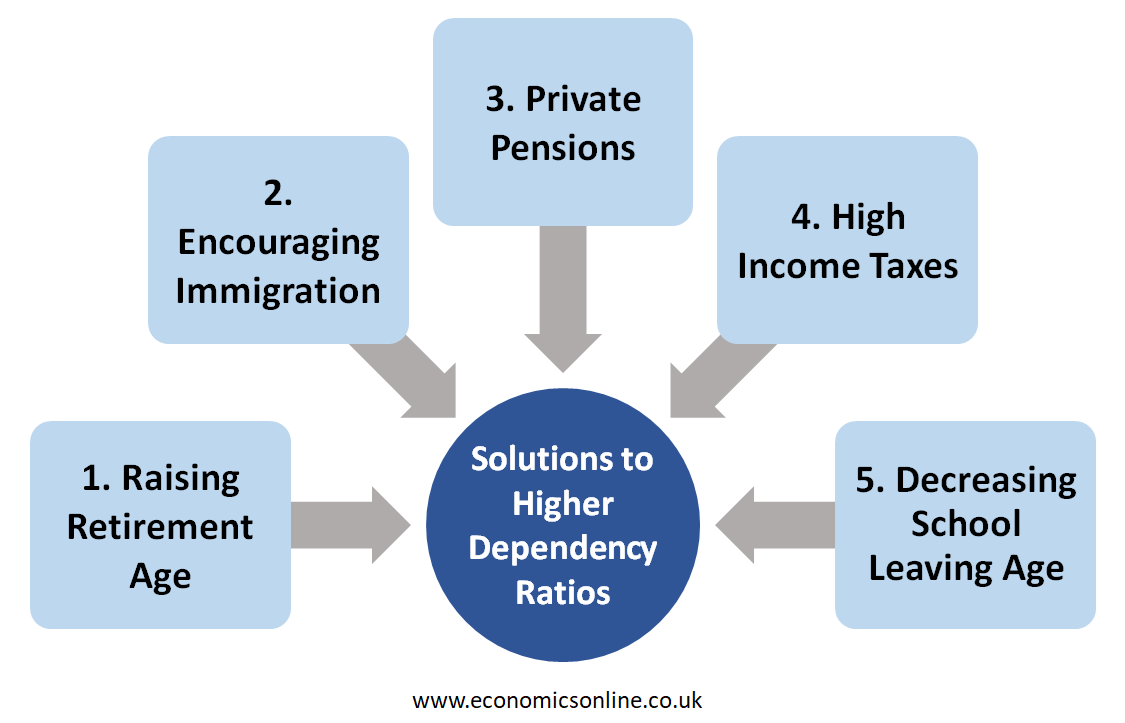
Dependency ratio - it is essentially the percentage of the population that is working divided by the percentage of the population that is not.
e.g. young, elderly, unemployed. The dependency ratio should be weighted in favour of those working
Young - parents
Elderly - government pensions - THESE 3 SHOULD NOT BE WORKING
Unemployed - welfare state
We want more in the independent category (19-64) to be working
→disengagement theory - the way society treats the old has positive benefits for society; the aging process and society’s reaction to it is part of the process by which the elderly (either through choice or legislation) are encouraged to abandon their occupational roles within the specialised division of labour.
→This process of ‘social disengagement’ allows the younger population to take their place in the labour market with minimum disruption.
→Essential, as young people need to be productive and are perhaps more productive than the older generation.
→‘Ageing is an inevitable, mutual withdrawal or disengagement, resulting in decreased interaction between the ageing person and others in the social system he belongs to.’
Eisenstadt - AGE
→age inequality for the young has to occur to allow young people to cope with the challenges of adult life
→struggles of youth:
PROBLEMS POSITIVE SPIN
seen as inferior to adults - treated differently → know what it feels like once you’re that age
managing hard friendships/relationships → shapes your personality
pocket money → budgeting/saving
chores → prepare you for living alone
coping with challenges → gain resilience
→saw adolescence as a stage for developing independance - argued youths need to go from the ascribed status of a child to achieved status as an independant adult
→claimed breaking away from family home is difficult and emotionally stressful and that youths do face an element of inequality, e.g. face inequality due to the juggling of work, home, education, friends, relationships, social pressures - THIS IS NECESSARY
→suggested that youth culture is inherently binding, in that shared interests with peers create a sense of community that helps young people get through the struggles
Cowgill and Holmes - AGE
• Age inequality exists because modernisation reduces the traditional roles and status of the elderly, but this is necessary for society to function
TRADITIONAL SOCIETIES
elderly had high status from wisdom, experience, and control of resources
central to social, religious, and economic life, custodians of culture and tradition
MODERN SOCIETIES
shift from agriculture to industry; formal education and technical skills more valued
extended families weaken; nuclear families and individualism grow
EFFECTS ON OLDER PEOPLE
Lack valued skills; lose economic power on retirement
Less family influence → status and power decline
FUNCTIONALIST VIEW
Decline is a necessary adaptation to modern society
Creates age inequality but not a failure - society prioritises economic/technological change over experience