PSYC2030 WEEK 8

0.0(0)
Studied by 0 people
call kaiCall Kai
learnLearn
examPractice Test
spaced repetitionSpaced Repetition
heart puzzleMatch
flashcardsFlashcards
GameKnowt Play
Card Sorting

1/17

encourage image

There's no tags or description

Looks like no tags are added yet.

Last updated 2:42 AM on 10/9/26
Name
Mastery
Learn
Test
Matching
Spaced
Call with Kai
Chat

No analytics yet

Send a link to your students to track their progress

18 Terms

1
New cards

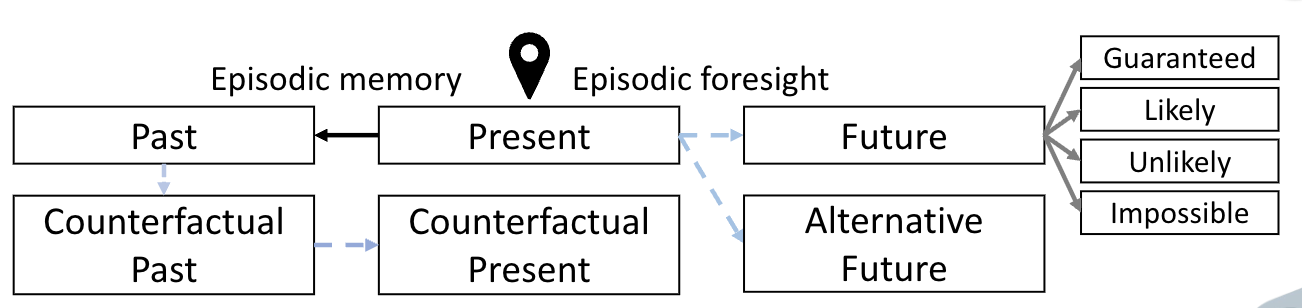
EPISODIC MEMORY

Concerns personal experiences in the past (yesterday, last year, childhood)
<p><span style="background-color: inherit; line-height: 19.55px; color: windowtext;">Concerns personal experiences in the past (yesterday, last year, childhood)</span></p>
2
New cards

EPISODIC FORESIGHT

  • The capacity to think about and project ourselves into the future 

  • Ex. What might happen tomorrow, what will not happen tomorrow, what can be done now so something might happen later. 


<ul><li><p class="Paragraph SCXO17539872 BCX0" style="text-align: left;"><span style="background-color: inherit; line-height: 19.55px; color: windowtext;">The capacity to think about and project ourselves into the future</span><span style="line-height: 19.55px; color: windowtext;">&nbsp;</span></p></li><li><p class="Paragraph SCXO17539872 BCX0" style="text-align: left;"><span style="background-color: inherit; line-height: 19.55px; color: windowtext;">Ex. What might happen tomorrow, what will not happen tomorrow, what can be done now so something might happen later.</span><span style="line-height: 19.55px; color: windowtext;">&nbsp;</span></p></li></ul><p></p>
3
New cards

WHEN CAN WE TRAVEL TO PAST AND FUTURE (VERBALLY)

4- and 5-year-olds: 

  • Can accurately answer what happened yesterday and what will you do/not do tomorrow 

3 year olds: 

  • Are correct in answering with events that have happened in the past  

  • But incorrect in accurately answering what happened yesterday and what will you do/not do tomorrow 

  • Have difficulty constraining their memory to just yesterday and tomorrow 


4
New cards

WHEN CAN WE TRAVEL TO PAST AND FUTURE (VERBAL + HYPOTHETICAL)

3 and 4 year olds passed: 

  • Could answer the question about which colour toy that played with yesterday and which one they would play with tomorrow 

4-year-olds passed, but not 3 year olds: 

  • 4 year olds could answer the hypothetical scenario questions about what colour toy they played with yesterday and which one they would play with tomorrow  

  • 3 year olds could not  

Discussion: 

  • When in the experimental situation they merely had to remember the colour of the toy they played with yesterday  

  • For the hypothetical situation they had to simulate a past and also a future, as well as remembering the colours which is more difficult.  


<p><span style="background-color: inherit; line-height: 19.55px; color: windowtext;"><strong>3 and 4 year olds passed:</strong></span><span style="line-height: 19.55px; color: windowtext;">&nbsp;</span></p><ul><li><p class="Paragraph SCXO192973124 BCX0" style="text-align: left;"><span style="background-color: inherit; line-height: 19.55px; color: windowtext;">Could answer the question about which colour toy that played with yesterday and which one they would play with tomorrow</span><span style="line-height: 19.55px; color: windowtext;">&nbsp;</span></p></li></ul><p class="Paragraph SCXO192973124 BCX0" style="text-align: left;"><span style="background-color: inherit; line-height: 19.55px; color: windowtext;"><strong>4-year-olds passed, but not 3 year olds:</strong></span><span style="line-height: 19.55px; color: windowtext;">&nbsp;</span></p><ul><li><p class="Paragraph SCXO192973124 BCX0" style="text-align: left;"><span style="background-color: inherit; line-height: 19.55px; color: windowtext;">4 year olds could answer the hypothetical scenario questions about what colour toy they played with yesterday and which one they would play with tomorrow&nbsp;</span><span style="line-height: 19.55px; color: windowtext;">&nbsp;</span></p></li><li><p class="Paragraph SCXO192973124 BCX0" style="text-align: left;"><span style="background-color: inherit; line-height: 19.55px; color: windowtext;">3 year olds could not&nbsp;</span><span style="line-height: 19.55px; color: windowtext;">&nbsp;</span></p></li></ul><p class="Paragraph SCXO192973124 BCX0" style="text-align: left;"><span style="background-color: inherit; line-height: 19.55px; color: windowtext;"><strong>Discussion:</strong></span><span style="line-height: 19.55px; color: windowtext;">&nbsp;</span></p><ul><li><p class="Paragraph SCXO192973124 BCX0" style="text-align: left;"><span style="background-color: inherit; line-height: 19.55px; color: windowtext;">When in the experimental situation they merely had to remember the colour of the toy they played with yesterday&nbsp;</span><span style="line-height: 19.55px; color: windowtext;">&nbsp;</span></p></li><li><p class="Paragraph SCXO192973124 BCX0" style="text-align: left;"><span style="background-color: inherit; line-height: 19.55px; color: windowtext;">For the hypothetical situation they had to simulate a past and also a future, as well as remembering the colours which is more difficult.&nbsp;</span><span style="line-height: 19.55px; color: windowtext;">&nbsp;</span></p></li></ul><p></p>
5
New cards

USING EPISODIC MEMORY FOR THE FUTURE

Suddendorf et al. (2011) 

  • Children had to think ahead to a future room and choose something that would help them there 

  • 4 year olds, but not 3 year olds, selected and retained the correct key 

  • Selecting the correct key illustrates using remembered information to prepare for a future problem. 


6
New cards

FUTURE POSSIBILITIES

A future event cannot be known with 100% certainty, so imagining a future event involves possibility.  

  • a forked-tube task showed that some 3 year olds and many 4 year olds can prepare for two mutually exclusive future possibilities 

  • This means they understood there was more than one possible future outcome 

  • 3 year old could recognise a strategy that prepares for future possibilities but they could not prepare for these possibilities independently  


<p><span style="background-color: inherit; line-height: 19.55px; color: windowtext;">A future event cannot be known with 100% certainty, so imagining a future event involves possibility.&nbsp;</span><span style="line-height: 19.55px; color: windowtext;">&nbsp;</span></p><ul><li><p class="Paragraph SCXO32979383 BCX0" style="text-align: left;"><span style="background-color: inherit; line-height: 19.55px; color: windowtext;">a forked-tube task showed that some 3 year olds and many 4 year olds can prepare for two mutually exclusive future possibilities</span><span style="line-height: 19.55px; color: windowtext;">&nbsp;</span></p></li><li><p class="Paragraph SCXO32979383 BCX0" style="text-align: left;"><span style="background-color: inherit; line-height: 19.55px; color: windowtext;">This means they understood there was more than one possible future outcome</span><span style="line-height: 19.55px; color: windowtext;">&nbsp;</span></p></li><li><p class="Paragraph SCXO32979383 BCX0" style="text-align: left;"><span style="background-color: inherit; line-height: 19.55px; color: windowtext;">3 year old could recognise a strategy that prepares for future possibilities but they could not prepare for these possibilities independently&nbsp;</span><span style="line-height: 19.55px; color: windowtext;">&nbsp;</span></p></li></ul><p></p>
7
New cards

PROBABILITIES OF FUTURE POSSIBILITIES

  • The ask compared future possibilities with different probabilities, including 0, 50 and 100% outcomes.  

  • Younger children could distinguish between guaranteed vs impossible contrasts (0 vs 100%), while distinguishing between two possible outcomes with different probabilities was harder (0 vs 50%, 50 vs 100%). 

  • From around 5 years, children could distinguish between different outcomes with different probabilities 


8
New cards

SUMMARY OF FUTURE THINKING

  • 3–4 years: recall past events and imagine future events. 

  • ~4 years: devise a solution to a future problem using memory. 

  • ~4 years: prepare for multiple future possibilities and distinguish impossible, possible and guaranteed outcomes. 

  • ~5 years: prepare for two possible futures that differ in probability. 


9
New cards

COUNTERFACTUAL THINKING

Counterfactual thinking is thinking about or imagining alternative outcomes for an event or behaviour that has already happened. It involves mentally 'undoing' a past event and considering an alternative timeline that did not actually occur.  

Counterfactual past: 

  • What could I have done differently? 

Counterfactual future: 

  • How would the present differ if the past had been different? 

Why it matters? 

  • It has implications for decision making, adapting future behaviour and concepts such as fault and responsibility. 


10
New cards

REASONING ABOUT COUNTERFACTUAL PAST

Harris, German & Mills (1996) 

  • Children were asked what would have happened if a character had taken off dirty shoes before walking across a clean floor 

  • Children from around 3 years could answer correctly (the floor would stay clean) 

McCormack et al. (2018) 

  • Angry birds long vs short route vs blocked route 

  • 4 and 5 year olds focused on the immediate intervention 

  • 6 year olds understood the downstream consequences that would still occur  


11
New cards

COUNTERFACTUAL EMOTIONS

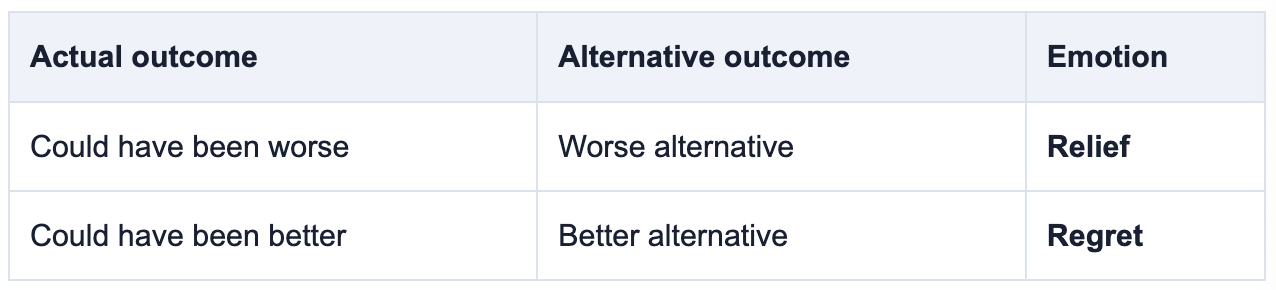
Counterfactual emotions depend on comparing what actually happened with what could have happened. 

12
New cards

COUNTER FACTUAL EMOTIONS EXPERIMENT

  1. Child chooses between two boxes with prizes 

  2. Child rates emotion about the chosen prize 

  3. The unchosen box is revealed 

  4. Child now rates how they felt about the chosen box  


  • Feeling worse after discovering a better alternative = regret 

  • Feeling better after discovering a worse alternative = relief 

  • Regret occurred around 5 years and relief at around 7 years  


Classic tasks often use gain-only contexts, whereas, in everyday life, relief almost always follows an almost-bad outcome rather than simply receiving a smaller reward.  
<ol><li><p class="Paragraph SCXO86399519 BCX0" style="text-align: left;"><span style="background-color: inherit; line-height: 19.55px; color: windowtext;">Child chooses between two boxes with prizes</span><span style="line-height: 19.55px; color: windowtext;">&nbsp;</span></p></li><li><p class="Paragraph SCXO86399519 BCX0" style="text-align: left;"><span style="background-color: inherit; line-height: 19.55px; color: windowtext;">Child rates emotion about the chosen prize</span><span style="line-height: 19.55px; color: windowtext;">&nbsp;</span></p></li><li><p class="Paragraph SCXO86399519 BCX0" style="text-align: left;"><span style="background-color: inherit; line-height: 19.55px; color: windowtext;">The unchosen box is revealed</span><span style="line-height: 19.55px; color: windowtext;">&nbsp;</span></p></li><li><p class="Paragraph SCXO86399519 BCX0" style="text-align: left;"><span style="background-color: inherit; line-height: 19.55px; color: windowtext;">Child now rates how they felt about the chosen box&nbsp;</span><span style="line-height: 19.55px; color: windowtext;">&nbsp;</span></p></li></ol><p class="Paragraph SCXO86399519 BCX0" style="text-align: left;"><span style="line-height: 19.55px; color: windowtext;">&nbsp;</span></p><ul><li><p class="Paragraph SCXO86399519 BCX0" style="text-align: left;"><span style="background-color: inherit; line-height: 19.55px; color: windowtext;">Feeling worse after discovering a better alternative = regret</span><span style="line-height: 19.55px; color: windowtext;">&nbsp;</span></p></li><li><p class="Paragraph SCXO86399519 BCX0" style="text-align: left;"><span style="background-color: inherit; line-height: 19.55px; color: windowtext;">Feeling better after discovering a worse alternative = relief</span><span style="line-height: 19.55px; color: windowtext;">&nbsp;</span></p></li><li><p class="Paragraph SCXO86399519 BCX0" style="text-align: left;"><span style="background-color: inherit; line-height: 19.55px; color: windowtext;">Regret occurred around 5 years and relief at around 7 years&nbsp;</span><span style="line-height: 19.55px; color: windowtext;">&nbsp;</span></p></li></ul><p class="Paragraph SCXO86399519 BCX0" style="text-align: left;"><span style="line-height: 19.55px; color: windowtext;">&nbsp;</span></p><p class="Paragraph SCXO86399519 BCX0" style="text-align: left;"><span style="background-color: inherit; line-height: 19.55px;">Classic tasks often use gain-only contexts, whereas, in everyday life, relief almost always follows an almost-bad outcome rather than simply receiving a smaller reward.&nbsp;</span><span style="line-height: 19.55px;">&nbsp;</span></p>
13
New cards

REGRET AND RELIEF IN DEVELOPMENTAL CONTEXT

  • This task involved losing or gaining a reward depending on the chosen box  

  • Children seemed to experience regret and relief from around 6 years  


14
New cards

JUDGING OTHERS REGRET AND RELIEF

Weisberg & Beck (2010) 

  • The task required children to infer an emotional response from counterfactual information about the non-chosen box 

  • 5 – 7 year olds could not identify that a character would feel sadder in the regret condition, or happier in the relief condition 

Jones et al. (2025) 

  • Children inferred the contents of a non-chosen box from another person's facial expression 

  • Older children were better at identifying counterfactual information from facial expressions 

  • Regret was easier to identify than relief  


15
New cards

COUNTERFACTUAL JUDGEMENTS ABOUT OTHERS CHOICES

The key question when judging another person's behaviour is where the person had another choice available. 

Gautem et al. (2023) 

  • Children judged how nice or mean characters were after characters bought gifts for someone else 

  • From 6 years, children considered what the character could have chosen when judging how nice/mean the action was 

Cross-cultural differences: 

  • US and China participants made judgements based on whether the character had a choice  

  • India participants did not show the same choice-based pattern 


16
New cards

SOCIAL CONSEQUENCES OF COUNTERFACTUAL JUDGEMENTS

No choice: 

  • Forgiveness 

  • Reconciliation 

Choice: 

  • Anger 

  • Apology 

  • Remorse 

  • compensation 


17
New cards

COUNTERFACTUAL THINKING SUMMARY

  • Counterfactual reasoning = more reliable around 6 years old  

  • Counterfactual emotions = regret and relief emerge during early school years, with the exact pattern depending on outcome context 

  • Other's counterfactual emotion = increasingly able to infer regret and relief from around 6 years old 

  • Counterfactual social judgements = from around 6 years children increasingly consider what another person could have chosen  


18
New cards

WHY DOES COUNTERFACTUAL THINKING DEVELOP LATER?

Counterfactual thinking places heavier demands on executive functioning than straightforward future simulation. 

  • Working memory = keep the actual past and the alternative past in mind 

  • Inhibitory control = represent what actually happened, inhibit it, then generate an alternative 

  • Cognitive flexibility = switch between actual and counterfactual past



