Legal System of England & Wales manual
 Call Kai
 Learn
Learn Practice Test
 Spaced Repetition
 Match
Match Flashcards
 Knowt Play
1/68

There's no tags or description
Looks like no tags are added yet.
Name | Mastery | Learn | Test | Matching | Spaced | Call with Kai | Chat |
|---|
No analytics yet
Send a link to your students to track their progress
69 Terms
What is the order of the courts?
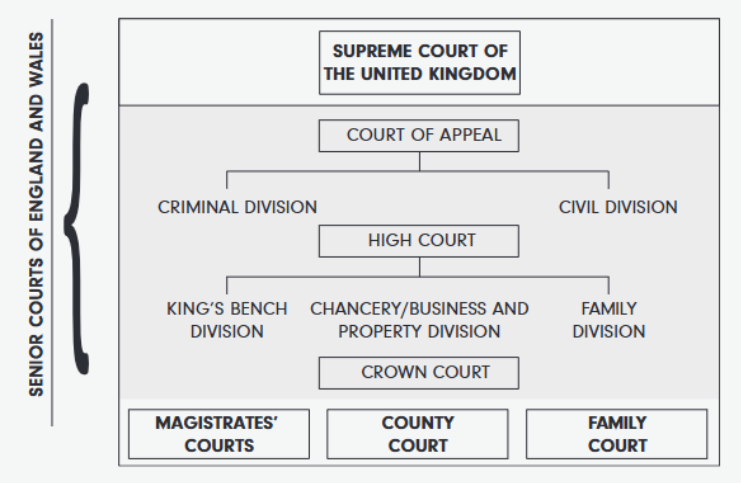
What is the difference between superior courts and inferior courts?
Superior courts have unlimited jurisdiction both geographically and financially, and generally try the most important and difficult cases.
Inferior courts have limited geographical and financial jurisdiction, and deal with less important cases (although they address significantly more cases than the superior courts and therefore play a crucial role in the legal system)
List the superior courts
Supreme Court
Court of Appeal
High Court
Crown Court
List the inferior courts
County Court
Magistrates’ courts
Family court
What is the difference between trial and appellate courts?
A trial court hears cases at first instance. A trial court will rule on issues of fact and law.
An appellate court will reconsider the application of legal principles to a case that has already been heard by a lower court. This appeals process allows errors of law - and occasionally fact and procedure - to be corrected
Which civil courts hear trials (courts of first instance)?
High Court
Family Court
County Court
Which criminal courts hear trials (courts of first instance)?
Crown Court
Magistrates’ Court
Which civil courts hear appeals?
Court of Appeal (Civil Division)
High Court (all 3 divisions)
Family Court
Which criminal courts hear appeals?
Court of Appeal (Criminal Division)
High Court (KBD)
Draw out the Civil Court structure

Who sits in a county court?
Circuit judges and district judges
What kind of cases does the county court (civil jurisdiction) usually hear?
They have unlimited financial jurisdiction (although mainly deal with claims of lower value). General types of work include: Contract/tort claims, Equity jurisdiction e.g. mortgages, disputes over wills, recover of land, disputes under the consumer credit Act
Where is the High Court?
In London (The Royal Courts of Justice) and in District Registries in major cities
Who sits in the High Court?
High Court judge (usually sitting alone)
What kind of cases does the High Court (civil jurisdiction) typically hear?
Claims must generally be valued at £100,000+ (£50,000 for personal injury) to be commenced in the Higher Court King’s Bench Division
Contract/tort claims
Specialised courts e.g. technology and construction court
Chancery/business and property division
Disputes over wills and administration of estates
trusts
land and mortgage actions
company law
bankruptcy
family division
Where is the Court of Appeal?
In London (The Royal Courts of Justice)
Who sits in the Court of Appeal?
Lord Justices of Appeal (usually 3 sitting at once)
What kind of cases (civil jurisdiction) does the Court of Appeal typically hear?
Appeals in civil cases from:
High Court, County Court, and certain tribunals
Where is the Supreme Court?
In London (Parliament Square)
Who sits in the supreme court?
Justices of the Supreme Court (usually 5 sitting at once)
What kind of cases (civil jurisdiction) does the Supreme Court typically hear
Appeals from: Court of Appeal and High Court
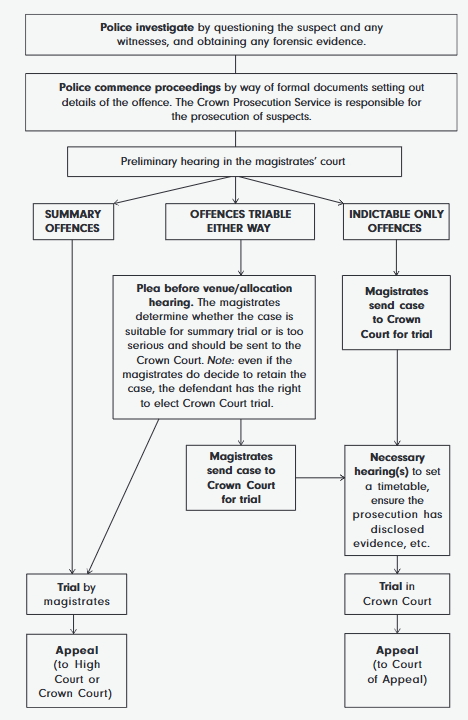
What is a summary only offence and give an example
These are minor offences and must be dealt with in the magistrates’ court e.g. driving without insurance or common assault
What is an indictable only offence and give an example
These are the most serious offences and can only be tried only in the Crown Court in front of a jury e.g. murder or robbery
Draw out the criminal procedure when the police wish to prosecute
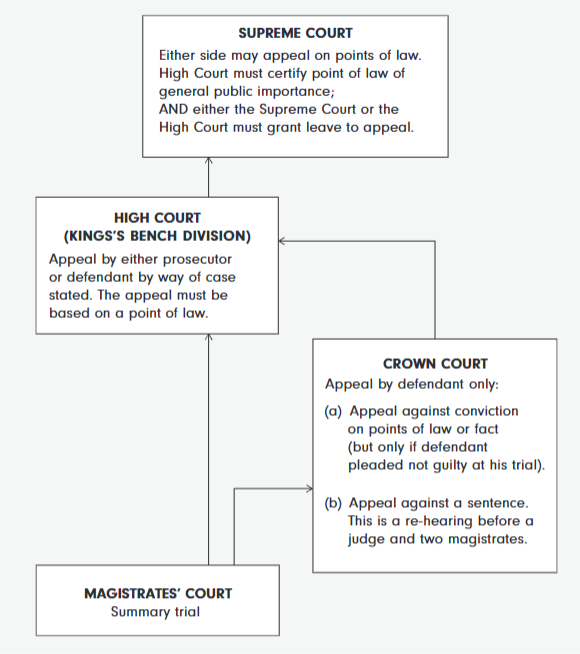
Draw out the route of appeal if a guilty defendant in the magistrates’ court wishes to appeal the verdict or sentence or both
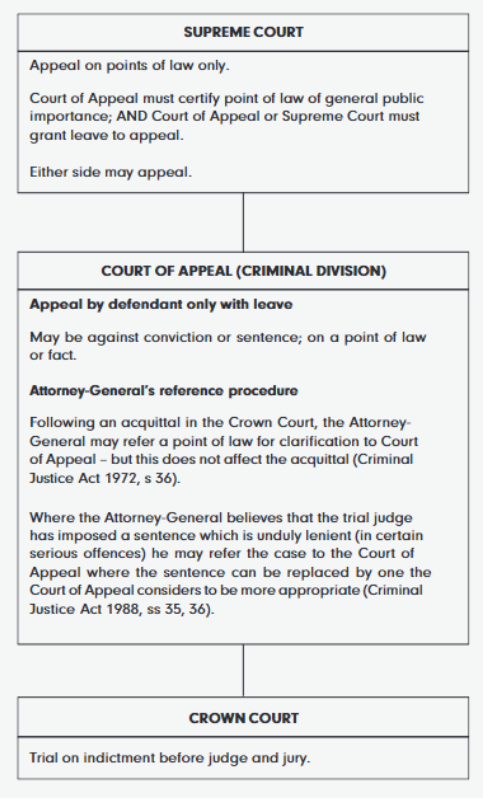
Draw out the process of trial in indictment: appeals
Who sits in the magistrates court?
Lay magistrates (not legally qualified - usually 3 sitting at once) or district judge (usually sitting alone)
What cases does the magistrates court (criminal jurisdiction) usually hear?
Issues of summonses and warrants for search/arrest
Bail applications
Trials of summary offences
Mode of trial procedure to decide whether case should be tried summarily or on indictment
Where is the Crown Court?
In various centres across the country
Who sits in the Crown Court?
High Court judge, circuit judge or recorder (usually sitting alone)
Jury for trials
What cases (criminal jurisdiction) does the crown court typically hear?
Trials on indictment
Committals for sentence from magistrates’ courts where the magistrates sentencing powers are inadequate
Appeals by defendants convicted summarily in magistrates’ courts
What cases (criminal jurisdiction) does the Court of Appeal typically hear?
Appeals in criminal cases from:
Crown Court by defendant
References by AG on points of law or against lenient sentences
Cases referred by the Criminal Cases Review Commission
What cases (criminal jurisdiction) does the supreme court typically hear?
Appeals from:
Court of Appeal (Criminal Division)
KBD (Divisional Court)
Where is the privy council?
In London (Parliament Square)
Where is the European Court of Justice?
Luxembourg
Where is the European Court of Human Rights?
Strasbourg
Who sits in the privy council?
Justices of the Supreme Court and Commonwealth judges who are members of the Privy Council (usually 5 sitting at once)
What kind of cases does the privy council hear?
Appeals from certain commonwealth countries
What kind of cases does the European Court of Justice hear?
Preliminary rulings on EU law and the actions of EU institutions
Actions against Member States to determine whether they have failed to fulfil their Treaty obligations
NB: influence reduced/removed by repeal of the European Communities Act 1972
Who sits in the European Court of Human Rights
Judges appointed from each state that is a party to the 1950 Convention
What kind of cases does the European Court of Human Rights hear?
It hears cases on alleged breaches of the European Convention on Human Rights
What is a right of audience?
The right of a person to appear and conduct proceedings in court
What must solicitors do if they wish to exercise a right of audience in the higher courts?
They must have completed the appropriate higher courts advocacy qualification:
The Higher Courts (Civil Advocacy) Qualification, which entitles the solicitor to exercise rights of audience in all civil proceedings in the higher courts; and/or
The higher Courts (Criminal Advocacy) Qualification, which entitles the solicitor to exercise rights of audience in all criminal proceedings in the higher courts
Who is the Lord Chief Justice?
The head of the judiciary (a role previously held by the Lord Chancellor) and the senior judge in England and Wales. President of all the courts, but also head of Criminal Justice
Who is the Master of the Rolls?
Head of Civil justice
How can a proposition stated in one case be binding in a later case?
A proposition stated in one case is binding in a later case if it is:
A proposition of law (not fact);
Part of the ratio decidendi of a case (e.g. the central legal reasoning of a case). Statements that are unimportant to the outcome (but which might have future significance) are obiter dicta - persuasive but not binding. Generally obiter involves:
The judge speculating about the decision they would have given if the facts of the case had been different
The judge addressing submissions that were made in legal arguments but that are no longer relevant given the ration of the case; or
dissenting judgements
Decided in a court whose decisions are binding in the present court
There are no relevant distinctions between the two cases
Who binds whom?

Does the UK Supreme Court bind itself?
No but it binds courts below and will ordinarily follow its own decisions
Does the Court of Appeal bind itself?
Yes it binds courts below and normally binds itself subject to the following exceptions:
Where there are two conflicting decisions of the Court of Appeal, it may choose which to follow
Where the previous decision of the Court of Appeal, even if not expressly overruled, conflicts with a Supreme Court decision
Where the decision was made per incuriam (e.g. the court neglected to consider a statutory provision or a binding precedent)
Where it was an interim decision by two judges (an exception added by Boys v Chaplin [1968] 2 QB 1)
Where one of its previous decisions is inconsistent with a subsequent decision of the European Court of Human Rights
In criminal matters, where a decision is obviously wrong and would lead to the appellant remaining in goal
Does the High Court Appellate bind itself?
It binds courts below and normally binds itself
Does the High Court 1st instance bind itself?
It binds courts below but not itself
Is the Crown Court binding?
No it binds no one
Is the County Court binding?
No it binds no one
Is the magistrates’ courts binding?
No it binds no one
What is the ratio?
The ratio is an application of the law to material facts. If a court considers a case before it to be different in some material way from the precedent cited, either on the facts or the law, the earlier case need not be followed. The present case will be distinguished
What is affirming?
A higher court confirms it agrees with the appeal before it from a lower court
What is applying?
A court adopts statements or reasoning from other decisions
What is departing?
A court of one level disagrees with a previous decision, in another matter, by an equal court
What is overruling?
A higher court comments on a previous unrelated decision by a lower court and declares it to be wrong
What is reversing?
A higher court disagrees with the earlier decision, in the same proceedings, of a lower court
What is the structure of an Act of Parliament
The Royal Coat of Arms
A short title
A year and chapter number, being that statute’s unique reference number
A long title, which serves to describe the purposes of the Act
The date of Royal Assent, being the final part of the process to enact legislation
The enacting formula, being a formally worded paragraph to confirm that the statute has passed all the relevant legislative processes
Many statutes are long documents, and bits of an Act are often parcelled together into different parts and chapters to promote understanding as well as consistency in approach and interpretation
Each provision of a statute is known as a section
Towards the end of the statute, there will be sections addressing matters of general interpretation as well as commencement of the statute, its application and extent
Many statutes also have a number of schedules. The content of such schedules is specific to each state, but a common purpose is to list amendments and repeals to other Acts of Parliament that must be made as a result of this statute coming into force
What is the literal rule?
Words must be given their plain and ordinary meaning
What is the golden rule?
Narrow - if a word is capable of more than one meaning, you can choose that meaning which does not produce an absurd result
Wide - even where a word had only one meaning, interpret it in a way that avoids a result that is obnoxious to public policy
What is the mischief rule?
The court considers what mischief or defect in the existing law the statute was intended to remedy
What is the purposive approach?
The court considers the reasons why the statute was passed and its purpose - and will interpret the statute on that basis
What presumptions do courts use when interpreting statutes?
Against alteration of the common law. Unless the statute expressly states an intention to alter the common law, the interpretation that does not alter the existing law will be preferred;
Against the retrospective operation of statutes. Where an Act of Parliament becomes law, a presumption arises that it will apply only to future actions, unless the legislation is specifically stated to have retrospective effect
Against criminal liability without guilty intention (mens rea). If a statute creates a new criminal offence, it is presumed that the defendant must have a ‘guilty mind’ to be convicted of that offence, unless Parliament makes it clear that the offence is one of strict liability
Against deprivation of the liberty of the individual. If there are two possible constructions of a statutory provision - one that is in favour of the defence and the other that is in favour of the prosecution - the construction that favours the defence should be used, unless Parliament intends the opposite;
Against deprivation of property or interference with private rights;
Against binding the crown. Unless there is a clear statement to the contrary, legislation is presumed not to apply to the Crown; and
Against ousting the jurisdiction of the courts
What are the intrinsic aids to statutory interpretation?
Statute must be read as a whole and in context
Find and read the interpretation sections
What are the extrinsic aids to statutory interpretation?
Interpretation Act (definitions of commonly found words)
Dictionaries
Other statutes
Hansard (record of Parliamentary debates):
If the statute is ambiguous or the literal meaning leads to absurdity; and
The material in Hansard consists of clear statements by a Minister or other promoter of the Bill
What other possible aids to statutory interpretation are there?
Speeches, academic tracts, well-known law books etc