Physics Exam 2 Content
 Call Kai
 Learn
Learn Practice Test
 Spaced Repetition
 Match
Match Flashcards
 Knowt Play
1/154

There's no tags or description
Looks like no tags are added yet.
Name | Mastery | Learn | Test | Matching | Spaced | Call with Kai | Chat |
|---|
No analytics yet
Send a link to your students to track their progress
155 Terms
what is the behavior when things of like charges are next to each other? what about opposite charges?
like charges: repulsion
opposite charges: attraction
can insulators have a charge
yes, even things like rubber can have a charge

what does this table represent
how likely things are to become positively and negatively charged
what is the triboelectric effect
when things become electrically charged after they touch or rub against a different material
what is a conductor? what is an example?
a material whose conduction electrons are FREE to move throughout
ex: metals
what is an insulator? example?
a material whose electrons RARELY move from atom to atom (tightly bound)
ex: nonmetallic substances
can conductors and insulators become polarized?
yes, conductors’ electrons are loose and can redistribute around the material, making the whole object become polarized. insulators’ electrons are more tightly bound but can shift to polarize the material
what is needed for polarization
an external charge
true or false: polarization can result in attraction of neutral objects
true!!
why do electrons move and not protons?
protons are in the nucleus and have a positive charge. they stay bound together there. plus, electrons are about 1/1836 mass of a proton
what is the relationship between the density of an electron cloud and the probability an electron will be found there
higher the density=the more likely an electron will be found there
how can a nucleus stay together with repulsion
strong nuclear force is attractive at short ranges and overpowers the repulsion among protons
during an electric charge transfer, does the amount of charge change?
the amount of charge stays the same but charges move
the total electric charge of the universe is ___
constant (law of conservation of charge)
what is the law of conservation of charge
no physical process can result in an increase or decrease in the total amount of electric charge in the universe (net charge will always be zero)
what happens when an uncharged metal sphere is touched by a charged rod?
some charge is transferred at the point of contact, and because this is a conductor, the transferred charge moves QUICKLY and spreads throughout the ENTIRE surface of the sphere

if there is repulsion, what can we assume about the charges?
they are the same charge
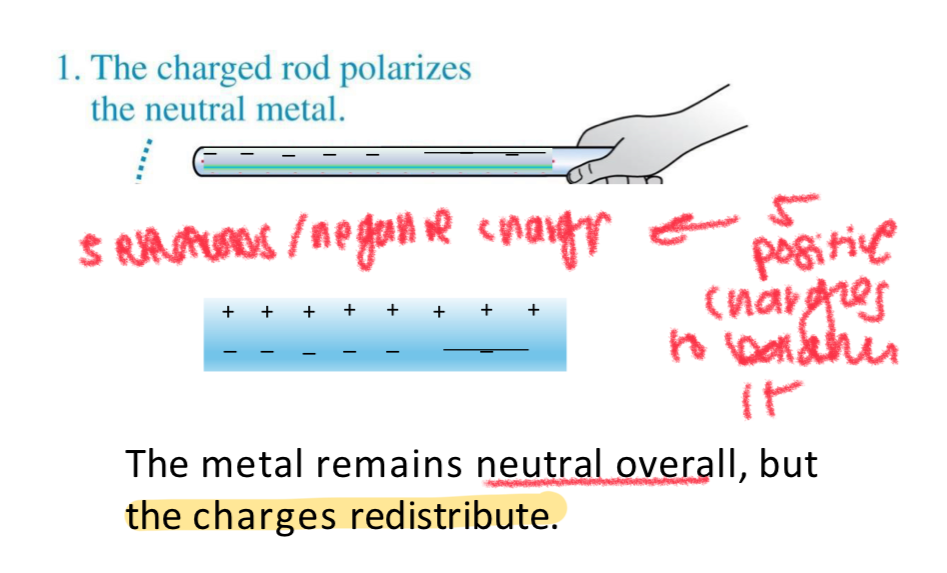
what is the overall charge of the metal when a charged rod polarizes a neutral metal?
the metal remains neutral even if the charges redistribute (notice how the location of the + and - change but the number of them still even out)
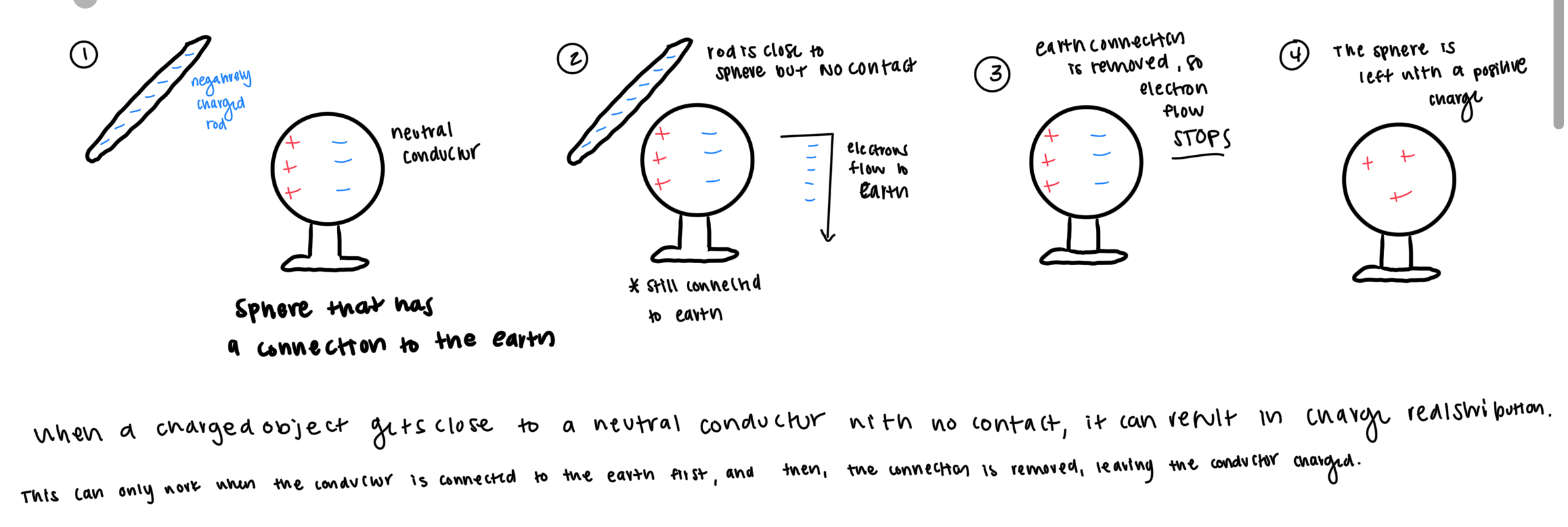
describe how conductors get charged without direct contact
a charged rod comes near a metal sphere THAT IS ATTACHED TO THE GROUND. there is a charge redistribution. the electrons are flowing to earth during redistribution, but once the earth connection is removed, electron flow STOPS. then, the sphere is left with a positive charge
for charging without direct contact, the charge of the sphere is _____ of the charged rod
opposite but equal
how quickly does charge redistribution occur in conductors vs insulators
conductors→quickly (electrons are free to move around)
insulators→slowly (because electrons are tightly bound to their atoms)
who is stephen gray
had experiments to charge objects using friction and induction and coined the substance “electric virtue”
what did benjamin franklin contribute to the scientific field
determined there is only one type of fluid (aka electricity)
consists of “positive” and “negative” charges (first to use those terms)
law of conservation of charge

the positively chagred rod attracts the negative charges towards the left, causing them to move into sphere 1 and sphere 2 is left with a net positive charge (deficiency of electrons). with the rod still being near and the spheres pulled apart, the extra (-) charge on sphere 1 and (+) on sphere 2 are left. then the rod is left→charges trapped

here the electrons move to sphere 1 bc it is closer to the positively charged rod. then the rod is removed but the sphere are still touching, so the charges can redistribute. this leaves the rods neutral (no net charge)
what two forms can a force act as?
push (repulsion) or pull (attraction)
force is an interaction between what two things
two objects (what it acts on) and the agent (the cause)
how many objects are needed for a force
2
when we say force is a vector, what do we need to consider
look at its magnitude and direction
do forces just happen upon contact?
they can be contact forces but long range forces also exist
why do we consider mass for the effect of forces?
because it tells us the amount of matter/resistance to acceleration
describe Charles Augustin de Coulomb’s experiment/what it gave us
set up like calorimeter. the ball was charged by rubbing it with fur and put inside the box to see repulsion/attraction

what is Coulomb’s law

do we need to consider direction with Coulomb’s law
yes! you need to see whether the charges are like or opposite to see if the arrows are going outwards or inwards. it can dictate whether you will be adding/subtracting
the forces on the two charges form a ____-______pair
action reaction pair
which is greater: electrostatic repulsion or gravitational attraction
electrostatic repulsion (k=9×10^9 while G is 6.67×10^-11 aka k is so much larger than G)
what is gravitational force proportional to (formula)
mass of interacting objects

what is electrostatic force proportional to? (formula)
the magnitudes (do not consider signs) of interacting objects

Newton’s third law says that forces exerted on the electron and proton are equal in magnitude and opposite in direction, so will they meet at the midpoint
no, they will meet closer to the proton bc it has a heavier mass and will accelerate slower than the electron
how do we find the forces exerted on two charges that are r distance apart from each other

forces are ______ for like charges and _______ for opposite charges
repulsive
attractive
what is Coulomb’s constant and electric constant

how does Coulomb’s law explain why we get zapped more in the winter
because the constant depends on free space (and in the winter there is less moisture→charge buildup)
how do we find net source when there are forces due to two or more objects
you find the vector sum (you need to consider direction when adding these to determine if they are being added or subtracted)

when is net force zero
when the force to the left and right are equal in magnitude (can set them equal to each other to find variables)

how do you describe a vector trigonometrically
find Ay as Asin(theta) and Ax as Acos(theta) and find the magnitude by adding the squares and taking the square root
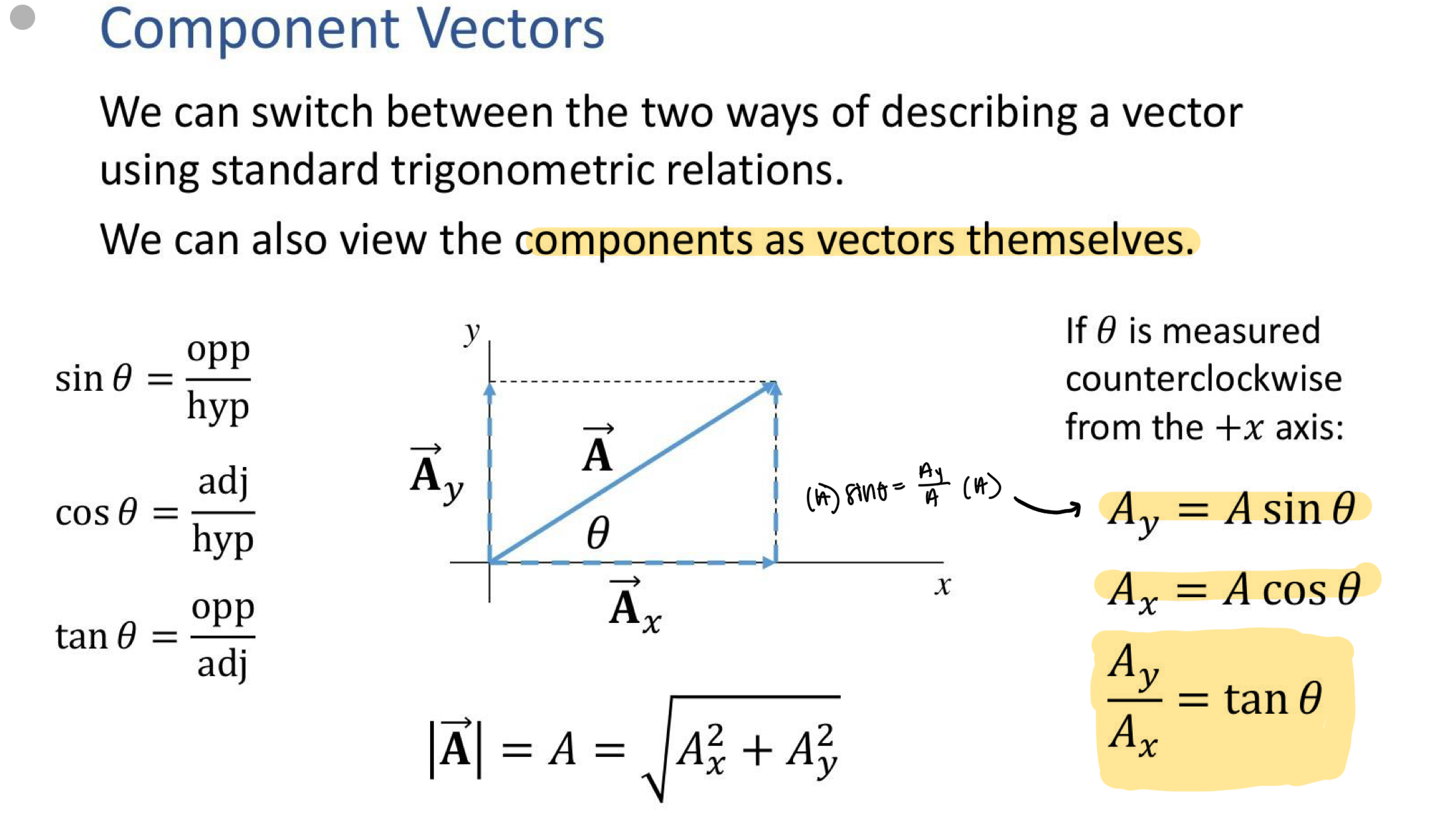
how do you add vectors if there and x and y values/if they are not all in one direction (x and y)
add all the x components (usually use Fcos(theta))
add all the y components (Fsin(theta))
find the total of each x and y components
square each x and y sum, add them, and then take the square root of the sum (can use tan to find angle)

what do we assume the charge for a point charge if there is no sign?
positive
the size of a dot is proportional to the _____ of the charge
magnitude
what does a positive test charge tell us if we have a positive sphere present?
it will probe the force felt around the sphere
the smaller the distance from the point charge the _____ the force
larger (reminder that force and distance are inversely related)
so if we have an electric force map, would we expect the force closer to the charge or farther to have the larger arrow/magnitude of force
the closer to the charge
is Coulomb’s only applied to point charges?
no, it can be applied to any type of charge distribution
what formula do we use if we do not have simply two point charges. what baout if we have a sphere and a point charge?
the sigma next to the A is charge density

when can we a assume a sphere can be treated as a point charge for Coulomb’s law
as long as the point charge is outside the sphere and the charge remains spherically uniform
what is the formula of electric field

what is the formula of the electric field at position r

the electric field is a ______ field
vector field
can we say the vector field exists at every point in space
yes because of source charge
how do we treat electric fields from multiple charges when they add up?
add them up as vectors (superposition)
when working with point charges and are trying to find the magnitude of the electric field, what formula do we use
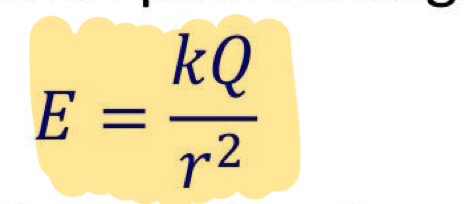
the force on a charge q in an elecric field is defined as

formula of magnitude of electric field due to a point charge

what can we assume about a charge if the arrows are point in within an electric field?
it is negative (electric field value will point out if the point charge is positive)
electric field lines from _____ charges to _____ charges
positive to negative
how do we draw the lines to show the strength of the field
stronger the field=more closely spaced lines/usually more lines as well
describe what an electric field would look like if a positive source charge was present
outward point (electrostatic repulsion)
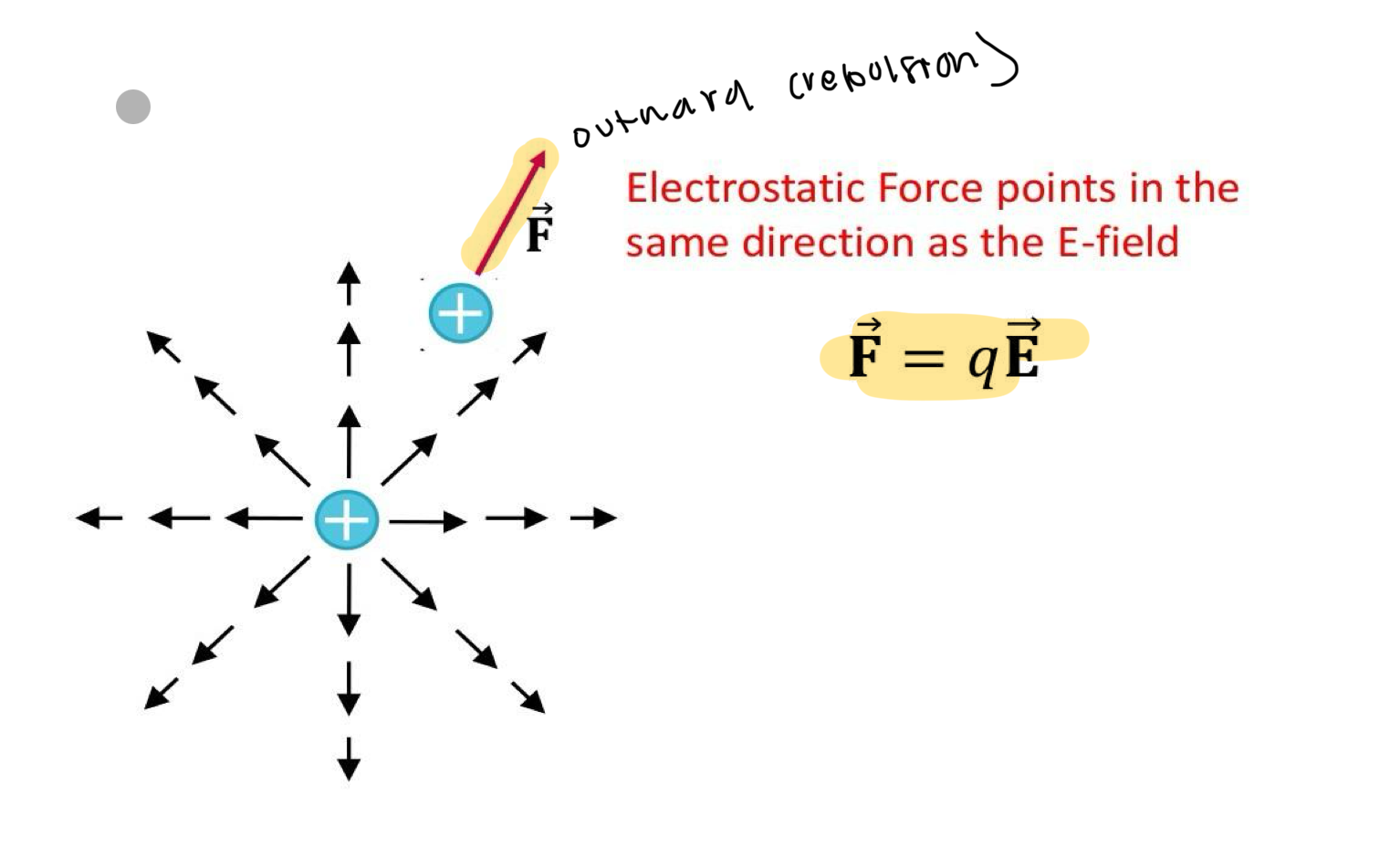
describe what an electric field would look like if a negative source charge was present
pointing inwards

describe how electric fields would look for multiple charges
you would see attraction/interaction if there are opposite charges, but there would be no attraction if they are of the same charge. plus, it depends on the magnitude of the charges

how would you add electric field that sum up but have x and y coordinated
find the E net, x: aka Ecos(angle) + ….
find the E net, y: aka Esin(angle)+….
then find the magnitude by square E net, y and E net, x, add them, then take square root
why can we assume Fc and Fcoul for an atom
because the electron would literally fall out of the atom
what is the velocity formula for the speed of the electron
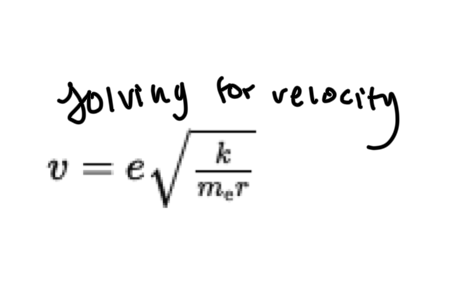
what is the relationship between coulomb force and centripetal force of atom

what is the function of a capacitor
helps keep the charge between the plates (electric field is uniform between the plates and zero outside)
how would you describe the charge distribution of an electric field near a large charged plate
uniform in direction and magnitude

how would you describe the electric field between the capacitor plates? outside?
uniform between the plates and zero outside
how would you describe the distribution of a charge placed on a conducting sphere?
it distributes uniformly on the surface of the sphere; NOT WITHIN THE VOLUME OF THE SPHERE, and the charges are all on the circumference/far apart one another to prevent repulsion

what is the value of the electric field within a conducting sphere
0!!! (the charge is all on the outside)
describe the charge distribution of a conducting sphere when a positive point charge is near the sphere
the negative charge will be on the surface closest to the positive point charge while the positive charges will be on the other side (either way the overall charge is neutral/the net charge is sitll zero)

IMPORTANT: describe what happens when you put a conducting sphere in an electric field? what concept does this explain
the field induces opposite charges on opposite sides of the conductor, but the net charge is still zero. the induced charge will produce a field within the conductor that will exactly cancel out the external field—this shows shielding where the charges will cancel out the external field to maintain the internal net charge of 0

electric field lines meet the surface of a conductor at _____ angles
right angles

when electric charges are at rest, the electric field within a conductor is _____
0
how does a lightening strike hitting a plane an example of shielding
nobody gets harmed inside because the electric field will still be 0 inside because the surface charges cancel out the external charges
describe electric charges and field lines near sharp points
they will be more densely packed, so the electric field will be more intense in those sharp points (reminder there are still no charges on the interior surface)

can shielding work in multiple directions?
no, it only works in one direction
can a conductor shield the external world from the charges it encloses
no, the internal electric field will remain zero still

IMPORTANT: describe electric flux when plate is perpendicular to electric field (aka surface area is parallel)
electric flux=EA

IMPORTANT: describe electric flux when plate is parallel to electric field (aka surface area is perpendicular)
electric flux is zero because the angle is to the surface area is 90 and cos90 is 0 (makes sense since no lines are passing through)

definition of electric flux
frequency of lines/how many lines are passing through
IMPORTANT: describe the formula when plate is at an angle to the electric field

what is the sign of flux for field lines that LEAVE the enclosed volume of the surface
positive
what is the sign of flux for field lines that ENTER the enclosed volume of the surface
negative
electric field formula

what is Gauss’s law define
how much flux is passing through a CLOSED surface

what is the value of that epsilon naught and what does it represent
represent the permitivity of free space aka how easily an electric field can form a travel through a classical vacuum

what is the formula for Gauss’s law

the flux of the electric field is the product of the ______ and the ______
product of the normal component of the electric field and the area though which it passes
what is the relationship between electric flux of a closed surface and the amount of charge it encloses
proportional (aka more charge it incloses the higher the electric flux)
when drawing conductors in electric fields, what are some things to keep in mind
make sure equal number of positive and negative signs on opposite sides
draw the charges closer together at the sharp edges
if positive, draw arrows away. if negative, make sure it shows attraction
show a little bend on the arrows when the surface is not straight

describe conservation of energy
energy will never be created nor destroyed. it just changes form