EXSS265 LCB
 Call Kai
 Learn
Learn Practice Test
 Spaced Repetition
 Match
Match Flashcards
 Knowt Play
1/26

There's no tags or description
Looks like no tags are added yet.
Name | Mastery | Learn | Test | Matching | Spaced | Call with Kai | Chat |
|---|
No analytics yet
Send a link to your students to track their progress
27 Terms
Strain
Deformation of tissue
Stress
Load placed on tissue
Personal trainer stretches their hamstring with 5lbs of pressure and the hamstring stretches 1 inch
What is the strain on the hamstring
What is the stress on the hamstring
Strain: Stretched 1 inch
Stress: 5lbs of pressure
What is the yield point:
Point on stress-strain curve where elasticity ends, marking permanent plastic deformity

If a ligament is strained past the yield point, will it return to its original length?
No
After tissue stretches past the yield, it ends the plastic zone
In the plastic zone, tissue no longer returns to original length

What happens to a muscle if it is stretched in the
Elastic Zone
Plastic Zone
Elastic zone
When stress is removed, muscle returns to normal lengthPlastic zone
Muscle is permanently deformed
5 Different Mechanical Forces
Compression
Tension/Tensile
Shear
Bending
Torsion
Compressive Mechanical Force
Squeezes or crushes an object by pushing opposing forces inward
ie. Ramming into the side of a quad, spinal fractures, acute bone fractues, spinal loading

Tension/Tensile Mechanical Force
Tissue pulled too hard in opposite directions
ie. Hamstring strain or tear from running, spring, jumping

Shear Mechanical Force
Unaligned, parallel forces push internal tissues or bones in opposite directions causing parts of a structure to slide past one another
ie. Implanting a foot that cuts or twists violently and causes the tibia to slide forcefully across the femur

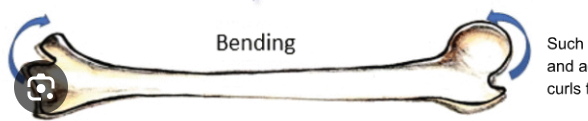
Bending Mechanical injury
Combined compression on one side of an object and tension on the opposite side, causing it to curve
One side pushing in while the other pulls out and lets the pressure drill through both
Asymmetrical load, dual stress
Torsion Mechanical Injury
Twisting force applied rotationally around an axis
ACL Tear, rotator cuff strain, humeral stress adaptation


Mechanical Force: Tension
Stress: Load placed on tissue (ie. body weight)
Strain: Deformation of tissue (ie. tendon strained to tissue failure)

Compression
Five Signs and Symptoms that indicate the injury is in the inflammation phase
When these signs and symptoms begin to resolve, what phase are they entering?
Pain
Swelling
Redness
Warmth
Loss of function
Proliferation/Fibroblastic Repair

What are the two main goals of the inflammatory response and the key chemical mediators?
Increase blood flow and signal more flow
Histamine
→ Increase vasodilation and cell permeabilityWall off and clean up
Leukotaxin
→ Causes margination
→ Leukocytes and platelets bind to fibrin to form fibrin clot
Necrosin
→ Leukocytes and necrosin clean up debris and fight infection
The 3 phases of healing and how long each of them lasts
Inflammatory Response
0-5 DaysProliferation/Fibroblastic Repair
3-5 Days — 6-8 WeeksMaturation(Remodeling)
6-8 Weeks — 6 Months-2 Years
What are the three goals of the Fibroblastic Repair phase?
Increase vascularization
Granulation tissue formation
Extracellular matrix of collagen, elastin, and ground substance
How does the maturation phase make the scar stronger?
Realigning Collagen Fibers
During fibroblastic repair, collagen and elastin are laid in random fashion
During maturation phase, collagen and fibers re-align along the lines of stress and strain to make the scar stronger
Read the clinic note below and determine the athletes phase of healing:
S: Junior MSOC athl c/o R anti Tibial pn. MOI: Kicked/tackled inf to shin guard at px a week ago. Denies neurological symptoms. Denies hearing a pop/crack. Pn at rest has decreased from 7/10 to a 1/10. pn while walking has decreased from 8/10 to a 3/10. Pn while running has decreased from 10/10 to a 5/10.
O: 1 week post inj, athl displayed reduce edema (sewlling) along the tibial crest (-) bump test, (-) compression test. AROM in DF/PF limited secondary to pn. MMT DF 5/5,
A: Probably moderate-severe R tibial contusion
P: Progress activity as tolerated per pn response.
Prolifration/Fibroblastic repair phase
Reduced pain and swelling indicated moving out of the inflammatory response
One week since injury indicates phase 2 of healing
What are the objectives of SOAP and HOPS?
SOAP
Lists the process of an evaluationHops
Are the components of an evaluation
Soap creates the overall categories that HOPS fit into
Put each component of HOPS into the right category of SOAP, and describe what a practitioner is looking for in each.
Subjective
History - Get the patients history
Objective
Observation - Do you see swelling or antalgic gait
Palpation - Do you feel warmth, swelling, crepitus, deformity, TTP (Tenderness to Palpation) - MMT, AROM, PROM, Anterior Drawer Test (ACL Tear or Knee instability)
Special Tests
Assessment - Diagnosis & Problem list priorities
Plan - Next steps and treatment/management


What muscle action is occurring when:
Athlete does plank:
Athlete at the gym performs RDL, lengthening their hamstrings
Athlete performs bicep curl:
Athlete does plank:
IsometricAthlete at the gym performs RDL, lengthening their hamstrings
EccentricAthlete performs bicep curl:
Concentric
Recall and Describe the 3 different muscle actions
Concentric
Muscle shortens while creating force to overcome a resistance
Ie. Lifting weight upward during bicep curlEccentric
Muscle lengthens while under a load of controlling a resistance
Ie. Slowly lowering the weight back down during a bicep curlIsometric
Muscle creates tension without changing length of causing joint movement
ie. Holding a plank or pushing against a solid wallBonus: Isokinetic
Muscle contracts at a constant fixed speed, regardless of applied force
ie. Using special rehab equipment like a biodex machine
Read note and determine potential injury:
A 20-year-old female lacrosse midfielder reports sudden pn in the posterior left thigh during a transition drill at practice. She reports accelerating to chase an opposing player when she felt a sudden “pull” in the back of her thigh. She immediately slowed down and was unable to continue sprinting. She rates pain as a 5/10 at rest and 8/10 when attempting to run. Walking is uncomfortable but possible. She denies hearing or feeling a pop and denied numbness or tingling. No previous injury to the left thigh. MMT 4/5. Upon palpation you feel a divot in her left hamstring.
Grade 2 (Partial Tear) of their hamstring
Divot in muscle with 4/5 MMT
Recall and Categorize Different Injury Grades
Grade 1: Mild, Minor Stretching or Microscopic Tearing of tissue fibers with Slight swelling and normal joint stability
Grade 2: Moderate, Partial tearing of tissue, Moderate bruising an noticeable pain and some loss of function or stability
Grade 3: Severe: Complete rupture/Full tear of tissue, severe pain, significant swelling, and major loss of function and complete joint instability