Lecture 18
 Call Kai
 Learn
 Practice Test
 Spaced Repetition
 Match
 Flashcards
 Knowt Play
1/30

There's no tags or description
Looks like no tags are added yet.
31 Terms
reading: true or false: being bilingual gives you more advantages in cognitive tasks than monolinguals don’t have
false: well, it’s more debatable than entirely false because sometimes bilinguals don’t show any effects or are even disadvantaged
reading: what do incoherent results in mental capacities for bilinguals show?
some studies lack of robustness and reliability
reading: define the “chicken-and-egg dilemma”
are you multilingual because you have more cognitive control: you have more memory capacity, eagerness to learn, etc
or do you have more cognitive control because you are multilingual: you were born in a multilingual family, which lead to early development of cognitive skills
*in both cases, you will end up being multilingual with more cognitive control
reading: what have developmental studies with longitudinal designs looked at?
they look at how multilingualism affects cognition
cognition changes because of cognitive control, proficiency and experience interact, which impacts efficiency and neural changes
they created a sample by having individual differences genetically and environmentally and different multilingual experiences
reading: what are the elements that interact that have an impact on efficiency and neural changes? (3)
cognitive control
proficiency
experience
reading: what are the aspects of a child’s environment that can impact cognitive abilities? (2)
unpredictably: don’t know which language will be used, or there could be some mixing
variability: being exposed to many languages means being exposed to many sounds and intonations
reading: what does a lot of variability in an environment imply?
you need to fine-tune attentional abilities and perceptual learning
reading: why is handling two languages more difficult?
it is harder for the processing system because there is more demands
reading: how does learning an L2 affect the brain?
it impacts the structure and how the brain works: a new skill requires some restructuring of brain areas to fit the demand better
reading: define “single-language context”
restriction on using only one language in certain situations
reading: define “dual-language context”
use of two languages in a certain context, no code-switching between two languages but only keeping two languages ready to use
reading: what’s the difference between single-language context and dual-language context?
single: restriction on using only one language in certain situations
dual: use of two languages in a certain context, no code-switching between two languages but only keeping two languages ready to use
reading: true or false: dual-language context implies code-switching
false: it actually doesn’t need code-switching, it only requires to have two languages ready to use
reading: what are the processes needed for interactional context language use? (8)
conflict monitoring
goal maintenance
interference suppression
opportunistic planning
salient cue detection
selective response inhibition
task disengagement
task engagement
reading: what are the adaptation of neural networks according to experience (neuroplasticity)? (3)
changes in anatomical features in specific brain areas
changes of cortical organization to enhance local processing
changes in connectivity
what do models trade off between? (2)
specificity/precision VS coverage
if your model is precision (specificity/precision), it won’t be able to explain everything (coverage)
if your model explains everything (coverage), it might not be able to explain some more specific details (specificity/precision)
true or false: models can simplify complex phenomena
true: BUT a complex phenomenon reduced to one model can become… complicated (think the trilingual modified hierarchical model)

true or false: language models account the truth
false:
models are based on data and how you interpret it
models aren’t made to be perfect but useful
models are usually made to explain a particular phenomenon, not the entire truth
what makes processing reading different from speaking? (3)
reading allows you to go back if you didn’t understand something
there is a lot of variability in the input stimulus when you’re speaking (accent, speed, pronunciation)
*there is variability in reading too (font, size, colour), but it is definitely stronger when you’re speaking
the sentence structure is looser when you speak (just think about psyc341 prof who never finishes her sentences)
define “cohort model”
as spoken language unfolds in time, from the moment the speaker says the first phoneme, your brain generates the possible lexical candidates
*the words that are the most likely are the cohorts

what impacts the cohort model? (2)
acoustic realization: subtle change on how you say the first phoneme
syllabification: the way you blend the phonemes together
*cohort model: as spoken language unfolds in time, from the moment the speaker says the first phoneme, the brain generates the possible lexical candidates

true or false: the cohort effect is deterministic
false:
it’s probabilistic (a bit like how AI generates words)
as the word goes on, there are less possibilities until it narrows down to one word
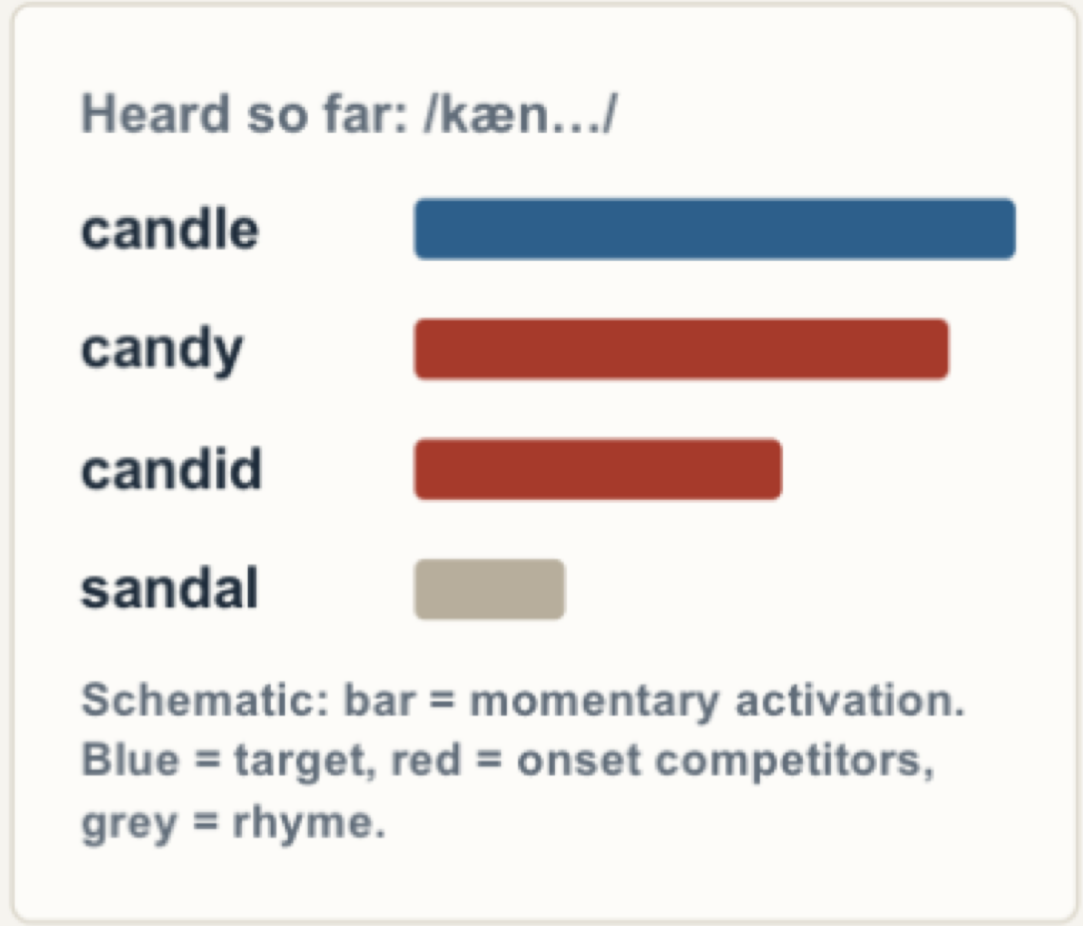
explain how the visual world paradigm is used to see if the cohort effect is language selective (no need to explain the results)
the visual world paradigm usually has 4 images and the participant hears “click on field”
participants will hesitate between the target word (field) and the competitor (feet), but not with the unrelated (church, car)
their fixation is tracked, as we assume that it matches what’s happening in their mind as they process the word when it’s being said
if the participant had the paradigm that was fully in English, the words were: field (target), feet (competitor), church (unrelated) and car (control, unrelated)
if the participant had the paradigm in English and French, the words were: field (target), fille (competitor in French), church (unrelated) and car (control, unrelated)

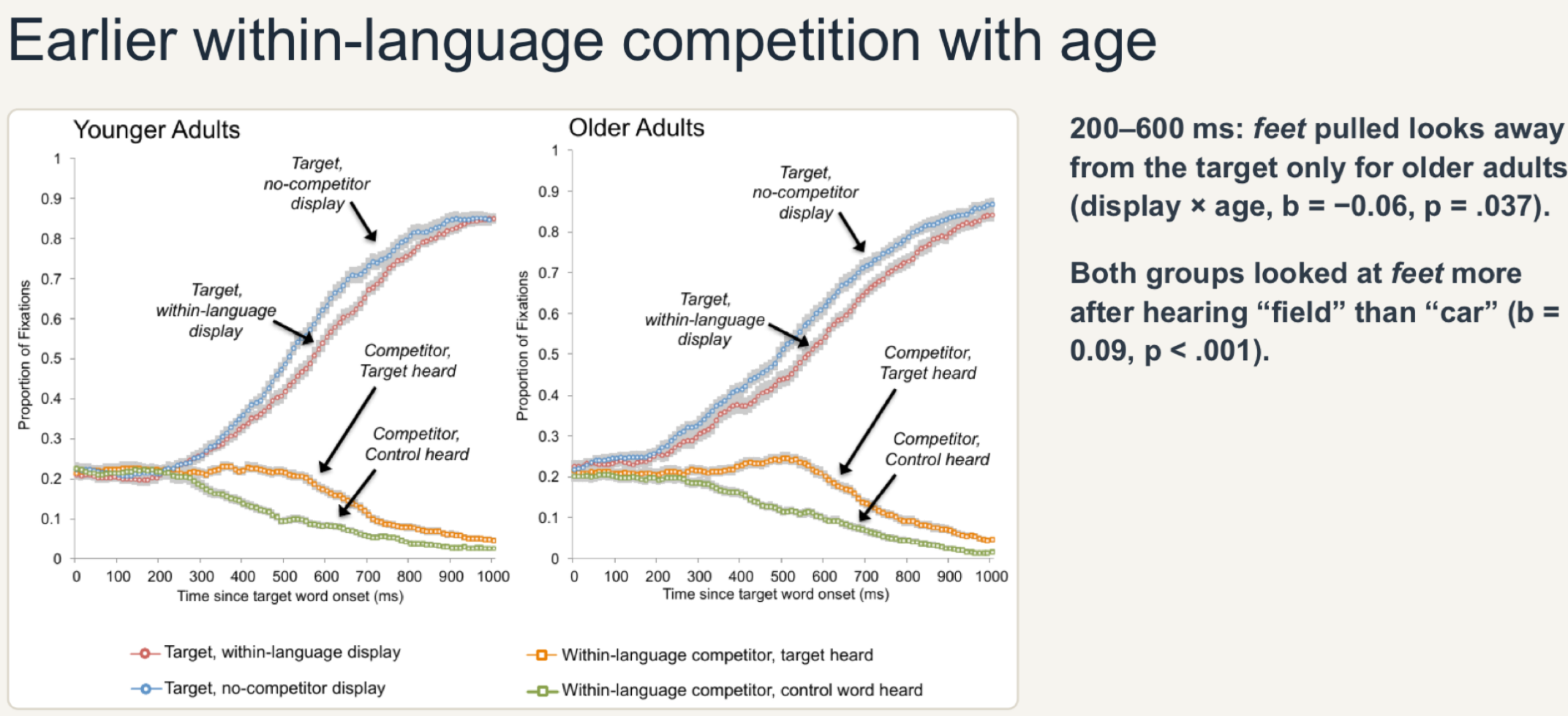
explain the results found for the within-language competition effect in the visual world paradigm
blue and red: eye movements towards the target picture (picture participant should be clicking on)
red: participants hear the target word (field), but there is competing picture present (feet)
blue: participants hear the target word (field), but there isn’t a competing picture
true for both younger and older adults: at first they are confused but they adapt
orange and green: eye movements towards the competitor picture (picture they shouldn’t be clicking on)
orange: participants hear the target word (field), but there is a competing picture present (feet)
the difference with the red line is that that line looked at eye movements towards the target (field) while this line looked at eye movements towards the competing picture (feet)
see the bump: this implies that participants had a moment of hesitation and looked back at the competitor before deciding that it wasn’t the correct picture
green: participants hear a control word (church), but both the target (field) and competing (feet) words are present
the orange line shows that participants looked at the competitor picture more often than the green line (and it makes sense because the green is a control word so they don’t need to look at the competitor)
→ conclusion: younger and older adults have some competition effect, but it is stronger on older adults

explain the results found for the across-language competition effect in the visual world paradigm
blue and red: eye movements towards the target picture (picture participant should be clicking on)
red: participants hear the target word (field), but there is competiting picture from another language present (fille)
blue: participants hear a target word (field) but without a competing picture from another language
orange and green: eye movements towards the competitor picture (picture they shouldn’t be clicking on)
orange: participants hear the target word (field), but there is competing picture from another language present (fille)
remember, orange focuses on the fixation of the competitor and not the target
green: participants hear a control word (church), but both the target (field) and competing in another language (fille) words are present
→ if you were high in proficiency, you have less competition across languages
→ if you were lower in proficiency, there was some difference (so some competition)
why is the across language effect less strong for speaking than reading?
the input is more variable when you’re speaking: there is a lot of differences in spoken signals that can help you detect which language is being spoken
within/language competition happens [earlier/later] when hearing the word
earlier
true or false: bilingualism and executive control are tied together
true
define “supervisory attention system”
domain that helps you navigate your goals and your schemas
true or false: the inhibitory control model is the first model to put tasks and attention together
true
Sophia is participating in a visual experiment where she is presented with five words on the screen and has the select the one spoken by the computer. Her reaction time is measured through eye-tracking. She hears the word "angle". Which of the other words presented on the screen might she spend more time looking at before clicking on the right answer?
a) Cat
b) Ankle
c) Pout
d) Mayor
Answer: b) ankle
Explanation: Ankle is considered an onset competitor of angle because they are part of the same word-onset cohort. In fact, hearing /an/ activates both ankle and angle. Therefore, she might spend more time looking at Ankle before choosing the right answer.
The other options are not suitable because they do not start with /an/. Indeed, when hearing /a/, she can rule out Cat, Pout, and Mayor, as they do not start with that phoneme. It is only when hearing /ang/ that she can identify the word to select.