Term 3 - 6.4 Stratospheric Ozone
 Call Kai
 Learn
Learn Practice Test
 Spaced Repetition
 Match
Match Flashcards
 Knowt Play
1/30

There's no tags or description
Looks like no tags are added yet.
31 Terms
6.4.2 UV Radiation (2)
6.4.2 UV Radiation:
UV light is divided into three categories: UVA, UVB. And UVC
Ozone absorbs UVB and UVC, protecting life on Earth from harmful effects
6.4.2 UVA (5)
6.4.2 UVA:
320-400nm
Least harmful form of UV radiation
Makes up ¬95% of the UV radiation reaching Earth's surface
Can penetrate deep into the skin and contribute to premature aging and DNA damage
Not absorbed by ozone
6.4.2 UVB (4)
6.4.2 UVB:
280-320nm
Partially absorbed by the ozone layer
¬5% reaching Earth's surface
More harmful than UVA and can cause sunburn, skin cancer, and damage to eyes and immune system
6.4.2 UVC (4)
6.4.2 UVC:
100-280nm
Most dangerous type of UV radiation
Almost completely absorbed by the ozone layer and oxygen in the atmosphere
Very little of it reaches Earth's surface
6.4.4 Human Health Impacts (3)
6.4.4 Human Health Impacts:
Skin cancer: Higher UVB exposure increases the risk of melanoma and other skin cancers
Cataracts and eye damage: UVB damaged the eyes, leading to clouding of the lends and vision problems
Immune system suppression: UV radiation can impair the immune response, making humans more susceptible to diseases
6.4.4 Ecosystem Impacts (3)
6.4.4 Ecosystem Impacts:
Marine ecosystems: UVB reduces phytoplankton productivity, affecting the entire food web in oceans
Terrestrial ecosystems: UVB harms plant growth, leading to shifts in biodiversity and ecosystem stability
Food security: Reduced plant and marine productivity can affect food availability for humans and wildlife
6.4.2 Benefits of UV Radiation (3)
6.4.2 Benefits of UV Radiation:
UVB radiation helps human skin produce vitamin D, crucial for bone health
UV light is used to kill bacteria and viruses
UV radiation is used to treat skin conditions like psoriasis and eczema
6.4.3 Stratospheric Ozone (3)
6.4.3 Stratospheric Ozone:
Ozone absorbs UVB and UVC radiation, preventing most of it from reaching Earth's surface
This absorption protects life by reducing the harmful effects of UV radiation on DNA, cells, and organisms
Without ozone, the Earth would be exposed to dangerous levels of UVB and UVC radiation
6.4.3 Formation of Ozone in the Stratosphere (3)
6.4.3 Formation of Ozone in the Stratosphere:
UVC radiation splits oxygen molecules (O2) into oxygen atoms (O)
These atoms combine with O2 to form ozone (O3)
This process naturally occurs in the stratosphere, creating a protective ozone layer
6.4.3 Natural Destruction of Ozone (2)
6.4.3 Natural Destruction of Ozone:
Ozone absorbs UV radiation, breaking down into O2 and O
This natural cycle of ozone formation and destruction creates a dynamic equilibrium, maintaining stable ozone levels under normal conditions
6.4.6 Ozone Depletion (4)
6.4.6 Ozone Depletion:
ODSs like CFCs are also potent in greenhouse gases, contributing to global warming
Global warming can affect atmospheric circulation, potentially delaying ozone recovery
CFCs release chlorine atoms when broken down by UV radiation in the stratosphere
These chlorine atoms catalyse the breakdown of ozone into oxygen
6.4.6 Ozone Depletion Process (5)
6.4.6 Ozone Depletion Process:
UV radiation breaks off a chlorine atom from a CFC molecule
The chlorine atom attacks an ozone molecule, breaking it apart and destroying the ozone
The result in an ordinary oxygen molecule and a chlorine monoxide molecule (CIO)
The CIO is attacked by a free oxygen atom, releasing the chlorine atom and forming an ordinary oxygen molecule
The chlorine atom is now free to attack and destroy another ozone molecule. One chlorine atom can repeat this destructive cycle thousands of times
6.4.6 Ozone-Depleting Substances (ODS) (2)
6.4.6 Ozone-Depleting Substances (ODS):
Chlorofluorocarbons (CFCs or freons) - propellants in spray cans, foam, refrigerants
Hydrochlorofluorocarbons (HCFCs) - replacements for CFCs
6.4.10 Chlorine Catalytic Cycle (2)
6.4.10 Chlorine Catalytic Cycle:
A single chlorine atom can destroy thousands of ozone molecules through a catalytic cycle
This process significantly depletes the ozone layer, especially in regions with high ODS concentrations
6.4.11 Polar Conditions and Ozone Depletion (2)
6.4.11 Polar Conditions and Ozone Depletion:
Polar regions experience colder stratospheric temperatures, leading to the formation of polar stratospheric clouds (PSCs)
These clouds convert chlorine compounds into their reactive forms, which destroy ozone when exposed to sunlight
6.4.7 Impact of Polar Ozone Depletion (2)
6.4.7 Impact of Polar Ozone Depletion:
The ozone hole forms over Antarctica each spring due to unique polar conditions
Ozone-depleting reactions occur more efficiently in polar regions due to cold temperatures and polar stratospheric clouds (PSCs) - provides surfaces for reactions that active chlorine compounds --> these reaction chlorine compounds destroy ozone when sunlight returns in the spring
6.4.11 Ozone Destruction in Polar Spring (2)
6.4.11 Ozone Destruction in Polar Spring:
Sunlight returns in the spring, triggering rapid ozone destruction as chlorine compounds become highly reactive --> UV radiation triggers chlorine-driven ozone destruction
This leads to the formation of the ozone hole over Antarctica
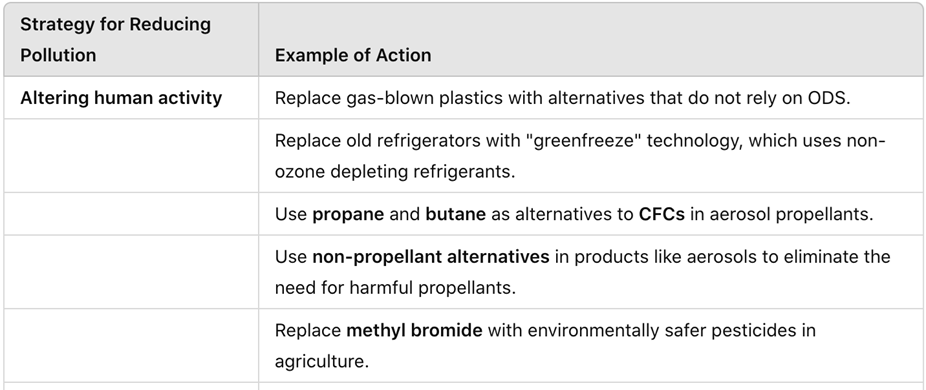
6.4.8 Strategies of Reducing Ozone Depletion - altering human activity
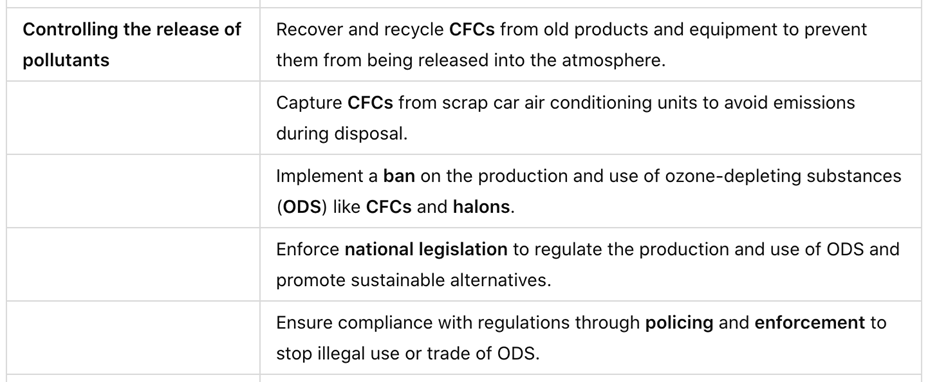
6.4.8 Strategies of Reducing Ozone Depletion - controlling the release of pollutants
6.4.8 Strategies of Reducing Ozone Depletion - cleanup and restoration

6.4.8 The Montreal Protocol (5)
6.4.8 The Montreal Protocol:
The Montreal Protocol, adopted in 1987, regulates ODS production and use globally
It is regarded as the most successfully environmental treaty, with nearly universal participation
Almost every country was part of the agreement
Legally binding commitments to phase out ODSs
Financial and technical support for developing countries to transition away from ODSs
6.4.8 Lessons for Other Global Issues (6)
6.4.8 Lessons for Other Global Issues:
The Montreal Protocol serves as a model for other global environmental challenges, such as climate change
The success of the protocol shows that science-based policy and international cooperation can address global issues effectively
An example of the precautionary principle
Easy for different countries to phase out ODSs at different times depending on their economic status
An example of collaboration between experts in different fields coming together to solve a problem
First protocol with regulations that were carefully monitored
6.4.9 Planetary Boundary for Ozone Depletion (1)
6.4.9 Planetary Boundary for Ozone Depletion:
Actions taken under the Montreal Protocol have prevented this boundary from being crossed
6.4.12 HFCs - A Solution with New Challenges (2)
6.4.12 HFCs - A Solution with New Challenges:
HFCs were introduced as replacements for CFCs because they do not deplete the ozone layer
However, HFCs are potent greenhouse gases, contributing to climate change
6.4.12 The Kigali Amendment (2)
6.4.12 The Kigali Amendment:
The Kigali Amendment to the Montreal Protocol aims to phase down HFCs to reduce their impact on climate change
Countries are working to develop alternative refrigerants with lower global warming potential (GWP)
6.4.13 Environmental Impact of Air Conditioning (2)
6.4.13 Environmental Impact of Air Conditioning:
Air conditioning is highly energy-intensive, leading to increased GHG emissions
Older systems used ODSs, while newer one use HFCs, both of which have environment impact
6.4.13 Sustainable Alternatives to Air Conditioning (2)
6.4.13 Sustainable Alternatives to Air Conditioning:
Natural refrigerants (e.g. hydrocarbons, ammonia, CO2) offer environmentally friendly alternatives
Improved building design (e.g. passive cooling, natural ventilation) and urban greening can reduce the demand for artificial cooling and lower emissions
6.4.13 Passive Cooling (1)
6.4.13 Passive Cooling:
Passive cooling: Incorporating architectural designs that minimize heat gain, such as proper insulation, reflective roofs, and energy-efficient windows, can reduce the need for artificial cooling
6.4.13 Natural Ventilation (1)
6.4.13 Natural Ventilation:
Natural Ventilation: Designing buildings to maximize natural airflow can reduce reliance on mechanical cooling systems
6.4.13 Urban Greening (2)
6.4.13 Urban Greening:
Urban Greening: Planting trees and creating green spaces in cities helps reduce the urban heat island effect (where cities are significantly warmer than surrounding rural areas due to concrete and asphalt absorbing heat)
Trees and plants provide shade and cool the air through evapotranspiration
6.4.13 Rewilding (1)
6.4.13 Rewilding:
Rewilding: Rewilding urban areas—restoring natural landscapes—can help to reduce the overall temperature of cities, making them less reliant on air conditioning